See your AI teammate in action now
Ready to make support faster, kinder, easier and help customers feel good about choosing you?
PS: Sales improves too...
No credit card required
14 days free trial
DIY or Guided setup
Ready to make support faster, kinder, easier and help customers feel good about choosing you?
PS: Sales improves too...
No credit card required
14 days free trial
DIY or Guided setup
Manish Keswani
When we talk about quality in a call center, we're not just talking about how fast an agent can get off the phone. That's the old way of thinking. True quality today is a delicate dance between efficiency (solving issues promptly), effectiveness (getting it right the first time), and the kind of genuine human connection that actually makes a customer want to stick around.

For a long time, call centers were managed like factory floors. The primary goal was churning through the maximum number of calls in the shortest time possible. Everything revolved around metrics like Average Handle Time (AHT), which treated customer service as a cost to be squeezed, not an opportunity to build anything meaningful.
But leading companies have realized this model is fundamentally broken. A rushed answer that doesn't actually solve the problem isn't quality—it's just a fast track to another call and an even more frustrated customer. In fact, nearly two-thirds of customers say they've had to contact a company again for the same issue, which tells you all you need to know about focusing on speed alone.
The modern view of call center quality puts customer outcomes first, well ahead of raw operational speed. Think of it like a restaurant. You want the kitchen to be fast, sure, but what really matters is whether the food is delicious and the order is correct. That's what brings people back.
This shift means we're now zeroing in on a completely different set of principles:
The goal isn't just a fast, correct answer. It's delivering a resolution that feels effortless and positive for the customer, turning what was once a cost center into a powerful engine for loyalty and retention.
The way we view quality has fundamentally changed. The old-school, cost-centric approach has given way to a modern one that sees the contact center as a hub for creating positive experiences and driving revenue.
| Metric Focus | Traditional View (Cost Center) | Modern View (Experience & Revenue Center) |
|---|---|---|
| Primary Goal | Minimize cost per interaction | Maximize customer lifetime value (CLV) |
| Key Metrics | Average Handle Time (AHT), calls per hour | First Contact Resolution (FCR), Customer Satisfaction (CSAT), Net Promoter Score (NPS), Customer Effort Score (CES) |
| Agent Role | Follow a rigid script, process calls quickly | Solve complex problems, build relationships, show empathy |
| Technology Use | Basic telephony, limited CRM | AI-driven insights, omnichannel platforms, agent-assist tools |
| Success Is... | A shorter call | A customer who doesn't need to call back |
This table shows a clear pivot. We're moving away from simply counting things and toward measuring what actually matters to the customer and the business's bottom line.
This doesn't mean we throw efficiency out the window. It's still incredibly important. The key is to balance it with effectiveness. A truly high-quality interaction is one where an agent uses their skills and the tools at their disposal to get to the right answer efficiently, completely erasing the need for a follow-up call.
Practical example: An agent for a utility company takes an extra two minutes to explain why a customer's bill was higher than usual (e.g., a rate change) and sets up a new payment plan. This is far higher quality than an agent who just grants a one-time extension to get off the phone quickly. The first interaction prevents future calls and builds trust; the second guarantees a callback next month. This strategic mindset is the bedrock of any modern, high-performing support operation.
If you want to improve quality in your call center, you have to measure what actually matters. Too many teams get caught up chasing vanity metrics like Average Handle Time (AHT), which only encourages agents to rush through calls. This often leaves issues half-solved and customers frustrated, creating more work down the line.
The real story of quality isn't told by a stopwatch. It's found in a balanced set of KPIs that look at the experience from all angles—the customer's, the agent's, and the business's. We need to ask better questions: Did we actually solve the problem? How hard did the customer have to work to get help? And how did we make them feel?
The customer’s voice is your ultimate source of truth. There are three classic metrics that give you a direct line into their experience, each telling a slightly different part of the story.
Practical example: An e-commerce brand saw decent CSAT scores but was baffled by the high number of repeat calls about order tracking. They added CES to their post-interaction surveys and discovered customers found it incredibly difficult to locate tracking info. Actionable insight: They made the tracking link the most prominent button in confirmation emails and on the site's dashboard. This simple fix slashed customer effort and led to a 30% drop in "Where is my order?" calls within a month.
While customer feedback is critical, you also need to know if your team is operating efficiently. The undisputed king of operational quality metrics is First Contact Resolution.
First Contact Resolution (FCR) is the percentage of issues you solve in a single conversation, with no need for a follow-up. In the call center world, FCR is the gold standard. Research from SQM Group shows the industry average hovers around 70%, but world-class teams hit 80% or higher. And the stakes couldn't be higher—a Salesforce survey found that 83% of consumers expect to get their problem solved on the first try.
Actionable insight: To improve FCR, create a "reason for repeat call" disposition code that agents must select. Analyzing this data will show you exactly why customers are calling back (e.g., "unclear instructions," "issue not fully resolved"), allowing you to address the root causes.
At the end of the day, quality is delivered by individual agents. A good agent scorecard looks beyond basic productivity numbers to assess the actual skills that lead to great customer outcomes.
Here are a couple of key metrics to track at the agent level:
By bringing together customer perception metrics like CES, operational cornerstones like FCR, and agent-level skills, you get a complete, 360-degree view of quality. This balanced approach ensures you're not just closing tickets—you're building relationships that strengthen your business, one conversation at a time.
Metrics give you the what—the raw numbers behind your contact center's performance. But a truly solid Quality Assurance (QA) framework? That tells you the why.
Building an effective QA program isn't about playing "gotcha" with your agents. It’s about creating a system for continuous improvement that everyone, agents included, can get behind. The goal is to shift the culture from catching mistakes to coaching successful behaviors.
A practical framework really boils down to two key pieces: a smartly designed scorecard that actually measures what matters, and a sensible call sampling strategy that gives you an accurate picture of performance without drowning your team in reviews.
Let's be honest, the old-school QA scorecard is often a long, soul-crushing checklist. It’s all about script adherence and compliance, which completely misses the bigger picture. A modern scorecard should focus on the skills that actually create happy, loyal customers—things like genuine empathy, sharp problem-solving, and a sense of ownership.
Instead of a simple pass/fail on whether an agent said the customer's name three times, a better approach is to create weighted sections that reflect what your business truly values. This ensures you're scoring what really drives quality.
Here’s a practical blueprint for a modern, weighted scorecard:
A well-structured QA scorecard is your constitution for quality. It clearly defines what "good" looks like and ensures every evaluation is consistent, fair, and focused on behaviors that directly impact the customer's experience.
This visual shows how the core metrics a good QA program influences are all interconnected.
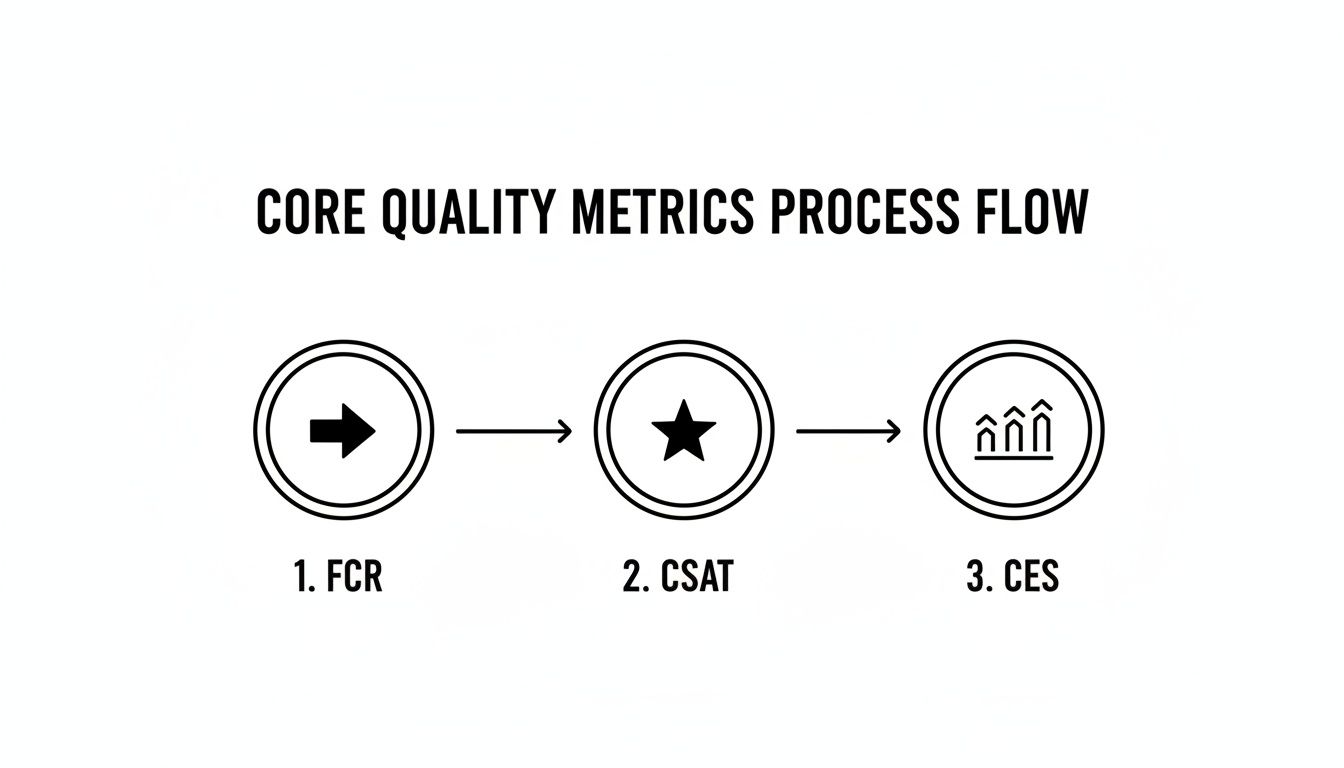
When you nail First Contact Resolution (FCR), it naturally leads to better satisfaction (CSAT) and less effort for the customer (CES). It's a perfect illustration of how getting the process right directly improves how customers feel.
Once you've got a great scorecard, the next question is obvious: which calls do you actually listen to? Reviewing every single interaction is a non-starter, so you need a smart sampling plan. The goal is to get a statistically sound sample that gives you a true snapshot of performance without creating a massive review bottleneck.
Most contact centers aim to review 3-5 interactions per agent per week. But what you review is just as important as how many. A balanced sampling plan should include a mix of:
Practical example: A SaaS company noticed a dip in customer satisfaction right after a big software update. Instead of just pulling random calls, their QA team shifted to review only calls about the new features. They quickly found that agents were struggling to explain one specific function. Actionable insight: They created a one-page job aid with talking points for that function and rolled out a 15-minute targeted training. CSAT scores bounced back in just two weeks.
Collecting quality data is one thing; actually using it is another. A scorecard full of numbers is just that—numbers. It's useless until you translate it into real-world improvements for your agents and, by extension, your customers. The magic of quality in a call center happens when you turn those insights into a coaching and performance engine. This means moving past just scoring calls and building a culture of diagnostic coaching.
The first, and most important, step is figuring out why a score was low. Was it an agent who didn't know what to do, a process that set them up to fail, or a tool that just didn’t work? Rushing into a coaching session without digging into the "why" is like trying to fix a car engine without knowing which part is broken. It’s a waste of everyone's time and can be incredibly frustrating for the agent.
Before you can coach anyone, you have to play detective. When you find a low-scoring interaction, your first instinct might be to look at what the agent did wrong. Resist it. Instead, start asking questions to find the real source of the problem.
This simple diagnostic process helps you separate issues that need coaching from those that need a bigger, systemic fix. After all, you can't coach an agent out of a bad process.
Once you've confirmed the issue is a genuine skill gap, the coaching conversation itself becomes the main event. The goal here is to empower, not to punish. A great coaching session turns QA data into a tool for growth that you and the agent use together.
The most effective coaching doesn’t feel like a review; it feels like a strategy session. It changes the conversation from "Here's what you did wrong" to "Let's figure out how we can win this scenario next time."
To make these conversations count, follow a simple, structured approach:
By getting to the root cause first and then using a supportive coaching framework, your QA program stops being a grading system and starts being a powerful engine for constant improvement.
Trying to deliver high-quality service on every single call is a massive undertaking. As your team grows, keeping that quality consistent gets exponentially harder. This is where modern AI becomes your most powerful ally in achieving excellent quality in the call center.
The goal of AI isn't to replace your best agents. It's to act as their co-pilot, amplifying their skills and helping every agent perform like your absolute best. AI automates the tedious, repetitive work, serves up instant intelligence, and guides agents through tricky situations. This frees them up to focus on the deeply human side of the job—building genuine rapport and showing empathy.
When you blend human talent with smart AI support, you create a system that is both incredibly empathetic and built to scale.
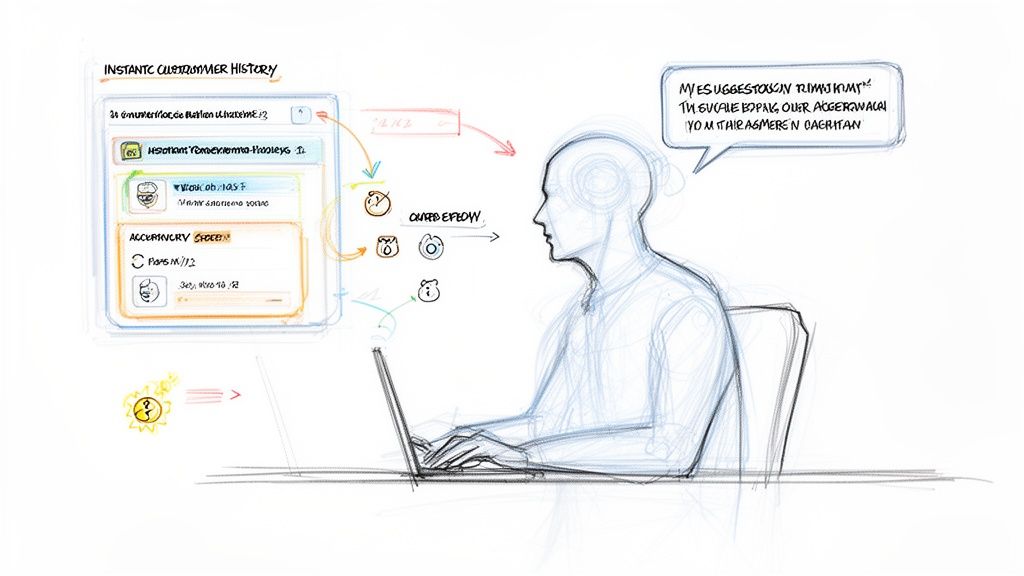
One of the fastest ways to frustrate a customer is to make them repeat themselves. When an agent asks, "Can you give me that order number again?" for the third time, it's a dead giveaway that your process is broken. AI-driven tools tackle this problem head-on by creating a single, unified view of the customer.
These systems instantly pull together a customer’s entire history from every channel—past orders, previous support tickets, recent website visits—and hand it to the agent in a clean, easy-to-read summary. The conversation immediately shifts from a clunky interrogation to a proactive, informed dialogue.
By arming agents with complete context the moment an interaction begins, AI directly attacks the root cause of customer frustration and dramatically increases the likelihood of a First Contact Resolution.
Complex issues like product returns or detailed troubleshooting often involve a lot of steps that are easy to forget under pressure. This can lead to wildly inconsistent service, where one customer gets a perfect resolution and the next is left completely lost.
AI-powered guided workflows solve this by giving agents a clear, step-by-step path for any given scenario. These aren't rigid, old-school scripts. Think of them more like smart checklists that adapt in real-time based on what the customer says, making sure every agent follows the best resolution path every time. This guarantees a consistent level of quality across your entire team, no matter an agent's experience level. Understanding the full scope of your operation is key; you can discover more about improving contact center operations in our detailed article.
Today's AI does more than just help agents solve problems efficiently; it can also spot opportunities to create more value. By analyzing conversations as they happen, these systems can pick up on subtle cues that a human agent might miss, turning a standard support call into a chance for growth.
The system listens for specific keywords, sentiment, and intent. Based on what it hears, it can feed real-time prompts to the agent, suggesting actions that help the customer and also benefit the business.
This kind of intelligent assistance helps agents become more proactive and perceptive, transforming the contact center from a cost center into a true driver of revenue and customer loyalty.
Transforming your call center’s quality isn’t a one-off task—it’s a multi-stage journey that strengthens your entire culture. Each step builds on the last, so a measured approach always beats a frantic dash. Think of this roadmap as your blueprint, guiding you from initial standards to a self-optimizing quality engine.
Imagine constructing a house: you wouldn’t hang doors before pouring the foundation, and you shouldn’t chase quality without first setting solid groundwork.
In this kickoff phase, you define what “excellent” looks like for your unique operation. This blueprint underpins every future quality initiative, so take the time to get it right.
Your primary goals here are:
With your foundation set, it’s time to collect data. Without a clear starting point, you won’t know if your efforts are moving the needle.
“You can’t plot a course on a map until you know where you currently stand.”
Now the real work takes off. With clear benchmarks in hand, you move from simple checklists to embedding quality into daily operations.
Follow this structured path and you’ll transform quality in the call center from a policing function into your most powerful driver of happier customers, engaged employees, and stronger results.
When it comes to rolling out a new quality program, leaders often run into the same practical questions. Here are a few of the most common ones I hear, along with some straight-ahead advice to guide your strategy.
This is the big one. The key is to position your new quality program as a tool for agent growth, not as a disciplinary stick. If your team sees QA as just another way to get dinged, you’ve already lost.
Actionable insight: Start by getting your top-performing agents involved in building the QA scorecard. When they have a hand in defining what "good" looks like, the whole thing feels more collaborative and fair.
More importantly, you have to connect the dots for them. Show your agents how hitting quality goals makes their jobs easier. Better First Contact Resolution means fewer frustrated customers calling back. Higher CSAT scores can be tied directly to bonuses, recognition, or career opportunities. It's all about framing quality as a win-win.
The most effective quality programs are built with agents, not just for them. When they see the program as a pathway to their own growth and a less stressful workday, they become its biggest advocates.
There's no single magic number here. The right mix of human and AI support shifts depending on what the customer needs in that moment. Think of AI and automation as your frontline for handling the simple, repetitive stuff.
Practical examples of tasks suited for automation include:
Handing these tasks off to technology frees up your human agents to do what they do best: handle emotionally charged conversations, untangle complex problems, and build genuine relationships with customers. The goal isn't to replace your people, but to augment their skills. A great system lets a customer seamlessly move from a bot to a human agent, with the full conversation history intact, so they never have to repeat themselves.
For your QA program to be seen as fair and trustworthy, consistency is everything. You need to get your evaluators in a room for calibration sessions at least once a month.
Here's a practical calibration process:
This process ensures an agent's score doesn't depend on which evaluator happened to pick their ticket.
MagicalCX is the empathy-first AI platform that turns your customer support into a revenue-positive experience, without sacrificing human connection. It automates complex journeys and guides agents with real-time insights, making every interaction feel personal and effortless. Discover how our platform can help you achieve world-class quality by visiting MagicalCX.com.


