See your AI teammate in action now
Ready to make support faster, kinder, easier and help customers feel good about choosing you?
PS: Sales improves too...
No credit card required
14 days free trial
DIY or Guided setup
Ready to make support faster, kinder, easier and help customers feel good about choosing you?
PS: Sales improves too...
No credit card required
14 days free trial
DIY or Guided setup
A guide to AI-powered customer service, covering modern AI support capabilities, core architecture, ROI and KPIs, industry use cases, and implementation steps.
Manish Keswani
Summary by MagicalCX AI
AI-powered customer service can cut cost per interaction from $6–$15 to under $1 while lifting first-contact resolution to 85–95%, turning support into a measurable revenue driver through faster resolutions and proactive upsell moments.
When we talk about AI-powered customer service, we're not just talking about chatbots that spit out pre-written answers. We're talking about a complete shift in how you support your customers, using smart technologies like machine learning and natural language processing to automate, assist, and genuinely improve every interaction.
This isn't just about deflecting tickets anymore. It’s about building an intelligent, responsive support system that can solve complex problems, predict what a customer needs next, and turn your support department from a cost center into a serious engine for growth.
We've all been there: stuck in a loop with a clunky chatbot that can't understand a simple request, inevitably ending with the dreaded, "Let me get you to a human." It’s frustrating. But that's old news.
The AI available today has moved worlds beyond those simple scripts. It’s less like a rigid flowchart and more like your best, most experienced agent—the one who remembers every past conversation, gets the context immediately, and has the authority to actually fix the problem. This guide will cut through the hype and show you what that looks like in practice.
The real game-changer is the leap from just answering questions to actively resolving complex issues. This is where AI starts to deliver real, measurable value.
Practical Example: Instead of just linking a customer to a help article about returns, an advanced AI can process the refund, generate a shipping label, and confirm the transaction—all within the same conversation. It’s about taking action, not just providing information. This is a big reason why 85% of Fortune 500 companies are now weaving AI into their core strategy, with customer satisfaction at the top of the list.
Modern AI also gives you the power to get ahead of problems. By analyzing patterns in customer interactions, an AI can flag a customer who might be at risk of churning or spot a chance to offer a helpful tip before they even think to ask. This flips the script, turning support from a reactive chore into a strategic advantage.
Actionable Insight: A key part of this evolution is using sophisticated tools like Conversation Intelligence, which analyzes calls and chats to pull out deeper insights and drive automated improvements. For instance, if an AI detects that multiple users are asking about a specific feature after visiting the same page, it can proactively trigger a pop-up offering a tutorial video to the next user who follows that path. This proactive approach shows customers you understand them and respect their time, which is fundamental to building trust and long-term loyalty.
The goal is to make support so seamless and effective that it becomes a core part of the product experience itself, turning satisfied customers into vocal advocates for your brand.
By embracing these capabilities, businesses aren't just improving support—they're building stronger customer relationships and gaining a powerful competitive edge.
To really get what makes modern AI-powered customer service feel so seamless, it helps to look under the hood. You don't need a computer science degree—just think of it as a highly skilled support team with three core specialists working in perfect sync.
Each of these specialists has a distinct role, but it's how they work together that creates an experience that’s personal, proactive, and incredibly efficient. This structure is the night-and-day difference between today's advanced AI and those frustrating, dead-end chatbots from a few years ago.
This concept map shows just how far customer service has come, moving from basic automation to the intelligent, revenue-driving systems we see emerging today.
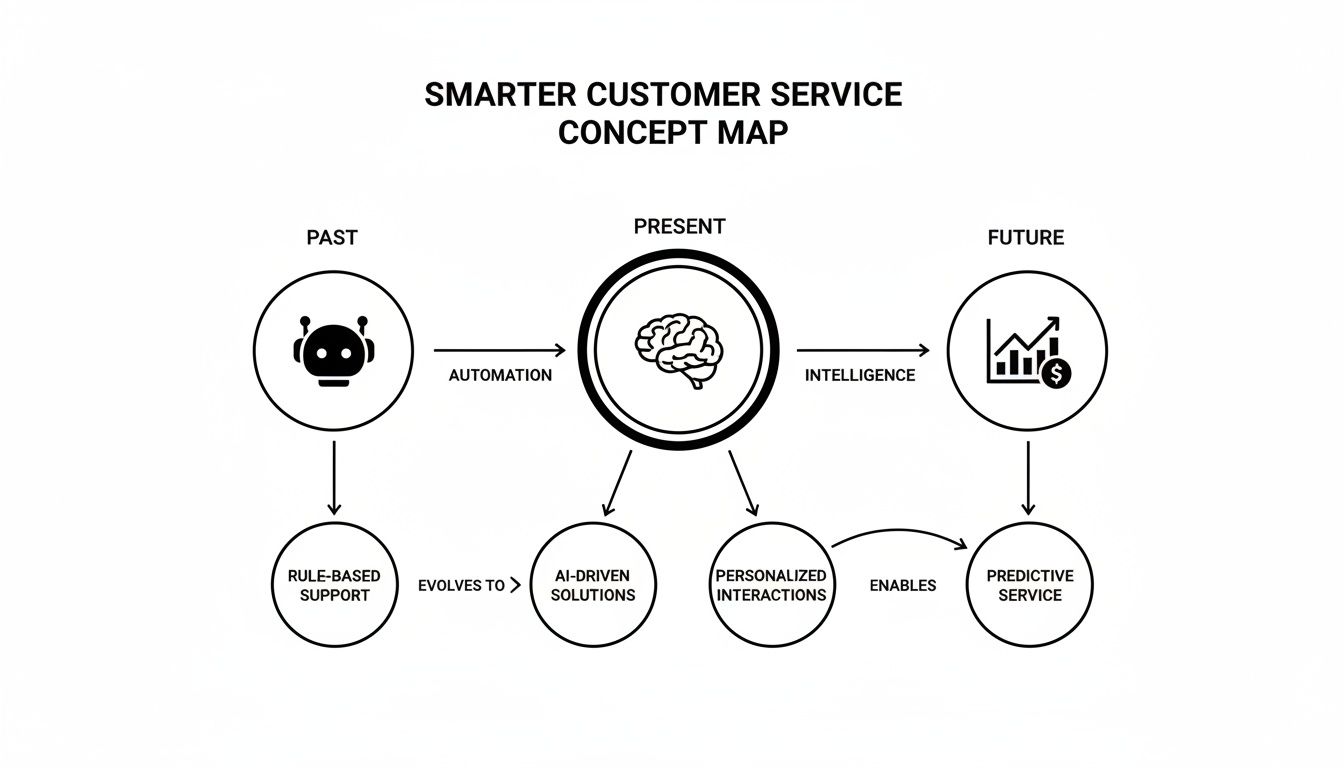
As you can see, the path is clear: from rule-based bots to true AI intelligence, with the final destination being a support function that actively contributes to business growth.
The first pillar is Conversational Memory. Picture a support agent who remembers every single interaction a customer has ever had with your brand—every purchase, every past question, every resolved ticket. That's what Conversational Memory brings to the table.
This ability lets the AI grasp the full context of a customer’s journey without forcing them to repeat themselves. It’s the difference between a generic "How can I help you?" and a personalized greeting that acknowledges their recent order.
Practical Example: A customer who just bought a pair of running shoes messages your site asking, "Is this waterproof?" Instead of asking for an order number, the AI uses Conversational Memory to instantly know which shoes they mean and gives a specific answer for that exact product.
This continuous context makes conversations feel natural and builds real trust by showing the customer they're known and valued.
Next up, we have Agentic Actions. This is what gives the AI the power to do things, not just talk about them. Here, the system moves beyond simply providing information and starts actively solving problems.
Think of this component as a personal assistant with the credentials to access your systems and complete tasks on the customer's behalf. It’s the engine that actually drives resolution.
Practical Examples:
These actions slash customer effort and resolve issues in seconds—a world away from traditional support flows that involve multiple steps and human handoffs.
Finally, Omnichannel Orchestration is the team coordinator. Customers today connect with brands across a huge range of channels—your website, email, social media, and messaging apps. This pillar makes sure the conversation stays consistent and contextual, no matter where it happens.
Practical Example: A customer can start a chat on your website to inquire about a product, follow up via email with a more detailed question, and get a final shipping confirmation on WhatsApp without ever losing their place or needing to start over.
This seamless integration is absolutely critical. Projections show that by 2025, a staggering 95% of all customer interactions will be handled by AI-powered systems. This huge shift is driven by the need for speed, scale, and 24/7 availability, especially for e-commerce and D2C brands drowning in inquiries. You can dig into more AI customer service statistics to see the trend lines.
By weaving these three pillars together, modern AI-powered customer service creates a unified, intelligent system that resolves issues fast and leaves customers feeling truly understood and cared for.
Beyond the cool technology, the question every business leader asks is simple: What's the payback? Adopting AI-powered customer service isn't just about looking modern; it's a hard-nosed financial decision that pays off by both cutting costs and creating new revenue. The impact is direct, measurable, and often surprisingly fast.
The most immediate win comes from slashing your operational costs. Think about all the repetitive, high-volume questions your team gets every day—"Where is my order?" or "How do I reset my password?" AI automates these instantly, freeing up your human agents to handle the complex, high-value conversations that actually need their expertise.
Imagine your AI as a force multiplier for the support team. It handles all the predictable stuff, so your best people can focus on solving the unpredictable problems. This efficiency boost hits your bottom line directly.
The numbers are staggering. Gartner forecasts that AI will cut global call center labor costs by a massive $80 billion by 2026. This isn't just wishful thinking; it's based on AI automating about 10% of all agent interactions through smart chatbots and voicebots. They resolve common issues on the spot, wiping out queues and the frustration of old-school IVR systems.
Practical Example: Health insurer NIB saved $22 million by deploying AI digital assistants. This move cut their need for human support by 60% and reduced agent phone calls by 15%.
But saving money is only half the story. A truly intelligent AI platform doesn't just answer questions—it actively helps grow your revenue. It's trained to pick up on subtle buying signals or moments of customer friction that a busy human agent might easily miss.
Practical Example: A customer asks about the warranty on a product they bought two years ago. A smart AI sees this as both a churn risk and an upsell opportunity. Instead of just giving a factual answer, it pivots the conversation: "Your original warranty has expired, but we have a new model with an extended three-year warranty and some great new features. Would you like me to show you a quick comparison?"
This kind of proactive engagement turns a routine support ticket into a sales conversation. It not only saves a customer who might have been thinking of leaving but also increases their lifetime value. Focusing on these kinds of strategies for customer experience optimization is how businesses turn their AI investment into serious profit.
To really see the financial impact, it helps to put the numbers side-by-side. The table below shows just how different the key performance indicators (KPIs) look for a traditional support team versus one powered by AI.
This table illustrates the direct impact of AI on key customer service performance indicators, showing clear improvements in efficiency, cost, and customer experience.
| Metric | Traditional Support | AI-Powered Support | Business Impact |
|---|---|---|---|
| Average Handle Time (AHT) | 6-10 minutes | < 1 minute for automated queries | Drastically reduced operational costs and improved agent capacity. |
| First Contact Resolution (FCR) | 70-75% | 85-95% for supported issues | Higher customer satisfaction and reduced need for follow-up interactions. |
| 24/7 Availability | Limited by staffing/shifts | Always on, instant support | Increased global customer satisfaction and captures sales opportunities anytime. |
| Cost Per Interaction | $6-$15 per live interaction | < $1 per automated interaction | Significant reduction in overall support expenditure. |
The difference is stark, highlighting dramatic improvements in efficiency and customer happiness. To see how these numbers might look for your specific business, feel free to try our AI vs. Human Support ROI Calculator.
By fundamentally shifting these core metrics, AI-powered customer service proves its value. It transforms your support department from a cost center into a strategic asset that actively drives business growth.
Theory and architecture are important, but seeing AI-powered customer service out in the real world is what really makes its value click. This isn't just a trendy add-on; it’s a core operational tool that adapts to solve specific, high-stakes problems across completely different business models.
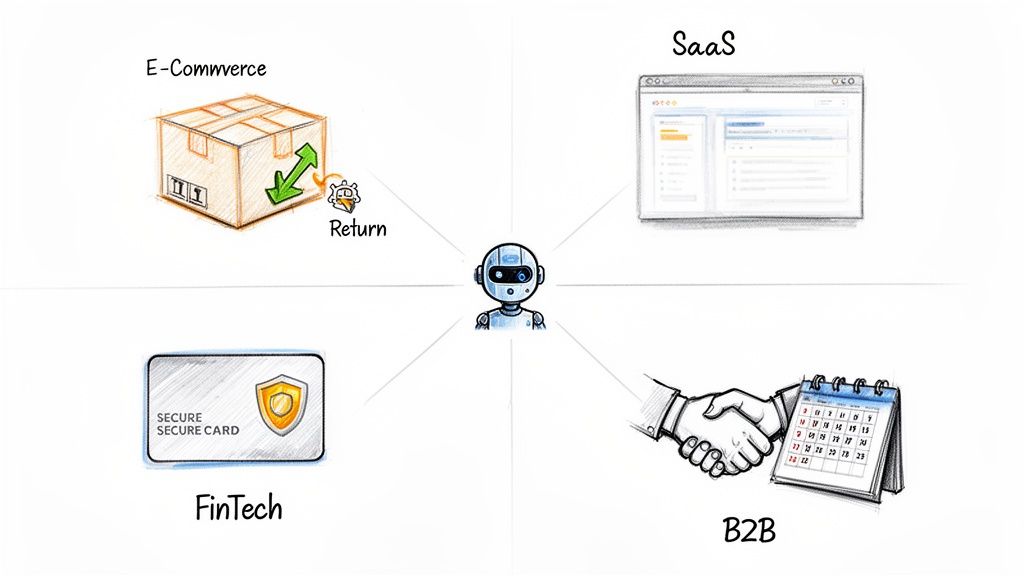
Let's walk through a few scenarios that show exactly how this works, turning moments of potential customer frustration into genuine satisfaction.
Think about a customer, Sarah, who just bought a dress that doesn't fit. The old way involved hunting for a returns page, printing a label, and then waiting days for any kind of update. It’s a clunky process that just adds friction.
With a smart AI system, her experience is completely different.
In under a minute, the entire return is done. No human agent needed. Sarah is happy with the speed and simplicity, which turns a negative experience (a dress that didn't fit) into a positive brand interaction that actually builds loyalty.
For any Software-as-a-Service (SaaS) company, getting users up and running—and keeping them—is everything. AI is a game-changer here, guiding new users and spotting chances for growth.
Imagine a new user, David, just signed up for a project management tool. He's trying to set up a custom dashboard but is feeling a little lost in the new interface.
The AI didn't just help David get started; it also handled a revenue-generating upgrade by understanding his needs in the moment.
This shift from reactive support to proactive guidance is what separates leading SaaS companies. The AI acts as a dedicated success manager for every single user, scaling personalization in a way that’s impossible for human teams alone.
In the world of financial technology, speed and security are everything. Customers need instant answers about their money, but they also need to know their data is locked down tight.
A user, Maria, spots a charge on her account she doesn't recognize. She needs to act fast.
This whole critical process is over in just a few minutes, any time of day or night. It delivers the speed and security customers expect, reinforcing their trust in the bank. For a deeper dive into this area, check out our guide on chatbots for banks and financial services.
These examples show how a well-designed AI-powered customer service platform becomes a fundamental part of the business—solving real industry problems while consistently delivering a better customer experience.
Jumping into AI-powered customer service can feel like a massive undertaking. But it doesn't have to be. With the right plan, you can break the project down into clear, manageable phases. Think of it less like a mountain to climb and more like a series of well-defined steps.
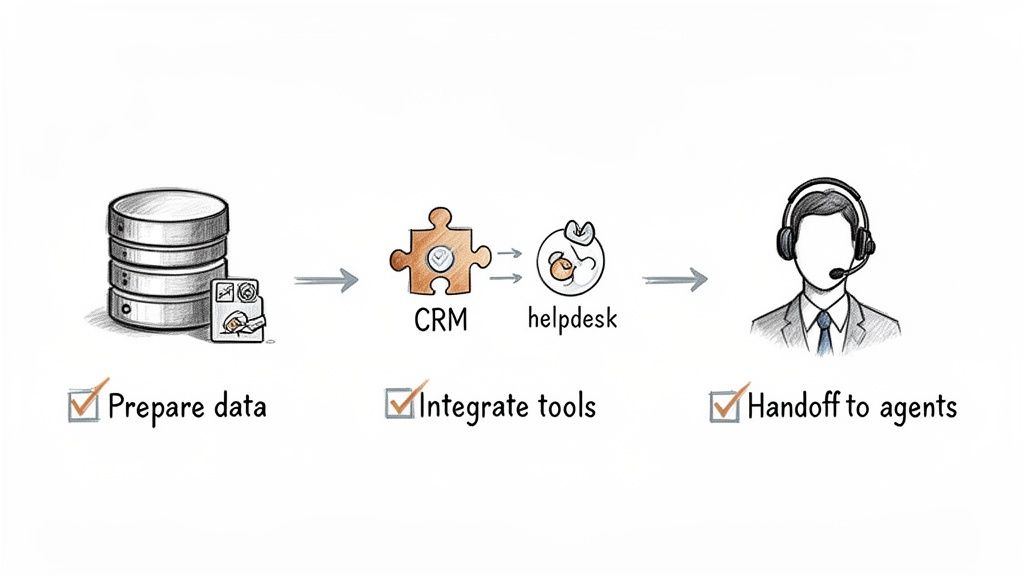
This roadmap zeroes in on three crucial areas: getting your data in order, connecting the AI to your existing tools, and mastering the handoff to your human agents. Get these right, and you're well on your way.
Your AI will only ever be as good as the data it learns from. Think of this phase as creating the "training manual" for your new AI teammate. The goal here is to feed it clean, relevant information so it can understand your customers and your business right out of the box.
Start by gathering all your historical support conversations—emails, chat logs, even call transcripts. This is a goldmine. It contains the real questions, the real problems, and the exact language your customers use. High-quality data is the bedrock of an AI that's genuinely helpful.
Here’s an actionable checklist to get your data ready:
An AI tool that sits by itself is little more than a fancy FAQ. The real magic happens when your AI-powered customer service platform connects seamlessly with the tools you already use every day, especially your CRM and helpdesk. This is what unlocks those powerful agentic actions, like actually processing a refund or updating a customer’s account information.
Actionable Insight: Think of your AI as a new hire. To be truly effective, they need login credentials for the same systems as everyone else. Integration gives the AI the "permissions" it needs to not just answer questions, but to actually resolve them.
This step is what turns your AI from a simple information source into a genuine problem-solver. Modern platforms like MagicalCX are built for this, often providing no-code connectors that link up with popular software in just a few clicks. For any team serious about automating their support workflows, understanding these integrations is key. You can dive deeper into this with our guide on help desk automation.
Let's be realistic: no AI can—or should—solve 100% of issues. The real goal is a powerful partnership between your AI and your human experts. A well-designed handoff makes sure that when a customer does need to talk to a person, the transition is seamless, contextual, and completely frustration-free.
The golden rule? Never make the customer repeat themselves. When the AI escalates a ticket, it absolutely must pass along the entire conversation history, including who the customer is, what they've already tried, and why they need more help.
Here’s an actionable strategy for an effective handoff:
Getting your AI-powered customer service platform up and running is a huge milestone, but the real journey starts after you go live. How can you tell if the AI is actually working? Measuring success isn't just about counting deflected tickets; it’s about tracking the metrics that prove you're delivering real business value and making customers happier.
At the same time, you need to be on the lookout for common mistakes that can quickly turn a promising AI project into a new source of customer frustration. If you know what to measure and what pitfalls to sidestep, you can build an AI support system that constantly learns, improves, and truly delivers on its promise.
To get a true read on your AI's impact, you’ll want to zero in on a handful of key performance indicators (KPIs). These are the numbers that tell the story of how well your AI is solving problems on its own and, just as importantly, how your customers feel about the whole experience.
The good news is that customer satisfaction with AI is on the rise. 80% of users report positive experiences, mostly because they get fast, reliable answers. In fact, 51% of consumers now prefer bots for quick help, a number that jumps to 61% among new buyers. Getting these AI interactions right can boost overall satisfaction by up to 20%, building the kind of loyalty that every business wants. You can dig into more stats about AI's impact on customer satisfaction on chatmaxima.com.
Even the most sophisticated AI will fall flat if it’s not implemented thoughtfully. Knowing the common tripwires ahead of time lets you build a strategy to avoid them, creating a support experience that feels genuinely helpful, not just automated.
A great AI support system shouldn't feel like talking to a machine. It should feel like getting an instant, accurate solution from your most efficient brand expert.
Here are three of the most common mistakes and actionable solutions to steer clear of them:
When you start exploring AI-powered customer service, a lot of questions pop up. It’s natural. Business leaders need to know how this will really affect their teams, what it takes to get it up and running, and whether a machine can actually represent their brand’s promise to customers. Getting straight answers is the only way to move forward with confidence.
Let’s tackle some of the most common concerns we hear from leaders who are considering this technology.
Absolutely not. Think of it this way: the best AI doesn't replace your people; it supercharges them. It’s designed to handle the flood of routine, repetitive questions that tie up your team’s time.
Practical Example: An AI can handle 80% of "Where is my order?" inquiries, freeing up your agents to focus on the complex, sensitive issues where their human touch—their empathy and critical thinking—truly shines, like calming an upset customer whose package was damaged. It actually makes their jobs more meaningful and less monotonous.
Getting started is probably easier than you think. Many of the best platforms today are built with a no-code approach, meaning you don't need a team of developers to get going. You can often handle the setup yourself, connecting it to the tools you already use.
For businesses with more complex systems, most top-tier providers offer a "white-glove" onboarding service. They’ll manage the entire integration process for you, making the transition smooth and taking the weight off your internal teams.
"While AI doesn't have feelings, it can deliver an empathetic experience. Using context from past conversations and understanding customer sentiment, a well-designed AI provides fast, accurate, and personalized solutions."
This is the big one, and it's a fair question. An AI can't feel empathy, but it can absolutely be designed to deliver an empathetic experience. How? By learning from every past interaction and sensing the customer's sentiment.
Practical Example: It shows understanding by providing the right answer, right away. It respects a customer's time by not asking for information it already has. It knows when a situation is escalating (based on keywords or repeated questions) and intelligently escalates to a human agent. This kind of supportive action is what builds a positive connection and shows your customers you've got their back.
Ready to see how an empathy-first AI can transform your support? Discover MagicalCX and turn your customer service into a revenue driver.


