See your AI teammate in action now
Ready to make support faster, kinder, easier and help customers feel good about choosing you?
PS: Sales improves too...
No credit card required
14 days free trial
DIY or Guided setup
Ready to make support faster, kinder, easier and help customers feel good about choosing you?
PS: Sales improves too...
No credit card required
14 days free trial
DIY or Guided setup
Manish Keswani
Measuring customer service isn't just about crunching numbers. It's the process of systematically tracking and analyzing every customer interaction to figure out what's working, what's not, and how you can do better to keep customers happy and grow the business. It’s how you turn vague ideas like “satisfaction” and “loyalty” into hard data that you can actually use to make smart decisions.
Too many companies still think of customer service as a cost center—a necessary evil for dealing with complaints. That's an outdated and dangerous perspective. When done right, customer service is a massive engine for revenue. Measuring its performance is the only way to prove that value and truly tap into its potential.
In today's market, whether you're a D2C e-commerce brand or a high-stakes FinTech platform, every single interaction matters. For a SaaS company, a slow response time isn't just a minor annoyance; it's a direct line to customer churn. For an online retailer, an unresolved support ticket is often the reason for an abandoned cart and the loss of that customer's business forever.
The financial stakes here are incredibly high. U.S. companies lose a jaw-dropping $75 billion a year because of poor customer service. That number is a direct consequence of unhappy customers, with nearly 74% of people in the U.S. saying they've had a bad experience recently. If you’re a CX manager, that’s not just a random statistic—it's a warning siren that unmeasured support is a direct threat to your bottom line.
This is where the idea of revenue-positive CX comes in. It's about shifting your mindset and seeing your support team not as a reactive "fix-it" crew, but as a proactive driver of growth. When you start measuring interactions systematically, you can:
A systematic measurement framework isn't just about generating reports to file away. It's about building a business that actively listens, adapts, and grows by putting the customer's experience at the very heart of its financial strategy.
Ultimately, measuring customer service connects the dots between what your support team does and what the business achieves. It lets you answer the big-picture questions, like, "How does improving our First Contact Resolution rate actually impact customer retention?" or "What's the real ROI of that new agent training program we launched?"
Without data, you're just guessing.
By measuring every touchpoint in the customer journey, you create a clear roadmap to not only deliver better service but also to directly strengthen your company’s financial health. You get to prove the incredible power of empathy in customer service and show everyone that it's one of the smartest investments a business can make.
A lot of companies get this backward. They start collecting data—CSAT scores, response times, you name it—without a clear plan, and end up with a dashboard full of numbers that don’t actually mean anything. A real measurement framework isn’t about hoarding data; it’s about generating insights that lead to action.
It all starts with a simple question: What are we actually trying to achieve?
Forget about the metrics for a minute. Are you trying to boost customer loyalty and get more repeat business? Maybe your main goal is to cut down on operational costs by making your support team more efficient. Or perhaps you want to mine customer conversations for product feedback that can guide your development roadmap.
Each of these goals requires a completely different lens. If you don't define your "why" first, you'll end up tracking vanity metrics that look pretty but do nothing for the bottom line.
This whole process is about turning customer service from a cost center into a growth engine. When you start measuring the right things, you can see exactly how poor service hurts revenue and, more importantly, how great service drives it.
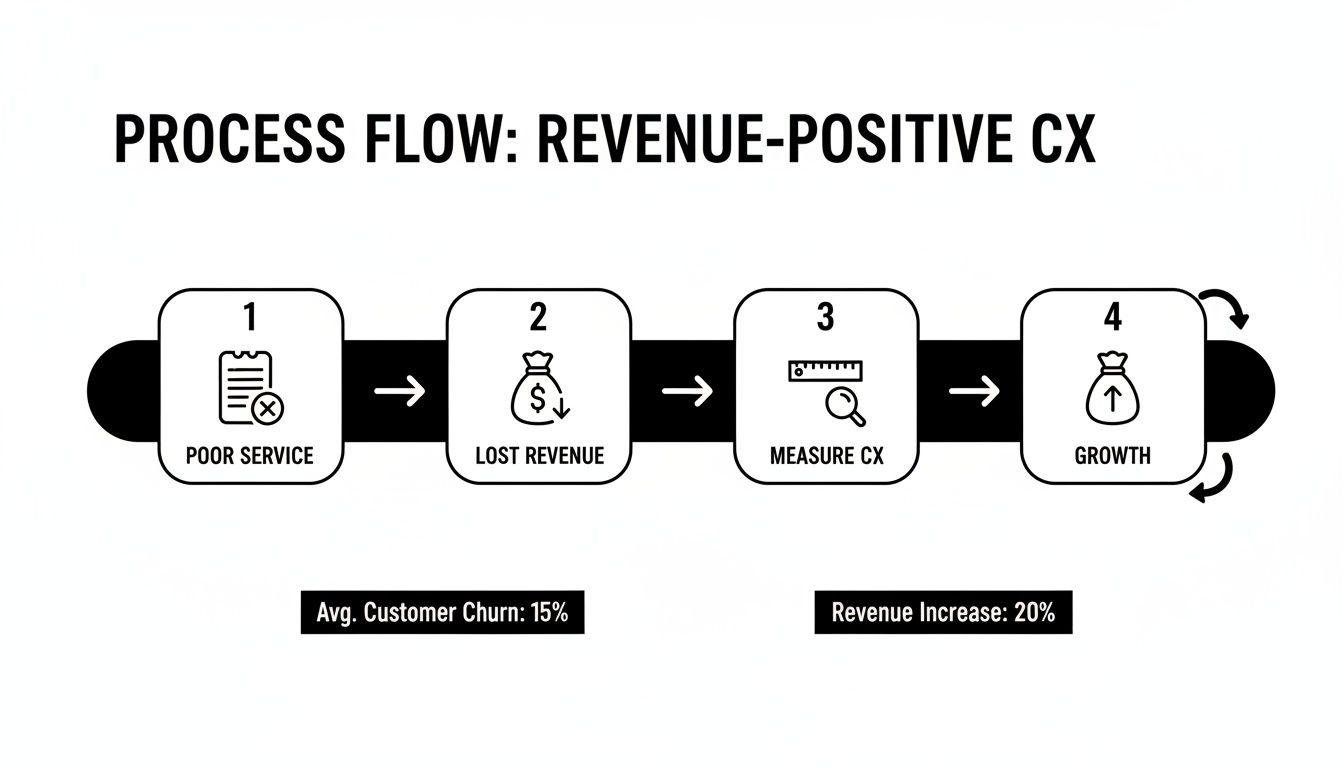
As you can see, the critical turning point is measurement. It’s what connects the day-to-day work of your support team to real financial growth.
Once your objectives are crystal clear, then you can start picking the right KPIs. The secret isn't in the metrics themselves, but in knowing which ones to use for which goal. Applying them generically gets you generic results.
Let's look at a couple of real-world scenarios.
Imagine a subscription box company struggling with churn. Their primary goal is loyalty. Instead of just looking at a broad satisfaction score, they decide to zero in on Customer Effort Score (CES), but only for customers who are in the process of canceling.
Now, let's take a B2B software company. Their main focus is on making their support agents more effective and cutting down the onboarding time for new hires. Their goal is pure operational efficiency. So, they decide to prioritize First Contact Resolution (FCR).
Their thinking is straightforward: if new agents can solve problems on the first try, it’s a clear sign that their training is effective and customers are getting help faster.
Your measurement framework is only as good as the actions it inspires. The point isn't just to measure; it's to build a repeatable process for turning data into tangible business improvements.
Think of your framework not as a rigid rulebook, but as a living roadmap. It has to adapt as your business and your goals evolve.
The best way to start is to define your main objective, then pick just one or two KPIs that directly track your progress. Don't try to measure everything at once. Focus is your best friend here.
If your goal is to boost customer loyalty...
If your goal is to increase operational efficiency...
If your goal is to improve the product with feedback...
When you build your framework this way—goals first, metrics second—you create a powerful system that ensures every piece of data you collect has a purpose. It moves your business forward, not in random bursts, but with deliberate, strategic steps.
Once you’ve nailed down your business objectives, it’s time to pick the Key Performance Indicators (KPIs) that tell you whether you're actually hitting the mark. This is a classic stumbling block. Many teams either drown in a sea of metrics or, worse, track vanity numbers that don't mean anything.
The secret isn’t to measure everything under the sun. It's about creating a balanced scorecard that paints a full picture of your customer experience. Think of it as a three-legged stool: you need to understand customer sentiment, operational efficiency, and the ultimate impact on the business. Get that mix right, and you'll move from just collecting numbers to finding real, actionable insights that help you grow.
These are the metrics that get straight to the heart of the matter: how do your customers feel? They’re your most direct line of sight into the emotional side of customer service and are absolutely essential for understanding satisfaction.
Customer Satisfaction Score (CSAT): This is your classic "How did we do?" survey, usually sent right after a support chat or call ends. It’s perfect for getting an immediate pulse check. Practical Example: An e-commerce brand sees CSAT scores dip by 10% for tickets related to returns. This immediately tells them to review their returns process or agent training on that specific topic.
Net Promoter Score (NPS): This one zooms out to measure long-term loyalty by asking, "How likely are you to recommend us?" It’s less about a single ticket and more about the customer's overall relationship with your brand. Actionable Insight: Don't just look at the overall score. Segment your "Detractors" (scores 0-6) and analyze their support tickets. You'll often find a common theme, like frustration with a specific policy, that you can address.
Customer Effort Score (CES): This measures how easy it was for the customer to get help. High-effort experiences are a massive driver of churn. Practical Example: A telecom company finds their CES is low because customers have to switch from chat to a phone call to verify their identity. By enabling verification within the chat, they reduce customer effort and improve the score.
The real magic happens when you look at these metrics together. A customer might give a high CSAT score because the agent was incredibly friendly, but a low CES score because they had to repeat their problem three different times. That combination tells a much richer, more actionable story than either metric could on its own.
While warm, fuzzy feelings from customers are great, you also have to make sure your operation is running smoothly. These metrics help you understand your team's capacity, spot bottlenecks, and deliver quality support without burning through resources.
First Contact Resolution (FCR): What percentage of issues are you solving on the very first try? A high FCR is a beautiful thing. Actionable Insight: If your FCR is low for a certain ticket category, it’s a huge red flag. It likely means your knowledge base is missing a key article or your agents need more training on that topic. Creating one solid help article can boost FCR significantly.
Average Handle Time (AHT): This tracks the average time it takes to handle an interaction. It’s tempting to push for the lowest AHT possible, but be careful. Actionable Insight: Instead of punishing agents for high AHT, look at the AHT of your top-performing agents (those with the highest CSAT and FCR). Their handle time is likely your 'ideal' AHT—a benchmark for quality and efficiency combined.
At the end of the day, customer service has to prove its value. These KPIs help you draw a straight line from your team’s work to the company’s financial health. This has never been more critical.
The stakes are incredibly high. A staggering 68% of consumers worldwide are willing to pay more for brands that offer great customer service. On the flip side, 64% of those same consumers will walk away after just one negative experience. If you need more data, check out these customer service statistics and trends that show how service quality directly impacts loyalty and revenue.
Here’s how to make that financial connection:
Sentiment Analysis: By using AI to scan the text in your support tickets, you can find the "why" behind your scores. Practical Example: Your CSAT might have dropped by 5% last month. Sentiment analysis can tell you this was driven by a 30% spike in negative comments about "slow shipping"—a specific, actionable insight.
Customer Lifetime Value (CLV): This is where you can build an undeniable business case. Actionable Insight: Segment your customers. Compare the average CLV of customers who have given you a CSAT score of 5/5 versus those who gave a 1/5. When you can show leadership that a happy customer is worth 3x more over their lifetime, your budget for improving support gets approved much faster.
To help you get started, here is a quick overview of the most common KPIs.
This table breaks down the essential metrics, what they tell you, and what a good target looks like.
| KPI | What It Measures | Best For | Industry Benchmark |
|---|---|---|---|
| CSAT | Short-term satisfaction with a specific interaction | Getting an immediate pulse-check on agent performance and issue resolution | 75% - 85% positive responses |
| NPS | Long-term customer loyalty and willingness to advocate for your brand | Understanding the overall health of the customer relationship | +30 to +50 is considered good; +70 is world-class |
| CES | The ease of a customer's experience in getting an issue resolved | Identifying and removing friction points in your support processes | Score of 5 or higher on a 7-point scale |
| FCR | Percentage of issues resolved in a single interaction | Measuring team efficiency and knowledge base effectiveness | 70% - 75% |
| AHT | Average duration of a customer interaction (talk, hold, wrap-up) | Diagnosing process inefficiencies and coaching agents | Varies wildly by industry; track your own trends |
| CLV | Total revenue a business can expect from a single customer account | Proving the long-term financial impact of good (and bad) service | Compare segments; positive support should correlate with higher CLV |
Remember, this isn't about setting and forgetting. Your KPIs should evolve as your business grows. What matters most is choosing a balanced set that gives you a complete, honest view of your performance from every angle.
So, you've picked the KPIs that matter. That’s a huge first step. But what’s next? Now comes the part where you actually wrangle the data and make it tell a story. Raw data from your helpdesk, CRM, and social media is just noise until you give it structure. A well-designed dashboard is what turns that chaos into clear signals your team can actually use.
The whole process starts by getting your tech stack to talk to each other, creating what's often called a "single source of truth." If you skip this, you’ll be stuck toggling between disconnected spreadsheets and reports, making it nearly impossible to see the big picture.
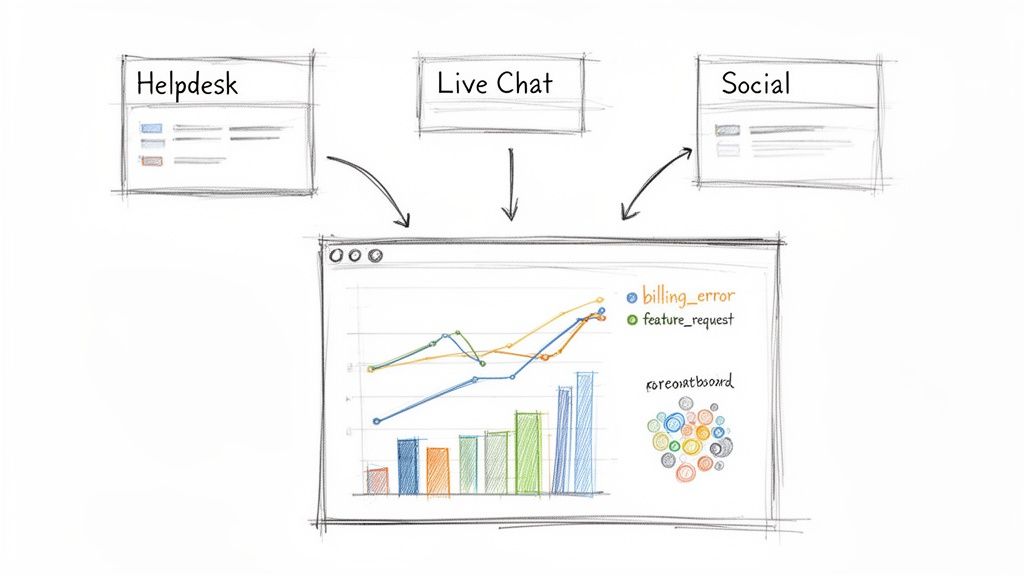
The real goal here is to make sure every single customer interaction, no matter where it happens, feeds into your central understanding of the customer experience. This means connecting your systems—helpdesk, live chat, social media monitoring tools, you name it—so all that data flows into one place.
One of the most effective, yet surprisingly simple, ways to do this is with a consistent tagging system. Think of tags as a universal language for all your customer issues. By using the same set of tags across every channel, you can instantly categorize thousands of conversations without having to read each one manually.
For instance, a direct-to-consumer brand might use simple, clear tags like:
shipping-delaydamaged-itembilling-errorfeature-requestpositive-feedbackPractical Example: An agent handling a live chat about a late package applies the shipping-delay tag. Your social media manager sees a tweet about a broken product and uses the damaged-item tag. Now, instead of guessing, you can see with certainty that 15% of all support contacts last month were about shipping delays—a specific, actionable insight pointing directly to a problem with your logistics partner.
A truly great CX dashboard does more than just throw up a few charts. It’s designed to show the relationships between different data points. Clutter is your worst enemy. Instead of trying to display every metric under the sun, focus on visuals that connect your operational data (like ticket volume) with customer sentiment (like CSAT) and real business outcomes (like retention).
The idea is to get beyond isolated numbers and start layering data to see cause and effect. This is where you go from just reporting on what happened to strategically guiding what happens next.
Your dashboard should answer questions, not just present data. A good chart makes you say, "I see," but a great chart makes you ask, "What if we changed this?" It's a tool for curiosity and action, not just reporting.
To build a dashboard that tells a story, try a few of these visualization tricks:
Overlay NPS Trends with Product Updates: Start by plotting your Net Promoter Score on a timeline. Now, add markers for every major product release or feature update. Actionable Insight: If your NPS score jumps two weeks after launching a highly-requested integration, you have clear evidence of the feature's positive impact on customer loyalty.
Correlate CSAT with Agent Training: Track your team's average Customer Satisfaction score week-over-week. On that same graph, mark the dates when you held specific training sessions—maybe one on handling angry customers or another on a new product feature. Actionable Insight: This helps you measure the ROI of your training efforts on customer happiness and justify future investment in agent development.
Map Ticket Volume Against Marketing Campaigns: A sudden spike in support tickets isn't always a sign of a problem. Overlay your incoming ticket volume with your marketing calendar. Actionable Insight: If you see a 30% increase in contacts tagged coupon-code-issue the day after a big email blast, you’ve just found a friction point in your campaign that you can fix for next time, improving both CX and marketing ROI.
Bringing all this together often requires some dedicated tools. If you're exploring your options, check out this guide on the best customer experience management tools that can help centralize your data and build powerful dashboards. The right platform makes it so much easier to connect these dots and turn your data into a clear roadmap for improvement.
Collecting data is just the first step. The real magic—and the real challenge—in measuring customer service is turning those numbers into meaningful change. Let's be honest, a dashboard full of pretty charts is completely useless if it doesn't actually inspire you to do something.
This is all about building a rhythm, a process where the feedback you get from customers directly fuels improvements across the entire company. If you don't connect the dots, all your measurement efforts are just an academic exercise.
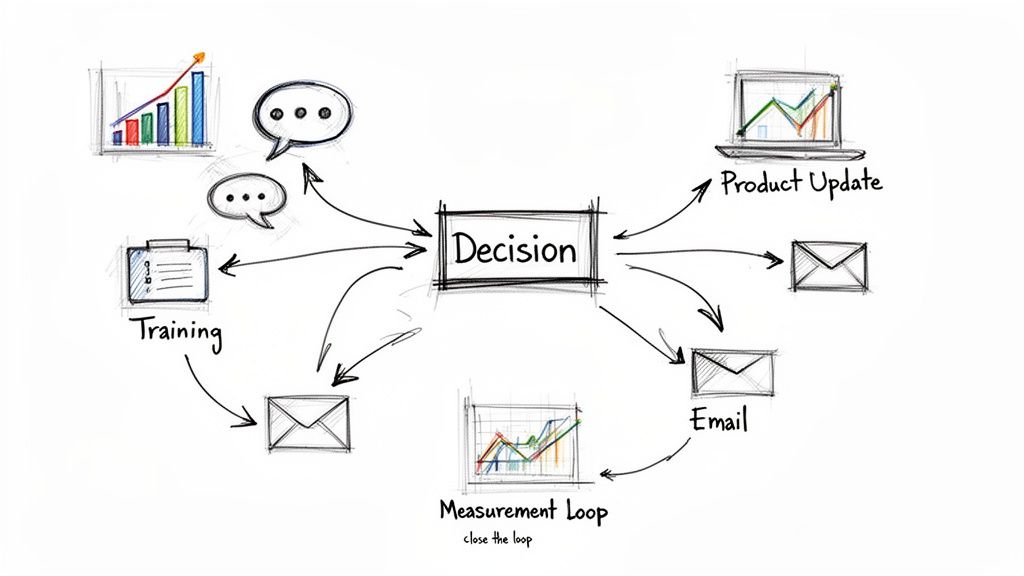
Not every piece of data deserves a five-alarm fire drill. You need a practical cadence for reviewing your metrics so that different insights get the right level of attention from the right people.
Here’s a review cycle that I've seen work really well in practice:
"Closing the loop" is a term that gets thrown around a lot, but what does it really mean? It means an insight doesn't just get logged in a report—it triggers a specific, cross-functional action, and you follow up to measure the outcome. This is how your support team evolves from a reactive cost center into a proactive, strategic partner.
Practical Example:
This kind of proactive teamwork is critical for scaling support without just throwing more people at the problem. An omnichannel customer service platform can be a huge help here, as it centralizes all your data and communication, making it much easier to spot these trends and get everyone on the same page.
Frankly, modern AI tools are a complete game-changer for closing the loop faster and more accurately. Instead of relying on manual ticket tagging and tedious analysis, AI can pinpoint the root cause of customer friction by analyzing thousands of conversations in real-time.
Think about this: by the end of this year, it's expected that 95% of all customer interactions will be powered by AI in some way. This shift allows businesses to track entirely new metrics, like AI deflection rates—the percentage of issues resolved without any human help at all. The best companies are already pushing this to 70-80%, which dramatically slashes their operational costs.
Here’s a glimpse of how AI speeds everything up:
Even with the best framework, theory only takes you so far. When you start putting these measurement principles into practice, real-world questions always come up. It's in navigating these practical hurdles that a team goes from just collecting data to actually building a customer-obsessed culture.
Here are a few of the most common questions I hear from teams, with some straight-up advice.
This is the classic balancing act. You need feedback, but you don't want to burn out your customers with constant requests. The right answer? It depends entirely on what you're trying to learn.
Actionable Insight: Tie surveys to key journey moments. For example, send an NPS survey 30 days after a new customer onboards or after their third purchase. That way, you’re gathering feedback on the moments that actually shape their long-term relationship with your brand.
Easy. It's getting obsessed with a single efficiency metric, usually Average Handle Time (AHT). I've seen so many teams go all-in on lowering AHT, thinking that faster service is always better service. It's a dangerous trap.
When you pressure agents to just get off the phone faster, they start cutting corners. They'll rush customers, give half-baked answers, and close tickets before the problem is truly solved. Sure, your AHT report might look great, but your First Contact Resolution (FCR) and CSAT scores will be in a nosedive. And guess what? Those same customers just call back, now even more irritated.
Actionable Insight: Good measurement isn't about one magic number. It’s about a balanced view. You must look at efficiency metrics like AHT right alongside quality metrics like CSAT and FCR. If AHT goes down but FCR also goes down, you haven't become more efficient—you've just created more work for tomorrow.
This is a great question. While you can't slap a single KPI on a feeling, you can absolutely measure its presence and, more importantly, its business impact.
This is where you combine the art and science of customer service. AI-powered tools are a massive help here. They can run sentiment analysis across every single customer conversation—chat, email, and even voice calls—to score the emotional tone. This lets you see, at a glance, what percentage of your interactions feel positive versus negative.
But technology is only half the story. You also need to build empathy into your human quality assurance (QA) scorecards. Don't just check for process compliance; add criteria that look for empathetic behaviors:
Actionable Insight: Correlate these qualitative scores with hard numbers. You'll likely find that your agents with the highest "empathy scores" on their QA reviews also have the highest CSAT scores and the highest customer retention rates. This data proves that empathetic service isn't just a "nice-to-have"—it's a core driver of business results.
Ready to stop guessing and start knowing? MagicalCX uses an empathy-first AI to analyze every customer conversation, pinpointing friction and uncovering opportunities automatically. Our live dashboards give you the actionable insights needed to turn your support team into a revenue engine. Learn how you can transform your customer service at https://www.magicalcx.com.


