See your AI teammate in action now
Ready to make support faster, kinder, easier and help customers feel good about choosing you?
PS: Sales improves too...
No credit card required
14 days free trial
DIY or Guided setup
Ready to make support faster, kinder, easier and help customers feel good about choosing you?
PS: Sales improves too...
No credit card required
14 days free trial
DIY or Guided setup
Manish Keswani
So, what exactly is a client retention program? It's more than just good customer service. It's a deliberate, proactive system you build to keep your existing clients happy, engaged, and loyal. You're moving beyond one-off support tickets to create personalized experiences that forge genuine, long-term relationships.
For example, instead of just solving a support ticket and closing it, a retention program might trigger an automated follow-up a week later asking, "Hey, did that solution work for you? Is there anything else we can help with?" It’s a small, proactive step that shows you care beyond the immediate problem.
The end game? Turning repeat buyers into your most powerful brand advocates. This isn't just a feel-good exercise; it directly fuels your bottom line. After all, keeping a client is almost always more profitable than grinding to find a new one.
We've all heard the old saying: "It's cheaper to keep a client than to find a new one." And while that's absolutely true, it barely scratches the surface. A well-designed client retention program isn't just about cutting costs; it's a powerful engine for compounding growth. Loyal clients do so much more than just buy again—they become a living, breathing part of your business ecosystem.
Think about what this looks like in the real world. A happy SaaS subscriber who renews their contract provides predictable revenue, which is great. But when they become a true advocate, they start leaving glowing reviews, referring new leads to your sales team, and offering priceless feedback that helps you build a better product. Their lifetime value skyrockets far beyond their subscription fee.
The link between retention and profitability isn't just a theory; it's a proven fact. Research from Bain & Company famously found that increasing customer retention by just 5% can boost profits anywhere from 25% to 95%. This isn't magic. It happens because long-term customers tend to spend more over time and are far less likely to jump ship over a small price increase.
Let's break it down with a couple of practical, actionable examples:
The goal is to evolve the relationship from a simple transaction into a genuine partnership. When clients feel like you "get" them and value their business, they're far less likely to be swayed by a competitor's flashy ad or a temporary discount.
Today's customers expect more than a solid product. They demand personalized, empathetic experiences. They want you to remember who they are, anticipate what they'll need next, and make them feel seen. As your business grows, trying to deliver this level of care manually becomes completely unsustainable.
This is where smart automation comes in. A modern client retention program uses technology to manage these critical relationships at scale. It’s what allows you to automatically send a personalized check-in email after a major purchase, flag an at-risk account based on their product usage, or celebrate a client’s anniversary with a special offer—all without anyone lifting a finger.
By treating retention as a core strategy, you transform your support team from a cost center into a powerful driver of sustainable, long-term growth.
Before you start firing off "we miss you" emails or launching a loyalty program, you need a solid blueprint. I've seen too many well-intentioned retention efforts fall flat because they started with random acts of kindness instead of a clear, strategic foundation.
A truly successful client retention program starts by defining exactly what winning looks like. Vague goals like "improve loyalty" are impossible to measure and, frankly, destined for the project graveyard. Your foundation has to be built on concrete, measurable objectives that turn your program from a fuzzy cost center into a strategic asset with provable value.
Let's get specific. Your goals need to be SMART—specific, measurable, achievable, relevant, and time-bound. This framework isn't just business jargon; it's what gives your team a clear target and guides every decision you'll make down the line. Start by asking, "What's the one business problem we're trying to solve right now?"
Here are a few examples of what strong, actionable retention goals look like in the real world:
See the difference? These aren't just hopes; they're targets. This kind of focus is crucial, especially when you consider that a huge number of companies are now prioritizing investments in retention. If you want to learn more, Sprinklr has some great insights on customer retention statistics.
Once you know what you're aiming for, you need to get crystal clear on who you're talking to. A one-size-fits-all retention strategy simply doesn't work. The real magic happens when you segment your client base not by who they are (demographics) but by what they do (behavior).
Your CRM is a goldmine here. It’s time to dig into purchase history, engagement levels, support ticket frequency, and how people are actually using your product. This is how you create smart, actionable segments that let you tailor your approach for maximum impact.
A client who has made ten purchases and actively refers new business needs a completely different conversation than a new client who just signed up. Treating them the same is a massive missed opportunity.
Forget generic labels. Think in terms of dynamic segments that reflect a client's current relationship with your brand. This approach lets you focus your time, energy, and budget where they'll make the biggest difference.
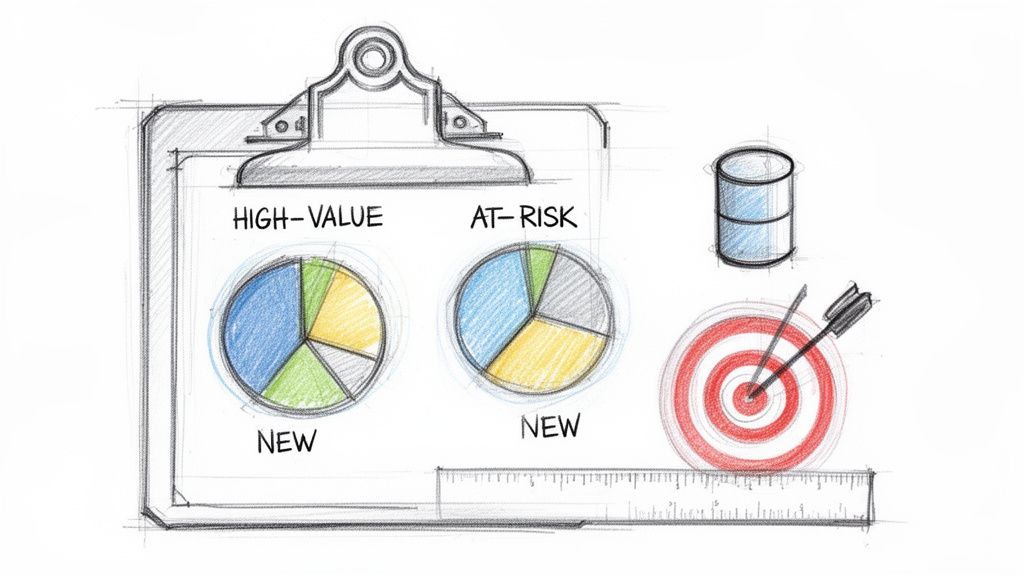
Here’s a practical way to start bucketing your clients:
| Client Segment | Characteristics | A Smart Retention Tactic |
|---|---|---|
| High-Value Champions | Your best customers. They buy often, have a high lifetime value, and tell their friends about you. | Give them exclusive access to new products, a VIP loyalty tier, or send a personalized thank-you gift out of the blue. Example: A coffee subscription company could send a free, exclusive mug to their top 1% of customers. |
| At-Risk VIPs | These were once high-value clients, but their engagement or spending has dropped off a cliff. | This is an all-hands-on-deck moment. Trigger a proactive check-in from a senior team member or offer a compelling incentive to win them back. Example: A marketing agency notices a key client's monthly check-ins have become shorter and less engaged, prompting the account director to schedule a dedicated "strategy refresh" call. |
| New & Promising | First-timers who had a good initial experience but haven't yet become die-hard fans. | Guide them with a targeted onboarding sequence, send genuinely helpful content, and nudge them toward a second purchase with a small incentive. Example: An online clothing store could send a "How to Style Your New Jeans" guide followed by a 10% off coupon for a matching top. |
| Dormant Clients | Customers who haven't bought or engaged in a long time (say, 90+ days). | Launch a "we miss you" campaign with a can't-refuse offer or a simple survey to find out what went wrong. Example: "It's been a while! Come back and see what's new with a $15 credit on us." |
When you segment your audience this way, you can start building specific playbooks and automated workflows for each group. Every interaction becomes more relevant and timely, laying the groundwork for a retention program that delivers real, measurable results.
Once you've set your goals and sorted out your client segments, it's time to get to the real heart of your client retention program. We're moving beyond just putting out fires. The goal here is to build a proactive strategy that puts you on the offensive, creating experiences that earn loyalty long before a client even considers looking elsewhere.
The entire approach hinges on mapping out the client journey to find those moments that truly matter. It’s not about flashy, expensive gestures. It’s about consistently showing up with the right message, at the right time, in a way that feels genuinely helpful.
For too long, "retention" has been something that kicks in when things go wrong. A bad support ticket. A missed payment. A complaint. A proactive strategy completely flips that script. It’s about anticipating what your clients need and creating positive touchpoints all along their journey, not just when there's friction.
This means you’re actively hunting for opportunities to add value, offer support, and celebrate their wins with them. Think about the difference between a generic renewal reminder and scheduling a strategic check-in a month before their contract is up to make sure they're squeezing every bit of value out of your service.
A reactive strategy basically says, "Please don't leave." A proactive, empathy-first strategy says, "We're invested in your success." This subtle shift in mindset makes all the difference in building relationships that actually last.
To be truly proactive, you have to see the journey through your client's eyes. While every business is unique, most client journeys have a few universal, high-impact stages where you can make a real difference.
Let's break down a few practical examples:
Modern retention is built on a foundation of personalization. Customers don't just appreciate it anymore—they expect it. In fact, 78% of customers are now looking for more personalized engagement, a demand that’s completely reshaping how businesses think about loyalty. This goes way beyond just using a {first_name} tag in an email. It’s about using data to create interactions that are aware of their context, showing you understand their specific history and needs.
This is where modern platforms really come into play, helping you create these personalized journeys at scale. They can automate complex workflows while making sure every single interaction still feels human. For example, a system can automatically flag an account with declining usage and trigger a personalized outreach from their success manager, complete with helpful resources tailored to the specific features they've stopped using. The data powers the action, but the execution feels personal.
By systematically collecting and analyzing feedback at each stage of the journey, you create a powerful flywheel for continuous improvement. This is your chance to truly listen to the voice of the customer and turn insights into action.
The difference between these two approaches isn't subtle; it's a chasm. One builds long-term value, while the other is often a last-ditch effort to stop the bleeding. When you look at them side-by-side, the better path becomes obvious.
| Attribute | Proactive Retention (Empathy-First) | Reactive Retention (Traditional) |
|---|---|---|
| Timing | Ongoing, throughout the entire client lifecycle. | Triggered by a negative event (e.g., complaint, cancellation request). |
| Focus | Maximizing client value and success. | Minimizing client loss and churn. |
| Tone | Helpful, supportive, and celebratory. | Apologetic, defensive, or transactional. |
| Tools | CRM data, usage analytics, journey mapping, automated workflows. | Support tickets, cancellation surveys, win-back discount offers. |
| Outcome | Builds deep loyalty, advocacy, and increases lifetime value. | May temporarily prevent churn but rarely builds true loyalty. |
By architecting your strategy around these proactive, empathetic touchpoints, you stop playing defense. You start building relationships that are not only more resilient to competition but also far more profitable and rewarding for everyone involved.
A brilliant retention strategy is just an idea until you give your team the tools and processes to make it real. Without the right tech stack and clear, repeatable playbooks, even the best-laid plans fall apart under the weight of manual work and inconsistent execution. This is where your strategy hits the ground and becomes part of your team's daily rhythm.
Think of your tech stack as the central nervous system for your entire client retention program. It’s what connects all the dots, giving you a 360-degree view of a client’s health, coordinating conversations across every channel, and firing off those proactive touchpoints we mapped out earlier.
Your CRM is the heart of the operation, but it can’t do everything alone. To really bring a proactive retention plan to life, you need to connect your customer data to the places where your clients actually are—whether that's their email inbox, your website's chat, or even WhatsApp.
A solid, modern retention stack usually looks something like this:
Imagine an e-commerce brand using its CX platform to spot a VIP customer who hasn't bought anything in 60 days. The system could instantly trigger a personalized "we miss you" message on WhatsApp, complete with a special offer based on their favorite products. That's the kind of smart, orchestrated touchpoint that’s impossible when your tools don't talk to each other.
Once your tools are in place, it’s time to create your playbooks. These aren't complicated manuals; they're simple, step-by-step guides that tell your team exactly what to do and say in crucial moments. Playbooks eliminate the guesswork and ensure every client gets the same thoughtful, on-brand experience.
The goal is to deliver emotionally intelligent communications with absolute consistency, whether it's an automated email or a one-on-one call. Every touchpoint should feel like it comes from the same company that cares.
The journey below shows how these playbooks map to key stages of the client lifecycle, turning reactive moments into proactive opportunities.
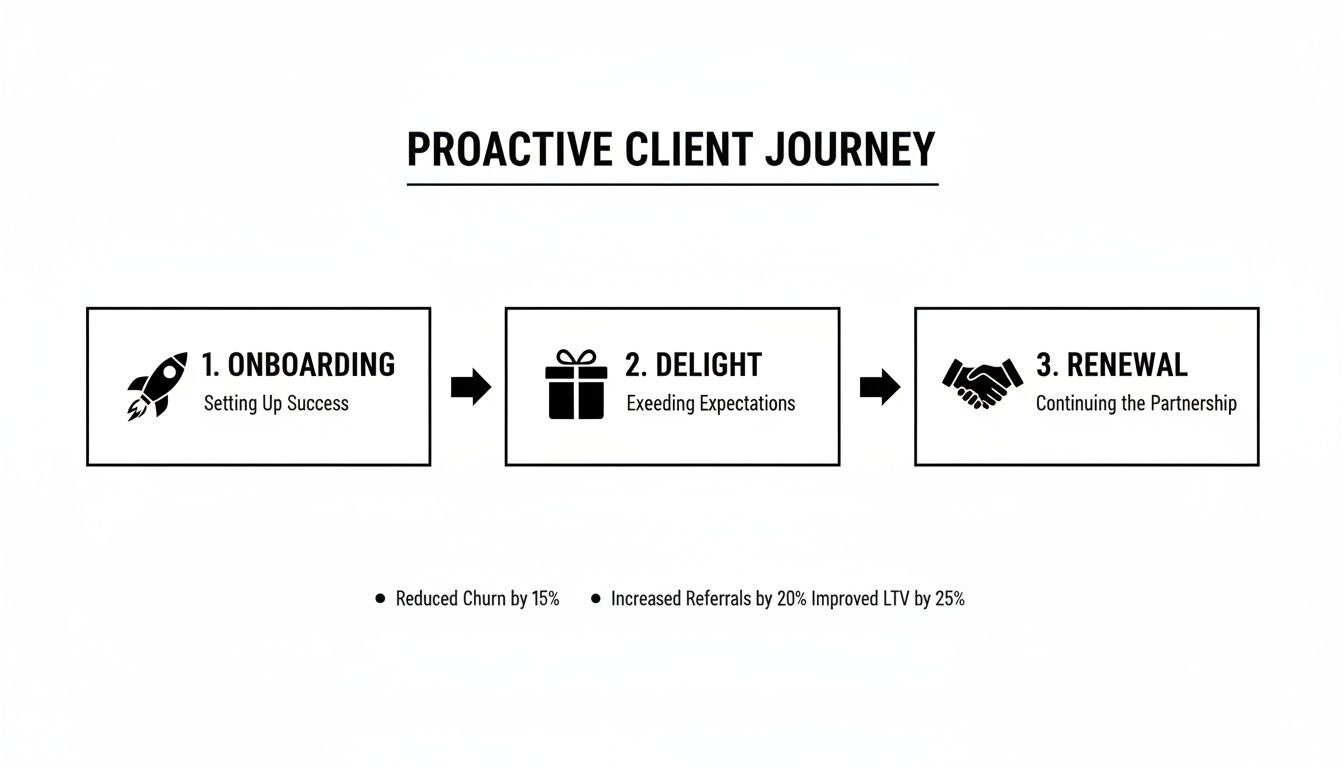
This highlights that retention isn’t a one-off event. It’s a continuous process of showing up and delivering value when it matters most. Your playbook is the script for those moments.
Here are a couple of practical playbook examples you can steal and adapt.
When a client's health score dips, every second counts. This playbook ensures a fast, coordinated, and empathetic response.
Never wait until the renewal is just around the corner. This conversation should be happening 60-90 days out.
By standardizing these critical interactions, you're not just being efficient—you're building a reliable, high-quality experience that fosters deep trust. Clients feel taken care of because your entire process is built around helping them succeed.
At the end of the day, a world-class retention program is born from this marriage of smart technology and human-centric processes. If you're looking to bring all your client conversations under one roof, exploring an omnichannel customer service platform is a fantastic next step toward building a more connected experience.
Getting your client retention program off the ground is a major milestone, but that's really just the beginning of the journey. The real work starts now. To build a program that genuinely moves the needle, you have to be obsessed with measuring what’s working, what isn't, and be ready to adapt on the fly.
Let's be honest: if you can’t measure it, you can’t improve it. And you certainly can’t prove its value to leadership when budget season rolls around. This means we need to look past the superficial vanity metrics and zero in on the numbers that actually tell the story of client loyalty and profitability.
To get an honest assessment of your program's health, you need a dashboard that gives you a few different angles on the situation. Each metric is a lens, and together, they provide a clear picture of client behavior and the real impact of your retention efforts.
Here are the KPIs I always keep a close eye on:
Tracking these top-level KPIs is a great start, but the game-changing insights are buried a level deeper in cohort analysis. This just means grouping clients based on when they joined (e.g., all the January sign-ups) and then watching how that specific group behaves over time.
This approach lets you answer the really important questions. Practical example: Your SaaS company introduced a new series of onboarding webinars in March. By comparing the 90-day retention rate of the "March Cohort" to the "February Cohort," you can see if the webinars had a tangible impact on reducing early churn.
Without cohort analysis, you’re flying blind. You might see your overall churn rate dip and pat yourself on the back, when in reality, a fantastic batch of new clients is just masking a growing problem with an older segment.
At the end of the day, your retention program has to justify its own existence in dollars and cents. Calculating its Return on Investment (ROI) is how you stop being seen as a "cost center" and start being recognized as a revenue engine.
The formula itself is pretty straightforward:
(Gain from Investment - Cost of Investment) / Cost of Investment
Let's walk through a real-world scenario. Imagine a SaaS company spends $10,000 in a quarter on a combination of a CX automation platform like MagicalCX and the staff time to manage it. In that same quarter, their new proactive playbooks successfully prevent 20 at-risk accounts, each worth $1,000, from churning.
Here's the math:
That simple calculation makes your case for you. It’s no surprise that many companies are upping their retention spend; the numbers just make sense. With a small 5% increase in retention potentially boosting profits by up to 95%, the financial upside of loyalty is massive. For more on this, check out the latest customer retention benchmarks and insights.
By constantly tracking your metrics, digging into cohort performance, and proving your ROI, you create a powerful feedback loop. You can spot the friction, double down on what works, and turn your retention program into a well-oiled machine for sustainable growth.
Even with the best blueprint in hand, a lot of practical questions pop up when you start building a client retention program. Let's dig into some of the most common hurdles I've seen teams face when they move from a great idea on paper to a real-world plan.
Getting ahead of these issues is key. If you don't tackle them head-on, they can easily derail your momentum.
This is the big one, isn't it? It’s often the very first roadblock. The trick is to completely reframe the conversation. Stop talking about retention as a "cost center" and start showing how it's a revenue-generating investment. Vague promises about "happier clients" just won't cut it with the finance team. You have to speak their language: hard numbers.
Here's an actionable plan:
When you frame it this way, it’s no longer a fuzzy request for resources; it's a straightforward, compelling business case.
Don't try to boil the ocean. If you’re working with a small team or a tight budget, the single most impactful place to begin is with your "At-Risk VIPs." These are the clients who have historically been high-value but are now showing signs of slipping away—maybe their product usage has dropped, or they've just gone quiet.
Why here? Because saving just one of these major accounts delivers a massive return. It’s far more effective than trying to re-engage a hundred low-value, dormant clients. It’s a classic 80/20 scenario.
Actionable first step: Identify your top 20 clients by lifetime value. Every Monday, manually check their activity from the previous week. If you see a significant drop for any of them, have a senior team member send a personal email like, "Hey [Name], just checking in. Is everything okay?" This targeted, high-touch approach requires almost no tech but can have an immediate, powerful impact.
This early success builds momentum and makes it much easier to justify expanding your program later.
This is a fantastic question, because the idea of "personalization" can feel completely overwhelming. The goal isn't to handcraft a unique experience for every single client. It's about making each interaction context-aware. It’s about showing the client you know who they are, what they’ve done, and what they likely need right now.
You can make a huge difference by starting with a few simple but powerful data points:
You don't need a team of data scientists to get this off the ground. Using these basic pieces of information shows you're paying attention. It makes clients feel seen, and that’s the real foundation of any lasting relationship.
A successful client retention program transforms your support team into a profit engine. MagicalCX provides the tools to build these meaningful, proactive relationships at scale with our empathy-first AI platform. Orchestrate your entire client journey and see the results for yourself.


