See your AI teammate in action now
Ready to make support faster, kinder, easier and help customers feel good about choosing you?
PS: Sales improves too...
No credit card required
14 days free trial
DIY or Guided setup
Ready to make support faster, kinder, easier and help customers feel good about choosing you?
PS: Sales improves too...
No credit card required
14 days free trial
DIY or Guided setup
Manish Keswani

Contact center operations are the engine room of your customer experience. It’s the combination of people, processes, and technology that dictates how every customer interaction unfolds. At its core, it's about making sure customers get consistently great service across every channel, all while keeping things running efficiently behind the scenes. An actionable insight here is to think of every support ticket not as a cost, but as an opportunity to solidify a customer relationship.
The old-school view of customer support as a necessary cost center is officially dead. Your customers now live in a digital-first world, and they expect their service interactions to be just as fast, personal, and seamless as everything else they do online.
Legacy contact centers, with their clunky phone queues and siloed data, just can't keep up. They’re a recipe for friction and frustration, and in today's market, that’s a quick way to lose business for good. Modernizing isn't just about plugging in new software; it's a strategic move that's absolutely critical for survival and growth.
When you get it right, your contact center operations become the driving force behind customer retention, loyalty, and even new revenue. The goal has shifted from just closing tickets to actually building relationships.
Think about how customers interact with brands today—it's a fluid journey that hops between different touchpoints. Someone might start a question on your website's live chat, follow up with an email an hour later, and then maybe even call in. They expect the agent who answers to know everything that's happened so far.
This new reality is driven by a few key expectations:
For decades, the holy grail of contact center performance was Average Handle Time (AHT). This pushed agents to get people off the phone as fast as possible, often sacrificing the quality of the solution to hit a number. That way of thinking is completely obsolete.
Today’s leading contact centers focus on metrics that measure the health of the customer relationship, not just the speed of the transaction. Success is now defined by KPIs like First Contact Resolution (FCR), Customer Effort Score (CES), and the long-term impact on Customer Lifetime Value (CLV).
This evolution requires a totally new playbook and a new set of tools. Platforms like MagicalCX were designed for this new reality, using empathy-first AI to handle the repetitive, manual work. This frees up your agents to focus on what they do best: solving complex problems and building real human connections. To see how this works in practice, you can learn more about how an omnichannel customer service platform brings all these touchpoints together.
The financial stakes here are enormous. In 2024, the global call center market was valued at a staggering USD $352.4 billion and is on track to hit USD $500.1 billion by 2030. Considering that agents can make up 95% of a contact center's operating costs, optimizing their effectiveness isn't just a small tweak—it's a massive financial lever. A strategic overhaul isn't just a good idea; it's essential.
Before you can even think about modernizing your contact center, you have to get brutally honest about where you stand right now. Skipping this diagnostic phase is a classic mistake. It's like trying to plan a road trip without knowing your starting city—you’ll end up going somewhere, but almost certainly not where you intended. A proper audit shines a light on those hidden friction points that quietly frustrate both your customers and your agents, giving you the hard data needed to make a case for change.
The point isn't to assign blame. It's to uncover real opportunities. You need to look past the usual surface-level metrics and get into the weeds of your team's daily reality—their workflows, the tech they use, and the actual journeys customers take. This is where you find the small, nagging inefficiencies that add up to major operational drag.
This process is really about moving from a reactive, queue-based model to something far more intelligent and proactive.
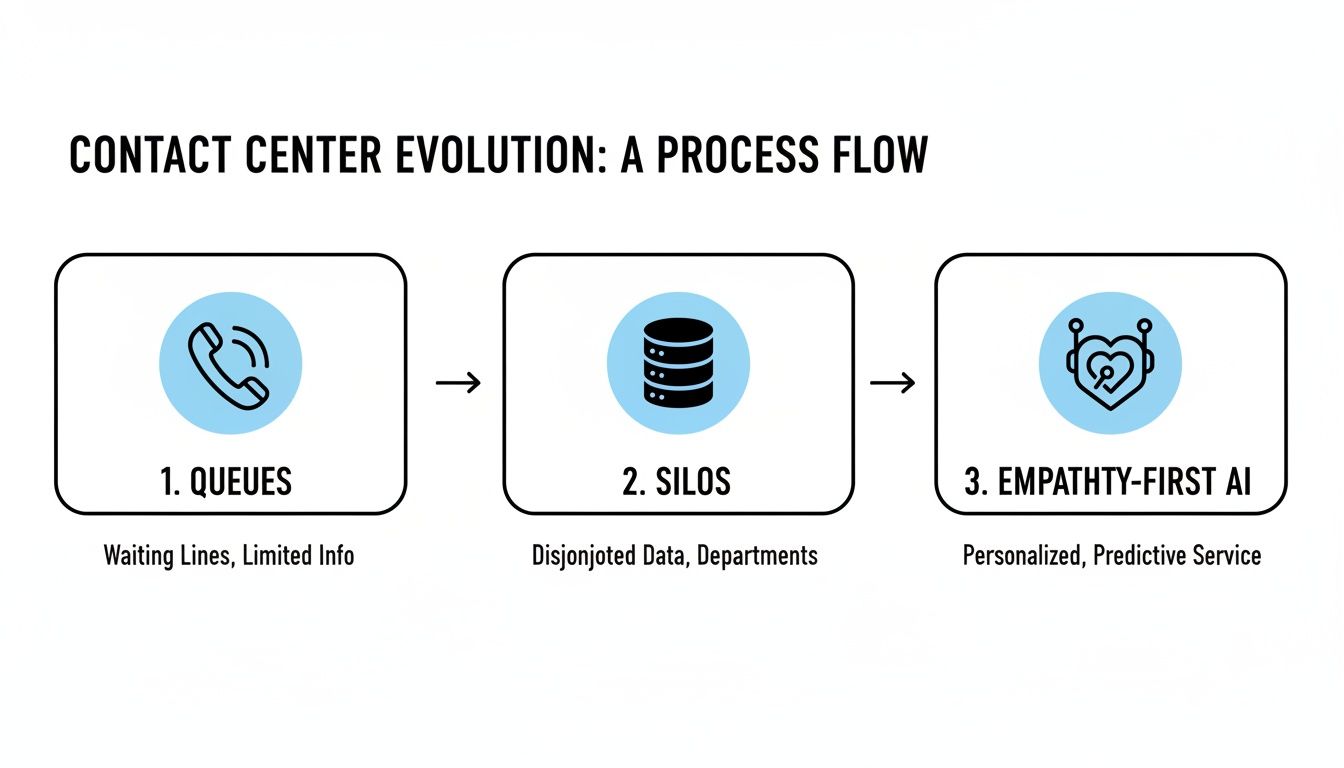
As you can see, the goal is to evolve past simply managing calls and chats. It’s about orchestrating truly context-aware experiences, and that starts with understanding what’s broken today.
Friction often hides in plain sight, usually disguised as "the way we've always done things." A great place to start your hunt is by looking for those repetitive, low-value tasks that eat up your agents' time and mental energy. These are your prime candidates for automation and process improvement.
Think about something as simple as manual data entry. If your agents are constantly copying an order number from your e-commerce platform, pasting it into your CRM, and then typing it again into a shipping tool—that’s a huge friction point. It’s not just slow; it’s a recipe for human error that can completely derail a customer's experience. Every single manual data transfer is a potential breaking point.
Another classic culprit is the channel handoff. When a customer moves from a chatbot to a live agent, does that agent get the full transcript instantly? Or are they forced to ask the dreaded, "Can you please tell me what you've already discussed with our bot?" That one question completely shatters the customer's confidence and screams "we have a broken process." An actionable insight is to secretly shop your own support channels. Initiate a chat, then call, and see if the phone agent knows about your chat. The results are often eye-opening.
To truly get it, you have to walk in your customer’s shoes. Pick a common reason people contact you—let's say processing a product return or changing a subscription—and map out every single touchpoint from their perspective.
By literally mapping this journey—on a whiteboard, in a spreadsheet, whatever works—you create a powerful visual of your operational gaps. The spots where customers have to repeat themselves or where agents seem blind to previous interactions are your highest-priority targets for modernization.
To bring some structure to this process, use a self-assessment checklist. It helps you benchmark your current state across the core pillars of your operation and forces an honest look at where the real problems are. Go through this with your team leads and a few frontline agents to get a complete picture.
| Assessment Area | Key Questions to Ask | Current State (1-5) | Notes for Improvement |
|---|---|---|---|
| Technology & Tools | Do our core systems (CRM, helpdesk, etc.) sync data automatically? Do agents have a single view of the customer? | e.g., "Agents toggle between 4 screens; CRM/OMS integration needed." | |
| Agent Workflow | How many manual copy/paste steps are in a typical interaction? How much time is spent on after-call work vs. customer-facing work? | e.g., "Automate ticket tagging; after-call work averages 90 seconds." | |
| Customer Journey | Do customers have to repeat information when switching channels? Is context from self-service (chatbot, IVR) passed to live agents? | e.g., "Chatbot transcripts are lost on escalation to voice." | |
| Knowledge Mgmt. | Can agents find accurate answers in our knowledge base in under 30 seconds? Is content regularly reviewed and updated by subject matter experts? | e.g., "KB search is poor; many articles are outdated." | |
| Data & Analytics | Can we track a customer's journey across multiple touchpoints? Are we measuring metrics beyond AHT and FCR, like Customer Effort Score (CES)? | e.g., "No visibility into self-service failures; need to add CES." |
Answering these questions gives you a clear, evidence-based starting line. It moves the conversation from "I think we have a problem" to "Here is exactly where our processes are breaking down, and here's the data to prove it." This foundation is what you'll build your entire modernization strategy on.
Your agents are the heart of your customer service, but they're often handcuffed by clunky, inefficient processes. The secret to standout service isn't just about hiring better agents; it’s about building smarter contact center operations that empower the team you already have. When you redesign workflows with the agent's experience in mind, you start to chip away at the frustrating busywork that leads to burnout and keeps them from focusing on what matters—the customer.
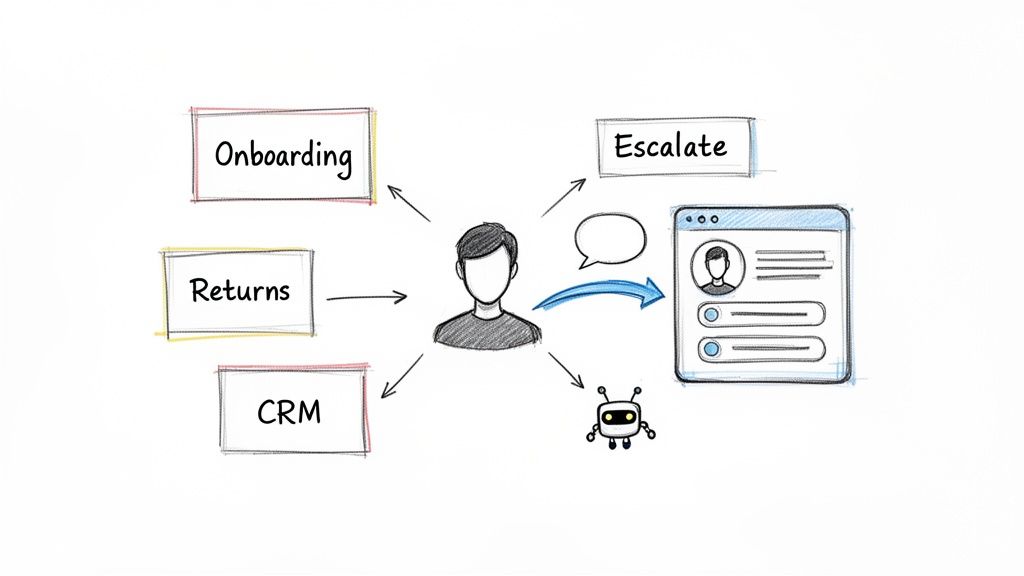
The goal here is a big one: shifting agents from being reactive ticket-closers to proactive problem-solvers. This can only happen if you give them an operational framework that serves up the right information, at the right time, in the right context. It’s all about making the right thing to do the easiest thing to do.
Let's be honest, not all customer issues are simple. Think about a complex process like a product return for an e-commerce brand or a subscription change for a SaaS company. These tasks often involve a tangled web of steps, systems, and potential exceptions, forcing agents to rely on messy cheat sheets or outdated knowledge base articles.
This is where guided workflows make a world of difference. Instead of making agents navigate a maze of policies and procedures on their own, you can turn these multi-step journeys into simple, automated paths.
Here's a practical example for managing a product return. A good guided workflow can automatically:
What used to be a 10-minute manual slog becomes a 30-second confirmation. This frees up your agents and, just as importantly, ensures 100% policy compliance. You're removing the mental burden, which allows them to focus their energy on the customer’s emotional state rather than just the administrative steps.
You can't deliver a truly personal experience when customer data is scattered everywhere. An agent is flying blind if they can't see a customer's past purchases, previous support tickets, or recent website activity. That's why a unified customer profile is non-negotiable for modern contact centers.
By pulling data from your CRM, e-commerce platform (like Shopify), and helpdesk into a single view, you give agents a complete 360-degree picture of who they're talking to.
When an agent can see a customer's entire history in one place, they move from a transactional mindset ("How can I close this ticket?") to a relational one ("How can I strengthen this customer's relationship with our brand?").
This single view makes proactive support possible. For instance, imagine an agent for a subscription box company sees a customer has paused their subscription three times in the last year. Instead of just processing another pause, the system can prompt the agent to offer a different delivery cadence or a product swap. It's a personalized solution that gets to the root cause of the issue and might just save that customer.
There's one phrase that makes customers cringe more than any other: "Can you please repeat that for me?" It’s a dead giveaway of a broken process and tells the customer you don't value their time. This friction almost always happens during an escalation from self-service or an AI bot to a human agent.
A seamless handoff is absolutely critical. The entire conversation history—every message typed, every button clicked, and every piece of information the customer gave the bot—must be preserved and presented to the human agent instantly.
Platforms like MagicalCX are built around this idea of conversational memory. When an issue needs a human touch, the system doesn't just pass along a ticket number; it transfers the full, rich context of what's happened so far.
This one capability can rebuild a customer's confidence and dramatically slash resolution time. By engineering these agent-centric workflows, you’re not just improving efficiency—you’re upgrading the quality of every single customer interaction.
Alright, this is where the magic really happens. We're moving past just plugging holes and into fundamentally rewiring your entire contact center. The goal isn't just to be reactive anymore; it's about building a support ecosystem that’s intelligent, proactive, and genuinely anticipates what your customers need—often before they even ask.
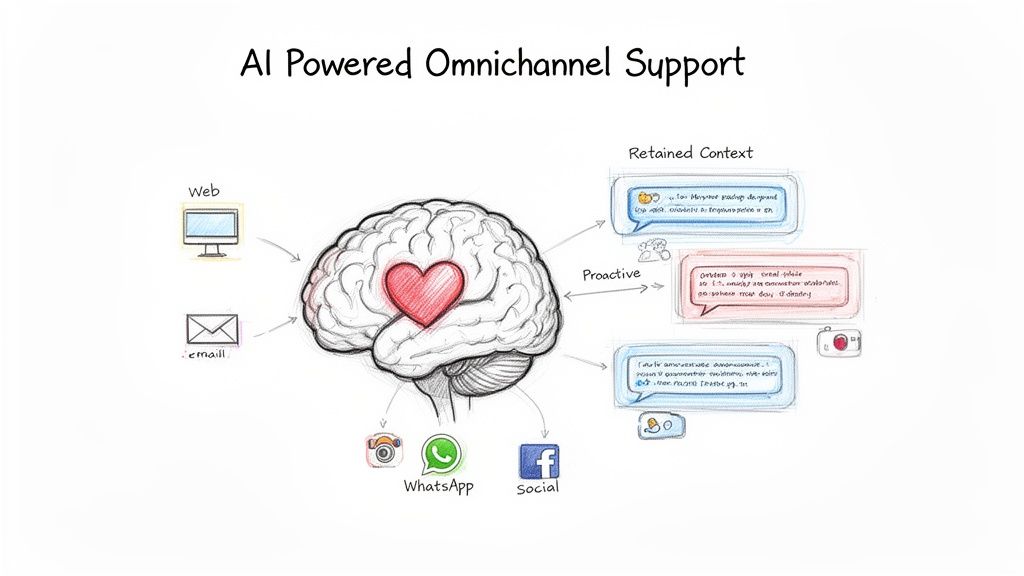
True modernization isn't about slapping a simple, FAQ-bot on your website. I’m talking about implementing an empathetic AI that understands context, remembers past conversations, and feels more like a partner to your agents than just a tool. This is the bedrock for delivering the kind of seamless, personal experiences people now expect as standard.
Let's be clear: the gap between a standard chatbot and an empathy-first AI is massive. A basic bot is really just a glorified search bar. It's rigid, trips over slang, and forgets the conversation a second later, forcing frustrated customers down a dead-end path.
An empathy-first AI, on the other hand, operates on a totally different level, powered by what we call conversational memory. It knows a customer's entire history—what they bought, their previous support tickets, even the tone of their last chat. This memory is what lets it hold truly dynamic, human-like conversations.
For instance, a customer pops up in chat saying, "My last order was late, and now this one is too."
That little bit of context instantly de-escalates the situation. The customer feels heard and understood, not like they're shouting into a void.
Here’s a hard truth: customers don’t think in channels. They just have a problem they need solved. A true omnichannel experience lets them float effortlessly between web chat, email, WhatsApp, and social media without ever losing their place in the conversation. This is more than just being active on different platforms; it’s about weaving them all into a single, unified customer journey.
To pull this off, you need a central "brain" that tracks every interaction, no matter where it happens. This means that when a customer starts a chat on your website and follows up with an email an hour later, the agent handling that email sees the full chat transcript instantly. No more "Can you remind me what you were talking about?"
The core principle of omnichannel is simple but incredibly powerful: Never make the customer repeat themselves. Every handoff, whether it's from bot-to-human or from Twitter to email, has to be seamless, preserving the full history and context of the problem.
Modern AI doesn't just put out fires; it actively looks for opportunities to strengthen customer relationships and, frankly, to drive revenue. This is the crucial leap from seeing support as a cost center to treating it as a profit center.
Imagine a customer with a subscription service who starts a chat to cancel because of the cost.
This response is genuinely helpful—it's empathetic—but it's also a strategic "save" that directly reduces churn. This is the heart of modernizing your contact center operations. We dig much deeper into these kinds of strategies in our guide on unlocking growth with AI customer service solutions.
The financial upside of this shift is hard to ignore. By 2026, conversational AI is projected to cut agent labor costs by a staggering $80 billion worldwide. Yet, there’s a long way to go. Today, only 20% of agents are actively using AI to help them with customer issues, which tells you there’s a massive opportunity for those who get it right. Ultimately, this transforms your support from a reactive "How can I help you?" model to a proactive "It’s already done" experience.
There's an old saying: what you measure is what you manage. For far too long, contact center operations have been judged by metrics like Average Handle Time (AHT) that just encourage speed over substance.
If you want to truly understand the health of your customer relationships and see if your modernization efforts are actually working, you need to rethink your dashboards and Key Performance Indicators (KPIs). It's time to measure what really matters.
Modern measurement isn’t about just tracking efficiency anymore. It's about capturing the quality of the customer's experience and tying it directly to your business's bottom line. Think of it as turning a flood of raw interaction data into a strategic compass that guides every decision you make.
The first, and maybe most important, step is to consciously move away from metrics that drive the wrong behaviors. Chasing a low AHT is a classic example. It pushes agents to rush customers off the phone, which often leaves issues unresolved and just creates more calls down the line.
Instead, we need to focus on KPIs that tell us about resolution and how the customer actually feels. The new guard of essential metrics includes a few heavy hitters:
First Contact Resolution (FCR): This is the gold standard for a reason. It tells you the percentage of issues you solve in a single interaction, with no follow-up needed. A high FCR is a dead giveaway that your processes are efficient, your agents are knowledgeable, and your whole support system is clicking.
Customer Effort Score (CES): This KPI gets to the heart of a simple but powerful question: "How easy was it to get help today?" Customers will reward you with their loyalty when you make their lives easier. Tracking CES is the best way to find and smooth out the friction points in your support journey.
Customer Lifetime Value (CLV) Impact: This is where you connect the dots between great support and long-term business value. Modern platforms can help you see how positive interactions—like a high CSAT score or a quick resolution—correlate with customers spending more and sticking around longer.
A great dashboard doesn't just show you what happened; it shows you why it happened. It connects agent performance and AI automation directly to customer loyalty and business growth, making the value of your contact center impossible to ignore.
Your dashboard should be your operational command center, not just a cluttered screen of numbers. A modern dashboard uses smart visualization to make complex data instantly understandable, giving you a clear, real-time view of both performance and what's coming down the pike.
Imagine a visual map of contact reasons that instantly flags a spike in questions about a new feature launch. This lets you be proactive—you can update your knowledge base or alert the product team before a small issue snowballs into a major problem. For a deeper dive, check out our guide on measuring customer service.
A well-designed dashboard also needs to clearly track the ROI of your technology. You can create specific widgets to monitor things like:
Data is totally useless if you don't do anything with it. The final piece of the puzzle is creating a regular rhythm for reviewing your dashboards and turning those insights into real operational improvements.
A practical example: set a recurring 30-minute meeting every Monday morning with team leads to review the past week's dashboard. Your only agenda item is to identify one friction point and one positive trend. Then, assign a single action item to either fix the friction or replicate the success. This small, consistent habit turns data into continuous improvement.
For example, if your dashboard shows a stubbornly low FCR for a specific type of issue, the next step is to drill down. Is the knowledge base article confusing? Do agents need more training on that topic? This is how you create a continuous feedback loop that actually drives improvement.
This kind of data-driven approach is largely possible because of the industry's massive shift to the cloud. The cloud-based contact center market was valued at USD $23 billion in 2022 and is projected to explode to USD $120 billion by 2032. This move to the cloud provides the flexible, scalable analytics you need for modern operations, especially as the number of remote contact center agents is expected to grow by 60% from 2022 to 2024.
By focusing on the right KPIs, you can strategically steer your operations toward better outcomes—for both your customers and your business.
Taking the leap to overhaul your support ecosystem can feel daunting. It’s a big project, and it naturally brings up a lot of questions about the cost, the timeline, and the real-world impact on your team. Frankly, you’d be crazy not to have these concerns.
Let's cut through the noise and tackle the most common questions I hear from leaders standing at this same crossroads. The goal here is to give you straight answers so you can move forward with a clear vision for your contact center operations.
You'd think the biggest challenge would be the tech itself, but it's not. The real hurdle is getting all your data to talk to each other and making your processes consistent across every single channel. A true omnichannel experience relies on a customer’s history and context flowing seamlessly from a website chat over to an email, then to a social media DM, and back again.
If that unified customer profile isn't at the heart of everything you do, you're left with a disjointed, frustrating mess. It’s that all-too-common scenario where a customer has to repeat their issue for the third time to a new person, which just kills trust on the spot.
The fix is a two-pronged attack: first, pick a platform with strong, native integrations out of the box. Second, be ready to completely rethink your internal workflows to be channel-agnostic. Your process needs to follow the customer, not the other way around.
This is a great question. Calculating the return on investment for sophisticated AI goes way beyond just cutting headcount or shaving a few seconds off handle times. The real value comes from both saving money and making money, which means you need to look at a broader set of metrics.
To get a true picture of your ROI, you need to track a few key things:
This is critical. Any modernization project lives or dies by how you manage the change with your people. You absolutely have to frame AI and automation as tools that empower your agents, not replace them. The story you tell internally must be about evolution, not elimination.
Position the change as a strategic move away from the mind-numbing, copy-paste tasks toward more engaging, high-impact problem-solving. One of the best ways to get buy-in is to bring your agents into the process right from the start. Ask them: "What are the most annoying, time-sucking parts of your day?" Those are your first and best candidates for automation.
Don't just train them on how to click the new buttons. Your training needs to cover the why. Show them exactly how this technology will make their jobs less stressful, reduce burnout, and give them the space to focus on the truly rewarding part of the job: helping people.
The timeline really depends on how complex your current tech stack is and how ambitious your goals are. But I'll tell you right now: a phased, iterative approach is always the way to go. Forget the "big bang" launch where everything changes overnight—that's a recipe for disaster.
A foundational rollout, maybe focused on automating the top 3 to 5 most common questions on your busiest channel, can often be up and running in a few weeks. This gets you a quick win, shows tangible value right away, and builds momentum.
From there, a full-blown omnichannel implementation that ties deeply into your CRM and other back-end systems might take anywhere from 3 to 6 months. The secret is to start small with a specific, measurable goal. This lets your team learn and adapt as the technology rolls out, making the entire transformation much smoother and more successful.
Ready to move from "How can I help?" to "It's already done"? MagicalCX is the empathy-first AI platform that transforms your support into a revenue-positive experience. Discover how we can modernize your contact center operations today.


