See your AI teammate in action now
Ready to make support faster, kinder, easier and help customers feel good about choosing you?
PS: Sales improves too...
No credit card required
14 days free trial
DIY or Guided setup
Ready to make support faster, kinder, easier and help customers feel good about choosing you?
PS: Sales improves too...
No credit card required
14 days free trial
DIY or Guided setup
Learn how to boost customer service with modern AI, covering conversational memory, omnichannel support, agentic actions, industry use cases, KPIs, and vendor selection.
Manish Keswani
Summary by MagicalCX AI
AI-driven customer service that combines conversational memory, omnichannel orchestration, and agentic actions can free up 20–40% of agent time and cut resolution time from 11 minutes to 2 minutes while keeping customer satisfaction comparable to human support.
Let's be honest: when you hear "AI for customer service," your mind probably jumps to those maddening chatbots that trap you in an endless loop, unable to understand a simple question. That’s not what we’re talking about here.
That old tech was built on rigid, "if-then" rules. It was basically a glorified FAQ page that forced you down a pre-set path. Step one inch off that path, and the whole thing would fall apart, leaving you begging to "speak to a human."
The AI customer service platforms emerging now are a completely different species. Think less of a clunky script and more of your top-performing agent—the one with a photographic memory and endless patience.
This new generation of AI understands nuance, remembers every single interaction you've had across any channel, and actually learns from each conversation to get smarter over time.
The real shift isn't just in the technology; it's in the entire philosophy behind it. Old automation was a defensive move, built to deflect tickets and slash costs, even if it meant frustrating customers.
Today’s AI is a strategic tool designed to build genuine loyalty and, yes, even drive revenue.
We're watching customer support evolve from a reactive cost center into a proactive, relationship-building engine. It's not about replacing your team but giving them superpowers to deliver incredible service at a scale you never thought possible.
This massive leap forward is built on a few core ideas that separate modern AI from those dinosaurs of the past:
This changes everything. The goal is no longer just to close tickets as fast as possible. It's about delivering intelligent, empathetic, and truly helpful interactions that solve problems before they even have a chance to escalate.
For example, imagine an e-commerce AI that doesn't just answer "Where is my order?" but instead proactively messages the customer about a potential shipping delay, explains why, and automatically offers a discount on their next purchase.
That’s the power of modern AI for customer service: turning a potential headache into a positive brand experience that builds trust and keeps customers coming back.
To really get what makes today's AI for customer service so different, we need to look under the hood. It’s not just about automating replies anymore. We’re talking about core capabilities that work together to create support experiences that feel surprisingly human. Think of these as the brain, the central nervous system, and the hands of your AI-powered agent.
The leap from old-school, rule-based chatbots to today's intelligent systems is huge. We've moved past rigid decision trees into a world of dynamic, context-aware AI that learns and adapts on the fly.
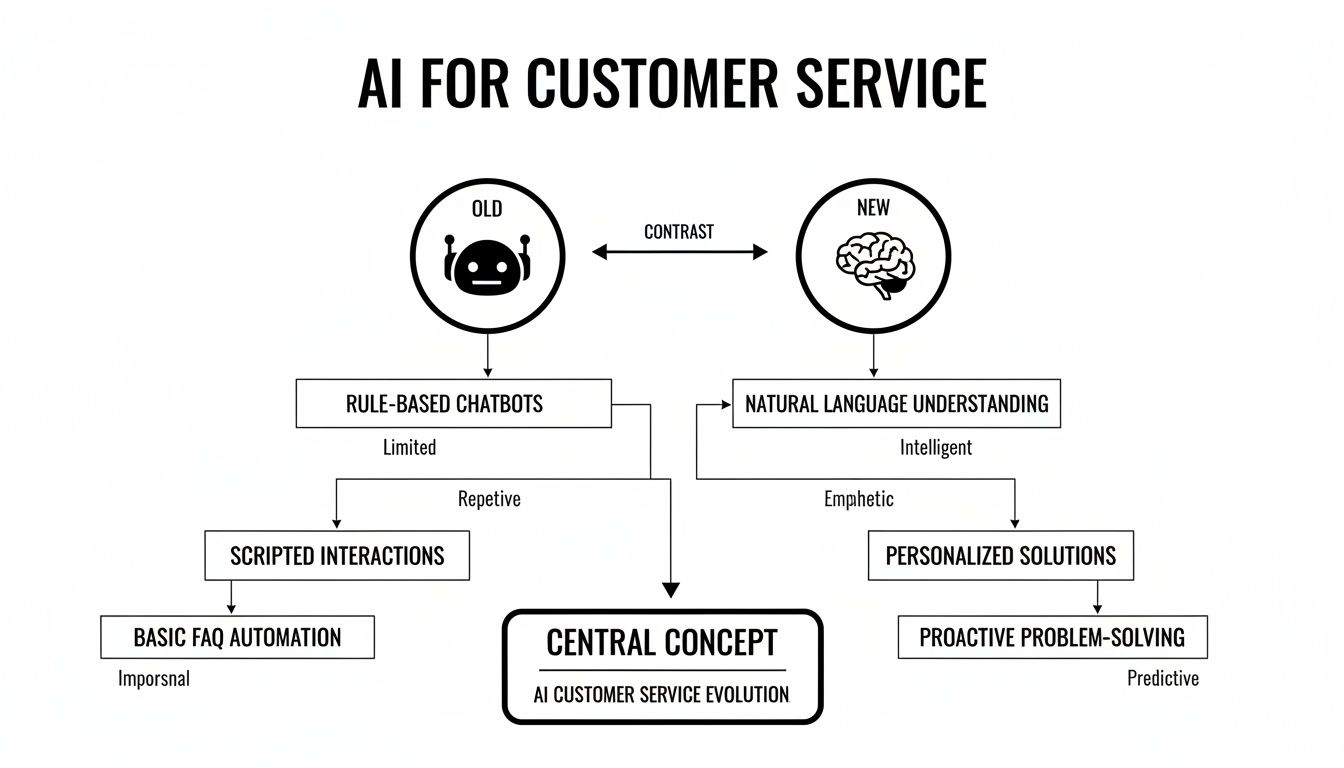
This shift is everything. It’s the difference between an unhelpful IVR and a genuinely useful assistant.
Imagine you had a support agent who remembered every single conversation with a customer. No more re-explaining past issues or starting from scratch every time. That's exactly what conversational memory delivers.
It’s the AI’s ability to retain and instantly recall a customer's entire interaction history, no matter when it happened or what channel they used. For example, a customer tweets about a buggy feature on Monday. On Wednesday, they open a web chat. The AI immediately recognizes them and says, "Hi Alex, thanks for reaching out. Are you still experiencing the issue with the dashboard we discussed on Twitter?" This immediately shows the customer you’re paying attention.
This single capability wipes out the number one frustration for customers: having to repeat themselves. It turns a series of fragmented interactions into one continuous conversation, making the customer feel heard.
Building on that memory, omnichannel orchestration is the magic that weaves all your separate channels—email, chat, social media, SMS—into a single, coherent customer journey. In the past, support was a mess of silos. A conversation on Twitter had no connection to an email thread.
Modern AI demolishes those walls. For example, a customer might start a chat on your mobile app to report a damaged item. The AI can then automatically send a follow-up email with return instructions and an SMS notification once their replacement has shipped, keeping the entire experience connected and seamless.
This means the experience is fluid and consistent for the customer, regardless of how they reach out. And for your team? They get a complete 360-degree view of the customer’s story, which is crucial for solving problems quickly and effectively. To see how this works in practice, check out our guide on help desk automation.
This is the game-changer. Agentic actions are what allow the AI to move beyond just understanding and communicating to actively doing things. It's the AI's power to execute tasks and run workflows on its own, directly within your business systems. This is what turns your support AI into a genuine digital team member.
So, instead of just telling a customer how to request a refund, the AI actually processes it. Instead of explaining how to reschedule a delivery, it just does it.
Here’s what that looks like in the real world:
This is where the massive efficiency gains come from. It’s predicted that by 2025, a staggering 95% of all customer interactions will involve AI in some way, and agentic capabilities are the driving force. Companies like Klarna have already used this to crush their resolution time from 11 minutes down to just 2 minutes, while maintaining customer satisfaction scores on par with their human agents. It’s about empowering the AI to resolve issues, not just deflect them.
Now, let's tie these capabilities directly to the outcomes you care about.
This table breaks down the core AI capabilities and connects them to specific, measurable business outcomes for support teams.
| AI Capability | What It Does | Practical Example & Business Impact |
|---|---|---|
| Conversational Memory | Remembers and recalls all past customer interactions across channels. | Example: The AI sees a customer previously asked about gluten-free options. Next time they chat, it can proactively mention new GF products. Impact: Reduces handle time and boosts CSAT by eliminating repetition. |
| Omnichannel Orchestration | Unifies all communication channels into a single, seamless conversation. | Example: A customer starts a return via web chat, gets an email with the label, and receives an SMS when the refund is processed. Impact: Improves First Contact Resolution (FCR) and creates a consistent brand experience. |
| Agentic Actions | Autonomously performs tasks and workflows in other business systems. | Example: A customer wants to change their flight. The AI accesses the booking system, finds an alternative, confirms with the customer, and rebooks it instantly. Impact: Frees up 20-40% of agent time and enables 24/7 instant resolutions. |
When you put these three pillars together—memory, orchestration, and action—you get a system that can remember, understand, and, most importantly, act. This is the foundation of a modern customer service operation that is not only hyper-efficient but also deeply satisfying for customers.
Understanding what an AI can do is one thing, but seeing it solve real-world problems is where the lightbulb really goes on. Let's move past the theory and look at how smart AI platforms tackle specific challenges in different industries, turning potential support headaches into moments that actually build your brand.
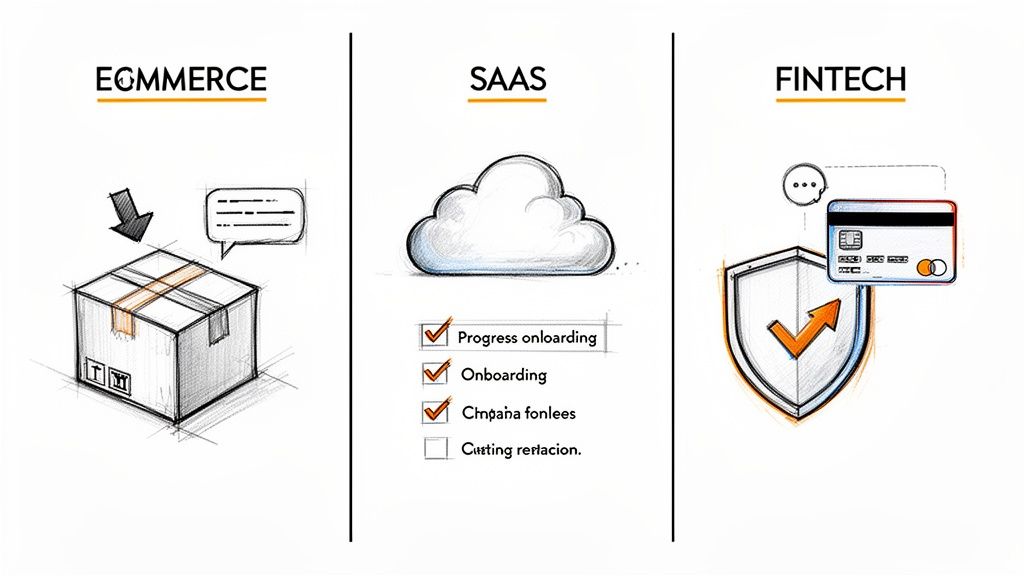
Every business model has its own unique friction points. A good AI solution doesn't just slap a generic bandage on the problem; it delivers a precise, empathetic response that fits the specific situation like a glove.
For any direct-to-consumer business, the post-purchase experience is where you win or lose a customer for life. The constant barrage of questions about order status and returns can easily swamp a support team, especially during the holidays. This is where modern AI shines, turning those high-volume, repetitive tasks into genuinely great service.
Picture this: a customer, Sarah, just got a pair of running shoes that are the wrong size. The old way meant digging for the returns page, printing a label, and then waiting days for an update. It’s a pain.
With an agentic AI, the entire experience changes.
This isn't just basic automation. It’s a guided, helpful workflow that solves her problem in less than two minutes. The AI handles the whole thing, freeing up human agents for trickier issues like styling advice or handling a damaged delivery claim.
In the Software-as-a-Service world, customer success lives and dies by smooth onboarding and easy account management. When users get stuck or want to tweak their plan, any friction can lead them straight to the "cancel subscription" button. AI is incredibly effective at navigating these make-or-break moments.
By automating routine account management and onboarding queries, SaaS companies can provide instant, 24/7 support that helps users find value faster and reduces the risk of them abandoning the platform.
Think about a new user, Mark. It's a Sunday afternoon, and he's trying to set up a critical integration for his new project management software. He's hit a wall and the help docs aren't clicking.
What could have been a moment of total frustration becomes a win. This kind of proactive guidance is huge for user activation. The same goes for plan changes—the AI can securely handle upgrades, downgrades, or billing questions, updating the user's account in real time without a human ever touching it.
In FinTech, everything boils down to security, accuracy, and trust. Customers are dealing with their money and sensitive data, so they need immediate, reliable answers. AI in this space has to be built for secure, precise processes while still maintaining a calm, empathetic tone, especially when things get stressful.
Let’s take a classic example: a fraud alert. A customer, Maria, gets a text about a suspicious transaction on her credit card.
In a situation where every second counts, the AI delivers instant resolution and reassurance, often faster and more efficiently than a human agent could. By handling these critical, process-driven tasks, the AI preserves customer trust and frees up human experts to focus on complex financial advice or in-depth dispute investigations.
So, you're thinking about bringing AI into your customer service operations. It’s a big move, but the real challenge isn’t just buying the tech—it’s proving its worth. The good news is that a modern AI platform is more than just a support tool; it's a data goldmine, giving you a live look into your team's performance, how your customers really feel, and even how it’s making you money.
Forget just counting deflected tickets. The right metrics reframe your AI investment from a cost center to a core part of your profit engine. By tracking the right KPIs, you can confidently show the C-suite the financial value of your strategy and find new ways to make it even better.
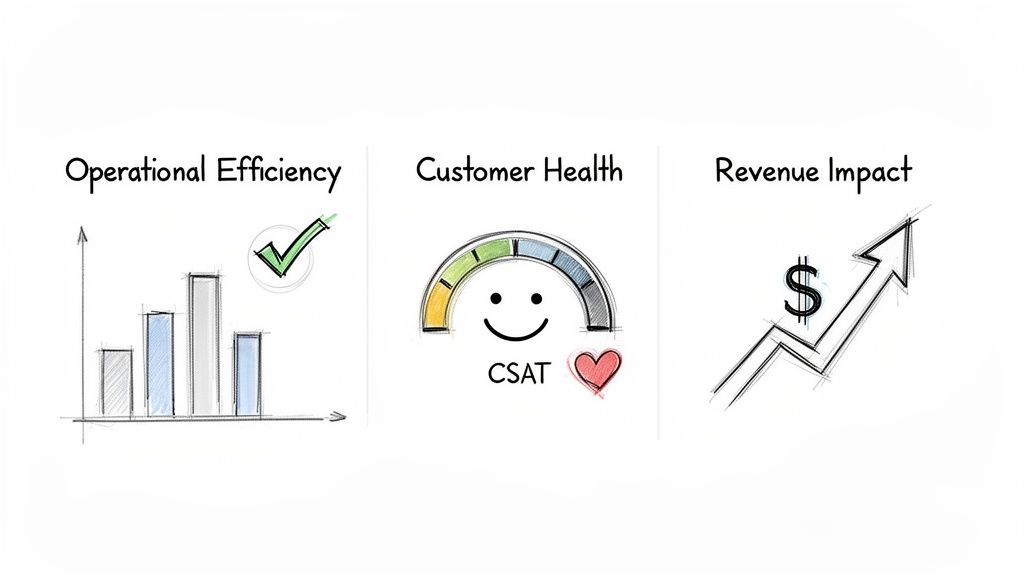
The first place you’ll see AI make a difference is in your team's day-to-day grind. This isn't about replacing people; it's about making their jobs easier and more impactful by automating the repetitive stuff.
Here’s what to keep an eye on:
The numbers back this up. AI-assisted agents resolve issues a staggering 47% faster and hit 25% higher FCR rates. For leaders, this translates to serious savings—some AI systems deliver an average return of $3.50 for every $1 invested. You can find more customer experience stats over at Outsource Accelerator.
Being efficient is great, but not if it comes at the cost of happy customers. A top-tier AI platform has to make the customer experience better, not just faster. The best systems are built to take the pulse of customer sentiment in real time.
A great AI interaction should feel effortless and empathetic. Measuring customer health tells you if you're hitting that mark or just closing tickets. This is where you prove that automation can actually strengthen customer relationships.
Keep your focus on these customer-centric KPIs:
Okay, this is where you connect all the dots and show how your support team is actually a revenue driver. When you can draw a straight line from your AI investment to the bottom line, you change the entire conversation. We dive deeper into this in our guide on measuring customer service effectiveness.
Modern AI platforms can track how support interactions directly influence sales and keep customers around longer.
By focusing on these three pillars—efficiency, customer health, and revenue—you can paint a complete, compelling picture of your AI's value. This data-driven approach doesn’t just justify the initial investment; it gives you the insights you need to keep making your customer service strategy smarter and more effective over time.
Choosing a partner for your AI for customer service is a massive decision. It’s going to shape your entire support operation for years to come, so you have to get it right. With every vendor promising the moon, it’s incredibly easy to get lost in the hype.
This checklist is designed to help you cut through that noise. Think of this less like buying a piece of software and more like hiring a critical new member of your team. You need a partner that not only brings the right skills to the table but also clicks with your company’s culture and can grow alongside you.
Before you even glance at a flashy demo, you need to lift the hood and check the engine. The platform's core technology has to be rock-solid, capable of handling the messy reality of customer conversations without just creating more work for your human agents.
Start by asking these non-negotiable questions:
A technically sound platform is just the price of entry. The real magic, the thing that sets a great AI apart, is its ability to think, learn, and communicate in a way that feels like a genuine extension of your brand.
An AI that sounds cold, robotic, or generic can do more damage to your brand than you might think.
The ultimate goal is an AI that customers don't even realize is an AI. It should embody your brand's unique personality, tone, and empathy in every single interaction, strengthening your brand identity rather than diluting it.
Drill down into the AI’s actual intelligence with these questions:
Finally, remember that you’re not just buying a product; you’re starting a long-term relationship. The quality of support and guidance you receive during and after implementation is a huge factor that too many people overlook. Choosing the right customer experience management tools means evaluating the people behind the software, too.
Gauge the quality of the partnership by asking:
Whenever you’re looking at a big change in how you operate, questions are going to come up. That’s a good thing. When it comes to AI for customer service, it's important to cut through the noise and get straight answers to the real-world concerns leaders and their teams are grappling with. Let's tackle those big questions head-on.
This is usually the first question on everyone's mind, and it’s completely understandable. The short answer? No. The goal here is to make your team better, not to replace it.
Think of AI as the ultimate assistant—one that happily takes on the thousands of repetitive, simple questions that flood your support queues and often lead to agent burnout. For example, it can handle every single "Where is my order?" request, process all standard refunds, and answer basic product questions 24/7. This frees up your human experts to focus on what they do best: handling the complex, nuanced, or emotionally charged conversations where a human touch really matters, like de-escalating a frustrated customer or providing in-depth technical troubleshooting.
The AI becomes your first line of defense, clearing the path so your agents can be the strategic problem-solvers and brand champions they were hired to be. This doesn't just improve customer outcomes; it makes the job itself more fulfilling.
The fear of a drawn-out, technically nightmarish implementation is enough to stop many projects before they even start. The good news is that modern AI platforms are a world away from the clunky enterprise software of the past. Many are now built for a surprisingly fast and smooth rollout.
Success usually boils down to two things:
A system that learns on its own is also a huge plus, as it gets smarter over time without needing constant manual adjustments. For most companies, a well-planned implementation can take just a few weeks, not months.
Yes, it can, and honestly, you shouldn't settle for anything less. You’ve invested a ton of time and effort into building a distinct brand personality, and a generic, robotic AI can unravel that trust in an instant.
The best systems are designed for deep customization. They learn from your actual knowledge base, past support conversations, and brand style guides. This gives you fine-grained control over the AI’s personality, tone, and even the specific words it uses.
Practical example: You can provide the AI with a "persona document" that outlines your brand's do's and don'ts (e.g., "Do use emojis, don't use formal language like 'sincerely'"). The AI will then generate responses that adhere to these rules, ensuring it sounds like a natural extension of your team, not just a boilerplate bot.
Let's be real: no AI is perfect. That's why one of the most important features to look for is a smart, seamless handoff to a human agent.
A well-designed AI knows its own limits. It can pick up on signs of customer frustration—like someone asking the same question over and over—or recognize when a problem is just too complicated for it to handle. When that happens, it should trigger an immediate and graceful transfer to the right person on your team.
Here's the crucial part: the AI must pass along the full conversation history and context. The customer should never, ever have to repeat themselves. For example, the AI should say, "I see you're having trouble with your invoice. Let me connect you with a billing specialist who can see our full conversation and sort this out for you right away." This simple step turns a potential point of failure into a smooth, positive experience.
Ready to see how an empathy-first AI can transform your support operations? MagicalCX delivers human-like conversations that build loyalty and drive revenue. Learn how we can help you scale your support without sacrificing quality at https://www.magicalcx.com.


