See your AI teammate in action now
Ready to make support faster, kinder, easier and help customers feel good about choosing you?
PS: Sales improves too...
No credit card required
14 days free trial
DIY or Guided setup
Ready to make support faster, kinder, easier and help customers feel good about choosing you?
PS: Sales improves too...
No credit card required
14 days free trial
DIY or Guided setup
Manish Keswani
Voice of customer, or VoC, is a term that gets thrown around a lot. At its core, it’s a systematic way of listening to what your customers are really saying, understanding their needs and frustrations, and then actually doing something about it.
It's not just about collecting feedback. VoC is about turning that feedback into a roadmap for improving your products, services, and the entire customer experience. It’s a shift from passively waiting for complaints to actively seeking out what your customers think and feel. For example, instead of just logging a complaint about a "confusing website," a good VoC program digs deeper to pinpoint the exact navigation element causing the confusion and routes that insight to the UX team.
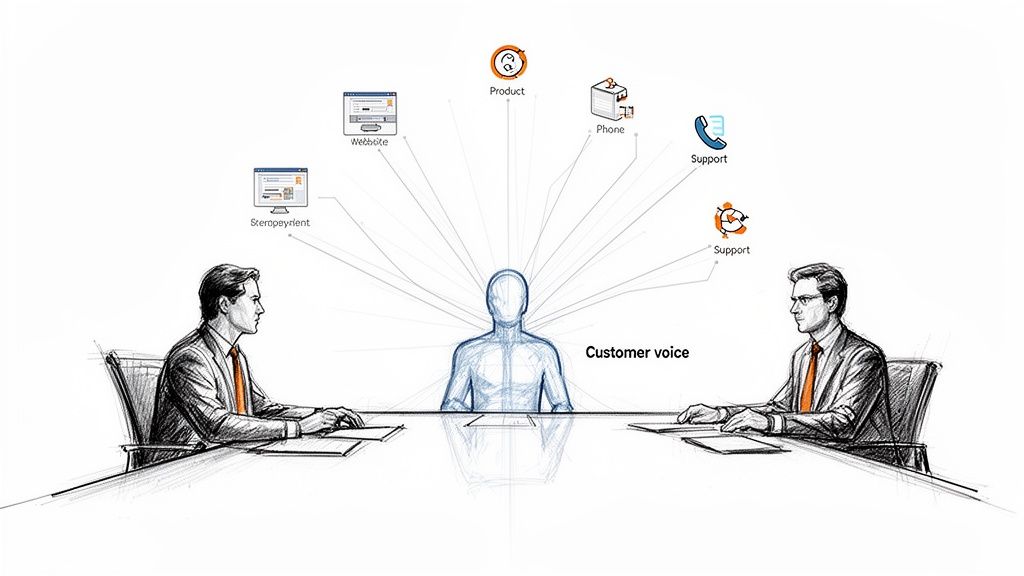
Think of it this way: imagine your most honest, insightful customer could join every single one of your internal meetings. That's what a great Voice of Customer program feels like. It’s not just another survey tool or a dusty suggestion box on your website; it's an active strategy that treats customer feedback as one of your most valuable business assets.
This means you’re systematically tuning into what your customers are saying everywhere—from support chats and call recordings to social media rants and online reviews. You’re listening to both the direct feedback they give you and the subtle clues hidden in their behavior.
A truly effective VoC program acts like your company’s central nervous system. It’s constantly sensing friction, identifying pain points, and spotting opportunities in real-time. Then, it sends those signals directly to the teams who can fix the problem or seize the opportunity.
For instance, if a handful of customers mention a confusing step in your checkout process through support tickets, a good VoC system immediately flags it. This isn't just a support issue anymore; it's a critical alert for the product and engineering teams. A practical example: an e-commerce company might see a pattern in support chats where users ask, "Where do I enter my discount code?" This insight, when routed to the design team, can lead to a simple UI change that makes the promo code field more prominent, reducing checkout abandonment. This is what makes voice of customer a proactive discipline, not a reactive one.
So many companies make the mistake of treating VoC as a one-off project. It’s actually a continuous loop: listen, understand, and act. It’s the difference between asking "how was your call?" and digging deeper to understand why they needed to call you in the first place.
When you boil it down, a solid VoC program rests on three key pillars. They work together in a cycle that fuels constant improvement.
By building this framework into your operations, you can finally stop guessing what customers want and start making decisions based on what they're telling you they need.
Let's be honest: understanding what your customers are thinking isn't just a nice-to-have. It’s a core business strategy that directly fuels your bottom line. A solid voice of customer program isn't another line item on the expense sheet; it’s an investment that pays for itself by shifting your decisions from guesswork to data-backed confidence.
When you start systematically listening to your customers, you gain the power to move the very metrics your leadership team watches like a hawk. We're talking about boosting customer lifetime value (LTV), cutting down churn, and even trimming your operational costs. Once you know exactly why people are leaving or what convinces them to stay, you can make surgical improvements that deliver tangible financial gains.
It’s easy to dismiss VoC as a "soft" metric, but its impact is anything but. A well-run program is brilliant at sniffing out hidden inefficiencies that are quietly draining your resources every single day. The insights you pull can show you precisely where your support team is getting bogged down or where your product is creating needless friction for users.
A VoC program is your early warning system. It tells you where the cracks are forming in the customer experience long before they turn into major structural problems that lead to churn and lost revenue.
Think about it in real-world terms. A subscription box company was getting flooded with support tickets all centered around account management. By digging into their voice of customer data from support chats and emails, they found the culprit: a single, confusing step in their online portal for pausing subscriptions. It was a customer dead end.
Armed with that direct feedback, they redesigned that part of the user interface to be dead simple. The results? They were immediate and powerful.
That one small change, driven entirely by listening to what customers were actually saying, led directly to lower operational costs and higher revenue. It's a perfect example of how VoC isn't just about satisfaction scores; it’s about making smart, strategic moves that protect and grow your business.
The secret is out, and the business world is catching on. The global Voice of the Customer (VoC) market was recently valued at around $9.5 billion and is on track to hit $22.5 billion by the early 2030s. What's fueling this explosion? A massive shift toward customer-centric thinking, with a staggering 88% of data-savvy companies confirming that customer data is what helps them get ahead of market trends. You can discover more insights about the VoC market and its rapid expansion for yourself.
This market surge tells a clear story. The companies that are actively listening and adapting are the ones pulling ahead. In a world where customers have endless choices, simply ignoring their voice is no longer an option.
Putting real resources behind a VoC program is a fundamental move for both survival and growth. It's how you build a more resilient, more profitable, and genuinely customer-obsessed organization.
A strong Voice of Customer program is built on a foundation of high-quality data. But let's be clear: collecting feedback isn't just about blasting out a generic annual survey. It's about strategically listening everywhere your customers are. Think of yourself as a detective gathering clues—some you have to ask for directly, while others are hiding in plain sight.
The feedback you gather will generally fall into two buckets. The first is direct feedback, which is what you get when you intentionally ask customers for their thoughts. The second is indirect feedback, the opinions and insights customers share on their own, unprompted.
This decision tree shows how investing in a well-structured VoC program isn't just a "nice-to-have." It's a direct line to critical business outcomes like boosting customer lifetime value and slashing churn.
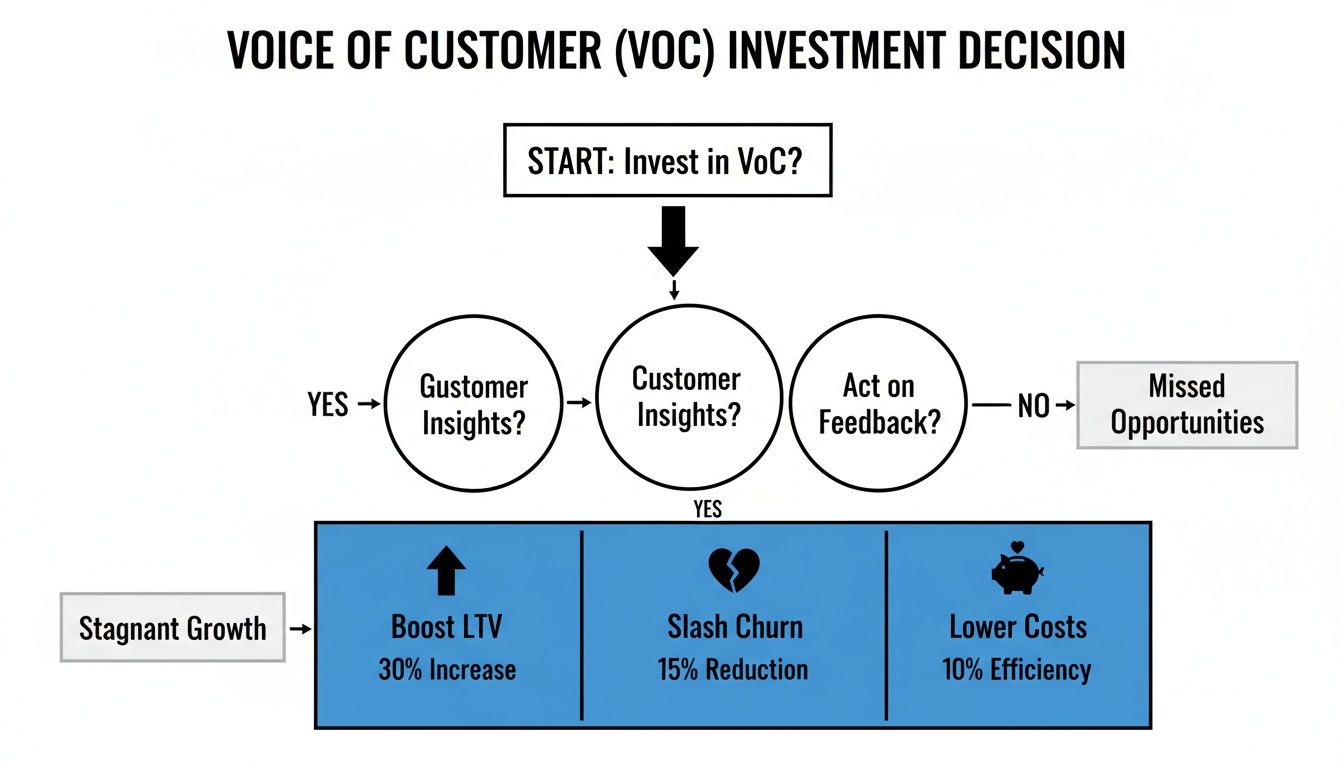
The real takeaway here is that VoC isn't just another expense. It's a strategic investment that directly improves the financial health of your business.
Direct feedback comes from pointedly asking customers what they think, usually with structured surveys. These are your tools for taking the pulse of the customer experience at specific, critical moments. Each type of survey gives you a different piece of the puzzle.
Net Promoter Score (NPS): You’ve seen this one. The classic "How likely are you to recommend us?" question gives you a 30,000-foot view of brand loyalty. It’s perfect for tracking long-term sentiment shifts when sent out periodically, like quarterly or twice a year.
Customer Satisfaction (CSAT): This one is all about the "right now." CSAT surveys measure short-term happiness with a single interaction, like after a support chat is closed or right after a purchase. It's your go-to for getting immediate feedback on how a specific team or process is performing.
Customer Effort Score (CES): My personal favorite. CES asks, "How easy was it to get your issue resolved?" This metric is brilliant for finding—and fixing—friction in your customer journey. For example, a low CES score after a customer changes their billing information might reveal a confusing interface that needs a redesign. Considering that 96% of customers who have a high-effort experience become more disloyal, this is a metric you can't afford to ignore.
The goal isn't to bombard customers with endless surveys. It's about being surgical. Ask the right question at the right moment to get the specific, actionable insight you need.
While asking for feedback is great, the real goldmine of voice of customer insight is often hiding in the data you already have. This is the unsolicited, unfiltered feedback customers give in their own words, and it's incredibly authentic.
This treasure trove of data includes:
The big challenge here has always been the sheer volume of this unstructured data. No human team can manually read through thousands of support tickets or social media mentions. This is where modern AI-powered customer experience management tools come in, automatically analyzing every conversation to spot trends, sentiment, and intent without burying your team in data.
So, which method is best? It all comes down to what you're trying to achieve. You wouldn't use a hammer to turn a screw. Similarly, you need to pick the right VoC tool for the job.
This table breaks down the most common collection methods to help you build a balanced and effective voice of customer data strategy.
| Method | Type of Feedback | Best For | Key Limitation |
|---|---|---|---|
| NPS Surveys | Direct & Quantitative | Measuring long-term brand loyalty and identifying promoters and detractors. | Lacks specific context on why a customer gave a certain score. |
| CSAT Surveys | Direct & Quantitative | Gauging immediate satisfaction after a specific interaction (e.g., support ticket solved). | Only captures a single moment in time, not the overall relationship. |
| Conversational Mining | Indirect & Qualitative | Uncovering the "why" behind customer issues by analyzing support chats and calls. | Requires AI tools to analyze unstructured data at scale. |
| Social Listening | Indirect & Qualitative | Monitoring brand reputation and spotting emerging trends in public conversations. | Can be noisy and may not represent your entire customer base. |
Ultimately, a world-class VoC program doesn't rely on a single source. It blends the quantitative clarity of direct surveys with the rich, qualitative context from indirect feedback to get a complete, 360-degree view of the customer experience.
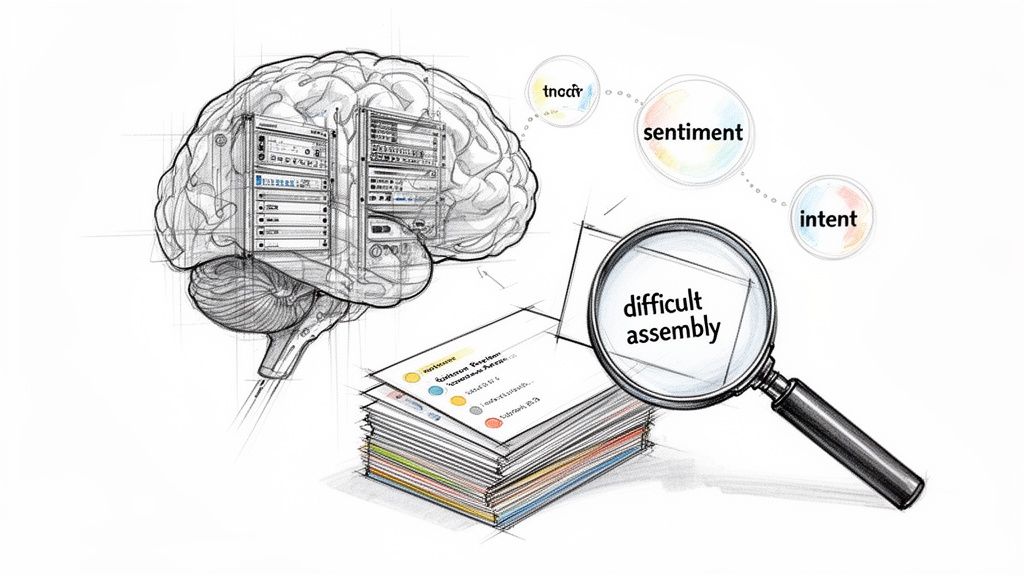
Collecting customer feedback is just the start. The real magic happens when you analyze it, but let's be honest—nobody has the time to manually read through thousands of support tickets, reviews, and survey comments. It's an impossible task. This is where Artificial Intelligence and automation step in to make a modern voice of customer program not just possible, but powerful.
Think of AI as a massive force multiplier for your team. It gives you the ability to understand every single customer conversation, not just a small, sampled slice. Instead of guessing, you can analyze 100% of your unstructured feedback to find the hidden trends and root causes that manual spot-checks always miss.
So, how does it work? AI tools lean on a technology called Natural Language Processing (NLP) to read and interpret human language, just like a person would, but at a colossal scale. This is the key to moving beyond simple scores and metrics. You can finally understand the why behind the numbers and connect the dots between feedback and customer behavior.
Three core AI techniques make this happen:
Sentiment Analysis: This is all about detecting the emotional tone in a piece of text—is it positive, negative, or neutral? It’s a quick way to gauge customer happiness across the board and instantly flag frustrated customers who need a follow-up, stat.
Topic Modeling: This is where the AI groups conversations into common themes. Imagine it scanning 10,000 product reviews and instantly telling you that "difficult assembly" is the top complaint driving 3-star ratings. An insight like that could take a human analyst weeks to uncover.
Intent Recognition: This figures out what the customer is actually trying to do. Are they trying to cancel their subscription? Ask about a feature? Complain about a bug? Knowing their goal helps you route their issue to the right team without any manual triage.
These capabilities are fundamentally changing how businesses listen. AI-powered sentiment analysis and NLP have redefined the voice of customer space by giving companies a way to find deep insights from all their feedback channels at once. We're moving from old-school surveys to real-time analysis of chats, emails, and social media. The best platforms are now reaching over 98% accuracy in understanding what customers want and how they feel. For a deeper dive, you can read the full research about the VoC platform market.
Theory is great, but seeing how this works in the real world is what really matters. Let’s say you run an e-commerce brand and want to fix your post-purchase experience.
Instead of just staring at a falling CSAT score, an AI tool can analyze all the related support tickets and reviews for you. It might reveal that the real culprits are "damaged packaging" and "late delivery notifications." Suddenly, you have a specific, actionable problem to solve.
Here are a few more ways this plays out:
Spotting Emerging Product Bugs: A SaaS company uses AI to monitor its support chats. The system flags a sudden spike in conversations mentioning a "login error after update." This automatically creates a high-priority ticket for engineering, letting them ship a fix before it becomes a massive headache for thousands of users.
Improving Agent Training: A contact center manager uses sentiment analysis on call transcripts. The AI highlights calls where customer sentiment plummets, revealing that agents are struggling to explain a new returns policy. That insight leads directly to a targeted training session. Problem solved.
Enhancing Marketing Messaging: A marketing team digs into online reviews for a new skincare product. Topic modeling shows that customers are raving about its "gentle formula," not the "anti-aging" benefits the campaign focused on. They tweak their ad copy to match what customers actually care about and see conversion rates climb.
When you use AI to analyze your voice of customer data, you’re doing more than just collecting feedback. You're building an intelligent system that surfaces critical business insights for you. You can learn more about putting this into practice by exploring AI customer service solutions. It’s about being proactive—addressing root causes, catching trends early, and making smarter decisions that are truly led by your customers.
Collecting and analyzing feedback is a great start, but let's be honest—the data itself doesn't fix anything. An insight sitting on a dashboard is just a number. It's worthless until it actually makes something happen.
A truly mature voice of customer program bridges that critical gap between knowing what customers want and actually delivering it. The real goal here is to create a responsive, closed-loop system where customers see tangible proof that their feedback matters.
This process is all about operationalizing your insights. It’s what separates companies that just passively listen from those that actively solve problems. It means building clear, automated pathways that shuttle specific pieces of feedback directly to the teams who can do something about it. When you get this right, you create a culture where every department, from engineering to marketing, is tuned into what your customers are really saying.
Think of your VoC program as an intelligent switchboard operator. Its job is to listen to every incoming call (your customer feedback) and instantly route it to the right person, all without any manual fumbling. That’s the magic of automated workflows.
Instead of insights piling up in a central inbox, they become immediate, actionable tasks assigned to the right people. This system is both fast and accountable. It's no wonder that companies that get this right can generate a 10x greater year-over-year increase in annual revenue—they’re simply faster at responding to customer needs.
Here’s how you can start building these automated workflows:
The core idea is simple: transform unstructured customer feedback into structured, trackable work. This closes the loop by ensuring every important piece of customer insight is seen, owned, and addressed.
Let's make this real. Imagine a customer is in a support chat, frustrated about a broken link in your checkout process. Without automation, that critical piece of feedback might die in an agent's notes. With a smart workflow, something much more powerful happens.
This whole process can happen in minutes, not days. The customer feels heard, the problem gets fixed before it affects more people, and a potential lost sale is saved. That's what it looks like to turn voice of customer insights into immediate business action.
Workflows aren't just for fixing what's broken; they're for preventing problems before they even escalate.
Take a software company that was struggling with high churn rates within the first month of a user signing up. They dove into their voice of customer data from support tickets and in-app feedback and found a key friction point. Their AI tool detected a clear pattern: new users were repeatedly clicking on the same navigation elements during onboarding, a dead giveaway that they were confused and stuck.
Instead of waiting for these users to get frustrated and cancel, they built a proactive workflow. The system was set up to spot this exact behavior. When a new user started showing signs of struggling in a specific area, it automatically triggered an email with a targeted help article and a short video tutorial for that feature.
The result? They gave users the right help at the exact moment they needed it, without them ever having to ask. This simple, automated intervention reduced their first-month churn by 15%. It’s a perfect illustration of how operationalizing VoC data can directly impact your bottom line.
So you've set up a Voice of the Customer program. That's fantastic. But to keep it going and get the resources it deserves, you have to prove its worth. Measuring success isn't just about watching survey scores tick up or down; it's about drawing a straight line from customer feedback to the business results your leadership team actually cares about.
You need to show a clear return on investment (ROI). When you can demonstrate how listening to customers leads to real, tangible improvements, you secure buy-in for the long haul. The real goal is to translate customer feelings into the language of business performance—showing how happy customers lead to lower costs and new revenue.
Metrics like Net Promoter Score (NPS) and Customer Satisfaction (CSAT) are great for a quick pulse check, but they don't paint the full picture. To really show the impact of your VoC efforts, you have to connect them to the operational key performance indicators (KPIs) that directly reflect efficiency and loyalty.
This means shifting the conversation from "customers seem happier" to "we are keeping more customers and spending less to support them."
Here are a few powerful metrics that tell that story:
To tell this story effectively, you need a dashboard. But not some overwhelming spreadsheet filled with every data point you can find. You need a simple, powerful dashboard that gives executives an at-a-glance view of customer health.
Your dashboard should instantly answer the big questions: What are people calling us about most? Where are customers getting stuck? What are we starting to do right? This kind of visual storytelling makes your data impossible to ignore. To build a dashboard this effective, you first need a solid grasp of measuring customer service from top to bottom.
A great VoC dashboard connects the dots for leadership. It should clearly show: "We listened to feedback about X, we implemented change Y, and it resulted in a 15% reduction in related support tickets."
This is how your voice of customer program stops being seen as a cost center and becomes a strategic asset. By linking your team's work directly to lower churn, reduced support costs, and stronger customer loyalty, you can prove its incredible value to the business with confidence.
Getting started with a Voice of Customer program often brings up a few common questions. Let's walk through some of the most frequent ones to help you build and run your VoC strategy with confidence.
This is a great question, and the distinction is crucial. Think of regular customer feedback as a collection of snapshots. It's the annual survey you send out, the suggestion box in the corner, or reviews left on a specific product page. These are valuable but often exist in isolation and are collected passively.
A true Voice of Customer program, on the other hand, is more like a continuous movie of your entire customer experience. It's a deliberate, company-wide system that actively pulls together feedback from all your channels—support tickets, social media mentions, live chats, and survey responses. The goal isn't just to collect data, but to analyze it all together to spot the big-picture trends and then, most importantly, get those insights to the right teams to act on them. It’s a closed-loop system designed for constant improvement.
You don't need a huge budget to get going. The secret is to start with the goldmine of data you already have. Your existing support tickets, chat transcripts, and app store reviews are overflowing with honest, unfiltered customer feedback, and they're completely free to access.
Practical First Steps:
Use these early wins to build your business case. Proving you achieved a 10% reduction in a common support ticket by listening to customers is powerful evidence when it's time to ask for a bigger investment in dedicated VoC tools.
Simply put, AI gives you scale and speed that a human team could never achieve. A person can manually read and tag a few dozen customer comments a day, at best. AI, however, can process tens of thousands of unstructured text comments from emails, call transcripts, and chats in just minutes.
AI automatically detects the core topics being discussed (like "shipping costs" or "login issues"), the sentiment behind the words (positive, negative, neutral), and even the customer's intent (like "cancel my subscription"). This means you can finally understand 100% of your customer conversations, not just the tiny fraction that answers a survey. You get the full, unbiased story of your customer experience.
Ready to turn customer conversations into your biggest growth driver? With MagicalCX, you can stop guessing and start knowing exactly what your customers need. Our AI-powered platform analyzes 100% of your support interactions to uncover actionable insights, automate workflows, and deliver an empathetically superior experience that boosts retention and revenue. See how MagicalCX can transform your customer support.


