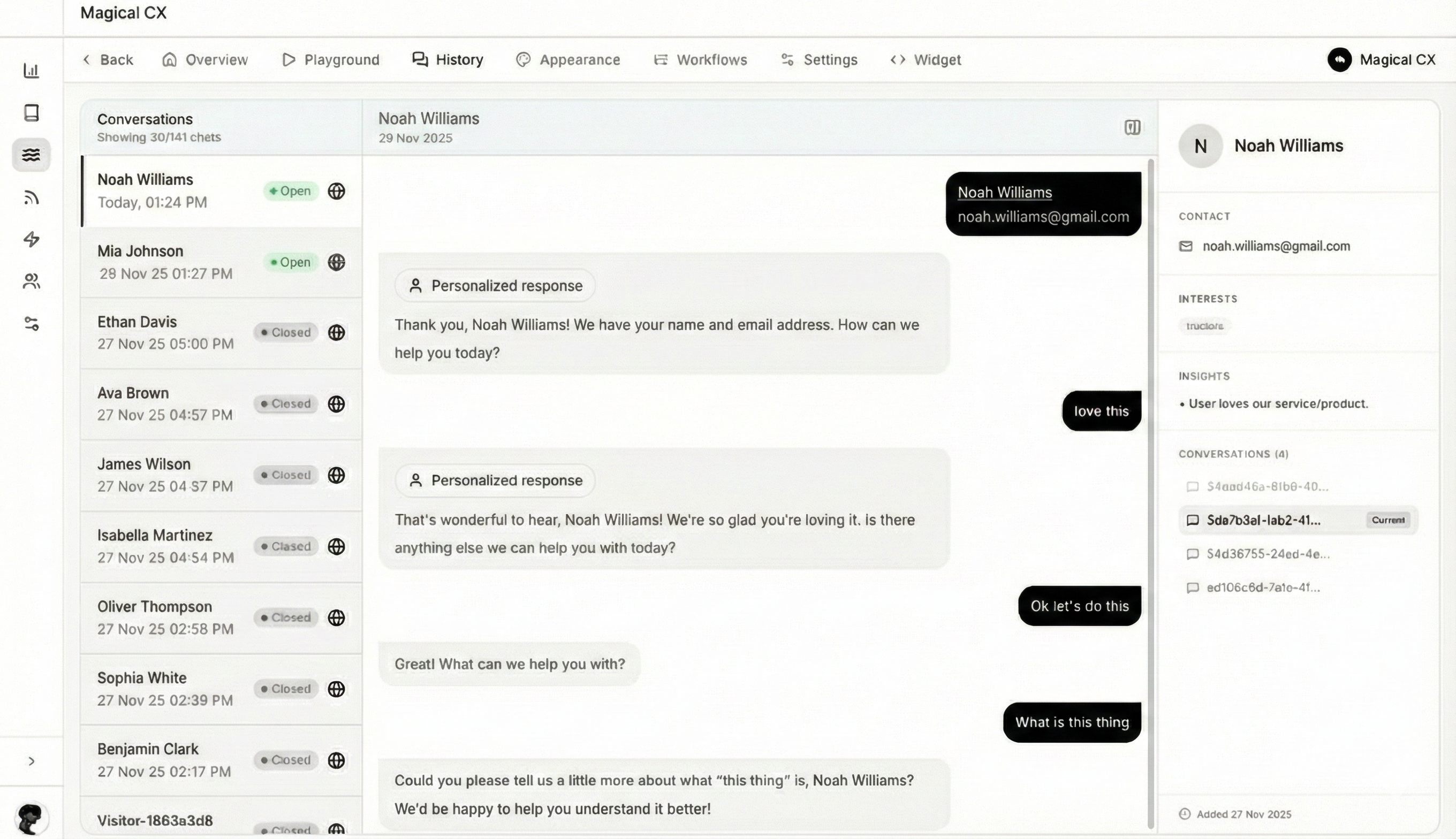
See your AI teammate in action now
Ready to make support faster, kinder, easier and help customers feel good about choosing you?
PS: Sales improves too...
No credit card required
14 days free trial
DIY or Guided setup
Ready to make support faster, kinder, easier and help customers feel good about choosing you?
PS: Sales improves too...
No credit card required
14 days free trial
DIY or Guided setup
Manish Keswani
An omnichannel customer service platform brings all your customer conversations—from email, web chat, social media, you name it—into a single, continuous thread. This gives your support team the full backstory on every customer, which means your customers never have to repeat themselves, no matter how they decide to get in touch.
Let's be real for a second. Customers hate repeating their story. Nothing kills the mood faster than a customer carefully explaining their issue in a live chat, only to be asked the very same questions when the conversation gets bumped to email. That kind of disconnected, siloed support is a frustrating relic of the past.
In that old model, every channel is its own island. Email, chat, social media, WhatsApp—they all operate in a vacuum. A conversation that starts in your Instagram DMs is completely invisible to the agent who picks up a follow-up email. This forces customers to start from square one every single time and leaves your support agents flying blind, without the context they need to actually help.
Think of a true omnichannel customer service platform as a kind of universal translator for your support team. Instead of each channel speaking a different, isolated language, the platform listens to every message and pulls it all into one coherent dialogue. It creates a single source of truth for every customer interaction, visible to any agent on any channel.
This is a world away from a standard multichannel setup. It's a common point of confusion, so let's clear it up.
A multichannel approach simply means you're available in multiple places. You have a support email, a chat widget on your site, and a Facebook page. But none of these channels talk to each other. It’s like having separate, disconnected phone lines for every department—the customer has to hang up and redial to talk to someone else.
An omnichannel approach, on the other hand, weaves all those channels together. A customer can start a conversation on chat, follow up with an email later, and get a quick update via SMS, and the entire history is right there in one continuous thread for your agent to see.
The core promise of omnichannel is continuity. It ensures the conversation follows the customer, not the channel. This creates a fluid, low-effort support journey that builds real trust and loyalty.
To make this crystal clear, here’s a quick comparison of the two approaches.
| Attribute | Multichannel Service | Omnichannel Service |
|---|---|---|
| Customer Experience | Disjointed and repetitive. Customers often have to restart the conversation on each new channel. | Seamless and consistent. The conversation history follows the customer across all channels. |
| Agent Workflow | Fragmented. Agents lack a unified view of the customer's history, leading to inefficiency. | Unified. Agents see the entire customer journey in one place, enabling faster, more personalized support. |
| Data & Insights | Siloed. Customer data is scattered across different systems, making it hard to see the big picture. | Centralized. All interaction data is connected, providing a complete 360-degree view of the customer. |
| Business Focus | Channel-centric. The focus is on being present on various channels. | Customer-centric. The focus is on creating a single, unified experience for the customer. |
Ultimately, the difference comes down to perspective. Multichannel is about the brand being in multiple places, while omnichannel is about creating one cohesive experience for the customer across all those places.
For today’s e-commerce and SaaS brands, providing a unified conversation is simply table stakes. Customers just expect you to know who they are and what they’ve talked to you about before, regardless of how they reach out. Anything less just feels broken.
This shift in expectations is driving massive market growth. The omnichannel customer service software market was valued at $4.96 billion and is on track to hit $15 billion by 2035, climbing at a steady 10.6% clip. As you can see from market data on omnichannel software, brands everywhere are moving toward integrated platforms that bring channels like web chat, email, WhatsApp, and Instagram under one roof.
At the end of the day, adopting an omnichannel platform is about shifting from a reactive, ticket-based mindset to a proactive, relationship-focused one. It’s how modern brands cut out the friction, build lasting customer loyalty, and turn customer service into a real competitive advantage.
A genuine omnichannel customer service platform is much more than a unified inbox—it's the central nervous system of your entire customer experience. While plenty of tools can pull messages from different channels into one place, a true omnichannel solution weaves them into a single, intelligent conversation. It’s the difference between holding a random pile of letters and reading a coherent, ongoing story.
To pull this off and deliver a truly seamless experience, a platform needs a specific set of core capabilities. These features work together to eliminate friction, empower your agents, and make customers feel like you actually know who they are.
Let’s dig into the five non-negotiable features that separate a powerful, customer-centric platform from a basic helpdesk.
This diagram perfectly captures the shift from siloed, multichannel support to an integrated, omnichannel approach where every conversation adds to one unified customer view.
The absolute bedrock of any real omnichannel platform is the Unified Customer Profile. Think of it less as a contact card and more as a living, breathing record of a customer's entire journey with your brand. It becomes the single source of truth, compiling every touchpoint—from every channel—into one chronological timeline.
Imagine a customer browsing a few products on your website. They then pop open a live chat to ask a question, leave, get an abandoned cart email, and finally reply to that email a day later. With a unified profile, the agent handling that email sees the entire sequence. They know which products the customer viewed, the specifics of the chat conversation, and the context of the cart recovery email. That complete picture is gold; it allows them to give a hyper-relevant, personal response that solves the problem fast.
This is where the magic really happens. Seamless Channel Switching is what lets a customer hop between communication methods without ever breaking the flow of the conversation. The context and history travel right along with them, which means they never, ever have to repeat themselves. It’s a simple concept that shows immense respect for their time and effort.
Here’s how it plays out in the real world:
This kind of effortless transition makes your support feel incredibly modern and accommodating, meeting customers on their terms.
An omnichannel customer service platform ensures the conversation follows the customer, not the channel. It’s about building one continuous dialogue that can happen in different places.
Today's automation is a world away from clunky, robotic auto-replies. In an omnichannel platform, Intelligent Automation uses AI to handle routine tasks with a human-like touch, freeing up your agents to focus on the complex, high-value conversations that really matter. This is all about gaining efficiency without sacrificing empathy.
Effective automation can:
This kind of automation works 24/7, giving customers immediate help while your human team can apply their skills where they have the most impact.
No matter how sophisticated your automation gets, some issues will always need a human expert. A Context-Aware Agent Handoff makes sure that when a conversation moves from a bot to a human—or from one agent to another—the full story is preserved.
When a handoff happens, the next agent doesn't just get a new ticket dumped in their queue. They get the whole package:
This gives the agent instant context, letting them jump in with a personalized greeting like, "Hi Jane, I see our bot wasn't able to track your package. I've looked into it and can see it's out for delivery today." It turns a potential point of frustration into a smooth, collaborative process.
Finally, a top-tier omnichannel platform must provide Actionable Analytics. It’s not enough to just collect data from every interaction; the platform has to present it in a way that reveals crucial insights about your customer experience. This is what turns raw data into a clear roadmap for improvement.
Instead of just tracking basic metrics like ticket volume, you can start answering strategic questions:
By analyzing this unified data, you can pinpoint friction, optimize your team's workflows, and make truly informed decisions that continuously elevate your entire support operation.
Bringing in an omnichannel customer service platform is much more than a simple tech upgrade. Think of it as installing a new engine for your business—one designed for sustainable growth. When you move to a unified system, you’re making a direct investment in your bottom line by turning customer experience from a point of friction into a real competitive advantage.
The connection is actually quite simple. A seamless customer journey creates happier customers. And happier customers stick around longer, spend more money, and tell their friends about you.
When a conversation can flow effortlessly from a quick social media DM to a detailed email follow-up without a single hiccup, you get rid of the frustration that makes people leave. That seamless feeling is the bedrock of modern customer loyalty, and it has a financial impact you can actually measure.
Customer retention is the ultimate report card for your customer experience. When you eliminate the need for customers to repeat their story every time they talk to someone new, you’re showing them you respect their time. That builds trust with every single interaction.
The data tells a pretty dramatic story here. Companies with strong omnichannel strategies retain a whopping 89% of their customers. Compare that to the dismal 33% retention rate for companies with disconnected, siloed approaches.
It gets better. Omnichannel buyers also have a 30% higher lifetime value (LTV) and drive revenue growth 3.5 times faster than people who only use one channel. If you want to dig deeper, these omnichannel statistics show the full impact on D2C brands.
A frictionless experience is a profitable one. Every time a customer doesn't have to start a conversation from scratch, you reinforce their decision to choose your brand over a competitor.
This jump in LTV isn't just a lucky coincidence. It's what happens when you create an environment where customers feel seen and understood, making them far more likely to come back again and again.
While making customers happy is the main event, an omnichannel platform also brings some serious operational wins. By unifying all your channels and giving agents a complete picture of every customer's history, you slash the time and effort it takes to solve problems.
Just look at these cost-saving benefits:
These efficiencies add up, allowing you to scale your support team without your payroll costs spiraling out of control.
This might be the biggest financial win of all: shifting customer service from a cost center to a proactive revenue driver. With a unified view of the customer—including their past purchases and what they’ve been looking at on your site—your support team is in the perfect spot to spot new opportunities.
This plays out in two powerful ways:
When you bring in smart tools, this gets even more effective. The right AI customer service solutions can analyze conversation sentiment to automatically flag at-risk customers or suggest relevant offers in real-time. This empowers your team to not only save relationships but also generate new revenue, proving that an investment in a great customer experience delivers a clear and compelling return.
Theory is great, but seeing how an omnichannel customer service platform actually works day-to-day is what really makes the concept click. Let's walk through a few real-world stories to see how these systems turn fragmented interactions into smooth, intelligent conversations.
We'll follow the customer journey across three totally different business models.
Picture a shopper, Maya, scrolling through Instagram when a pair of sneakers from an online boutique catches her eye. She’s curious but has a quick question about the material, so she sends a DM.
The platform effortlessly connected her social media identity with her website activity and her mobile number. The result was a single, fluid shopping experience that felt both personal and helpful.
Now, let's think about David, a user of a project management SaaS tool. He’s having a tough time setting up a new integration and starts looking for help.
Sarah has the full picture without David having to repeat a single thing. This context-aware handoff prevents a frustrating support loop and gets him to a solution fast. It's a perfect example of where the principles of empathy in customer service shine, as the technology empowers the agent to be more understanding from the get-go.
In a true omnichannel flow, the customer's history precedes them. The agent's first job is no longer information gathering; it's problem-solving.
Finally, let's look at a marketing agency courting a new client. This journey is naturally longer and involves multiple people on the client's side.
Every single communication, whether from a web form, an email chain, or a text message, adds another layer to that client's story. This single source of truth ensures anyone at the agency—from sales to project management—can provide consistent, informed service, building a stronger B2B relationship at every single touchpoint.
Choosing the right omnichannel platform is a huge decision. It's the foundation of your customer experience for years to come, so you have to get it right. To cut through the marketing fluff and sales pitches, you need a solid framework for asking the tough questions.
Let's focus on the four pillars that truly matter: integrations, scalability, AI sophistication, and the agent experience. A platform might have a slick-looking demo, but a weakness in any one of these areas can cause major headaches down the road.
Your new platform can't be another data silo; it has to be the central hub of your customer operations. That means seamless integration with your existing tools—especially your CRM and e-commerce platform—is an absolute must. Without it, you’ll never get that complete, 360-degree view of your customer.
When you're talking to vendors, get specific. Ask them:
A truly integrated platform doesn’t just collect data. It pushes critical context directly into your agent's workspace, so they can solve problems without having to flip between a dozen different tabs.
Don't just think about your needs today. The platform you choose needs to support where you're headed over the next three to five years. Scalability isn't just about handling a higher volume of tickets. It's about supporting more channels, more agents, and more complexity without the system slowing to a crawl.
This need is driving incredible growth in the market. The cloud-based contact center space is projected to explode from $6.4 billion in 2025 to $38.3 billion by 2035. That's a clear signal that businesses are investing heavily in flexible, cloud-powered systems built for the future. You can learn more about this rapid market expansion and its drivers here.
"AI-powered" is slapped on everything these days, but the reality is that its sophistication varies wildly from platform to platform. Your job is to figure out if you're getting a simple, keyword-based chatbot or a truly intelligent system that understands context and intent.
Here’s what to look for:
At the end of the day, even the most feature-packed platform is worthless if your team hates using it. The agent experience is everything. A clean, intuitive interface reduces training time, prevents costly mistakes, and empowers your agents to deliver better, faster service.
Before you sign any contracts, insist on a hands-on demo or a trial period. Let your agents get their hands on it and give you their honest feedback. As you compare options, check out their transparent pricing models to see how they bundle features and agent seats—it often reveals a lot about their philosophy on the agent experience.
Making the leap to an omnichannel customer service platform is a big move, and it's natural to have questions. Even when the benefits seem clear, the practical side of things can feel a bit fuzzy.
Let's clear the air and tackle some of the most common questions and myths that come up. This is your quick-reference guide for sorting out the details and getting confident about upgrading your support strategy.
This is easily the most frequent point of confusion, and the answer boils down to a single, powerful idea: integration.
Multichannel support just means you’re available in multiple places. You might have an email inbox, a live chat widget on your site, and a team managing your social media messages. The problem? None of these channels talk to each other. They’re all operating in their own little silos. A customer who explains their problem on chat has to start all over again if they follow up by email.
An omnichannel customer service platform is different. It weaves all those channels into one unified, continuous conversation. The system holds onto the context, so when a customer jumps from an Instagram DM to a WhatsApp message, your agent sees the entire history right there. No more repeating themselves.
Think of it this way: Multichannel is like having a bunch of separate phone calls in different rooms. Omnichannel is one long conversation that follows you from room to room without ever hanging up.
An integrated platform isn't just about making agents work faster; it's about helping them work smarter. It removes the daily friction that causes frustration and burnout, leading to a huge boost in efficiency.
Here’s how it all comes together:
This combination allows a smaller, happier team to manage a much larger volume of customer inquiries with way less stress.
Years ago, this kind of project was a massive, resource-draining ordeal. Thankfully, things have changed. Modern cloud-based platforms have made implementation far more straightforward and accessible for businesses of all sizes.
Today, many of the best solutions are built for a user-friendly setup, often with pre-built integrations for the tools you already use, like Shopify, Salesforce, or Magento.
Of course, any new technology requires some planning. But the key is to stop thinking of it as a cost and start seeing it as an investment. The ROI from better agent efficiency, higher customer retention, and reduced churn often pays for the platform surprisingly quickly.
When you're looking at vendors, make sure they offer solid onboarding support and a dedicated success manager. The right partner will guide you through the whole process, making it feel manageable, not overwhelming.
Absolutely. In fact, an omnichannel customer service platform can be a total game-changer for small and growing businesses. It helps you punch way above your weight, delivering the kind of seamless, personal support that used to be reserved for giant corporations with massive call centers.
For a smaller company, the impact is immediate. By automating the easy stuff and centralizing every conversation, a small team of three agents can perform like a team of ten without having to constantly hire more people. It builds a foundation that can scale with you, ensuring your customer experience stays amazing as your business grows.
It lets you compete on the quality of your service, not the size of your team.
Ready to see how a truly unified, empathy-first platform can transform your support from a cost center into a growth engine? MagicalCX combines conversational memory and intelligent automation to deliver human-like support that builds loyalty and drives revenue.