See your AI teammate in action now
Ready to make support faster, kinder, easier and help customers feel good about choosing you?
PS: Sales improves too...
No credit card required
14 days free trial
DIY or Guided setup
Ready to make support faster, kinder, easier and help customers feel good about choosing you?
PS: Sales improves too...
No credit card required
14 days free trial
DIY or Guided setup
A guide to AI-powered customer service platforms, covering omnichannel support, conversational memory, agentic automation, human handoff, ROI metrics, and rollout steps.
Manish Keswani

Summary by MagicalCX AI
AI-powered customer service platforms that combine omnichannel memory, agentic task automation, and seamless human handoff can automate about 40% of tickets and save roughly $32,000 per month for a team handling 10,000 support requests at $8 each.
When you hear "AI customer service," you probably think of those simple chatbots that pop up on websites. But that’s old news. Today's AI-powered customer service platforms are so much more than that. They're intelligent systems designed to manage and elevate every single customer interaction, no matter where it happens.
Think of them as the brain of your entire support operation. They go way beyond answering basic questions by actually understanding what a customer needs, automating complex workflows, and giving your human agents the full context to solve problems faster than ever before.
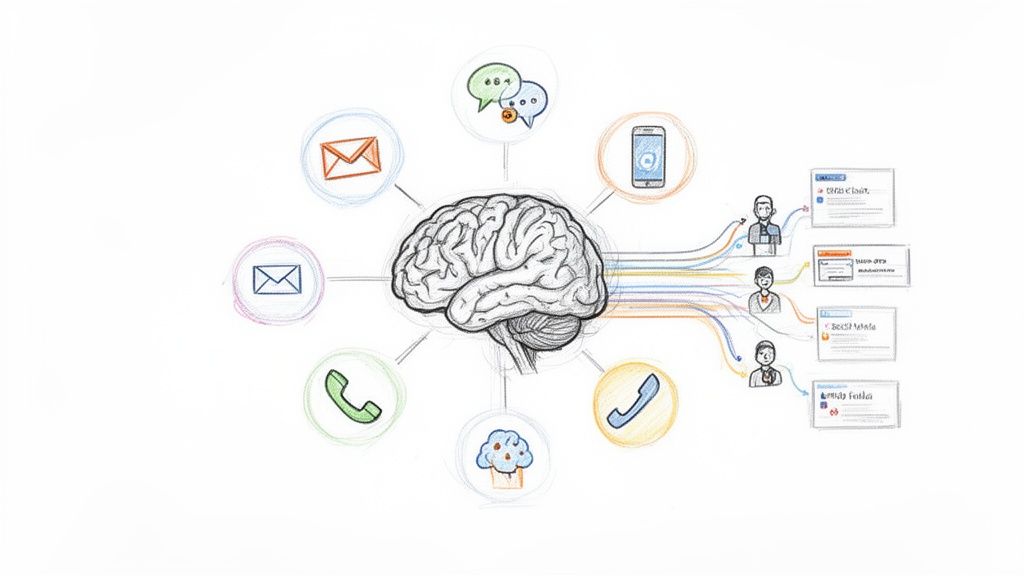
If your current customer support feels like an old-school telephone switchboard—where every call needs an operator to manually connect the dots—an AI platform is the upgrade to a modern air traffic control system. It doesn't just route conversations; it anticipates issues and often resolves them before a human even needs to get involved.
This isn't just about sticking a chatbot on your homepage to handle FAQs. We're talking about a fundamental shift from a collection of separate, reactive tools to a single, proactive system. It’s a central intelligence hub that seamlessly manages conversations from every touchpoint you have.
For any growing company, the real pain points are clear: How do you scale support without hiring an army of agents? How do you offer great service 24/7? And how do you turn customer support from a cost center into something that actually builds loyalty? True AI platforms are built to solve exactly these problems.
A huge part of their job is to tear down the communication silos that frustrate customers and agents alike. They do this by:
This unified approach is what creates a truly cohesive customer experience. For a closer look at how to build this kind of journey, our guide on creating an omnichannel customer service platform is a great resource.
Think of it this way: The platform doesn’t just answer questions; it understands relationships. It knows a customer's purchase history, their previous support tickets, and even their sentiment, allowing for truly personalized and effective service.
Here’s the biggest leap forward: these platforms have moved from passively answering questions to actively solving problems. A traditional chatbot might give you a link to the returns policy. An advanced AI platform can actually start the return, generate the shipping label, and schedule the pickup—all right inside the chat window.
This is where things get really interesting. Many modern platforms are using incredibly sophisticated Generative AI customer service to make conversations feel more natural and genuinely helpful. This technology allows the AI to perform tasks, automate processes with multiple steps, and basically give your human agents superpowers to resolve complex issues in a fraction of the time.
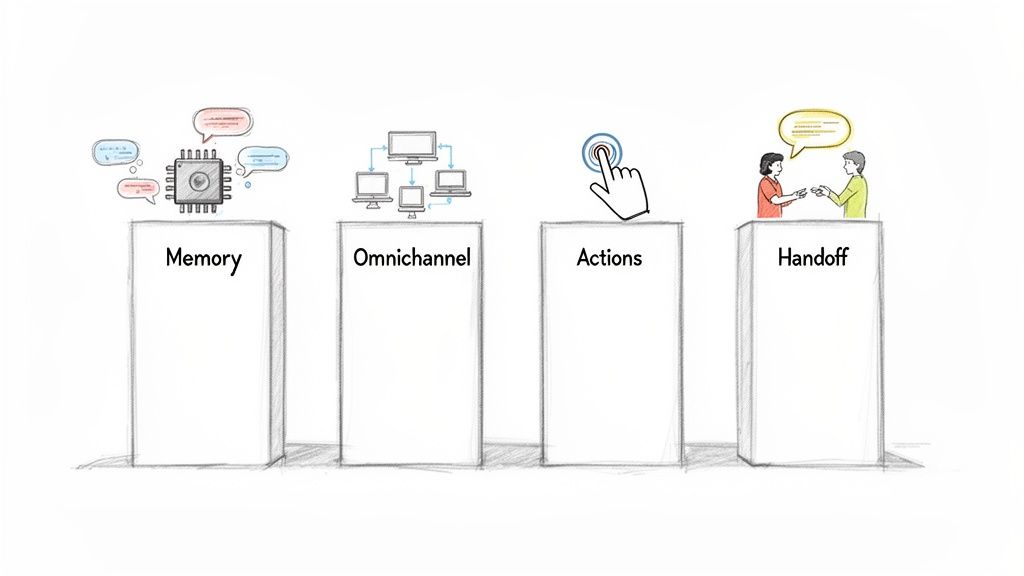
While simple chatbots can handle basic FAQs, truly intelligent AI-powered customer service platforms are built on four core capabilities. Think of these as the foundation that separates a helpful gadget from an operational powerhouse. They all work together to create customer experiences that feel personal, smart, and incredibly efficient.
Understanding these four pillars helps you cut through the marketing noise to see what really makes a platform work. Each one is designed to solve a classic customer service headache, turning a moment of friction into an opportunity to build loyalty.
We’ve all been there: explaining the same problem to three different support agents. Conversational memory makes that infuriating loop a thing of the past. It’s the AI’s ability to remember every single interaction a customer has ever had with your business, no matter the channel or how long ago it was.
It’s like giving your support team a perfect, shared memory. A customer who emailed about a shipping issue last week can send a WhatsApp message today without starting over. The AI instantly knows the context, connects the dots, and provides a relevant, proactive response.
Actionable Insight: When evaluating platforms, ask vendors to demonstrate how the AI handles a conversation that moves from web chat to email. A practical demo will reveal the true strength of its conversational memory.
If memory is about remembering the past, omnichannel orchestration is about flawlessly managing the present. This pillar knits all your communication channels—web chat, email, Instagram DMs, SMS—into one continuous conversation.
Imagine a customer starts a chat on your website from their laptop but has to run. With good orchestration, an agent can pick up that exact conversation and reply via email, with the full chat history right there. The customer gets a seamless response without ever feeling like they've been tossed between different departments.
This is critical because customers don’t see channels; they see one brand. A platform that orchestrates these interactions ensures your company always presents a unified and helpful front, everywhere. You can learn more about the benefits of AI in customer service and how this builds lasting loyalty.
Modern AI doesn’t just talk; it does. Agentic actions refer to the platform’s ability to perform tasks and trigger processes in your other business systems, right from the chat window. This is where AI stops being just an information kiosk and becomes a real problem-solver.
Here’s what that looks like in the real world:
This capability cuts customer effort down to almost zero and delivers the instant gratification people have come to expect.
Let’s be realistic: no AI can solve 100% of problems. That's why a smooth escalation process is the final, essential pillar. A seamless handoff ensures that when an issue needs a human touch, the transition is completely frictionless for both the customer and your agent.
The AI is smart enough to know when to escalate—based on complexity, customer frustration, or specific keywords. It then routes the conversation to the right person, armed with a full summary of what’s happened so far. Modern platforms even include features like AI-powered chat summarization to give agents instant context on long or complex threads.
The push for these advanced capabilities is why the global AI customer service market is expected to reach USD 83,854.9 million by 2033. Businesses are investing heavily because this technology doesn't just cut costs—it empowers their human agents to be more effective.
To really grasp the shift, let’s compare the old way with the new.
The table below breaks down the fundamental differences between legacy customer service operations and what’s possible with a modern AI platform. It’s a move from reactive, manual work to proactive, intelligent automation that benefits everyone involved.
| Feature | Traditional Support (Manual) | AI-Powered Platform (Automated & Intelligent) |
|---|---|---|
| Availability | Limited to business hours; often involves long wait times. | 24/7 instant support for common issues, with immediate agent routing. |
| Customer Context | Relies on agents reading past tickets; information is often siloed. | Full conversational memory across all channels provides instant, complete context. |
| Problem Resolution | Agents manually perform tasks in separate systems (e.g., CRM, billing). | AI performs agentic actions directly within the chat to resolve issues instantly. |
| Channel Consistency | Disconnected experiences; customer has to repeat themselves. | Omnichannel orchestration creates a single, seamless conversation thread. |
| Agent Handoff | "Cold" transfers where the new agent has little to no context. | "Warm" handoffs with AI-generated summaries and complete interaction history. |
| Scalability | Hiring more agents is the only way to handle increased volume. | AI handles a majority of inquiries, allowing the team to scale efficiently. |
As you can see, the difference isn't just about speed; it's about intelligence. AI-powered platforms create a more resilient, efficient, and customer-centric support operation from the ground up.
So, you're considering a sophisticated AI platform. It's a big move, but what does it really mean for your bottom line? Let's cut through the noise and figure out how these advanced features translate into actual dollars and cents.
The real value of an AI-powered customer service platform isn't just about deflecting tickets. It’s about a fundamental shift in how your business operates, measured across three key areas. When you focus on these pillars, you can build a rock-solid business case that proves its worth long after you go live. You'll stop seeing support as a cost center and start seeing it for what it is: a growth engine.
This is the most straightforward win and where you'll see the fastest returns. By automating all those repetitive, time-sucking questions, you can dramatically reduce the need for a massive support team and the associated costs—salaries, benefits, training, you name it.
Think about it. How many times a day does your team answer "Where's my order?" or "How do I reset my password?" An AI platform can handle a huge chunk of these without anyone lifting a finger, freeing up your human agents to tackle the tricky, high-value problems where they can really make a difference.
Actionable Insight: To build your business case, start by auditing your support tickets from the last 30 days. Categorize them by topic (e.g., order status, password reset, feature question). The top 3-5 categories are your prime candidates for automation and will form the core of your ROI calculation.
Let's say you handle 10,000 tickets a month, and each one costs you about $8. If your new AI platform automates just 40% of them, you’re looking at $32,000 in savings every single month. That’s how quickly this kind of investment can pay for itself.
Feel free to run your own numbers with our AI vs. Human Support ROI calculator to get a clearer picture.
Here’s where things get really interesting. A truly smart platform doesn't just save money—it makes money. By understanding a customer's history and intent, the AI can spot opportunities to upsell, cross-sell, and step in to save customers who are about to walk away. All of this directly boosts your Customer Lifetime Value (CLV).
Imagine a customer is repeatedly clicking on the cancellation page for your SaaS product. Instead of just letting them go, the AI could proactively open a chat, figure out what's wrong, and offer a personalized discount or a quick call with a specialist. You just turned a near-certain loss into a moment that builds loyalty.
This is where the magic happens:
Finally, the long-term, strategic ROI comes from the treasure trove of data these platforms gather. Every single customer conversation becomes a source of powerful insights, uncovering friction points, sentiment trends, and brand-new issues before they blow up.
This data is gold. It empowers you to make smarter, data-backed decisions across the entire company. For example, if your AI dashboard reveals that 30% of all support chats are about a single, confusing feature in your app, that's not just a support problem—it's a bright, flashing signal for your product team to prioritize a redesign.
There's a reason the conversational AI market is projected to hit USD 82.46 billion by 2034, according to Fortune Business Insights. Businesses are realizing its strategic value. This isn't just about fixing today's issues; it's about using customer feedback to prevent tomorrow's, creating a continuous improvement loop that fuels smarter products and better marketing.
The real magic of an AI-powered customer service platform isn't in the abstract tech specs; it's what happens when you see it solve real-world problems. We're talking about tangible, industry-specific headaches that eat into profits and frustrate customers. From online retail to FinTech, businesses are finding clever ways to tackle their unique challenges.
Looking at how these platforms are used in different sectors gives us a practical blueprint for what’s possible. Each industry leans on specific AI capabilities to fix its most common and costly support issues. Let's break down how four key industries are putting this technology to work.
If you run an e-commerce or direct-to-consumer (D2C) business, you know the drill. Your customer conversations are dominated by a constant stream of repetitive but critical questions about orders, products, and returns. Automating these is the only way to scale without letting service quality slip.
Here’s a practical example of how they’re doing it:
In the fast-moving world of Software as a Service (SaaS), a customer's success often comes down to two things: a smooth start and fast support. AI platforms are becoming essential for delivering the kind of instant, scalable help that gets users to that "aha!" moment faster.
A Qualtrics study revealed that 43% of customers would jump to a competitor after just one bad support interaction. When customer retention is the name of the game, that makes excellent, AI-driven support a business imperative.
Here are a few common use cases:
When it comes to money, trust and security are everything. AI platforms help financial companies provide fast, accurate, and secure support for sensitive questions, all while staying on the right side of strict compliance rules.
To give you a clearer picture, here’s a quick summary of how these AI capabilities are being applied across different sectors.
| Industry | Primary Use Case | Key AI Capability Used | Business Impact |
|---|---|---|---|
| E-commerce | Order & Return Automation | Agentic Actions | Reduces ticket volume by 40-60%; increases upsell opportunities. |
| SaaS/Tech | User Onboarding & Troubleshooting | Conversational Memory | Improves user activation rates; lowers churn by providing instant help. |
| FinTech | Secure Account Inquiries | Secure API Integration | Enhances customer trust; ensures 24/7 compliant support for sensitive issues. |
| B2B | Quote Generation & Lead Routing | Omnichannel Orchestration | Speeds up the sales cycle; ensures high-value leads are never missed. |
As you can see, the application isn't one-size-fits-all. The most successful companies identify their biggest points of customer friction and deploy AI with surgical precision to solve those specific problems.
Bringing an AI-powered customer service platform on board might feel like a massive project, but modern tools have made it surprisingly manageable. You don't need a team of data scientists on standby. By following a clear, phased approach, you can move from planning to launch without the usual chaos, ensuring a smooth transition that starts adding value right away.
Think of it less like a daunting tech overhaul and more like a series of smart, strategic steps. The key is to tackle your biggest support headaches first. This way, you'll see a real impact almost immediately.
Before you even think about booking a demo, the first and most critical step is to define what success actually looks like for your team. A vague goal like "improve customer service" is a recipe for failure. You need to get specific with measurable targets you can actually track.
Actionable Example:
Once you know what you’re aiming for, it’s time to get your data in order. A powerful AI platform is only as good as the context it has. This means making sure it can plug into your existing systems—like your CRM (Salesforce, HubSpot) or e-commerce platform—without a hitch. Clean, accessible customer data is the fuel for a smart, personalized AI.
With your goals set and data ready, it's time for the fun part. Pinpoint the top three to five most repetitive, soul-crushing tasks your support team deals with every single day. Don't try to boil the ocean and automate everything at once. Focus on the low-hanging fruit to give your team an immediate morale and efficiency boost.
Common starting points are things like handling returns, onboarding new users, or managing subscription changes.
This initial process is all about building a solid foundation, moving from strategy to data preparation before hitting the launch button.
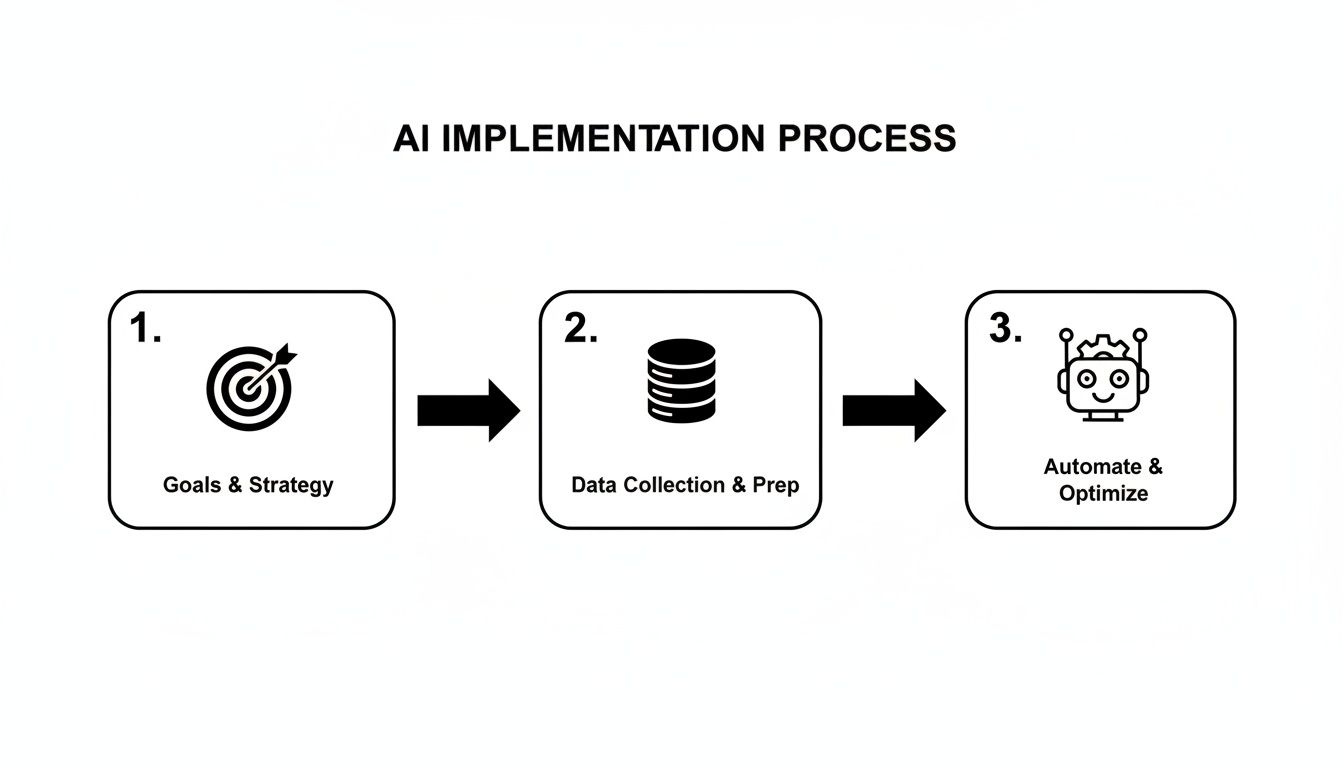
This simple, three-part process ensures you start strong before expanding the AI's role into more complex customer journeys.
Next, you'll want to inject your brand's personality into the AI. Is your brand witty, formal, or super friendly? Configure the AI's tone of voice to match. Then, train it on your existing knowledge base, help articles, and past chat logs so its answers are not just correct but sound genuinely like you.
Alright, it's go-time. Start small by launching the AI on a single channel, like your website chat. A controlled rollout lets you monitor performance, gather real customer feedback, and fine-tune things in a low-risk environment. Once you're confident, you can expand to other channels like email or social media.
Use the platform's built-in dashboards to keep a close eye on your key metrics, like automation rate and CSAT scores. This data creates a powerful feedback loop for constant improvement. There's a reason the generative AI market is forecasted to rocket past USD 5,323.92 million by 2035—these systems are designed to learn from every single interaction, making your support operation smarter over time. As you can read in this detailed market analysis, platforms like MagicalCX use this technology to turn support into a revenue-positive part of the business.
Actionable Insight: Set up a weekly 30-minute review of the AI's "unresolved" conversations. Look for patterns in what it couldn't answer. This is your goldmine for identifying gaps in your knowledge base or new automation opportunities.
You've done the research and you’re convinced AI can elevate your customer service. Now comes the hard part: picking the right partner. With a sea of AI-powered customer service platforms all claiming to be the best, it’s easy to get lost in a whirlwind of flashy demos and slick sales pitches.
Think of it like hiring a critical team member, not just buying a piece of software. You wouldn't hire someone based on their resume alone; you'd want to know if they fit your culture, can handle the pressure as the company grows, and genuinely care about your mission. The right platform is an extension of your brand, so this decision carries real weight.
As you start taking calls with vendors, keep these key evaluation points in mind. They’ll help you cut through the noise and figure out which platforms are built for the long haul and which are just another basic tool.
Knowing what you want is only half the battle; you also need to know what to run away from. Making the wrong choice can lock you into a frustrating contract and set your customer experience back by months, if not years.
A recent Qualtrics study highlighted that 43% of customers would switch to a competitor after just one negative support interaction. Choosing a platform that creates friction is a risk you can’t afford to take.
Be on high alert for these warning signs during the sales process:
Thinking about bringing an AI platform into your customer service mix naturally brings up some questions. It's a big step. Most leaders I talk to are weighing the cost, the time it'll take to get running, and what it all means for their current support team. Let's tackle those head-on.
Absolutely not. Think of it less as a replacement and more as a superpower for your existing team. The best AI platforms are designed to handle the high-volume, repetitive stuff—the "Where's my order?" or "How do I reset my password?" queries that eat up so much time.
This frees up your human agents to focus on the work that truly requires their expertise: navigating complex problems, handling sensitive situations, and building real relationships with your customers. It actually makes their jobs more rewarding and cuts down on burnout. The goal is to create a single, unified team where the handoff between AI and human is so smooth, the customer never feels a bump.
This is a common worry, but the timeline is probably much shorter than you imagine. We're not talking about a massive, months-long IT project anymore. For most companies, you can have a foundational system up and running in just a few days or weeks.
The first steps are straightforward: connect the AI to your help desk, let it learn from your knowledge base, and set up a handful of automated workflows for your most frequent questions.
Practical Example: A mid-sized e-commerce brand could connect their Shopify store and knowledge base on a Monday, spend Tuesday and Wednesday building automations for their top 3 questions (order status, returns, product info), and go live on their website chat by Friday.
You need to look at a few different things—efficiency gains, the quality of service, and the real impact on your bottom line. Just flipping a switch on AI isn't enough; tracking the right metrics is how you'll know it's working and find opportunities to make it even better.
Here are the key performance indicators (KPIs) I always tell teams to watch:
Ready to see how an empathy-first AI can transform your support operations from a cost center into a revenue engine? Discover MagicalCX and learn how to deliver proactive, personalized service that builds lasting customer loyalty. Visit the MagicalCX website to get started.


