See your AI teammate in action now
Ready to make support faster, kinder, easier and help customers feel good about choosing you?
PS: Sales improves too...
No credit card required
14 days free trial
DIY or Guided setup
Ready to make support faster, kinder, easier and help customers feel good about choosing you?
PS: Sales improves too...
No credit card required
14 days free trial
DIY or Guided setup
Manish Keswani
Let's get straight to it: customer experience management tools are the platforms that help you track, manage, and ultimately improve every single interaction a customer has with your business.
Think of it this way: instead of seeing each customer chat, email, or phone call as a separate, isolated event, these tools string them all together. They create a single, continuous story for each customer. This allows your team to deliver support that’s not just helpful but also deeply aware of the customer's history and context, no matter which channel they use. For example, an agent can see a customer's frustrated tweet from this morning right next to their support email from yesterday, and address both issues at once.
Imagine your business as a complex orchestra. You have sales, marketing, and support teams—all different sections of instruments. A customer experience management (CXM) tool is the conductor, making sure every note, every interaction, plays in perfect harmony. Without that conductor, you get chaos. The customer is forced to listen to a disjointed, frustrating performance, repeating their story over and over again.
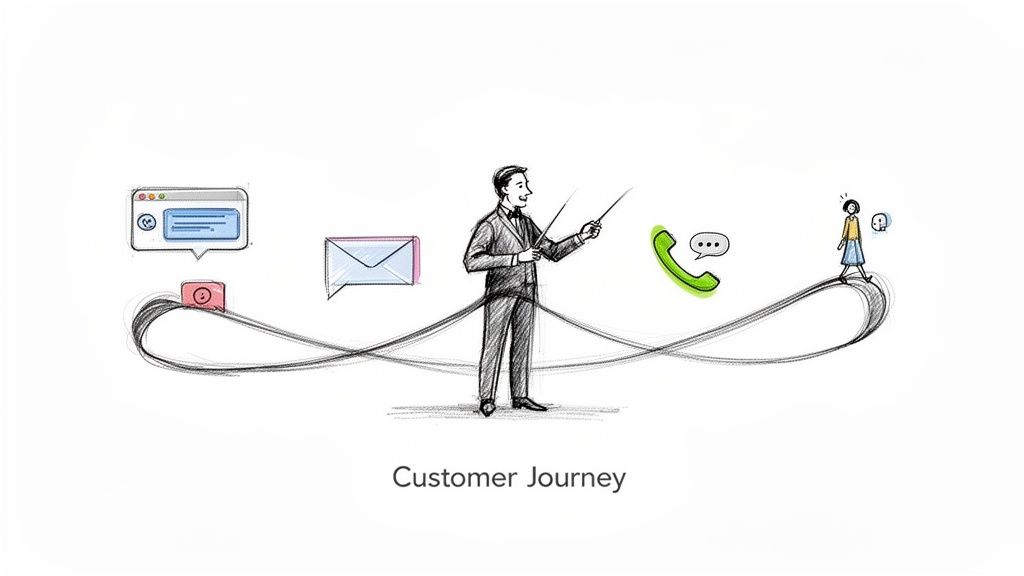
These platforms pull all customer data and conversations into one place, creating a cohesive timeline. This is a game-changer. It shifts your support from being purely reactive (solving problems as they pop up) to proactively engaging and preventing frustration. Your team isn't just answering a single question; they see the entire history, understand the full context, and can even anticipate what the customer might need next.
The fundamental goal here is to move past simply managing relationships (what a traditional CRM does) and start orchestrating the entire customer journey. This means pulling together data from every touchpoint—like seeing that a customer recently abandoned a shopping cart after chatting with support about a shipping question—to build a rich, detailed profile for every single customer.
This unified view gives your teams the power to provide support that feels both personal and empathetic. The benefits are immediate and tangible:
This table breaks down the essential components of a comprehensive Customer Experience Management tool, helping you quickly grasp the key functionalities.
| Pillar | Core Function | Business Impact |
|---|---|---|
| Data Unification | Aggregates all customer data from various sources (CRM, support, marketing) into a single, unified profile. | Provides a 360-degree customer view, eliminating data silos and enabling personalized interactions. |
| Journey Orchestration | Maps and manages the customer journey across all touchpoints, from initial awareness to post-purchase support. | Ensures a seamless and consistent experience, reducing friction and improving customer satisfaction. |
| Omnichannel Communication | Enables seamless conversation flow across different channels (email, chat, social media, phone) without losing context. | Meets customers where they are, providing convenience and boosting engagement rates. |
| Analytics & Insights | Tracks key metrics, analyzes customer feedback, and identifies trends to inform business decisions. | Drives data-backed improvements to products, services, and the overall customer experience. |
| Automation & AI | Uses AI to automate routine tasks, predict customer needs, and provide intelligent recommendations to agents. | Increases operational efficiency, reduces agent workload, and allows for proactive, intelligent support. |
Understanding these pillars is the first step toward seeing how a CXM platform functions as the central nervous system for all customer-facing operations.
In today’s crowded market, the experience you provide is your brand. It’s the one thing competitors can't easily copy. And businesses that truly invest in CX are reaping the rewards.
The global market for Customer Experience Management software was valued at USD 26,095.26 million in 2023 and is projected to skyrocket to an incredible USD 157,273.58 million by 2032. This isn’t just hype; it reflects a massive shift in business strategy. Companies that prioritize CX see 4-8% higher revenue growth than their competitors. You can dig deeper into the numbers behind this trend by exploring market reports on CXM software growth.
A CXM platform is not just another piece of software; it's an operational philosophy. It’s about structuring your teams and processes around the customer's perspective, ensuring every touchpoint adds value and strengthens the relationship.
Ultimately, these tools give you the foundation for understanding the complete customer story. This holistic view is the launching pad for all the advanced AI-driven features and automation we’ll explore later in this guide. Get this foundation right, and you can transform your support department from a cost center into a powerful engine for growth.
So we know what CXM tools are, but what features actually make them work? It's easy to get lost in a sea of buzzwords, but a few core capabilities truly separate the best platforms from the rest. These aren't just nice-to-haves; they're the engine of the entire operation.
Think of it like building a high-performance car. You need a powerful engine, a responsive steering system, and an intelligent computer managing it all. Each part is critical, and they all have to work together perfectly. Let's look at the must-have components for any serious CXM platform.
First up, omnichannel orchestration. This is the big one. It’s all about creating one single, continuous conversation with a customer, no matter how they choose to contact you. It’s the magic that makes customer interactions feel effortless instead of frustrating and broken.
Imagine a customer starts a live chat on your website about a billing error, gets interrupted, and then sends an email a few hours later. Without omnichannel orchestration, that's two separate tickets. Your agent has no idea what happened before, and the customer has to repeat their entire story. It’s a terrible experience.
With true orchestration, that conversation just flows. The agent who picks up the email can see the full chat transcript and instantly understands the context. This doesn't just save everyone time; it shows the customer you’re actually listening. It's about meeting people where they are without ever dropping the thread of the conversation. If you're looking to build this, a great place to start is understanding what goes into a true omnichannel customer service platform.
Right behind orchestration is the unified customer profile. This is the single source of truth for every customer—a living, breathing file that pulls together every piece of data you have on them.
We're not just talking about a name and email address. A truly unified profile brings everything together in one place:
This complete 360-degree view is priceless. For an e-commerce brand, an agent can instantly see a customer's recent order, their entire support history, and even their loyalty status. This context allows for incredibly personal and proactive service, like offering a tailored discount on a product they've been eyeing.
The third non-negotiable feature is automated workflows. This is your secret weapon for scaling support without letting quality slip. These intelligent systems take all the routine, repetitive tasks off your agents' plates so they can focus on the complex issues where human empathy really shines.
Think about all the common processes that can be automated:
A top-tier CXM tool doesn't just manage interactions; it automates outcomes. It handles the predictable, rules-based stuff so your team can apply their expertise and problem-solving skills where it counts.
By putting these automations to work, a retailer can slash ticket volume for "where's my order?" inquiries, and a SaaS business can create a much stickier product by ensuring every new customer gets off to a great start. These three features—orchestration, unified profiles, and automation—are the bedrock of any modern CXM strategy.
Picking the right customer experience management tool isn’t about finding a magic bullet that works for everyone. It’s far more nuanced than that. The platform that’s perfect for a fast-paced e-commerce store will likely fall flat for a growing SaaS company or a heavily regulated FinTech firm.
The biggest mistake you can make is grabbing a generic, off-the-shelf solution. You’ll end up paying for a laundry list of features you never touch while missing the one or two critical capabilities that could actually solve your biggest headaches. The key is to start by pinpointing your most painful, high-priority problem—the one that creates the most friction for your customers and the most manual work for your team.
This simple decision tree can help you get started, focusing on whether your primary need is bringing all your customer data together or automating repetitive tasks.
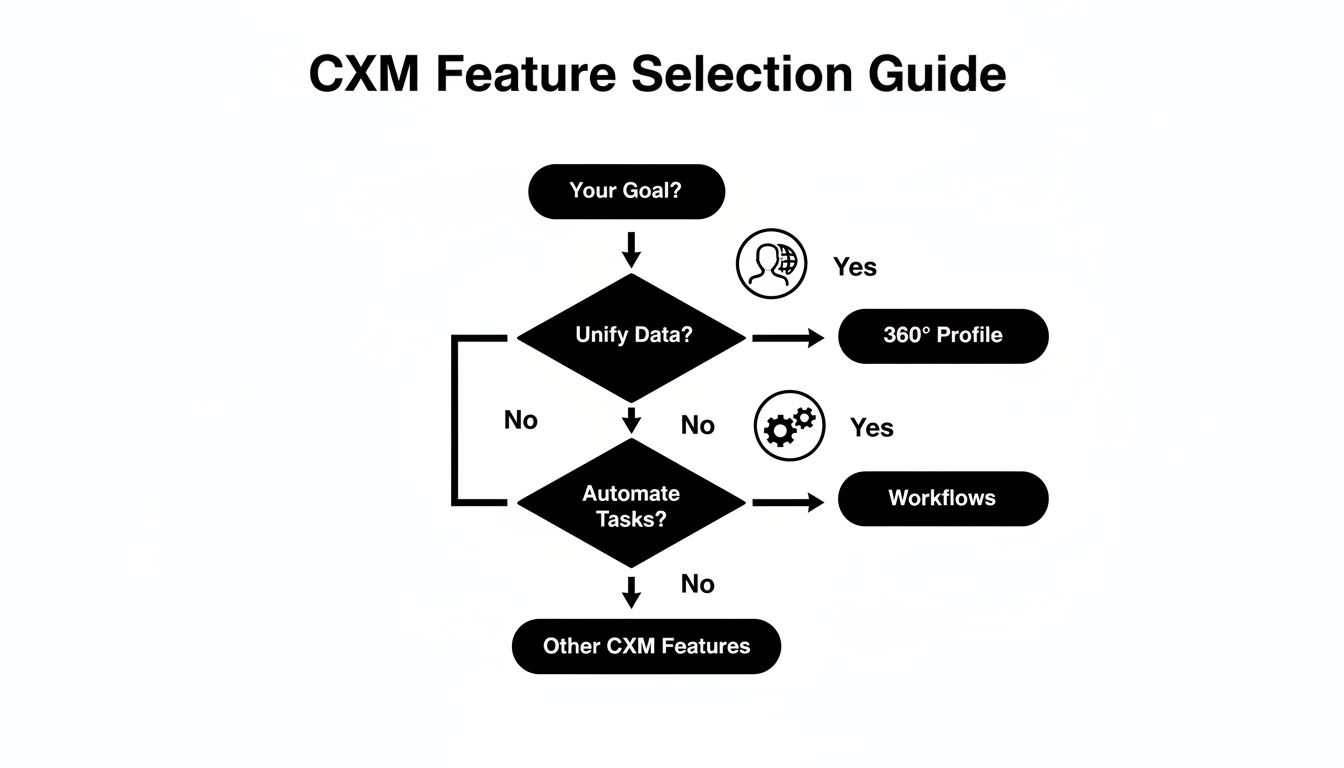
As the chart shows, if you’re trying to unify scattered data, a 360-degree customer profile is non-negotiable. If automation is the goal, powerful workflows are where you need to focus.
For any online retailer or direct-to-consumer (D2C) brand, the entire customer journey revolves around orders, shipping, and returns. The most relentless question is, "Where is my order?" (WISMO), and a clunky returns process can kill customer loyalty instantly.
A practical example: if a CXM tool can’t plug directly into platforms like Shopify or Magento, it's a non-starter. Your platform has to pull real-time order data straight into the support dashboard so your agents—or your AI—can see a customer's full history without ever leaving the screen. The goal is to automate these simple, data-driven questions and free up your people for the truly complex problems.
In the world of SaaS, it’s all about retention. Customer churn is the enemy, so experience management has to be laser-focused on smooth user onboarding, driving feature adoption, and offering proactive support.
Here, the right CXM tool needs to talk to your product analytics and CRM. This connection gives your support team a window into how people are actually using your software. For example, if the system sees a user repeatedly stumbling over a key feature, it can trigger an automated, helpful message or a link to a tutorial. It’s about spotting frustration before it turns into a cancellation notice.
The FinTech industry plays by a completely different rulebook. Efficiency is great, but security, compliance, and trust are the real currency. Customers are handing over incredibly sensitive financial data, so every single interaction has to be locked down and perfectly documented.
A FinTech-ready CXM platform must be built on a foundation of robust security, offering things like end-to-end data encryption and secure messaging channels. For example, a customer should be able to securely upload identity documents directly within a chat window, with the file encrypted and stored in a compliant manner. It also needs to create detailed audit trails for every customer conversation to satisfy strict financial regulations.
Choosing the right CXM tool begins with a clear-eyed look at your industry's unique customer journey. E-commerce lives and dies by order integrations, SaaS needs to see what users are doing, and FinTech requires unshakeable security. Matching a tool’s strengths to these core needs is the only way to ensure it’s a success.
To make these differences crystal clear, the table below breaks down what each industry really needs from a CXM platform.
This comparison maps the critical CXM features and common use cases across different business sectors. Use it to quickly identify which functionalities will deliver the most value for your team and your customers.
| Industry | Top Priority Use Case | Essential CXM Feature | Example Scenario |
|---|---|---|---|
| E-Commerce | Managing order inquiries and processing returns efficiently. | Deep E-commerce Platform Integration (e.g., Shopify, Magento). | An AI agent instantly accesses order data to tell a customer their package will arrive tomorrow, without human intervention. |
| SaaS | Reducing churn by improving user onboarding and adoption. | User Activity Tracking & Proactive Engagement. | The platform identifies a user struggling with a new feature and automatically sends a targeted in-app guide to help them succeed. |
| FinTech | Ensuring secure communication and maintaining compliance. | Advanced Security Protocols & Comprehensive Audit Trails. | A customer's request to change their account details is handled through a secure, verified channel, with every step logged for compliance. |
| B2B Services | Nurturing long-term client relationships and managing complex issues. | Shared Inboxes & Collaborative Case Management. | An account manager and a technical specialist collaborate within the same ticket to resolve a client's complex issue quickly. |
By homing in on your industry’s specific pain points, you can sidestep the trap of a generic, one-size-fits-none solution. Instead, you'll find a customer experience management tool that starts delivering real, measurable value from day one.
Artificial intelligence is completely reshaping how companies talk to their customers. For a long time, customer support was just seen as a cost—something you had to deal with. Now, it's becoming one of the most powerful ways to drive revenue. We're not talking about those clumsy, first-generation chatbots that just get in the way. Modern AI, when built into customer experience management tools, works more like a highly-skilled personal assistant. It anticipates what you need, remembers your preferences, and actually takes action to make your life easier.
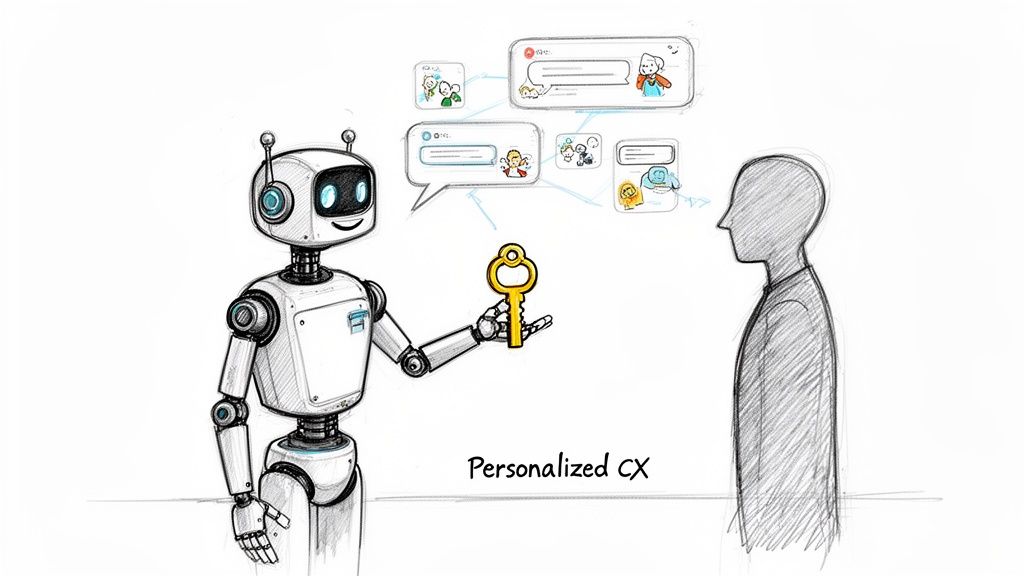
This evolution is driven by technology that goes way beyond simple, scripted answers. The real goal here is to build an "empathy-first" experience where every single interaction feels understood, personal, and genuinely helpful. This approach doesn't just fix a problem; it creates a real emotional connection that keeps customers coming back and fuels long-term growth.
What's one of the most annoying things for a customer? Having to repeat themselves over and over. That's where truly smart AI comes in, bringing the concept of conversational memory to the table. This means the system remembers every single interaction a customer has had with you, no matter the channel. It's the digital version of walking into your local coffee shop and having the barista start making your usual drink before you even order.
Think about it. A customer asks about a product feature on your website's chat on Monday. Two days later, they send a follow-up question about shipping on WhatsApp. An AI with conversational memory instantly pieces those two conversations together, grasping the full context. The customer never has to start from scratch. This ability is at the heart of delivering the kind of seamless, personal service people now expect. You can learn more about this technology in our guide on AI customer service solutions.
The next major leap for AI is giving it the power to perform agentic actions. This is a game-changer. It means the AI can do more than just spit out information; it can actually perform tasks for the customer right within your own business systems. The AI goes from being a passive knowledge base to an active problem-solver.
Here are a few real-world examples of what this looks like:
This ability to take direct action turns a support interaction from a tedious, multi-step process into a single, effortless resolution. It massively reduces customer effort and frees up your human agents to handle the most complex and sensitive issues.
The most sophisticated customer experience management tools bring all of this together to create a system that feels genuinely helpful. It’s like a great hotel concierge who doesn't just answer your questions but also anticipates what you might need next. An empathy-first AI engine can analyze a customer's journey and past interactions to offer help before they even ask for it.
For example, imagine a customer keeps visiting the help page for setting up a specific feature in your SaaS product. The AI can proactively pop up a chat saying, "Looks like you're working on the analytics dashboard. Would a quick video guide be helpful?"
This isn't just about being efficient. It’s about showing your customers you understand their struggles and are there to help them succeed. Large companies are already all over this, controlling over 58-60% of the Customer Experience Management market by weaving customer data directly into their business operations. Their rapid adoption is fueled by AI that provides predictive insights and smart automation, turning empathy into something you can actually measure.
By connecting empathetic support directly to business growth, AI is proving that a helpful, positive experience is one of the best tools you have for boosting sales and earning customer loyalty for years to come.
Picking the right customer experience management tool is a huge step, but a great platform is just the beginning. To get any real value, you have to implement it correctly and know how to measure its impact. The whole point is to get up and running smoothly so you can start seeing that investment pay off.
A successful rollout isn't about just flipping a switch. It's about strategically connecting the new tool to your existing business systems and honing in on the metrics that actually matter.
Fortunately, modern CXM platforms are built for flexibility. Many offer quick, do-it-yourself setups that can have you live in a few hours—often just by adding a small snippet of code to your website. For businesses with more complex needs, providers like MagicalCX offer "white-glove" services to handle the entire transition for you. You can check out different pricing and service tiers to see what kind of implementation path fits your team and budget.
The most critical part of this process? Integration. Your CXM tool can't live on an island. It has to talk to your other core software, especially your CRM and e-commerce platforms like Shopify or Salesforce. This connection is what allows the platform to pull in crucial context—customer history, order data, and past conversations—to create that unified profile you need for truly empathetic support.
Once your tool is live, your focus needs to shift to measuring what's working. It's easy to get lost in a sea of data, so don't track dozens of vanity metrics. Instead, concentrate on a few key performance indicators (KPIs) that directly link customer happiness to business health. These are the numbers that will prove your ROI.
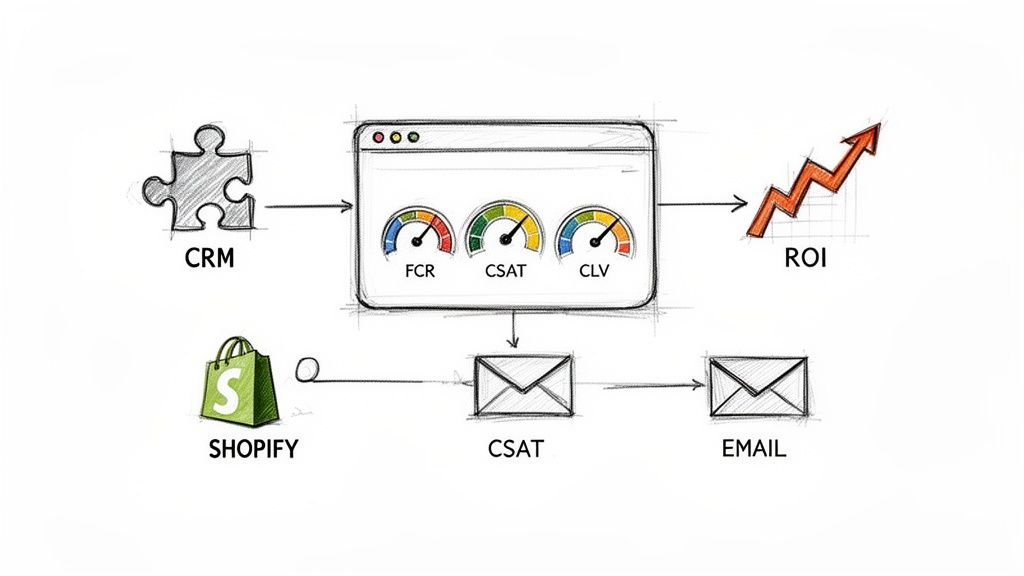
The real power of a CXM platform isn’t just in managing conversations; it's in turning raw data into actionable insights. Your dashboard should be a command center that helps you spot problems before they escalate.
Think of your CXM dashboard as more than just a reporting tool—it's your early warning system.
Let's say you suddenly see a spike in support tickets all asking about the same thing: shipping costs. That’s not just a bunch of isolated queries; it’s a clear signal of friction in your customer journey. It probably means your shipping information is confusing or hard to find on your website.
Armed with that insight, you can take immediate action. You could update your FAQ page, clarify the shipping policy in the checkout process, or create a new help article. By identifying and fixing these small pain points proactively, you stop them from becoming major sources of frustration. This is how you demonstrate a clear, compelling return on investment—by showing that your CXM tool doesn't just solve problems, it helps you build a better experience from the ground up.
Even with a solid strategy, I get it—diving into the world of customer experience management tools can feel a bit overwhelming. Choosing a new platform is a big deal, and it's totally normal to have questions about the cost, the setup process, and how it’s all going to affect your team. Let's tackle the most common questions head-on to give you the clarity you need.
My goal here is to cut through the noise and give you straight answers. This way, you can confidently pick a tool that not only fixes today's headaches but also sets you up for real, long-term growth.
This is the big one, and the honest answer is: it varies. A lot. The final price tag depends on a few key things, like how many features you actually need, the size of your support team, and the sheer volume of customer conversations you handle every month. There's really no one-size-fits-all number.
Simpler tools aimed at smaller teams might start with a straightforward monthly fee per user, which is a great way to get started without a huge upfront commitment. On the other end of the spectrum, enterprise-level platforms built for massive organizations are a serious investment, often with custom pricing and annual contracts.
The best way to think about this is to flip the question from a cost to an investment. What's the potential ROI? Think about the time saved, the boost in agent efficiency, and, most importantly, the impact on customer loyalty. Even a 1% increase in retention can boost profits by 5%.
Many of the newer, AI-driven platforms are moving toward scalable, usage-based pricing that grows with you. When you're comparing options, look for total transparency and don't forget to ask about one-time setup or implementation fees. Nobody likes surprises on the first invoice.
Yes, and frankly, it has to. Integration isn't a "nice-to-have" feature; it's the absolute foundation of a useful CXM platform. A tool that can't talk to your other systems is a dead end—it just creates another silo and can't see the full picture of your customer.
The best customer experience management tools are designed to be the central nervous system of your tech stack. They need to connect seamlessly with your core systems, like:
When you're evaluating a tool, make integrations a top priority. Check out their list of native, one-click connections and have your technical team review their API documentation. You need to be sure it can connect to everything you rely on, including any custom-built software.
The timeline can be anything from a couple of hours to a few months. It really just depends on the complexity of the platform and what your team needs to get out of it.
Many modern, user-friendly platforms like MagicalCX are built for speed. You can often get up and running in an afternoon just by adding a snippet of code to your website or connecting it to your existing helpdesk. This kind of self-service setup is perfect for agile teams who want to start seeing a return right away.
On the flip side, a full-scale enterprise rollout is a bigger project and will naturally take more time. These often involve migrating years of data from an old system, designing complex automated workflows, and training hundreds of support agents.
The best providers give you both options. Look for a platform that lets you choose between a quick, do-it-yourself setup and a more comprehensive, guided "white-glove" implementation. That way, you can pick the path that best fits your team's technical skills and timeline.
This is probably the biggest myth out there. The goal of an AI-powered CXM tool isn’t to replace your people—it’s to augment them. It's about creating a powerful partnership where technology and human agents work together to make the entire customer experience better.
AI is brilliant at handling the simple, repetitive questions that flood your inbox 24/7. All those "Where is my order?" or "How do I reset my password?" tickets? An AI can resolve them instantly, which frees up your incredible human agents to focus on what they do best:
A practical example: a customer is furious about a billing mistake that has caused them major issues. The AI can handle the initial data gathering, but the system should be smart enough to route this high-emotion issue directly to a senior human agent who can provide the necessary empathy and find a creative solution. It’s the perfect blend of automation's speed and the irreplaceable value of a human touch.
Ready to transform your support from a cost center into a revenue driver? MagicalCX is an empathy-first AI platform that delivers human-like, context-aware support across all your channels. Learn how you can increase profits while lowering operational costs with MagicalCX.


