See your AI teammate in action now
Ready to make support faster, kinder, easier and help customers feel good about choosing you?
PS: Sales improves too...
No credit card required
14 days free trial
DIY or Guided setup
Ready to make support faster, kinder, easier and help customers feel good about choosing you?
PS: Sales improves too...
No credit card required
14 days free trial
DIY or Guided setup
A guide to the 7 best AI chatbot platforms for customer service in 2026, covering key features, pricing models, integrations, and ideal use cases.
Manish Keswani
Summary by MagicalCX AI
In 2026, the best customer service chatbots are revenue-aware agents that resolve issues end-to-end, with models like Intercom Fin charging as little as $0.99 per successful resolution and platforms like MagicalCX claiming up to 98% answer accuracy when grounded in a strong knowledge base and CRM context.
The search for the best AI chatbot for customer service is no longer just about deflecting tickets. It’s about creating intelligent, autonomous agents that deliver context-aware, personalized experiences, turning routine support into a powerful engine for customer loyalty and revenue growth. Modern AI has evolved far beyond basic Q&A bots; today's top solutions can understand complex intent, recall past interactions, and proactively solve issues before they escalate.
This guide provides a comprehensive roundup of the leading platforms, designed to help you make an informed decision. We’ll dive deep into specific solutions, from standalone, empathy-focused tools to fully integrated helpdesk suites and specialized marketplaces. For any chatbot to succeed, it needs a solid foundation of information. A core component of this is understanding how to build a high-performing knowledge base, as this directly fuels the AI's ability to provide accurate and instant answers.
Here, you will find a clear, actionable comparison of the top options available today. We'll examine key features, pricing structures, and ideal use cases for industries like e-commerce, SaaS, and FinTech. Each entry includes screenshots and direct links to help you navigate your options efficiently. Our goal is to equip you with the insights needed to select a chatbot that not only resolves customer queries but actively enhances your customer experience and contributes directly to your bottom line.
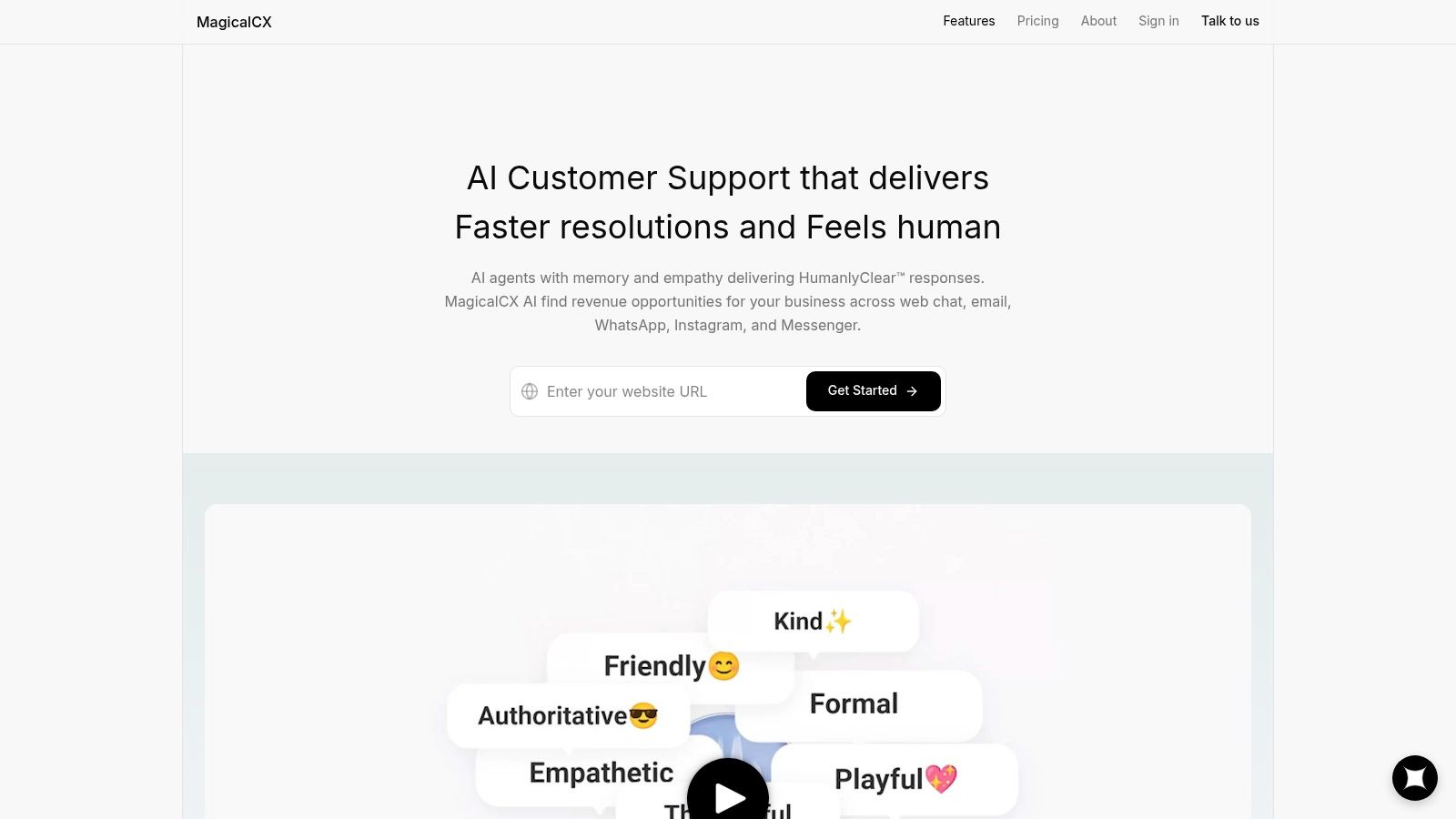
MagicalCX positions itself as an empathy-first AI platform, making it a standout choice for businesses aiming to transform customer support from a cost center into a revenue driver. It's designed not just to answer questions, but to understand customer history and sentiment, delivering responses that feel personal and context-aware. This approach makes it a particularly strong contender for the title of best AI chatbot for customer service, especially for high-touch industries like e-commerce, SaaS, and FinTech.
The platform's core philosophy is built around HumanlyClear™ responses, which are powered by a persistent conversational memory. This means customers never have to repeat themselves, whether they're switching from web chat to WhatsApp or picking up a conversation from last week. For a D2C brand, this could mean the chatbot remembers a customer's previous sizing issue and proactively suggests the right fit for a new product, creating a seamless and personalized shopping experience.
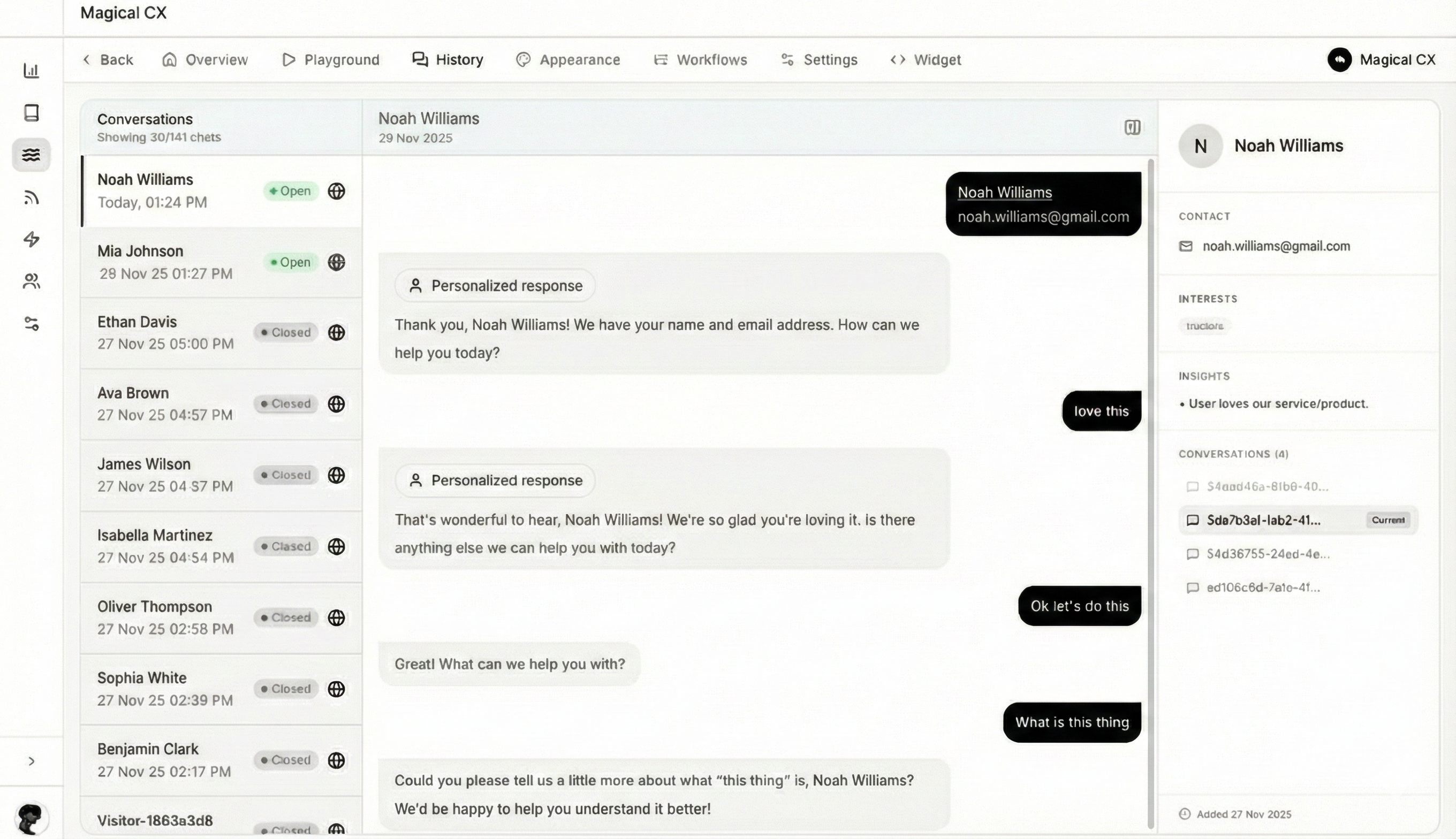
MagicalCX goes beyond standard chatbot functionalities with a suite of features engineered for both operational efficiency and revenue generation. Its architecture is built to handle complex, multi-step customer journeys autonomously.
A mid-market e-commerce brand could use MagicalCX to manage post-purchase inquiries. The AI can handle "Where is my order?" questions by pulling real-time data from Shopify, manage return requests through its guided workflow, and use the EFRO™ engine to offer a discount on a future purchase to a customer who had a shipping delay, turning a potential negative experience into a loyalty-building moment.
For businesses interested in leveraging AI for proactive support, the insights from its live dashboards can be invaluable. These analytics highlight common friction points in the customer journey, allowing operations teams to make data-driven improvements. To dive deeper into what differentiates various systems, you can explore the landscape of AI-powered customer service platforms and see how they stack up.
MagicalCX does not list public pricing on its website; you need to schedule a demo to receive a custom quote. However, it offers a 14-day free trial (no credit card required) and includes its white-glove setup at no extra cost, lowering the barrier to entry for businesses wanting to test its capabilities.
| Strengths | Weaknesses |
|---|---|
| Empathy and Context: HumanlyClear™ replies and persistent conversational memory create a superior customer experience. | No Public Pricing: Requires a demo/quote to get cost information, which can slow down the initial evaluation process. |
| Revenue-Aware Automation: The EFRO™ engine proactively turns support interactions into revenue opportunities. | Vendor Claims Need Validation: The +98% accuracy claim is impressive but should be validated with your own data and use cases. |
| Operational Efficiency: Guided workflows and omnichannel support significantly reduce manual ticket volume and agent workload. | |
| Flexible Deployment: Free white-glove setup and robust integration options make it adaptable for various tech stacks. |
Bottom Line: For companies that view customer service as a core part of their brand identity and growth strategy, MagicalCX offers a powerful, well-rounded solution. Its unique focus on combining empathetic, context-aware support with revenue-generating automation makes it one of the best AI chatbot for customer service options available today.
Website: https://www.magicalcx.com
Intercom positions itself as an AI-first customer service platform, moving beyond simple chatbots to offer a complete, resolution-focused solution. Its centerpiece, the Fin AI Agent, is designed to understand complex queries and provide complete, accurate answers across every customer channel, from your website chat to email, SMS, and even social media platforms like WhatsApp.
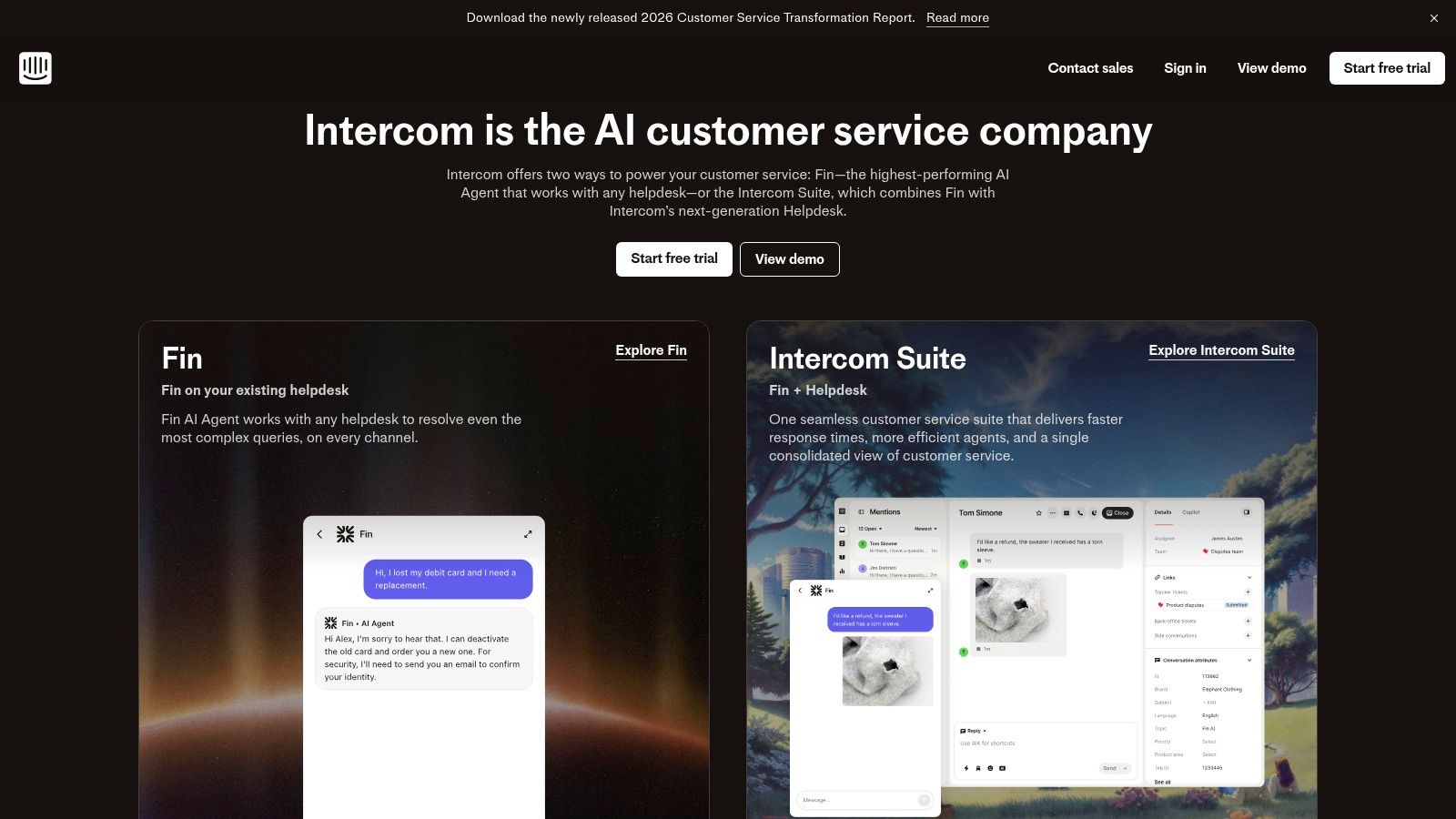
What makes Intercom one of the best AI chatbot for customer service platforms is its unique pricing model and flexible integration. Instead of charging per conversation or interaction, Fin's pricing is based on resolutions. You pay $0.99 per successful resolution, making costs predictable and directly tied to value. This model encourages deploying an AI that truly solves problems rather than just deflecting them. Furthermore, while Intercom offers a robust helpdesk, you are not forced to migrate. Fin can integrate directly with existing systems like Zendesk or Salesforce, allowing you to enhance your current workflow without a disruptive platform switch.
Actionable Insight: When setting up Fin, start by connecting it to your most comprehensive and up-to-date knowledge base. Then, use the "guardrails" feature to restrict its answers to only that content. This prevents hallucinations and ensures brand consistency from day one. For example, if your pricing page is out of date but your knowledge base article is correct, the guardrail ensures the AI only pulls from the approved source.
While the per-resolution pricing is a major advantage, businesses should be aware of potential minimum commitments, especially for deployments that only use the Fin AI Agent without the full Intercom helpdesk. Additionally, some outbound channels, like proactive messaging campaigns, may incur separate usage fees that need to be factored into your budget. This structure is a key part of a broader strategy of help desk automation, where each component is optimized for efficiency.
Best for: SaaS and subscription companies who need a powerful, easily integrated AI that can handle complex user queries and value a transparent, resolution-based pricing model. It's also ideal for teams that want to augment their existing helpdesk with best-in-class AI without a full system migration.
Zendesk is a mature, widely adopted customer service platform that has deeply embedded AI across its entire Suite. Rather than treating AI as a separate product, Zendesk integrates it as a core component of its omnichannel workflows, offering an agent-assist Copilot, powerful add-ons, and fully autonomous "Advanced AI agents." This makes it a formidable choice for teams already standardized on the Zendesk ecosystem or those looking for an all-in-one solution with enterprise-grade capabilities.
What solidifies Zendesk's position as one of the best AI chatbot for customer service platforms is its tiered approach to automation. Teams can start with the AI features built into the Suite plans, such as intelligent routing and macro suggestions. As needs evolve, they can activate the Copilot for agent assistance at a transparent per-agent price, or deploy Advanced AI agents for higher autonomy. This scalability allows businesses to grow into their AI strategy without needing to switch platforms, leveraging a massive app marketplace and ecosystem integrations along the way.
Actionable Insight: When starting with Zendesk AI, activate the intelligent triage feature first. It automatically analyzes incoming tickets for intent, sentiment, and language, allowing you to build routing rules that send high-priority issues (e.g., negative sentiment from a VIP customer) directly to a specialized human agent, while letting the bot handle routine queries like password resets. This provides immediate value by prioritizing agent time.
While the base AI features are powerful, accessing the most advanced capabilities often requires purchasing add-ons or moving to higher-tier plans, which can significantly increase the total cost of ownership. Pricing details for the most autonomous features, like Advanced AI agents and their resolution-based costs, are not always public and may require direct sales engagement, making initial budget forecasting a bit more complex. Exploring the benefits of AI in customer service can help build the business case for these investments.
Best for: Mid-market and enterprise companies already invested in the Zendesk ecosystem who want to scale their AI capabilities within a unified, familiar platform. It's also ideal for support teams that require deep integrations and robust compliance, analytics, and omnichannel features.
While not a chatbot provider itself, G2's Chatbots Software category is an indispensable research hub for any team evaluating the best AI chatbot for customer service. It functions as a peer-review marketplace, aggregating thousands of verified user reviews, detailed feature comparisons, and real-world satisfaction ratings. This allows you to move beyond vendor marketing and understand how these platforms actually perform in live business environments.
What makes G2 essential is its powerful filtering and comparison engine. You can instantly narrow down dozens of options based on critical criteria like company size, industry-specific features (e.g., e-commerce integrations, HIPAA compliance), language support, and user satisfaction scores. The platform’s proprietary Grid reports visually map out market leaders versus high-performers and niche players, giving you a quick-glance understanding of the competitive landscape. G2 provides direct links to vendor websites, allowing you to seamlessly transition from research to a free trial or demo.
Actionable Insight: Use G2’s comparison feature to select your top three to four chatbot candidates. Create a custom comparison chart focusing on your must-have features, like "proactive chat," "knowledge base integration," and "API access." For example, an e-commerce brand should add "Shopify Integration Quality" as a column and check reviews specifically mentioning it. Export this view and share it with your team to create a data-driven foundation for your decision-making process.
As a marketplace, G2's model includes sponsored placements, which can sometimes appear at the top of category pages or in search results. It is important to look for the "Sponsored" tag and cross-reference these listings with organic rankings and user reviews. Additionally, since G2 is a research aggregator, you must still visit each vendor's site to get precise, up-to-the-minute pricing and package details, as this information is not always fully updated on the G2 platform itself.
Best for: Any company in the initial research and shortlisting phase of selecting an AI chatbot. It is particularly valuable for support leaders and operations teams who need to build a business case for a new tool, backed by unbiased user data and comprehensive market analysis.
Rather than a single platform, the Shopify App Store is a vast marketplace where ecommerce brands can find hundreds of AI chatbot apps designed specifically for their unique needs. These solutions install directly into a Shopify store, providing a native experience for both the merchant and the customer. This ecosystem approach allows direct-to-consumer (D2C) brands to choose a tool perfectly tailored to their scale, budget, and specific customer service challenges, from order tracking to proactive product recommendations.
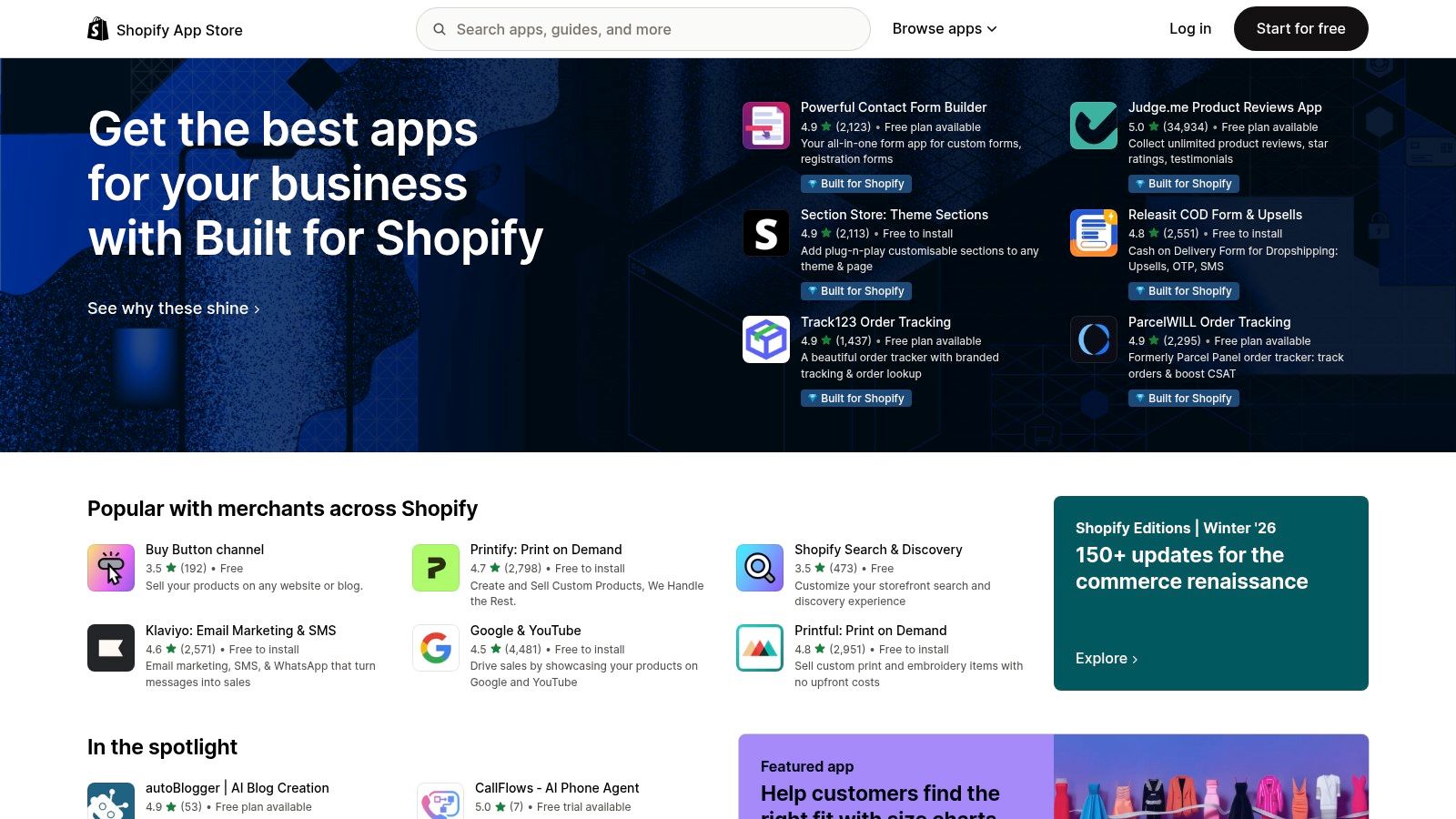
What makes the Shopify ecosystem one of the best sources for an AI chatbot for customer service is the sheer variety and ease of deployment. Apps are built with ecommerce workflows in mind, handling common queries like "Where is my order?" (WISMO), returns, and product questions out of the box. Many apps offer transparent, tiered pricing and free trial periods, allowing businesses to test and validate a solution with minimal risk. This plug-and-play model is ideal for merchants who need to enhance their storefront with powerful AI capabilities without complex, custom integrations.
Actionable Insight: When choosing an app, filter for those with deep integrations into your other key tools, such as your email marketing platform (e.g., Klaviyo) or SMS provider. For example, a chatbot integrated with Klaviyo can tag a user based on their query (e.g., "interested-in-new-product"), triggering a follow-up email campaign automatically. This transforms a support interaction into a marketing opportunity.
The main challenge is the "paradox of choice" - the quality and feature depth can vary dramatically between apps, requiring careful research and vetting. Some lower-tier or free plans may impose strict limits on the number of AI-powered conversations, tracked products, or a lack of advanced features, forcing you to upgrade as you scale. Additionally, relying on a third-party app means you are dependent on their development roadmap and support quality.
Best for: Ecommerce and D2C brands of all sizes operating on the Shopify platform. It's especially powerful for small to mid-sized businesses that need a cost-effective, easy-to-deploy AI chatbot that solves common ecommerce support queries without requiring a dedicated development team.
For businesses deeply embedded in the Salesforce ecosystem, the Salesforce AppExchange serves as a central marketplace for extending Service Cloud capabilities with AI-powered chatbots. Rather than being a single product, it offers a curated collection of both native Salesforce solutions, like Einstein Bots, and a wide array of third-party applications. This approach allows organizations to select a bot that leverages their existing CRM data for highly personalized and context-aware customer interactions.
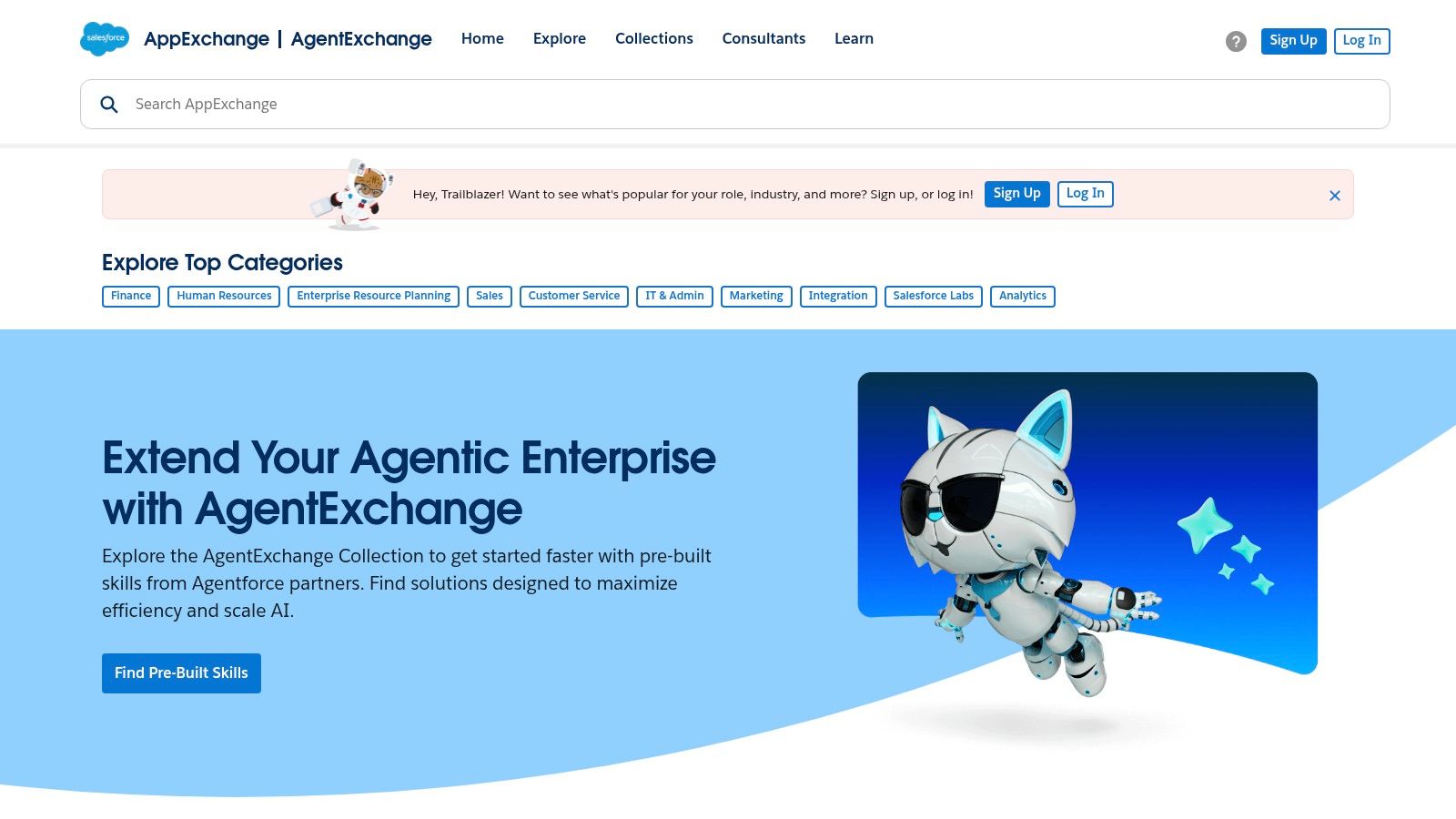
What makes the AppExchange a compelling destination for finding the best AI chatbot for customer service is its focus on native integration and accelerated deployment. Companies can choose from pre-built partner accelerators and industry-specific templates designed to speed up implementation. For instance, a financial services firm can deploy a bot pre-configured to handle common banking queries, all while securely accessing customer account information directly from Salesforce. This eliminates the need for complex, custom integrations and ensures that bots operate within the platform's robust security and compliance guardrails.
Actionable Insight: Before committing, identify a specific, high-value process you want to automate. For example, qualifying a new sales lead. Search the AppExchange for bots with pre-built "flows" for lead qualification. In your proof-of-concept, test this exact flow. Can the bot correctly capture lead information, update the Salesforce record, and assign it to the right sales rep? This practical test validates its real-world utility for your business.
The primary challenge with the AppExchange is pricing transparency; many listings require you to contact the sales team for a custom quote, which is common for enterprise-focused solutions. Furthermore, while accelerators help, implementation can still be complex. Some community feedback highlights potential configuration hurdles and performance lag, underscoring the importance of thorough testing before a full-scale deployment.
Best for: Organizations already using Salesforce Service Cloud who want a chatbot with native CRM access and the ability to leverage platform-level security. It's ideal for businesses looking to fast-track deployment using industry-specific templates and packaged partner solutions.
For enterprises deeply integrated into the Amazon Web Services ecosystem, AWS Marketplace offers a different approach to sourcing an AI chatbot. Instead of a single vendor, it’s a curated digital catalog where you can discover, procure, and deploy third-party conversational AI platforms and professional services directly within your AWS environment. This makes it a powerful option for organizations that want to leverage existing AWS commitments, streamline procurement, and ensure new tools align with their established cloud infrastructure.
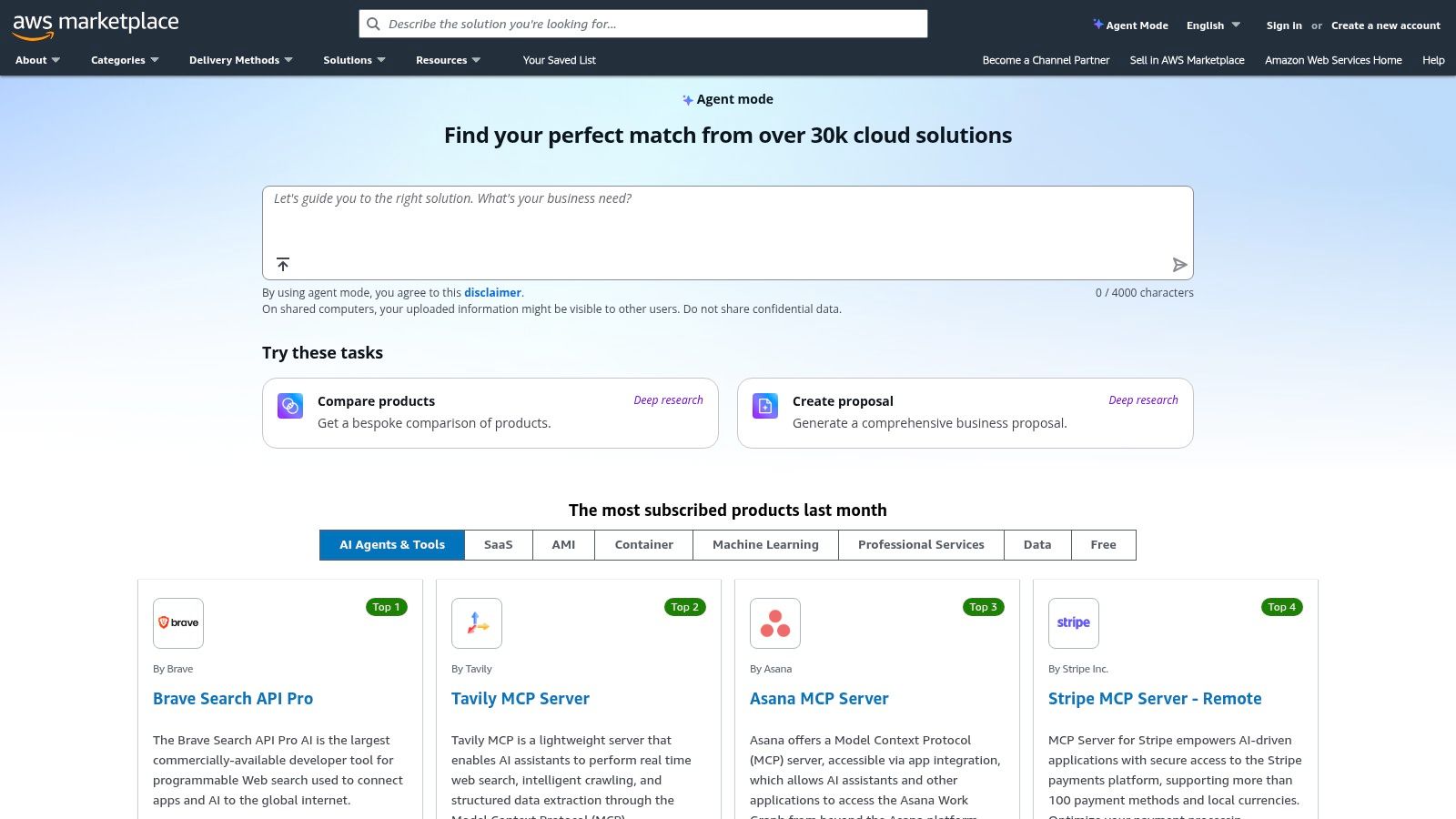
What makes AWS Marketplace a unique entry on this list of the best AI chatbot for customer service is its function as a strategic procurement hub. You can find leading chatbot vendors like Cognigy or Kore.ai and purchase them using your AWS account. This consolidates billing and simplifies the often-complex security and compliance reviews, as vendors are vetted for AWS compatibility. Furthermore, it supports flexible deployment models, from ready-to-use SaaS subscriptions to containerized applications (AMIs/containers) that you can run on your own EC2 or EKS infrastructure for greater control.
Actionable Insight: Use the "Private Offers" feature in AWS Marketplace to negotiate custom pricing and terms directly with chatbot vendors. A practical way to leverage this is to bundle the software license with a package of professional services (e.g., 40 hours of implementation support) directly from the vendor, all consolidated into one AWS transaction. This can unlock significant discounts and tailored service-level agreements not available through public listings.
Navigating the marketplace can be overwhelming, as the sheer number of listings makes direct comparison difficult, and many require you to request a custom quote, slowing down the evaluation process. Additionally, while procurement is simplified, the technical ownership and MLOps (Machine Learning Operations) for deploying and managing the chatbot solution often remain entirely with your internal team, requiring significant in-house expertise.
Best for: Large enterprises and mid-market companies already committed to the AWS ecosystem. It’s ideal for organizations with stringent procurement processes, a need for consolidated billing, and the internal technical resources to manage and architect cloud-native solutions.
| Item | Implementation complexity 🔄 | Resource requirements ⚡ | Expected outcomes ⭐📊 | Ideal use cases 💡 | Key advantages |
|---|---|---|---|---|---|
| MagicalCX | Medium — DIY or free white‑glove; CRM integration available 🔄 | Moderate — CRM/data access, initial setup or vendor implementation ⚡ | High empathy + revenue lift; improved FCR and AOV; vendor claims +98% accuracy ⭐📊 | E‑commerce, D2C, subscriptions, contact centers, SMBs/mid‑market 💡 | Persistent conversational memory; revenue‑aware automation; 360° profiles |
| Intercom (Fin AI Agent + Helpdesk) | Low — low‑lift setup; works with or without migrating helpdesk 🔄 | Low–Moderate — usage‑based Fin pricing (per resolved convo); minimal engineering ⚡ | Predictable cost per resolution; fast time‑to‑value; agent assist options ⭐📊 | Quick AI deployment; teams keeping existing helpdesk; SMBs to mid‑market 💡 | Usage‑based pricing; easy integration with existing helpdesks; fast setup |
| Zendesk (Suite + AI) | Medium–High — Suite + optional add‑ons; enterprise config 🔄 | Moderate–High — licensing, Copilot/QA/WFM add‑ons and configuration ⚡ | Robust governance, omnichannel AI and scale; enterprise compliance ⭐📊 | Enterprises standardizing on Zendesk; teams needing governance & integrations 💡 | Deep ecosystem, flexible AI add‑ons, broad marketplace integrations |
| G2 — Chatbots category | Low — research/comparison platform, no deployment 🔄 | Minimal — time to research and compare vendors; no engineering ⚡ | Broad user‑driven insights and verified reviews for shortlists 📊⭐ | Vendor research and shortlisting prior to procurement 💡 | Verified reviews, side‑by‑side comparisons, free to use |
| Shopify App Store — AI Chatbot apps | Low — app install and native Shopify integration 🔄 | Low — app pricing/tiering; some configuration for storefront flows ⚡ | Fast deployment into storefronts; ecommerce features (WISMO, recommendations) 📊⭐ | D2C Shopify stores needing rapid chat/order support and native UX 💡 | Immediate installation, transparent app pricing, ecommerce‑focused features |
| Salesforce AppExchange — Bot solutions | Medium–High — Salesforce org integration and configuration 🔄 | Moderate–High — Salesforce licensing, partner accelerators, implementation effort ⚡ | Native CRM access, packaged accelerators; secure org‑level bots 📊⭐ | Organizations on Salesforce needing bots tied to Service Cloud & CRM 💡 | Deep CRM integration, industry templates, partner‑led accelerators |
| AWS Marketplace — Conversational AI | Medium–High — AWS‑aligned deployments and procurement 🔄 | High — cloud deployment patterns (containers/AMIs), MLOps and technical ownership ⚡ | Consolidated billing, enterprise procurement, AWS‑native deployment options 📊⭐ | AWS‑centric enterprises seeking vetted vendors and private offers 💡 | Streamlined procurement on AWS, deployment artifacts, enterprise options |
We've journeyed through a comprehensive landscape of AI chatbot solutions, from standalone powerhouses like Intercom and Zendesk to curated ecosystems within Shopify, Salesforce, and AWS. The core takeaway is clear: selecting the best AI chatbot for customer service isn't about finding a tool that simply answers questions. It's about forging a strategic partnership with a platform that amplifies your brand's voice, understands customer intent, and actively contributes to your bottom line.
Your final decision hinges on a thoughtful evaluation of your unique business context. The path for a fast-growing D2C brand will look vastly different from that of a multinational enterprise already embedded in the Salesforce ecosystem.
Recapping our analysis, the modern AI chatbot is no longer just a deflection tool. It's a proactive agent for retention, upselling, and building loyalty. For instance, a FinTech company cannot afford generic, robotic responses when handling sensitive financial queries. It needs a chatbot that provides accurate, empathetic, and secure information, turning a moment of anxiety into an experience of trust.
Similarly, an e-commerce brand's chatbot should do more than track an order. It should be able to ask, "While we wait for that tracking update, did you know we just released a new accessory that pairs perfectly with your recent purchase?" This shift from reactive support to proactive engagement is the hallmark of a truly advanced AI partner. The solutions we've explored, particularly platforms like MagicalCX, are designed around this principle of turning service interactions into revenue-positive opportunities.
Choosing your ideal AI chatbot requires a structured approach. Avoid getting lost in feature comparison tables and instead focus on a strategic evaluation tailored to your operational reality.
Define Your Primary Use Case: Be brutally honest about your main goal. Is it reducing ticket volume in your contact center? Increasing lead conversion on your SaaS pricing page? Or providing 24/7, high-touch support for premium subscription customers? A chatbot optimized for lead capture (like many basic website bots) will fail at complex post-purchase support.
Map Your Technical Ecosystem: Where does your customer data live? If you're all-in on Salesforce, exploring the AppExchange is a logical first step. If your team operates across multiple systems, a platform with robust, API-first integrations is non-negotiable. Don't underestimate the "hidden" cost of poor integration, it leads to fragmented customer views and frustrating experiences.
Run a Pilot Program with Real Scenarios: Demos are designed to impress; real-world performance is what matters. Identify your top 5-10 most common and most complex customer queries. Create a scorecard and test each shortlisted vendor against these specific scenarios.
How the AI handles the nuance, context, and multi-step resolution in these queries will reveal its true capabilities far better than any sales pitch.
Scrutinize the AI's Learning Mechanism: Ask vendors critical questions. How does the AI learn and improve? Is it a "black box," or do you have visibility and control over its training data? The best AI chatbot for customer service will offer a transparent system where your team can easily review conversations, correct errors, and refine responses, ensuring the bot's voice always aligns with your brand.
Ultimately, this decision is a long-term investment in your customer experience. The right platform will not only automate repetitive tasks but will also uncover insights, identify customer friction points, and become an indispensable part of your growth engine. Choose the partner that empowers you to build stronger, more profitable relationships, one conversation at a time.
Ready to see how an AI partner can transform your customer service from a cost center into a revenue driver? MagicalCX is built for high-touch businesses that demand empathetic, accurate, and context-aware conversations. Schedule a demo today and discover how the right AI can help you build lasting customer loyalty.