See your AI teammate in action now
Ready to make support faster, kinder, easier and help customers feel good about choosing you?
PS: Sales improves too...
No credit card required
14 days free trial
DIY or Guided setup
Ready to make support faster, kinder, easier and help customers feel good about choosing you?
PS: Sales improves too...
No credit card required
14 days free trial
DIY or Guided setup
Learn how to define CSAT (Customer Satisfaction Score), calculate and interpret it, compare it with NPS and CES, review benchmarks, and improve CSAT.
Manish Keswani

Summary by MagicalCX AI
CSAT, calculated as the percentage of customers who rate an interaction 4 or 5, is a fast, transactional early-warning metric that 39% of digital CX pros rank among their most crucial measures and that typically targets 75% to 85% as a solid benchmark.
Ever wondered what CSAT stands for? It's your Customer Satisfaction Score, and it’s one of the most direct ways to measure how happy a customer is with a specific interaction they just had with your business. Think of it as a quick pulse check on a single moment in their journey, like right after a support chat or a new purchase.

The best way to understand CSAT is to think of it as immediate feedback. It’s not trying to measure a customer's lifelong loyalty to your brand. Instead, it’s all about a specific touchpoint. Did our support agent actually solve your problem? Was checking out on our website a breeze?
This laser focus on individual transactions is what makes the Customer Satisfaction Score so powerful. It helps you pinpoint exactly where things are going right—or wrong—in your customer journey. For example, if you see a sudden dip in CSAT scores tied to your checkout process, it’s an actionable insight that a recent update may have introduced a bug. You can quickly see if a new feature is confusing users or if a shipping delay is causing frustration.
To make it even clearer, here’s a quick rundown of the key details.
| Component | Description |
|---|---|
| Metric Name | Customer Satisfaction Score (CSAT) |
| Purpose | Measures customer happiness with a specific interaction or touchpoint. |
| Question | Typically asks, "How satisfied were you with [interaction]?" |
| Scale | Commonly uses a 1-5, 1-7, or 1-10 scale, or descriptive words (e.g., Very Satisfied). |
| Focus | Transactional and short-term, not overall brand perception. |
| Timing | Deployed immediately after an interaction for the most accurate feedback. |
This table shows just how simple and direct the CSAT metric really is. It’s designed to be straightforward for both you and your customers.
At its core, the Customer Satisfaction Score is all about capturing your customer's feelings while the experience is still fresh. This immediate feedback gives you real, actionable data you can use to improve everything from employee training to your product itself.
When an e-commerce store asks, "How satisfied were you with your recent purchase?" they get an instant signal. A high score means the process is working. A low score is a red flag, an early warning that something is broken and needs to be fixed before it impacts more people.
This isn't just a niche metric; it's a major player. A 2021 survey found that customer experience pros ranked CSAT as the second most crucial metric (39%) for tracking digital CX improvements, trailing only direct revenue. You can learn more about the widespread use of CSAT in business to see just how common it is.

Knowing what CSAT stands for is one thing, but the real value is in the calculation. The good news is you don’t need to be a data scientist to figure it out. The formula is refreshingly simple and gives you a clear percentage of happy customers.
Here's the basic math:
(Number of Satisfied Customers ÷ Total Number of Survey Responses) x 100 = Your CSAT Score (%)
So, what exactly is a "satisfied customer"? In the most common 1-to-5 scale surveys, anyone who gives you a 4 (Satisfied) or a 5 (Very Satisfied) is counted as satisfied. These are the people you want to focus on for this calculation.
Let's break it down with a real-world scenario. Say an online clothing store wants to check how customers feel about their checkout experience.
First, you'll add up the number of satisfied customers, which is 90 + 30 = 120. Now, just plug that into the formula:
(120 Satisfied Customers ÷ 150 Total Responses) x 100 = 80%
Boom. The store has a CSAT score of 80% for its checkout process. This score provides an immediate, actionable insight. For example, if last month's checkout score was 85%, this 5-point drop is a clear signal to investigate what changed. It's a straightforward number that gives them an instant read on performance. For more ideas on what to track, take a look at our guide to measuring customer service.
A CSAT score is only as good as the data behind it, and that's where timing comes in. This metric is all about capturing in-the-moment feelings.
If you wait too long to send the survey, your customer’s memory of the experience will fade, and their feedback won't be as sharp or accurate. The best practice is to trigger the survey right after the key moment—like when a support ticket is closed, a product is delivered, or a free trial ends. That's how you get the most honest feedback.
It's easy to think of a Customer Satisfaction Score as just another number to track on a dashboard. But that's a mistake. CSAT is much more than a simple reporting metric—it’s a core part of your growth strategy.
Think of it as an early-warning system. It flags friction points in your customer journey long before they snowball into churn, negative reviews, and lost revenue. That one simple number tells a powerful story about how well your business is actually working for the people who matter most.
A low score isn't just a bad grade; it's a map pointing directly to a problem. It gives you a clear, actionable starting point for making things better.
At its heart, CSAT is a diagnostic tool. It helps you uncover those hidden cracks in your customer experience that you'd otherwise never see—at least not until they cause real damage. When you tie CSAT scores back to specific interactions, you can zero in on what’s broken and fix it fast.
Understanding the why behind a low score is the first step toward turning a negative experience into a loyalty-building opportunity. It’s all about using data to make smarter, proactive decisions.
High CSAT scores feel good, but they do much more than that—they directly translate into a healthier bottom line. One study found that companies truly focused on their customers (and the feedback they provide) are 60% more profitable than companies that don't. It just makes sense: happy customers stick around, spend more money, and tell their friends about you.
This powerful link turns customer satisfaction into a predictable driver of revenue. Better scores lead directly to higher customer retention and a bigger customer lifetime value (CLV).
To get the most out of CSAT, you can’t look at it in a vacuum. It works best when integrated into a broader strategy of customer experience analytics, giving you a complete picture of every interaction. By truly listening to the Voice of the Customer, you build a loyal base that becomes the engine for sustainable growth. Learn more about how to capture and act on the Voice of the Customer in our detailed guide.
Knowing what CSAT stands for is one thing, but knowing when to use it is where the real magic happens. In the world of customer experience, you'll constantly hear about three big players: CSAT, Net Promoter Score (NPS), and Customer Effort Score (CES). It’s easy to lump them together, but they each tell a very different story about your customer.
Think of them like tools in a mechanic's toolbox. You wouldn't use a hammer to check your tire pressure, right? Each one has a specific job.
CSAT is the tire pressure gauge. It gives you a quick, immediate reading on a specific interaction. Did that last support call go well? Was the checkout process smooth? It’s a snapshot of a single moment.
NPS is the full engine diagnostic. It’s looking at the bigger picture—the overall health of your relationship with the customer. It helps you understand their long-term loyalty and whether they're likely to stick around.
CES is the torque wrench. It measures how much effort a customer had to put in to get something done, like resolving an issue or returning a product. The goal is to find out where things feel clunky or difficult for them.
So, how do you decide which one to use? It all comes down to what you’re trying to find out. Are you focused on long-term brand loyalty, the quality of a recent interaction, or how easy you are to do business with?
This table breaks down the core purpose of each metric, helping you pick the right tool for the job.
| Metric | Measures... | Typical Question | Best Used For |
|---|---|---|---|
| CSAT | In-the-moment satisfaction | "How satisfied were you with your support call today?" | Getting immediate feedback on specific, transactional interactions like a purchase or helpdesk ticket. |
| NPS | Overall brand loyalty and advocacy | "How likely are you to recommend our company to a friend?" | Gauging long-term customer relationships and predicting future growth and referrals. |
| CES | Ease of a specific interaction | "How easy was it to get your issue resolved?" | Identifying and removing friction from customer processes, like returns or account updates. |
Each metric gives you a valuable, but different, piece of the puzzle. Using them together often provides the most complete picture of your customer’s journey.

As this shows, a higher CSAT score isn't just a number to report—it's a direct driver of business growth. Happy customers stick around longer and spend more, fueling a cycle of retention and increased revenue. While CSAT is great for those immediate check-ins, pairing it with a broader metric like NPS gives you both the micro and macro view. You can dive deeper into how to improve your Net Promoter Score in our guide.
So, you've calculated your CSAT score. The next question is always the same: is it any good? While everyone wants a single magic number, the truth is that context is everything. Understanding where your industry typically lands is the first step in setting realistic goals and figuring out how you truly stack up.
Generally speaking, a CSAT score between 75% and 85% is considered a pretty solid performance. But take that with a grain of salt. Averages can be misleading because customer expectations change dramatically depending on the business they're dealing with.
Think about it—you probably have a lot more patience for a shipping company dealing with a complex customs issue than you do for a software app you use every single day that suddenly stops working. This difference in expectation is why benchmarks vary so much.
Here’s a quick look at what "good" looks like in a few different spaces:
These numbers aren't just random; they tell a story about the unique pressures and customer relationships within each sector. For a deeper dive, you can find more industry-specific CSAT benchmarks at Salesforce.com.
Comparing your score to the industry average is a great reality check, but it’s not the whole story. Honestly, the most important benchmark is your own trend line. A competitor’s score can’t tell you if that new onboarding process you launched last month is actually making a difference.
The real power of CSAT comes from tracking your own progress over time. A score that is consistently improving month-over-month is a far better indicator of a healthy customer experience than simply matching an external number.
Use industry data as your starting point, not your finish line. Your real goal should be to beat your own last score. Each survey response is a clue that helps you figure out your next move to keep your customers happy.

Knowing what CSAT means is one thing, but making that number climb is where the real work begins. Boosting customer satisfaction isn't about guesswork or luck—it’s about having a solid game plan.
A smart strategy focuses on three core pillars: your people, your processes, and your technology. Businesses that actively work to improve customer satisfaction scores don't just track the metric; they build a system around it. By tackling each of these areas, you can turn customer feedback into real, noticeable improvements.
Your support team is on the front lines. They’re the human voice and face of your company, and their every interaction directly shapes your CSAT score. Investing in your team is one of the fastest routes to better satisfaction.
A practical action is to start with soft skills training. Focus on empathy, active listening, and how to de-escalate a tense situation. An agent who can truly connect with a frustrated customer has the power to turn a bad experience into a great one.
Giving your agents the autonomy to solve problems without waiting for a manager's green light is a game-changer. For example, empower an agent to offer a small refund or a discount right away to resolve an issue on the first contact. This cuts down resolution time and proves you trust your team to make the right call.
Even the most talented agent will struggle if they're stuck in a clunky, confusing process. These frustrating internal systems are a major cause of low CSAT scores. The goal is to hunt down and eliminate these bottlenecks.
A good first step is to map out common customer journeys, like processing a return or updating billing info. Where do things get bogged down? A practical example for an e-commerce store is simplifying a complicated, multi-step return process into a one-click request from the customer's order history. Removing friction from these key processes is a direct path to higher satisfaction.
The right tech is your secret weapon for delivering efficient, personalized support that can scale. It automates the boring stuff, gives your team the info they need, and helps create a smooth experience for your customers.
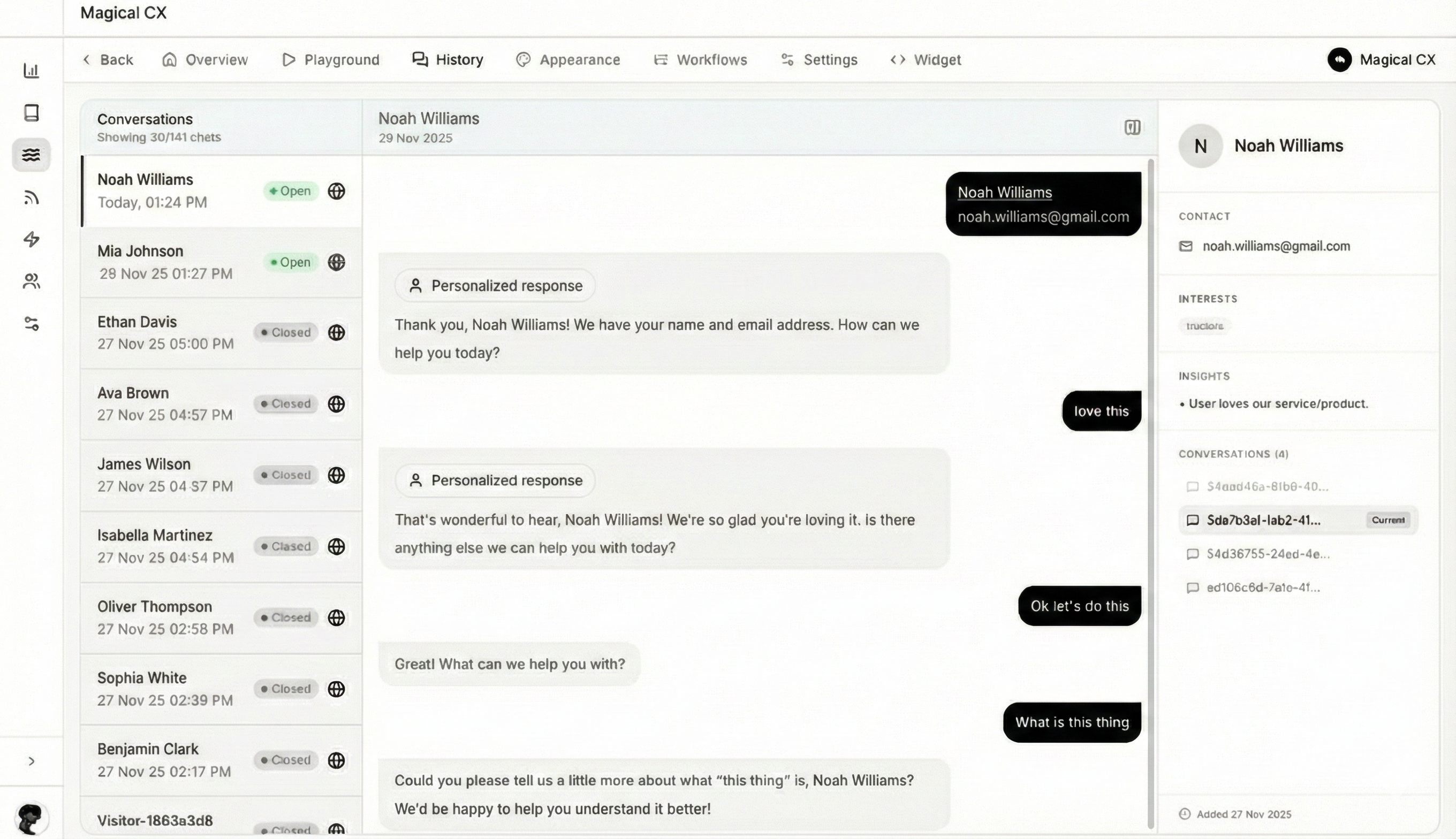
For instance, a platform like MagicalCX can instantly pull up a customer's entire conversation history, meaning they never have to repeat their issue. It can also automate answers to common questions like, "Where's my package?", which frees up your agents for more complex problems. This blend of smart automation and full context helps you deliver faster, more personal support—a surefire way to lift your CSAT score.
Even once you've got the basics down, a few practical questions always pop up when it's time to put CSAT to work. Let's tackle some of the most common ones we hear from leaders trying to get this right.
Timing is everything. You want to catch the customer right when the experience is fresh in their mind. The best practice is to send the survey immediately after a key interaction wraps up.
Practical examples include:
If you wait even a day, their memory of the details starts to fade, and your data gets fuzzy.
CSAT isn't a crystal ball, but it's a fantastic early warning system. A sudden, sharp drop in your scores after a specific event—say, a new software update or a change in your return policy—is a huge red flag for dissatisfaction that often comes before customers start leaving.
By keeping an eye on these trends, you can jump on problems before they convince a customer to walk away.
Think of a consistently low CSAT score as the smoke alarm for your customer experience. It’s not the fire itself, but it’s telling you there's a problem that needs your immediate attention.
Hands down, the most common pitfall is failing to act on the feedback. Collecting scores is pointless if you don't dig into the "why" and make real changes. It's just vanity data at that point.
Always give customers a chance to elaborate. After they rate their satisfaction, ask a simple, open-ended question like, "Could you tell us a bit more about why you chose that score?" The real gold is in those free-text answers.
Another common slip-up is asking for feedback too often. Bombarding customers with surveys leads to fatigue, which tanks your response rates and can even annoy the very people you're trying to help.
Ready to turn those CSAT insights into real, automated action? MagicalCX uses conversational AI to resolve issues on the spot and give your team the context they need to deliver truly exceptional service. See how MagicalCX can help you improve your customer satisfaction.