See your AI teammate in action now
Ready to make support faster, kinder, easier and help customers feel good about choosing you?
PS: Sales improves too...
No credit card required
14 days free trial
DIY or Guided setup
Ready to make support faster, kinder, easier and help customers feel good about choosing you?
PS: Sales improves too...
No credit card required
14 days free trial
DIY or Guided setup
A guide to voice of customer examples, covering NPS comments, product reviews, support transcripts, usability tests, social mentions, interviews, case studies, and surveys.
Manish Keswani
Summary by MagicalCX AI
Companies that operationalize Voice of Customer feedback into automated workflows can turn passive customers into promoters by 15% and cut churn by 20%, proving that systematic listening plus fast action is a direct lever for revenue growth.
In a market where customers have endless choices, understanding their perspective is the ultimate competitive advantage. A robust Voice of Customer (VoC) program is no longer optional; it is the engine for sustainable growth, retention, and product innovation. VoC is the systematic process of capturing what your customers are saying about your brand, products, and services, then transforming that feedback into actionable business improvements. This isn't just about collecting survey scores; it's about deeply understanding the needs, expectations, and frustrations expressed across every touchpoint.
This article moves beyond abstract theory to provide a comprehensive list of voice of customer examples you can implement immediately. We will break down eight distinct types of customer feedback, from raw NPS comments and detailed support transcripts to unfiltered social media mentions and usability test observations. For each example, you'll find a strategic analysis covering:
You will learn how to transform raw customer data into a powerful tool for building empathetic, revenue-generating experiences. We'll also explore how modern tools like MagicalCX can automate the process, turning unstructured feedback into precise, context-aware actions that improve customer satisfaction and operational efficiency, proving that listening to your customers is the most direct path to a stronger bottom line.
Net Promoter Score (NPS) surveys are a cornerstone of modern Voice of Customer (VoC) programs. They ask a simple question: "On a scale of 0 to 10, how likely are you to recommend our brand/product to a friend or colleague?" While the numeric score is a valuable benchmark, the real gold is in the open-ended follow-up question: "Why did you give that score?" These qualitative comments are raw, unfiltered feedback that reveal the why behind customer sentiment.
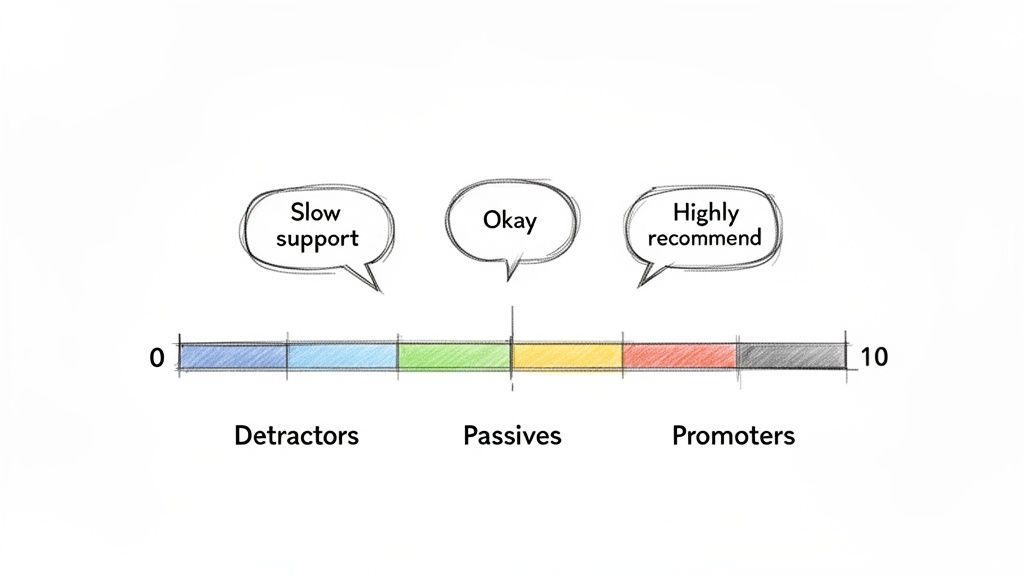
This feedback is essential for understanding customer satisfaction drivers and pain points. For MagicalCX users, NPS comments provide direct insight into how automation is perceived, identifying specific friction points where an AI interaction felt frustrating or where it exceeded expectations.
NPS comments are more than just feedback; they are actionable signals. A FinTech firm, for instance, noticed a recurring theme in comments from "Passive" customers (those who score a 7 or 8). They weren't unhappy, but they consistently mentioned a desire for faster resolution on account issues like password resets.
Actionable Insight: The firm used this insight to implement a MagicalCX automated workflow specifically for account resets. This freed up human agents for more complex issues and turned a point of friction for passives into a fast, satisfying experience, encouraging them to become promoters. This single change improved their "Passive to Promoter" conversion rate by 15% in one quarter.
An e-commerce brand saw a pattern in "Detractor" comments (scores 0-6) citing slow support response times. This data validated the need for an AI-powered triage system to instantly categorize and route inquiries, dramatically cutting down the "time to first response" and addressing the core complaint.
Product reviews and ratings, found on platforms like Trustpilot, G2, Capterra, and Amazon, are a powerful and public form of the voice of customer. These customer-authored evaluations offer detailed assessments of everything from product quality and feature usability to the returns process and support interactions. For any business, especially D2C and B2B SaaS brands, these reviews act as highly influential social proof and provide a direct line into customer perceptions.
This feedback is a treasure trove for identifying specific pain points, feature gaps, and moments of delight. For MagicalCX users, analyzing product reviews reveals where automated interactions are succeeding and where they might feel impersonal, guiding the optimization of AI-powered conversations to be more empathetic and effective.
Product reviews are not just for potential buyers; they are a strategic asset for product and support teams. A B2B SaaS platform, for example, had a solid 4.2-star rating on Capterra, but several detailed low-star reviews consistently mentioned a "clunky and confusing onboarding" process. This feedback highlighted a critical barrier to user adoption and long-term value.
Actionable Insight: The company leveraged this insight to implement MagicalCX-powered guided workflows for new users. This automated, step-by-step onboarding addressed the core complaint directly, reducing early-stage churn by 20% and turning a significant friction point into a key differentiator praised in subsequent reviews.
Similarly, a D2C fashion brand noticed a trend in its 5-star Trustpilot reviews: customers repeatedly praised the "fast and easy returns process." This feedback validated that their investment in an automated, self-service returns portal was not just an operational efficiency but a major competitive advantage that drove customer loyalty.
Recorded interactions between customers and support agents, whether from chat, email, or phone, are among the richest sources of Voice of Customer (VoC) data. These transcripts and logs capture real-time customer needs, pain points, and emotional states during moments of high intent. They expose gaps between stated policies and actual customer experience, showing where agents excel, struggle, and where AI can effectively scale empathetic support.
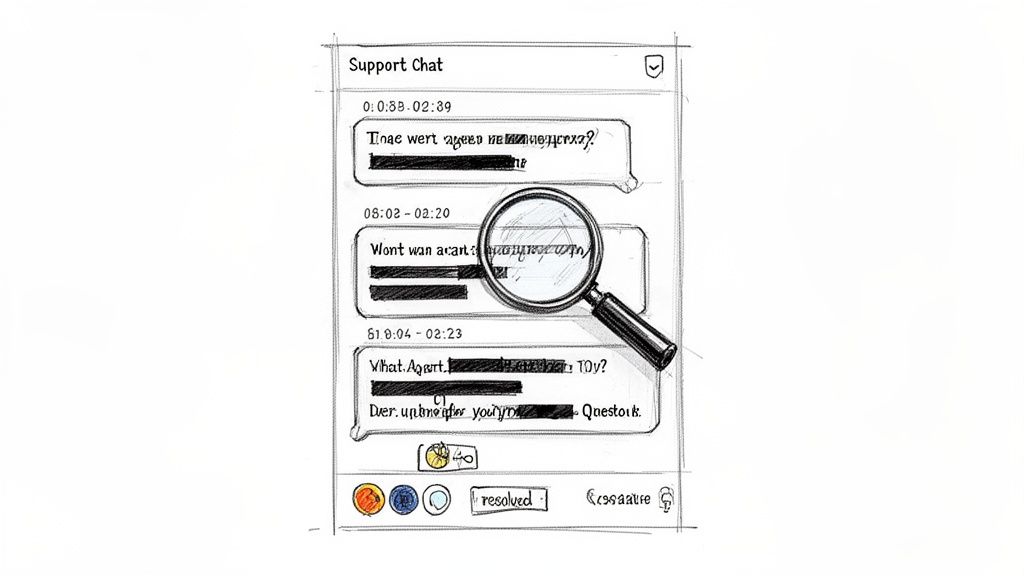
This granular data is a goldmine for identifying common friction points and product knowledge gaps. For MagicalCX users, analyzing transcripts reveals high-volume, repetitive inquiries that are prime candidates for automation, freeing human agents to focus on complex, high-value conversations that require a human touch.
Support transcripts provide a direct, unvarnished look into your customers' worlds, offering a roadmap for both operational and product improvements. A SaaS company, for example, analyzed its onboarding support chats and discovered that new users repeatedly asked, "How do I integrate with Shopify?" This wasn't just a support query; it was a clear signal of a gap in their self-service resources.
Actionable Insight: The company built a MagicalCX guided workflow that proactively walks new users through the Shopify integration process. This not only reduced support ticket volume by 30% for that specific issue but also improved new user activation rates by removing a critical point of friction early in the customer journey.
Similarly, an e-commerce brand's analysis of 500 support transcripts revealed that 40% of all inquiries were related to their returns process. This data highlighted a massive operational inefficiency. Automating the entire returns workflow with an AI-powered system reduced manual agent involvement by over 65%, cutting costs and improving customer satisfaction with a faster, more consistent process.
Watching a user interact with your product or website provides some of the most visceral and unfiltered Voice of Customer (VoC) data available. Usability testing captures real-time reactions, verbalized frustrations, and moments of delight as customers attempt to complete specific tasks. These direct quotes and behavioral observations go beyond what surveys can capture, revealing the unspoken friction points in a user's journey.
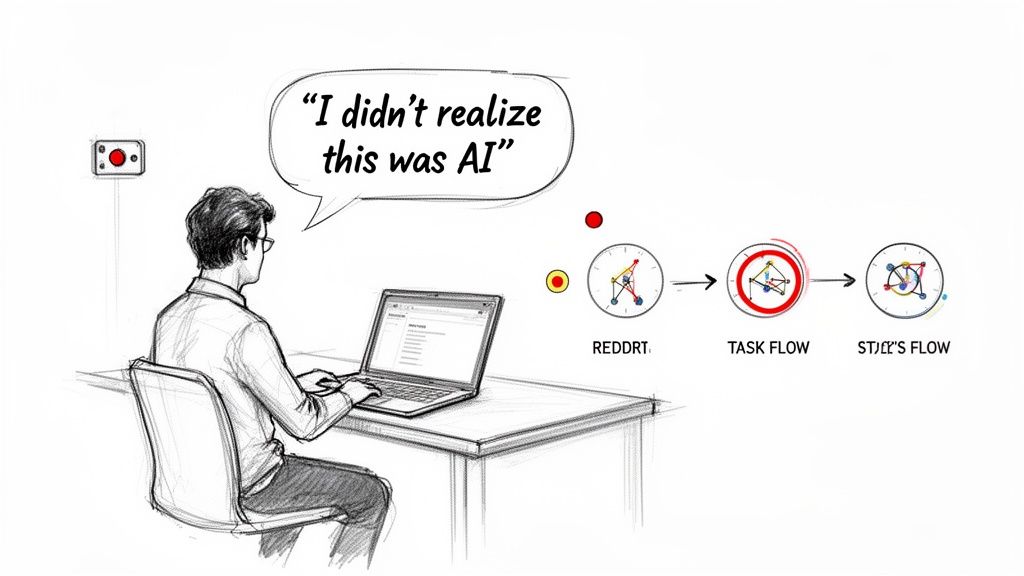
For MagicalCX users, usability tests are crucial for validating whether an AI-driven support flow feels natural and genuinely helpful. Seeing a user hesitate or hearing them say, "Wait, what does this mean?" provides direct, actionable feedback to refine automated conversational experiences, making them more intuitive and human-like.
This type of VoC feedback is less about statistical significance and more about identifying high-impact design and workflow flaws. An e-commerce company testing a new automated returns process heard a user exclaim, "The return process took 3 steps in the old system. With this, it's one confirmation. I was done in 30 seconds." This quote became a powerful validator for the efficiency gains of their new workflow.
Actionable Insight: A contact center heard a common pain point during usability tests: "Why do I have to explain my issue twice-once to the chat, once when I get transferred?" This powerful quote directly highlighted the need for conversational memory preservation. Implementing a MagicalCX workflow that passes the full chat context to a human agent eliminated this repetitive step, dramatically improving the customer experience and reducing average handle time by over 45 seconds.
Another powerful example came from a FinTech company testing its new AI chat. A user was observed almost closing the window, but then the AI proactively offered a solution. The user remarked, "I almost closed the chat because it felt robotic, but then it asked exactly what I needed. That changed my mind." This insight validated the importance of empathy-first AI timing and proactive assistance.
Social media and community forums like Reddit, Twitter, and LinkedIn are vast, real-time focus groups. Unlike solicited feedback, these mentions are organic, capturing raw, unfiltered customer sentiment in moments of high emotion. Monitoring these channels provides a direct line into public perception, competitive weaknesses, and emerging trends, making it an indispensable source of voice of customer examples.
These public conversations reveal authentic customer language and peer-to-peer discussions that significantly shape brand reputation. For MagicalCX users, social listening is crucial for understanding how customers perceive automated support in the wild, identifying where AI-driven interactions are celebrated for their speed or criticized for a lack of empathy.
Social mentions are more than just noise; they are strategic signals for product, marketing, and support teams. A SaaS company, for example, monitored a Reddit thread where users complained about a competitor's confusing AI chatbot. The comments highlighted a specific pain point: the bot couldn't understand context across multiple queries.
Actionable Insight: The company leveraged this competitive intelligence to inform their marketing messaging. They launched a campaign highlighting their MagicalCX-powered bot's superior conversational memory, directly addressing the market's frustration and positioning their brand as the more empathetic, intelligent solution. This led to a 12% increase in demo requests from that marketing channel.
An e-commerce brand noticed a positive tweet celebrating a two-minute support resolution via WhatsApp. This single post validated their investment in an omnichannel strategy and provided powerful, user-generated content for their marketing team to amplify, showcasing their commitment to fast, convenient service.
While surveys provide quantitative data, customer interviews offer deep, qualitative narratives that surveys can't capture. These one-on-one conversations, typically lasting 15-60 minutes, go beyond surface-level feedback to uncover the motivations, emotions, and detailed context behind a customer's experience. They are a powerful form of voice of customer examples because they reveal the "why" behind customer behavior in rich detail.
For MagicalCX users, interview excerpts can pinpoint the exact moment an AI interaction created trust or caused frustration. For instance, a customer might explain, "When I was frustrated about a return delay, the support message felt genuine, not templated. It made me feel less angry even though the wait was the same." This reveals the immense value of empathy in automated responses.
Customer interviews provide the nuanced story behind the data points. A SaaS company, for example, conducted interviews with users who had recently interacted with their AI support. They discovered a recurring theme: users valued accuracy and context far more than just speed. One customer's comment was particularly revealing.
Actionable Insight: The customer stated, "What changed my mind wasn't just faster support-it was that the agent already knew I'd been frustrated before. They didn't make me repeat myself. That felt like they actually cared." This insight drove the company to prioritize MagicalCX’s conversational memory feature, ensuring its AI always had full context, which significantly boosted user trust and satisfaction.
Similarly, a FinTech company learned from interviews that security concerns were a major barrier to adopting new AI-driven features. Hearing a customer say, "When the AI offered an upgrade, I almost said no. But it explained why it was safe... I felt protected, not sold to," validated the need for proactive, transparent communication in all automated interactions.
Case studies and success stories are powerful, structured narratives that transform a single customer's experience into a compelling Voice of Customer asset. They go beyond simple feedback to document a customer’s entire journey: their initial challenge, the solution they implemented, and the measurable results they achieved. This form of VoC combines quantitative data with qualitative storytelling, providing proof of value.
For businesses evaluating solutions like MagicalCX, these stories offer tangible evidence of ROI. They demonstrate how automation can solve specific, real-world problems, such as reducing onboarding friction for a SaaS company or cutting support costs for an e-commerce brand, making the potential impact concrete and believable.
Case studies are more than just marketing collateral; they are strategic tools that validate a product's impact and guide product development. For example, a mid-market contact center was struggling with high agent attrition (35% annually) and a steep cost-per-contact of $4.50. Their success story became a critical VoC example.
Actionable Insight: The case study documented how implementing MagicalCX's AI-first workflows not only reduced their cost-per-contact to $2.80 but also lowered agent attrition to 22%. This dual-metric success story provided the product team with clear evidence that improving the agent experience directly correlates with financial efficiency, justifying further investment in agent-assist AI features.
Another example is a FinTech firm that used an automation case study to secure executive buy-in for a broader digital transformation. The story, which highlighted a 60% reduction in manual compliance checks, turned an operational win into a strategic argument for company-wide innovation.
Structured surveys are a powerful method for collecting standardized Voice of Customer (VoC) data at scale. Deployed via email, in-app pop-ups, or post-interaction links, these questionnaires use a mix of quantitative metrics (like rating scales and multiple-choice questions) and optional qualitative fields to measure customer sentiment on specific aspects of their experience, from product features to support quality.
This quantitative approach allows businesses to track key metrics over time and analyze trends with statistical confidence. For MagicalCX users, surveys are invaluable for benchmarking performance before and after automation rollouts. They provide hard data on improvements in perceived support speed, quality, and overall customer satisfaction across large segments of the user base.
Survey responses provide clear, measurable signals that guide strategic decisions and validate the impact of CX initiatives. A SaaS company, for example, wanted to gauge the perceived quality of its support interactions. A pre-rollout survey showed that only 58% of users felt their interaction was "personalized and empathetic."
Actionable Insight: After implementing a MagicalCX workflow that used customer data to personalize automated responses, the company re-ran the survey. The score jumped to 76%, an 18-point increase that closed the gap with their human agent baseline and provided clear ROI for the automation investment. This tangible data secured the budget for expanding the AI program.
Another D2C brand used a post-purchase survey to ask, "How quickly did you receive a response to your inquiry?" on a 1-5 scale. Before implementing an AI triage system, their average score was 3.2. After MagicalCX began instantly routing inquiries, the score climbed to 4.6, a 44% improvement that directly addressed a major point of customer friction.
| Source | Implementation complexity 🔄 | Resource requirements ⚡ | Expected outcomes 📊 | Ideal use cases 💡 | Key advantages ⭐ |
|---|---|---|---|---|---|
| NPS Comments | Low 🔄 — simple survey send, but text analysis needed | Low ⚡ — inexpensive to collect; needs text analytics at scale | 📊 Quick sentiment snapshot + trend indicator; actionable themes ⭐ | Benchmarking, executive tracking, post-touchpoint validation 💡 | Industry-standard metric; scalable and tied to loyalty ⭐ |
| Product Reviews & Ratings | Low 🔄 — public platforms, straightforward collection | Medium ⚡ — monitoring across sites, moderation effort | 📊 Social proof, SEO lift, feature gaps and competitive signals ⭐ | Acquisition, competitive research, marketing testimonials 💡 | High credibility (third‑party); detailed user examples ⭐ |
| Support Transcripts & Chat Logs | High 🔄🔄🔄 — large volumes, transcription & redaction | High ⚡ — transcription, compliance, analyst time | 📊 Operational insights, automation candidates, training data ⭐ | Conversational AI training, QA, automation design 💡 | Verbatim customer language; rich model-training source ⭐ |
| Usability Test Quotes & Observations | High 🔄🔄🔄 — planning, moderation, recordings | High ⚡ — recruitment, lab/tools, researcher effort | 📊 Task-level UX findings; clear friction points and behavior evidence ⭐ | UX redesign, flow validation, empathy and timing checks 💡 | Reveals real behavior and subtle usability issues ⭐ |
| Social Media Mentions & Community Posts | Medium 🔄🔄 — real-time monitoring, noisy signal | Medium ⚡ — social listening tools, rapid response team | 📊 Real-time reputation signals; viral risk/opportunity ⭐ | Crisis detection, influencer discovery, competitive monitoring 💡 | Authentic, timely feedback with amplification potential ⭐ |
| Customer Interview Excerpts | High 🔄🔄🔄 — scheduling, skilled interviewing | High ⚡ — time, incentives, transcription & analysis | 📊 Deep motivations and narratives for positioning ⭐ | Product‑market fit, messaging, priority setting 💡 | Rich stories and quotes that explain “why” customers act ⭐ |
| Case Study Excerpts & Success Stories | Medium 🔄🔄 — customer collaboration and approval | Medium-High ⚡ — interviews, writing, design, legal review | 📊 Demonstrable ROI and proof points for sales/marketing ⭐ | Enterprise sales, prospect persuasion, sector-specific proof 💡 | Concrete ROI metrics and credible third‑party validation ⭐ |
| Survey Responses & Quantitative Feedback | Low-Medium 🔄🔄 — survey design + distribution cadence | Medium ⚡ — survey tools, sampling, analysis | 📊 Statistically robust trends, segmentation, KPI tracking ⭐ | Broad satisfaction tracking, pre/post product launches, cohorts 💡 | Scalable, comparable metrics enabling trend analysis ⭐ |
We've explored a wide array of voice of customer examples, from the detailed verbatims in NPS comments to the raw, unfiltered feedback found in support transcripts and social media mentions. Each example represents more than just a data point; it's a direct line to your customer's experience, a story waiting to be understood, and an opportunity for strategic action. The true power of a VoC program lies not in the volume of feedback you collect but in the velocity and intelligence with in which you act upon it.
The journey from passive listening to proactive engagement is the defining characteristic of a modern, customer-centric organization. It's the difference between knowing a customer is frustrated and automatically routing them to a specialized retention team before they even consider churning. It’s the gap between seeing a feature request in a product review and systematically tagging it, prioritizing it with product teams, and closing the loop with the customer once it’s live.
To truly operationalize the voice of the customer, focus on three core pillars:
Transforming your organization doesn't happen overnight. Start small, prove the value, and build momentum.
By treating every piece of customer feedback as a strategic asset, you move beyond reactive problem-solving and begin building a proactive, resilient, and deeply empathetic business. The voice of customer examples we’ve covered are your roadmap. They provide the raw material to not only improve your product and service but to build an operational engine that anticipates needs, personalizes experiences, and turns customer-centricity into your most significant competitive advantage and a powerful driver of sustainable growth.
Ready to turn your customer feedback into an automated, revenue-driving engine? MagicalCX uses empathy-first AI to understand customer intent from any channel and orchestrates intelligent, personalized actions that build loyalty and scale support. See how you can transform your VoC program from a listening post into an action-oriented growth center by visiting MagicalCX today.


