See your AI teammate in action now
Ready to make support faster, kinder, easier and help customers feel good about choosing you?
PS: Sales improves too...
No credit card required
14 days free trial
DIY or Guided setup
Ready to make support faster, kinder, easier and help customers feel good about choosing you?
PS: Sales improves too...
No credit card required
14 days free trial
DIY or Guided setup
Manish Keswani

Improving your Net Promoter Score really boils down to a simple, repeatable cycle: diagnose the root causes behind your current score, take targeted action to fix the rough spots, and consistently follow up with your customers. It’s less about obsessing over a number and more about building a system that turns customer feedback into real, tangible improvements.
Trying to raise your Net Promoter Score isn't a one-and-done project. It’s a fundamental shift in how your business listens and responds to customers. The score itself is just a symptom of your overall customer health; the real work starts when you dig deeper than the number and start diagnosing the specific experiences that create your detractors, passives, and promoters.
This playbook is designed to walk you through that exact process. We're going to sidestep the often-misleading industry benchmarks and instead focus on what a ‘good’ score actually means for your business and its unique customer base. Lasting improvement comes from sifting through the qualitative feedback to find the hidden patterns and taking decisive action.
The journey to a better NPS always begins by identifying the precise moments where your customer experience is breaking down. These friction points look different depending on your business, but they are always specific and measurable.
By pinpointing these specific, actionable problems, you can stop guessing and start building targeted solutions. This continuous cycle of listening, understanding, and acting is what really moves the needle on NPS.
The goal is to transform NPS from a passive report card into an active, operational tool. It should become a compass that guides your product, support, and marketing teams toward creating experiences customers genuinely want to tell their friends about.
This simple, continuous process for improving your NPS can be visualized in three core stages: Diagnose, Act, and Improve.
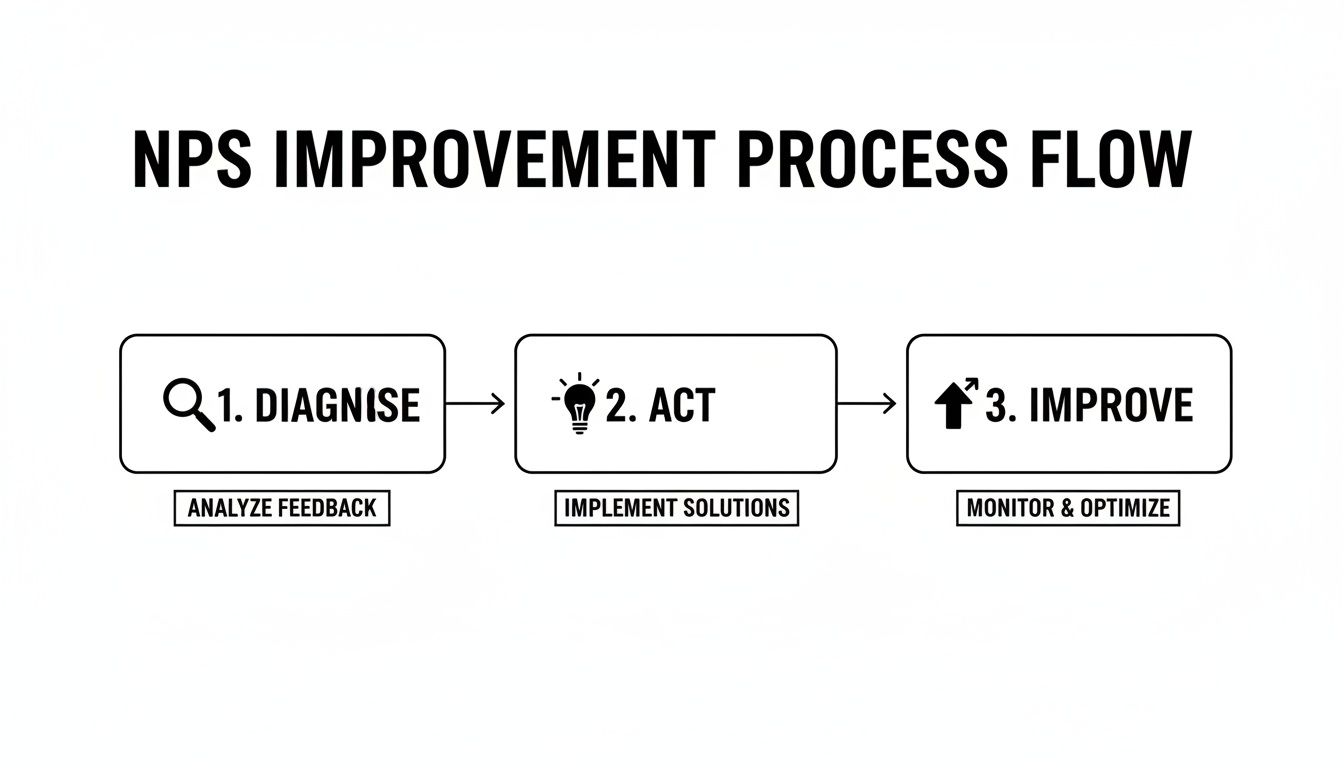
This flow highlights that improving your score is an ongoing cycle, not a one-time fix. To set realistic goals within this cycle, it helps to understand what the different score ranges actually mean in practice.
Here’s a quick breakdown to help you benchmark your performance and set meaningful targets.
| NPS Score Range | Performance Level | What It Means For Your Business |
|---|---|---|
| Below 0 | Needs Improvement | You have more detractors than promoters, signaling significant issues in the customer experience that need urgent attention. |
| 0 - 30 | Good | A positive score is a solid foundation. You have more happy customers than unhappy ones, but there's plenty of room to grow. |
| 31 - 70 | Great | Customers are generally loyal and satisfied. Your focus should be on maintaining this level and fine-tuning the experience. |
| 71 - 100 | Excellent/World-Class | You're a leader in customer experience. Your customers are true brand advocates, driving organic growth. |
While any score above 0 is considered healthy, achieving scores of 50+ signals exceptional customer loyalty. This isn't just a vanity metric; it's tied to real business outcomes. For instance, organizations with highly engaged employees also see 21% higher profits, showing how internal culture fuels external success. You can dive deeper into the data on what makes a good NPS score and see how it directly connects to your bottom line.
Your Net Promoter Score is a snapshot, not the full picture. That single number tells you what customers are feeling—but it won’t reveal why they feel that way. To move the needle, you need to pair the quantitative with the qualitative and dig into the stories behind each rating.
This diagnostic work matters now more than ever. A recent Forrester survey found NPS fell in 20 out of 39 industry-country combinations, underscoring a widespread need to sharpen customer experience efforts. Yet, industries like Healthcare and Ecommerce saw meaningful lifts by investing proactively in CX programs—proof that focused strategies can flip negative trends.
A headline NPS often hides big swings inside your customer base. Break your score into logical buckets to pinpoint opportunities and pain points at a granular level.
• Customer Lifecycle Stage: Are newcomers less enthusiastic than longtime users? A dip in NPS from 10 to -5 in the first 30 days could flag major onboarding gaps.
• Product Line Or Service Tier: Is one subscription plan underperforming? If your 'Pro' plan has an NPS of 50 while your 'Basic' plan sits at 15, you know where to investigate. Recurring complaints around a specific feature might signal a design or pricing issue.
• Support Channel Interaction: Compare NPS from customers who self-serve (NPS 40) against those who phone in (NPS 5). Large gaps often highlight friction points in your support workflow that need immediate attention.
Imagine a SaaS vendor discovering its enterprise clients rave (NPS of 60) while small businesses gripe (NPS of -10). Instead of overhauling the entire platform, that contrast steers you to tailor improvements where they matter most, like creating a simpler onboarding flow for the SMB segment.
Shifting from a single NPS figure to a segmented breakdown is like swapping a fuzzy photo for HD—suddenly, you see exactly where to focus.
The free-text response to “What’s the primary reason for your score?” is pure gold. But mining dozens or hundreds of comments at random won’t get you there. You need a structured, actionable approach.
Start by tagging each comment with keywords that match your biggest areas of interest: “shipping,” “UI,” “pricing,” “agent knowledge,” “bug,” and so on. Over time, those tags reveal the issues your customers mention most frequently.
Practical Example: Theme Analysis
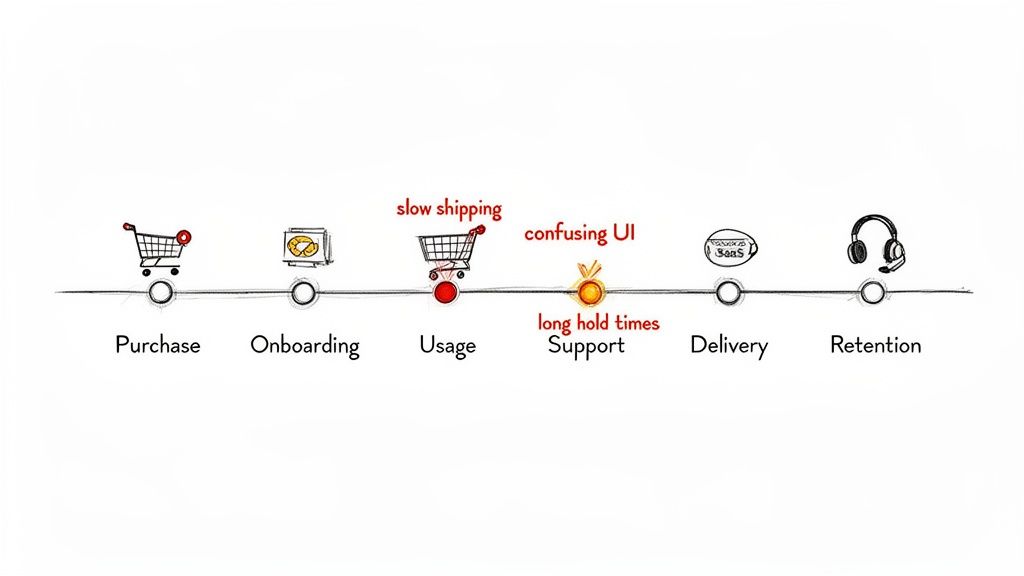
• An E-commerce Brand finds 70% of detractor comments mention “slow shipping” or “damaged box,” prompting an immediate review of warehouse and carrier partners. Action: Renegotiate SLAs with their primary carrier.
• A SaaS Platform notices a surge in “confusing UI” after a major feature launch, signaling a quick-win redesign for the product team. Action: Schedule a usability testing session with five users for the following week.
• A Contact Center sees “long hold time” appear three times more often than any other complaint, making it the top target for staffing or workflow tweaks. Action: Adjust agent schedules to better align with peak call volume hours.
By quantifying your qualitative feedback, you transform vague grumblings into a clear, prioritized roadmap. The right customer experience management tools can automate tagging, surface trends instantly, and free your team to act on those insights—fast.
You've pinpointed the 'why' behind your NPS score. Now for the fun part: deciding what to actually do about it. Raw feedback is just a starting point. The real magic happens when you turn those customer comments into a concrete plan for improvement, one that directly tackles the pain points dragging your score down.
The most effective fixes usually fall into one of three buckets: fixing your operations, improving your product, and building proactive customer experiences. Each one gives you a different lever to pull to boost your NPS.
A lot of low NPS scores are just symptoms of a broken process or a clunky product. The best place to start is by looking at the tangible, day-to-day interactions that are obviously frustrating people.
Operational Fixes are all about your internal processes and workflows.
Product & UX Fixes focus on the product or service itself.
Fixing problems is good. Preventing them from ever happening is even better. This is where you can get really smart with technology and process design to create a customer journey that just works.
This is an area where modern tools can make a huge impact. For instance, using guided workflows in your support system can automate common but tricky requests, like processing a return or downgrading a subscription. This ensures every customer gets the same fast, consistent experience, which cuts down on the human errors that create detractors.
Another game-changer is conversational memory. Instead of making customers re-explain their entire life story every time they contact you, a system like MagicalCX remembers every past interaction across every channel. This lets your team provide context-aware support that anticipates what the customer needs, often solving a problem before it even escalates. It can turn a potentially negative interaction into a surprisingly delightful one.
The goal here is to move away from a reactive, "break-fix" model. You want to get to a point where you're proactively designing friction out of the customer journey from the very beginning. This doesn't just raise your NPS; it also lowers your support costs.
To help you connect the dots, here’s a look at common issues that create detractors and the kinds of solutions that actually move the needle.
| Business Type | Common Detractor Driver | High-Impact Intervention Example |
|---|---|---|
| E-commerce | "My package was late/lost." | Re-evaluate shipping carriers and renegotiate SLAs for guaranteed delivery windows. Implement proactive SMS/email notifications for delays. |
| SaaS | "The onboarding process was confusing." | Redesign the in-app welcome tour. Create a "Getting Started" video series. Offer a 1:1 onboarding call for premium-tier customers. |
| Contact Center | "I had to call three times to fix my issue." | Invest in agent training for first-contact resolution. Implement a quality assurance program that scores calls based on FCR, not just speed. |
| Mobile App | "The app crashes every time I try to check out." | Prioritize bug-fix sprints over new feature development. Increase automated testing coverage for critical user paths like login and payment. |
| Retail | "The return process was a nightmare." | Introduce a QR-code-based, no-box-needed return option with a partner like Happy Returns. Clarify the return policy on the website. |
These are just examples, of course, but they show how a specific customer complaint can point directly to a specific, actionable fix.
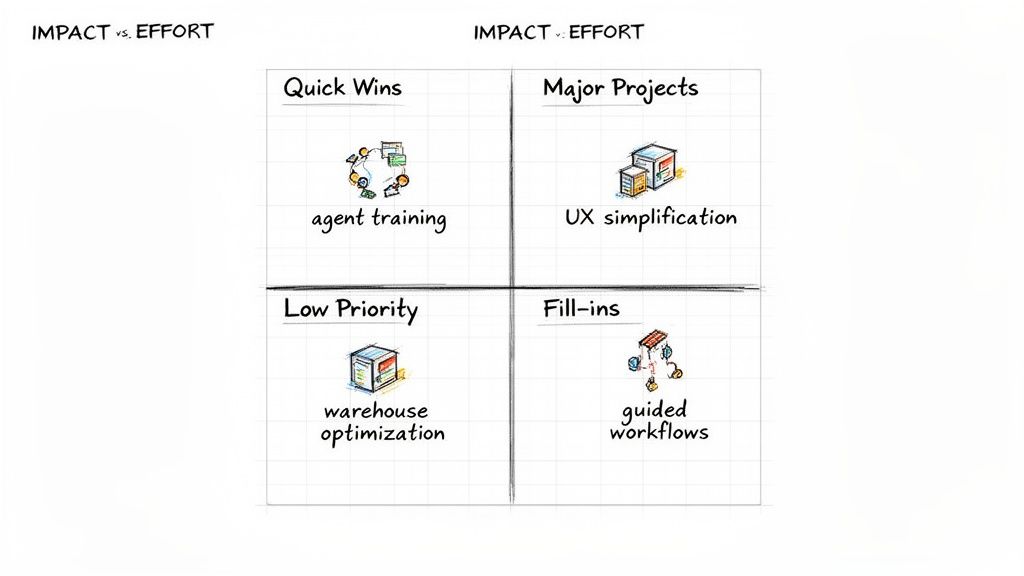
You’ll likely end up with a long list of potential fixes, and you can't tackle everything at once. This is where a simple Impact vs. Effort matrix becomes your best friend. It’s a straightforward framework for sorting your ideas so you can focus on what really matters.
Divide your initiatives into four quadrants:
This kind of structured thinking forces you to put your limited resources where they’ll have the biggest effect. Remember, execution is everything. Industry benchmarks show the median NPS is around 42, but the gap between the best and the rest within the same industry is huge. For example, manufacturing companies range from an NPS of 29 to 75. That massive difference comes down to a consistent, prioritized investment in the customer experience. You can dive deeper into NPS benchmarks and industry performance to see how a relentless focus on execution is what truly separates the leaders from the laggards.
Collecting feedback is just the start. The real magic—and the real work—begins with what you do next. A dashboard full of NPS data is useless if you don't act on it. Closing the feedback loop is what transforms a bad experience into a loyalty-building moment and stops frustrated customers from walking out the door.
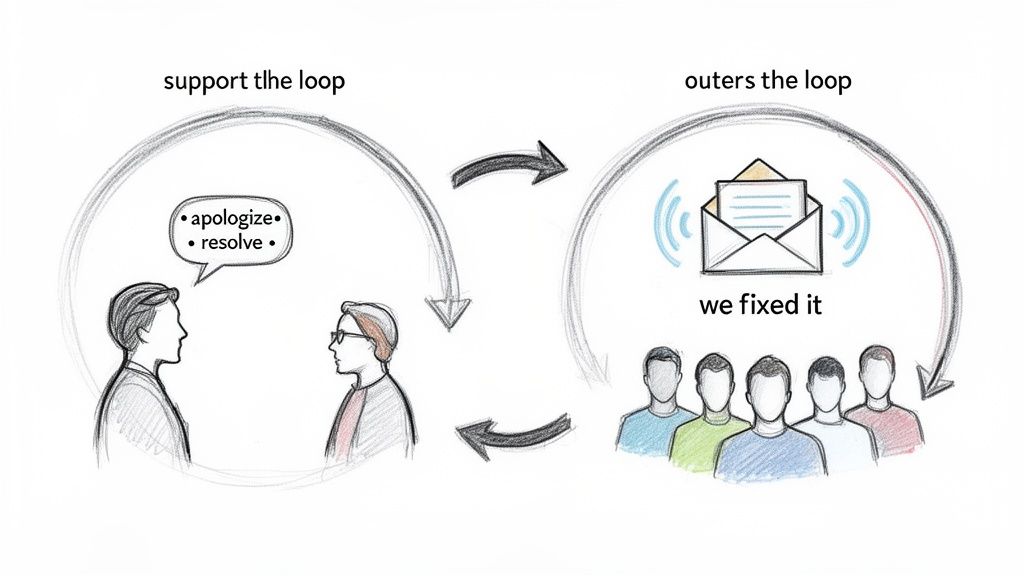
Think of this process on two levels: the immediate, personal response and the wider, systemic fix. You absolutely have to nail both if you're serious about improving your Net Promoter Score.
The inner loop is all about that personal, one-on-one follow-up with a customer. This is non-negotiable for Detractors, but it's also a golden opportunity with Passives and even Promoters. Your goal is to react fast, listen hard, and solve the specific problem that left them unhappy.
You'd be surprised how a quick, genuine response can completely turn a situation around. Research has shown that customers whose problems are solved promptly can become even more loyal than those who never had an issue to begin with.
Here’s a practical workflow you can implement today:
A Detractor's feedback isn't just a complaint to be managed. It's a gift—a raw, unfiltered look at a friction point in your business. That insight is pure gold.
While the inner loop is about putting out individual fires, the outer loop is about fire prevention. This is where you zoom out, analyze all the feedback to spot recurring themes, and then—this is the crucial part—tell your customers about the systemic changes you've made.
This step proves you're not just hearing them; you're listening and evolving. Honestly, it's one of the most powerful long-term drivers for improving your Net Promoter Score.
Here's what that looks like in the real world for an e-commerce brand:
This proactive move accomplishes two massive things. First, it makes those customers feel genuinely valued. Second, it gives former Detractors a compelling reason to give you another shot, reassuring them that the problem is gone for good. By consistently fixing and communicating, you build a rock-solid reputation for caring that will naturally create more Promoters.
An NPS program that actually moves the needle isn't a one-off project. It's a living, breathing system you build for constant learning and improvement. Once you've dug into the feedback, designed some fixes, and followed up with customers, the real work begins: building the engine that measures what's working and scales it across the entire business. This is how you prove your efforts are paying off and make sure the customer's voice is heard in every decision.
Static spreadsheets and monthly reports are relics of the past. If you want to see the real impact of your changes as they happen, you need live dashboards that track NPS in near real-time. The trick is to slice and dice this data using the same drivers you pinpointed in your initial diagnosis.
This direct line of sight connects your actions to customer reactions.
For a Contact Center: Let's say you just launched a new training module for agents on first-contact resolution. Your dashboard should let you filter NPS scores specifically from customers who've spoken with support. Actionable Insight: If you see that score start to tick upward from 15 to 25 in the weeks after the training, you've got solid evidence your investment is working.
For an E-commerce Brand: After getting feedback that your checkout process is a nightmare, your dev team ships a simplified new flow. Actionable Insight: By keeping a close eye on the NPS from first-time buyers after the launch, you can immediately see if their satisfaction is higher than that of the previous cohort. If NPS for this group jumps from 5 to 30, you have a clear win.
Your dashboard should become the single source of truth for customer sentiment. It transforms NPS from a historical metric into a live, operational tool that answers the most critical question: "Are the things we're doing actually making customers happier?"
Seeing a trend on a dashboard is great, but correlation isn't causation. To be absolutely sure which changes are making a real difference, you need to run controlled experiments, like A/B tests. This scientific approach takes the guesswork out of the equation and gives you the confidence to double down on what works.
Practical Example: A/B Testing Retention Offers
This experimental mindset is a key part of truly measuring customer service performance beyond just the basic metrics.
A powerful NPS program can't be siloed in the customer support department. To make a real impact, customer feedback has to become part of the company's DNA. This means creating clear, repeatable processes that involve everyone.
Here’s how to make it happen:
When you build these structures, you ensure the customer's voice isn't just a whisper—it's a guide that steers your product roadmap, sharpens your marketing, and smooths out your operations. Your NPS program becomes less of a report card and more of a growth engine.
As you start digging into your Net Promoter Score, you're bound to run into some questions. That’s a good thing—it means you're taking it seriously. Improving your NPS isn't a one-and-done project; it's an ongoing process. To keep you moving forward, here are some straight-up answers to the questions we hear most often from teams trying to turn customer feedback into real, lasting loyalty.
This is a big one, and the honest answer is: it depends entirely on your business. There's no magic number, but there are some solid rules of thumb to get valuable feedback without annoying your customers.
For businesses built on individual transactions, like an e-commerce store, the sweet spot is usually a few days after the product arrives. That gives the customer time to actually use it, but the memory of the purchase is still fresh. On the other hand, if you're a SaaS company or another subscription-based business, a quarterly survey often works best to get a consistent pulse on overall customer health.
Beyond those regular check-ins, you can get incredibly valuable insights by triggering surveys based on specific customer moments.
Whatever cadence you choose, the most important thing is consistency. We always recommend setting a "cooldown" period. Make sure the same customer isn't getting a general relationship survey more than once every 90 days to avoid survey fatigue.
Drop everything and close the loop with that person, fast. A score between 0 and 6 isn't just a bad number; it's a fire alarm. That customer is screaming that they've had a terrible experience, and they are a major churn risk. Your response needs to be quick and human.
A prompt, genuine follow-up from a real person can completely change the dynamic. It can de-escalate frustration and, in many cases, even be the first step to winning them back. Your goal isn't to get defensive or prove them wrong. It's to listen, figure out what went wrong, and own the problem.
A low score is a customer raising their hand to say, "I'm about to leave, and here's why." Ignoring that is a massive missed opportunity. A real, empathetic response shows them their feedback actually matters, and that’s how you start rebuilding trust.
Your front-line team needs a dead-simple playbook for this. The second a detractor score hits, it should trigger an alert and get assigned to someone who has the power to reach out, apologize, and lay out a clear plan to make things right. That personal touch makes all the difference between a customer lost forever and a second chance.
Low response rates can be a killer. If only a handful of people are responding, you can’t be sure if the feedback you're getting is truly representative or just the opinion of a vocal minority. Getting more responses isn't about just sending more emails; it's about being smarter with your approach.
First, meet your customers where they are. Email is the default, but it's not always the best channel.
Next, make the survey ridiculously easy to complete. The classic two-question NPS survey (the 0-10 score and the open-ended "why?") is popular for a reason—it’s fast and respects the customer’s time. Every single extra question you add will cause more people to bail.
Finally, get your timing and messaging right. Send the survey while the experience is still top-of-mind. Frame your request by telling them why you're asking and what's in it for them—a better experience. Over time, as you start closing the loop and showing customers you're making changes based on their feedback, they'll become far more willing to share their thoughts in the future.
Ready to turn customer feedback into your biggest growth driver? MagicalCX uses an empathy-first AI to automate support, identify friction points, and deliver the personalized experiences that create promoters. See how it works.


