See your AI teammate in action now
Ready to make support faster, kinder, easier and help customers feel good about choosing you?
PS: Sales improves too...
No credit card required
14 days free trial
DIY or Guided setup
Ready to make support faster, kinder, easier and help customers feel good about choosing you?
PS: Sales improves too...
No credit card required
14 days free trial
DIY or Guided setup
Learn how to improve customer experience in 2026, covering CX audits and KPIs, empathy-first AI design, omnichannel conversation memory, automation playbooks, and human handoffs.
Manish Keswani

Summary by MagicalCX AI
With 77% of customers reporting a product or service problem in 2025 and 93.4% preferring a human over a bot, the fastest path to CX-driven growth in 2026 is empathy-first AI that delivers 24/7 self-service while preserving seamless, context-rich human handoffs.
To truly improve customer experience, you have to move beyond outdated, reactive support. The goal is to build a proactive, empathy-first model. This isn't just about using technology for efficiency; it's about using it to genuinely understand and anticipate customer needs. Every single interaction should feel positive and personal, building the kind of loyalty that lasts.
Let's be direct: customer expectations have skyrocketed, and the old ways of doing support are completely broken. Long waits on hold and robotic, scripted answers just don’t cut it anymore. Today's customers expect fast, personal, and effective help. They have very little patience for anything less.
This isn't just a hunch; the data tells a pretty alarming story. Recent research paints a clear picture of widespread frustration. The National Customer Rage Survey revealed that in 2025, a massive 77% of customers had a problem with a product or service in the past year—an all-time high. At the same time, Broadridge found that 71% of consumers feel most companies need to do a much better job with their customer experience.
These aren't just numbers. They represent a huge, growing gap between what businesses deliver and what people actually want.
A big part of this friction comes from what I call the "AI trust gap." Businesses are rushing to adopt AI to manage the flood of support requests, but customers are rightly skeptical. In fact, a whopping 80.6% of people believe AI in support is just a sneaky way for companies to cut costs. Nearly half are willing to cancel their service if a bot is their only option.
The desire for a real human connection is overwhelming. 93.4% of customers would rather talk to a person than a bot. This doesn't mean AI is useless; it means we’ve been using it all wrong. The point isn't to replace your team but to make their jobs easier and make automated support feel less, well, robotic.
This infographic breaks down the strategic shift you need to make—from causing customer frustration to driving real business growth by putting empathy at the core of your AI.

The real insight here? The bridge from frustration to growth is built with a new kind of technology—one designed from the ground up for empathy.
The following table contrasts common CX headaches with the modern solutions that can fix them, showing the clear business benefits of making this shift.
| Common Customer Frustration | Empathy-First AI Solution | Business Outcome |
|---|---|---|
| Getting stuck in bot loops | Seamless human handoff with full context | Reduced churn, higher agent efficiency |
| Repeating information to new agents | Unified customer profiles across channels | Faster resolutions, improved CSAT |
| Impersonal, scripted responses | AI that understands intent and sentiment | Deeper customer connection, more loyalty |
| Limited support hours | 24/7 intelligent self-service automation | Lower operational costs, better accessibility |
By addressing these core frustrations with smarter, more empathetic technology, you're not just solving problems—you're building a competitive advantage.
The answer isn't to ditch automation. It's to make it smarter, more aware of context, and fundamentally more human. When you make this strategic pivot, customer support stops being a cost center and becomes a powerful engine for loyalty and revenue.
When you successfully improve the customer experience, you'll see tangible results across the business:
By balancing the efficiency of AI with a genuine human touch, you can meet modern expectations head-on. This philosophy is the foundation of a strong digital customer experience. For a deeper dive, check out our guide on how to build a superior digital customer experience.

Before you can start fixing things, you need an honest, clear-eyed view of where you actually stand. A real CX audit isn’t about glancing at a dashboard; it's about getting your hands dirty and finding the exact friction points that frustrate customers and drain your resources. The goal is to get out of reactive fire-fighting mode and start proactively designing a better experience.
This whole process kicks off by mapping the entire customer journey. You need to trace every single touchpoint, from a customer’s first-ever visit to their most recent support ticket. Only then will the cracks in the foundation start to appear.
First things first, you need to find out precisely where things are going wrong. Are customers constantly asking about shipping policies? Is one particular feature in your SaaS product generating a flood of support tickets? Your contact drivers are a goldmine for uncovering these hidden pain points.
The real magic happens when you understand the 'why' behind a customer contact. A spike in tickets about "billing errors" isn't the problem itself. The real problem is the confusing checkout flow or the vague subscription renewal email that causes those tickets in the first place.
A simple but powerful way to visualize this is to create a "Friction Log." For each stage of your customer journey, just document the most common issues you see cropping up.
As you dig into this, remember that understanding and improving data quality is absolutely critical. All the feedback, ticket data, and analytics you gather are only as good as the data itself. Clean, well-structured information is what allows you to accurately pinpoint those friction points.
A truly practical CX audit goes way beyond staring at spreadsheets. It means actually putting yourself in your customer’s shoes. This hands-on approach gives you the kind of context that raw numbers can never provide.
Try running through this simple checklist to get a feel for it:
Once you have a handle on the friction points, you need to set Key Performance Indicators (KPIs) to track whether your fixes are actually working. The trick is to avoid vanity metrics. Instead, choose KPIs that directly reflect the health of your customer relationships.
For a deeper dive, you can learn more about measuring customer service performance in our guide.
Here are a few impactful metrics worth tracking:
| Metric | What It Tells You | Why It's Actionable |
|---|---|---|
| First Contact Resolution (FCR) | The percentage of issues solved in a single interaction. | A low FCR often points to gaps in agent knowledge or clunky processes. It tells you where to focus training or tool improvements. |
| Customer Effort Score (CES) | How easy it was for a customer to get their issue resolved. | A high effort score is a direct predictor of frustration and churn. It shines a light on overly complex customer journeys. |
| Ticket Deflection Rate | The number of issues resolved via self-service without an agent. | This shows how effective your knowledge base and automation are, helping you directly measure the ROI of your self-service efforts. |
By focusing on these practical audits and actionable metrics, you build a solid foundation. This data-backed understanding is the essential first step to genuinely improve customer experience and turn your support team into a strategic asset.
Alright, let's move from theory to practice. You've audited your current customer experience, and now it’s time to get your hands dirty and start designing. The focus here? Making your automated conversations feel genuinely human.
This isn't about fooling customers into thinking they're chatting with a person. Far from it. It's about building an AI that's emotionally intelligent, aware of the situation, and speaks in a voice that’s unmistakably yours. The goal is to build real trust, not just crank through support tickets.
An empathy-first AI gets it. It understands that a customer reporting a software bug isn't just a ticket number—they're a frustrated professional whose whole workflow just came to a grinding halt.
So, what separates a run-of-the-mill chatbot from an empathy-first AI? It all comes down to understanding context and intent. A basic bot hears "my order is late" and immediately spits out a tracking link. An empathetic AI, on the other hand, recognizes the anxiety and frustration behind the words.
This means scripting responses that validate the customer's feelings before jumping to a solution. Think of it as the digital version of a great support agent saying, "I can only imagine how frustrating that must be. Let me see what I can do."
The guiding principle is simple: Solve the emotion first, then solve the problem. A customer who feels heard is infinitely more receptive to the solution you provide, even if it’s the exact same one a purely transactional bot would have offered.
For example, a customer's tone and word choice can signal a high-stakes issue. Your AI should be trained to pick up on these cues—like frustration, urgency, or anger—and adjust its own tone in response. We know from experience that analyzing sentiment allows agents (both human and AI) to grasp the situation quickly and prioritize what really matters.
This all sounds great in theory, but what does it look like in practice? Let's walk through two common, high-stress scenarios and see how to handle them with genuine empathy.
Scenario 1: The Dreaded E-commerce Shipping Delay
A customer is (rightfully) upset about a delayed order from your online store.
See the difference? The empathetic response acknowledges the feeling, takes ownership, provides the same core information, and then offers a gesture of goodwill that feels fair.
Scenario 2: The SaaS Service Outage
A user at a software company can't access a critical feature because of an unexpected outage.
This response is specific. It confirms the exact problem, conveys urgency, sets a realistic expectation, and provides a path for more information—all while respecting the user's time. If you want to dive deeper, you can explore the nuances of empathy in customer service in our detailed article.
A truly intelligent "empathy engine" knows the difference between just solving a problem and creating a brand-building moment. Its job isn't just to deflect tickets but to actually strengthen the customer relationship. This means being strategic about when to introduce a helpful offer versus when to simply resolve the issue.
The key is fairness. An offer should feel like a genuine apology or a helpful suggestion, not a clumsy sales pitch.
By designing conversations that are contextually aware and emotionally intelligent, you can transform your AI from a simple tool into a powerful ambassador for your brand.

Here's a simple truth: your customers don't care about your channels. They have a problem and they just want it solved. It doesn’t matter if they start on an Instagram DM, follow up via email, and finally land on your web chat.
When each channel operates in its own silo, you create a disjointed, frustrating mess. That’s a fast track to losing a customer’s trust. The real goal is to move beyond messy multichannel support and achieve true omnichannel orchestration. This isn't just about showing up on different platforms; it's about weaving every interaction into a single, continuous conversation that respects your customer's time.
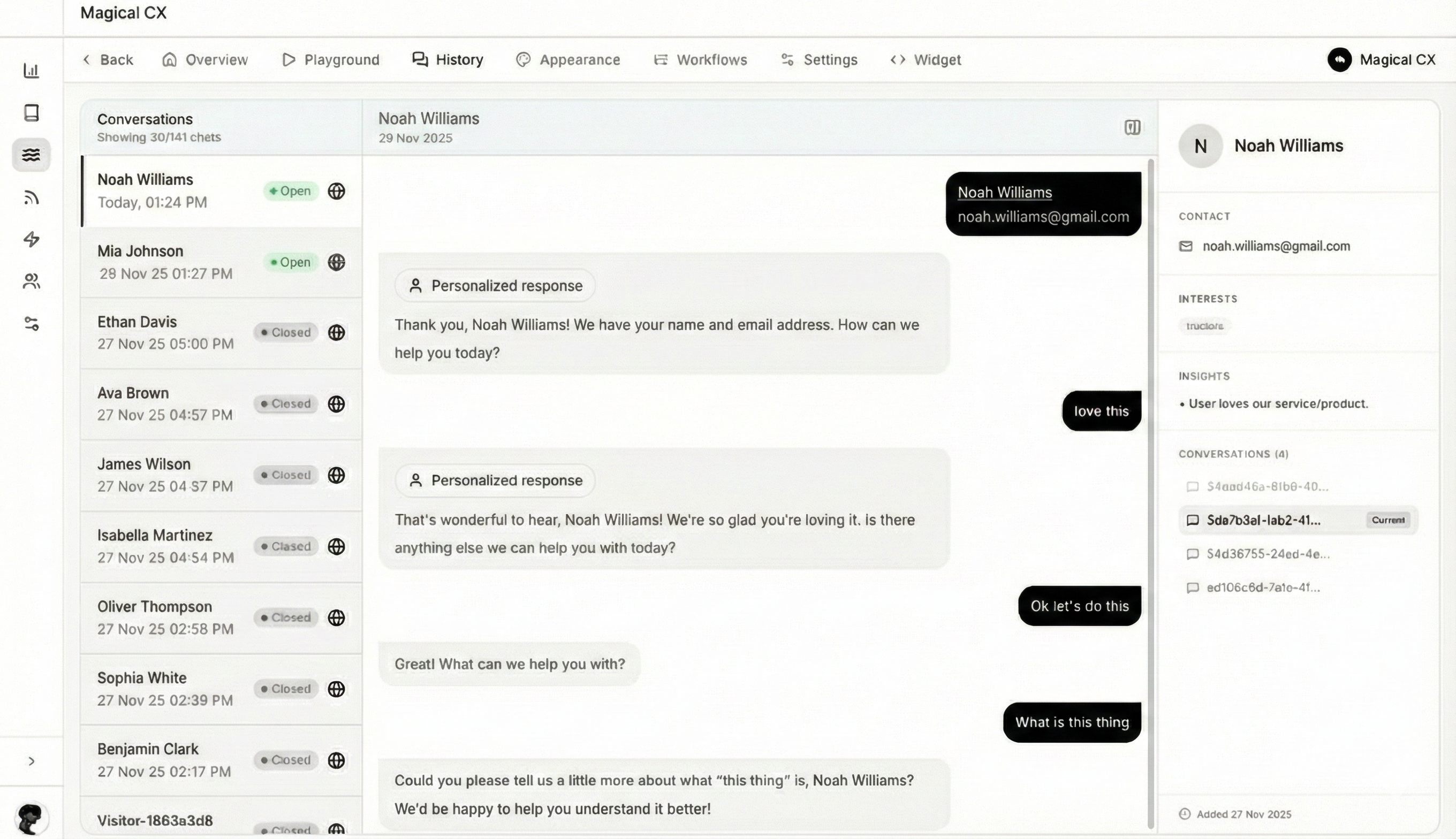
What makes this seamless experience possible? Conversational memory. This is the technology that retains a customer's full interaction history, regardless of where or when it happened. It's the secret to finally killing that dreaded phrase, "Can you start from the beginning?"
Think about this all-too-common scenario:
Without conversational memory, the agent who opens that email is flying blind. They have to ask for the order number all over again, making the customer repeat themselves. But with it, the agent instantly sees the entire Instagram chat and can pick up the conversation exactly where the bot left off.
The goal is to make channel-switching invisible to the customer. For them, it should feel like one single, ongoing dialogue with your brand, not a series of separate, frustrating conversations.
This persistent context is what separates a modern CX from one that’s just getting by. It proves you're organized and, more importantly, that you value your customer's time.
Pulling this off requires the right tools and, frankly, the right mindset. Your support platform has to be powerful enough to consolidate every touchpoint—from social media comments to secure messages—into one unified customer timeline.
Let's imagine how this plays out for a FinTech company:
This fluid experience isn't just a nice-to-have; it builds deep trust, which is absolutely critical in the world of finance. But having the right technology is only half the battle. Your team needs to know how to use it. That's why consistent training customer service teams is completely non-negotiable.
The data tells a compelling story. A few years back, global customer experience excellence saw a 3% average increase, but the real story is that top brands outperformed their market averages by a massive 11%. These leaders get it: consistent, personalized service across every channel is a powerful competitive edge.
This insight helps explain why 80% of organizations had adopted an omnichannel strategy by 2020—a huge jump from just 20% a few years prior. And for these customer-centric companies, the payoff is clear: they are 60% more profitable than their peers who are lagging behind.
Ultimately, building a true omnichannel system is one of the most impactful moves you can make to improve your customer experience. It transforms your support function from a scattered collection of channels into a single, intelligent system that builds loyalty with every single interaction.

Smart automation isn't about getting rid of your support team; it's about making them superheroes. The real goal is to automate the predictable, repetitive customer journeys so your agents can save their brainpower for the complex, high-stakes conversations that actually require a human touch.
When you get this right, you do two things at once: you give customers instant, accurate answers to common questions, and you free up your best people to solve the problems that truly matter. This is how you build a customer experience that can scale without losing its personal feel.
So, where do you start? Look for the high-volume, low-complexity interactions. These are prime candidates for guided workflows that can flawlessly handle multi-step processes, cutting down on both agent workload and customer headaches.
Here are a few playbooks I’ve seen work wonders.
For E-commerce: Painless Returns and Exchanges A difficult returns process is a guaranteed way to lose a customer for life. Instead of making them email you or wait on hold, you can build an automated flow that handles the entire thing.
What was once a major point of friction is now a smooth, self-service experience. The customer gets what they need, right now, and your team has one less ticket to worry about.
For SaaS: Smarter Onboarding and Plan Changes In the SaaS world, a user's first few interactions and their ability to manage their account are make-or-break moments. Automation can be your co-pilot here, guiding users through these crucial journeys.
These automated touchpoints help users find value fast, which is the secret to keeping them around for the long haul.
Automation is great, but it can't solve everything. The real moment of truth is what happens when a bot has to pass the baton to a human. If that handoff is clunky, you’ve just erased all the goodwill you built.
A smooth handoff isn’t a nice-to-have; it’s a necessity.
When a problem calls for human empathy or creative problem-solving, the agent must get the full story. That means seeing every message and every piece of information the customer has already shared. This lets them skip the dreaded, “So, can you tell me what the problem is?” and get straight to a solution.
This is where a unified customer experience platform really proves its worth. It ensures the complete conversation history—including what the bot already tried—is laid out for the agent in a clean timeline. The agent instantly sees the customer's sentiment, their goal, and the steps they've already taken.
The industry is moving this way, and fast. By 2025, it's predicted that 75% of brands will be using AI in their customer experience. And while 94% of business leaders see the potential for self-service, there's a disconnect. Though 88% of contact centers use some form of automation, only 25% have it fully integrated.
With 72% of businesses making customer success a top priority, the platforms that combine powerful automation with flawless human collaboration are no longer optional. As detailed in Nextiva's latest customer service trends report, bridging this gap is critical.
This integrated strategy—automating the predictable while perfecting the handoff for the complex—is how you deliver an experience that feels both incredibly efficient and genuinely personal. It’s the formula for transforming customer support from a cost center into a powerful engine for loyalty.
As you start putting these strategies into practice, you're bound to run into a few common questions. Let's tackle the big ones head-on, so you can move forward with confidence.
This is the question every CX leader gets from their CFO. Proving the return on your customer experience investment isn't about fuzzy feelings; it's about connecting your work directly to the bottom line. You need to speak the language of business: revenue and costs.
Forget vanity metrics. Instead, focus on the financial indicators that leadership actually cares about.
The most powerful business case you can build will hit both sides of the coin: cost savings and revenue growth. Show how automation slashed your support ticket volume and cut average handle time in half, saving on operational costs. Then, point to the increase in upsells from customers who had a stellar support interaction.
When you walk into a meeting with hard data showing lower churn, reduced costs, and higher customer spending, your CX budget is no longer an expense—it’s an investment with a clear return.
For a small team, going omnichannel can feel like trying to boil the ocean. The secret isn't to be everywhere at once. It's to be excellent on the few channels that truly matter to your customers.
First things first: look at your data. Where are your customers actually contacting you? Don't guess. If 90% of your inquiries come from email and web chat, then that’s where you focus. Forget about the other channels for now.
The next step is non-negotiable for a small team: you need a unified platform. A tool that pulls all your chosen channels into one shared inbox is a lifesaver. It stops your team from drowning in a sea of browser tabs and prevents things from falling through the cracks.
Here’s a practical game plan:
This phased approach, built on a central platform, lets you deliver a fantastic omnichannel experience without needing to hire a dozen new people.
This is a big one. The goal is to use AI to augment your human team, not replace them. When you get this right, AI actually makes your support feel more personal, because it handles the boring stuff and gives your agents the context they need to build real rapport.
The foundation is conversational memory. Your AI has to remember every past interaction, on every channel. A customer should never, ever have to repeat themselves. It’s the single biggest factor that makes a bot feel smart instead of robotic.
Next, the AI needs to understand more than just words—it needs to grasp context and emotion. A truly helpful bot can detect frustration in a customer's message and adjust its tone. It won’t offer a chirpy, scripted response to someone who is clearly upset.
Finally, and this is critical, you must design a seamless handoff to a human. The AI needs to know its own limits. When an issue gets too complex, emotional, or sensitive, the system should proactively route the conversation to a human agent—along with the entire chat history. The agent can then jump in without missing a beat, making the whole thing feel like one continuous, intelligent conversation.
Ready to improve customer experience with an empathy-first AI platform? MagicalCX combines conversational memory, smart automation, and seamless human handoffs to transform your support into a scalable, revenue-driving engine. Learn more and see how it works.


