See your AI teammate in action now
Ready to make support faster, kinder, easier and help customers feel good about choosing you?
PS: Sales improves too...
No credit card required
14 days free trial
DIY or Guided setup
Ready to make support faster, kinder, easier and help customers feel good about choosing you?
PS: Sales improves too...
No credit card required
14 days free trial
DIY or Guided setup
Learn how to reduce customer churn by diagnosing churn drivers with cohort analysis, support and usage data, exit surveys, then applying onboarding, proactive support, and automation.
Manish Keswani

Summary by MagicalCX AI
In subscription businesses, even a “manageable” 5% monthly churn compounds into a 46% annual customer loss, so the fastest path to growth is diagnosing churn drivers and boosting retention since just a 2% retention lift can match the profit impact of a 10% cost cut.
If you really want to know how to reduce customer churn, the secret isn't some complex formula. It comes down to one thing: figuring out why your customers are leaving and then giving them a compelling, human reason to stay. This guide will show you how to get ahead of problems instead of just reacting to them, transforming your support team from a cost center into your most powerful engine for growth.

We often talk about churn as just another metric, but it’s more like a silent leak that can sink your entire business. For any company with a subscription model, whether you're a SaaS platform or a direct-to-consumer (D2C) brand, the math is brutal.
A monthly churn rate of 5% might not sound alarming at first. But over a year, that compounds to a staggering 46% loss of your customer base. If that number creeps up to 10% a month, you're on track to lose over 70% of your customers in a single year. The damage adds up fast.
The fix is clear: prioritize retention over acquisition. A mere 2% improvement in retention can deliver the same bottom-line impact as a 10% cut in costs.
This is a fundamental truth that many growing companies learn the hard way: it’s always more profitable to keep the customers you have than to chase new ones. After all, returning customers are known to spend 67% more than new ones. Every customer you save is a massive win for your bottom line.
For decades, we’ve been conditioned to see customer support as a necessary expense. But what if we've been looking at it all wrong? What if your support function is actually your best defense against churn?
An "empathy-first" automation strategy isn’t about replacing your team with bots. It’s about arming them—and your entire system—with the intelligence to see trouble coming and act before it boils over.
Practical Example: Imagine a customer of your project management software is clicking around, clearly struggling to use a key feature like creating sub-tasks. The old way? You wait for them to give up and send a frustrated support ticket. The new way? An AI with conversational memory sees those patterns of struggle and proactively serves up a quick, 15-second tutorial video right inside the app. That small, empathetic gesture doesn't just solve a problem; it prevents a negative experience and quietly reminds the customer of your product's value.
Understanding the cost of churn is the first step. The next is building a practical playbook of methods to reduce subscription churn. The real magic happens when you start mapping the common reasons people leave to specific, intelligent solutions that feel personal, not automated.
To truly get a handle on churn, you have to connect the why (the reason a customer is unhappy) with the how (the perfect intervention to fix it). We’ve found that most churn issues fall into a few common buckets.
Here’s a practical breakdown of the biggest churn drivers and how a modern AI-powered platform like MagicalCX can help you get ahead of each one.
| Churn Driver | Business Impact | MagicalCX Solution & Practical Example |
|---|---|---|
| Poor Onboarding | Customers don't see value and leave within the first 30 days. | Guided Workflows automate step-by-step setup. Example: A user logs in for the first time and is immediately prompted to connect their calendar, creating their first automated scheduling link in under 60 seconds. |
| Reactive Support | Slow response times lead to frustration and a feeling of being ignored. | Agentic Actions instantly resolve common issues. Example: A customer asks "Where is my order?" and the AI immediately pulls tracking info from Shopify and displays it in the chat. |
| Feeling Undervalued | Generic, one-size-fits-all communication makes customers feel like a number. | Conversational Memory provides personalized, context-aware interactions. Example: A returning customer is greeted with, "Welcome back, Jane! Last time we talked about setting up your team. Are you ready to add them now?" |
| Product Friction | Customers struggle with a feature or bug and quietly disengage. | Proactive alerts trigger outreach with helpful resources before a user complains. Example: The system detects a user has tried and failed to export a report three times and automatically opens a chat offering help. |
By pairing the right tool with the right problem, you move from playing defense to playing offense, creating positive experiences that build loyalty and stop churn in its tracks.
Before you can build a retention strategy, you have to play detective. The biggest mistake companies make is trying to fix a problem they don’t truly understand. Simply staring at your overall churn rate is like looking at a single number on a car's dashboard and trying to guess why the engine is sputtering. You need to get your hands dirty and find the real culprits.
This means shifting your focus from a single, scary metric to a detailed diagnosis. We're on a mission to uncover the when and the why behind every cancellation. It’s about blending the cold, hard numbers with the messy, human stories to get a complete picture of where the friction lies.
Your top-line churn number is a symptom, not the disease. To find the root cause, you have to start slicing up your data using cohort analysis. Instead of lumping all lost customers into one massive, anonymous group, group them by when they signed up—the "January 2024 class," the "February 2024 class," and so on.
Suddenly, patterns jump out. You might discover that a huge chunk of your March cohort vanished within the first 45 days. That’s not a random event; it's a bright red flag pointing directly at your onboarding process.
Actionable Insight: If you see a churn spike across several cohorts at the same time, check your company timeline. Did you just change your pricing? Roll out a confusing new feature? The goal is to evolve your thinking from, "Our churn is 5%," to a much more actionable insight like, "Customers on our Pro Plan are 40% more likely to leave in month two if they haven't adopted our 'Reporting' feature." Now you have a specific problem to solve.
Data tells you what is happening, but it rarely tells you why. For that, you need to hear from your customers. This is where you pair your quantitative findings with qualitative insights to get the full story.
Actionable Steps: Here is where to look for qualitative gold:
feature_confusion, billing_issue, or bug_report. Over a month, these tags will reveal your biggest friction points.Interestingly, the reasons customers leave are often predictable. A recent ElectroIQ report found that just three core issues drive 53% of all customer churn: poor onboarding (23%), a failure to build a relationship (16%), and bad customer service (14%). You can dig into more of these industry benchmarks by checking out the full customer retention statistics on ElectroIQ.com.
Once you start merging these data sources, you can create a "Churn Profile" for your business. This isn't just a list of complaints; it's a clear-eyed summary of your top 3-5 churn triggers, each one backed by both numbers and real customer stories.
Practical Example: A D2C subscription box company might find its top churn driver is a rocky post-purchase experience. The data shows a massive drop-off after the second box. Their support chats are full of customers frustrated with confusing delivery tracking, and exit surveys frequently mention "I have too much product." That’s a churn profile you can act on by introducing an option to "skip a month."
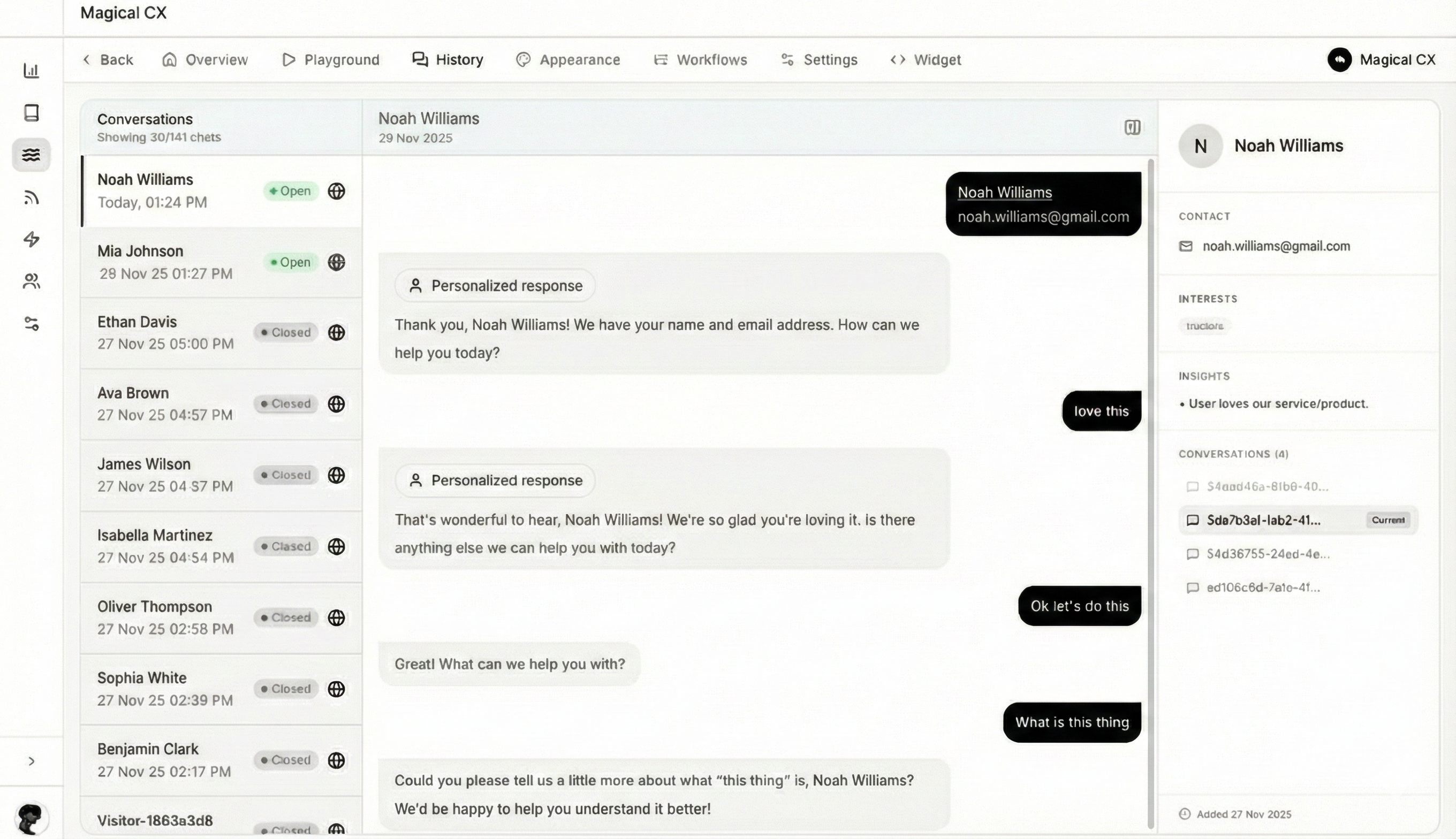
A platform like MagicalCX can put this on autopilot, with live dashboards that surface these friction points automatically.
This kind of visualization is powerful because it does the pattern-spotting for you. You can see a spike in negative sentiment or a cluster of common issues that would otherwise be buried in spreadsheets, giving you a chance to get ahead of a problem before it costs you customers.
Your goal isn't just to hoard data; it's to find the story hidden within it. A sharp Churn Profile turns vague guesswork into a focused plan of attack.
With this diagnosis done, you know exactly where the leaks are in your ship, and now you can start building specific, targeted patches to fix them.
Once you’ve figured out why customers are leaving, it’s time to shift from analysis to action. Generic, one-size-fits-all retention tactics fail because they don’t solve the specific problems your customers are experiencing. The secret is designing targeted interventions.
Before you build those plays, your diagnosis should follow a clear process, combining hard data with human feedback to get a clear picture of what’s going wrong.

With this foundation, you can be confident that every strategy you create is grounded in solid evidence, not just guesswork.
The first few weeks with your product are make-or-break. If new users don't quickly grasp the value or hit that first "aha!" moment, they'll leave. For many companies, poor onboarding is the silent killer. A guided workflow is your best defense.
Practical Example: A project management SaaS sees a 40% drop-off within the first 14 days. They find that users who never create and assign their first task are almost guaranteed to churn.
This simple, automated journey ensures every new user accomplishes a core, value-driving action within minutes, dramatically increasing the odds they'll stick around.
Waiting for frustrated customers to file a support ticket is a losing strategy. The most dangerous friction often happens in silence. Proactive support flips the script by using intelligence to anticipate needs and offer help before the customer even has to ask. This is where AI with conversational memory truly shines.
The best support experience is the one your customer never knew they needed. Proactive outreach turns moments of potential frustration into opportunities to build trust.
Practical Example: A customer of a D2C subscription service is trying to manage their account. The system notices they’ve viewed the "change delivery date" page three times in five minutes without taking action. Instead of waiting for an angry email, an AI-powered chat can pop up: "Having trouble adjusting your next shipment? I can help with that right now." This approach deflects support tickets and stops churn in its tracks.
A customer's needs evolve over time. A lifecycle campaign is a series of automated, personalized messages sent at the right moment to keep users engaged and remind them of your value. This requires omnichannel orchestration—connecting with customers on the platform they actually use.
Actionable Examples:
These campaigns show you’re paying attention. For a more detailed look at building these kinds of programs, this proactive guide to customer retention and growth is a fantastic resource.

Good intentions don't scale; operationalized empathy does. Automation is your best tool for creating consistently positive experiences. The point isn't to replace your support team. It's to empower them by automating repetitive work, freeing them up for the moments where a human touch is essential.
Nothing sours a customer relationship quicker than making them repeat their story. Conversational Memory is designed to fix this by giving your AI a perfect, persistent memory of every past interaction.
Practical Example: A customer contacts you a week after chatting about a shipping delay on their order. Instead of a robotic "How may I help you?", the AI picks up right where they left off. "Welcome back, Sarah. I see your order #12345 was delivered yesterday. Is everything looking good?" That small detail changes the entire tone. The customer immediately feels seen and remembered. You can learn more by exploring building empathy into your customer service with modern tools.
A basic chatbot provides information. A modern AI gets things done. This is the difference Agentic Actions make, allowing the system to execute tasks directly for the customer. Instead of just telling a customer how to process a return, an agentic AI does it for them.
Actionable Examples:
The most empathetic action is often the one that saves the customer time and effort. When your AI can solve a problem instantly, you're not just being helpful—you're showing respect for their time.
As powerful as automation is, knowing when to escalate an issue to a person is just as crucial as knowing what to automate. The key is making this handoff invisible. The AI must transfer the entire conversation history, customer profile, and a summary of the issue directly to the agent, avoiding the dreaded, "So, could you tell me what the problem is?"
This hybrid support model gives you the best of both worlds: the AI handles high-volume tasks 24/7, while your human agents focus on moments that demand genuine connection and creative problem-solving.
Deciding what to automate can feel daunting. This framework provides a clear way to allocate tasks to maximize both efficiency and customer satisfaction.
| Task Category | Best Suited for AI Automation | Best Suited for Human Agents |
|---|---|---|
| Information & Status | Checking order status, tracking shipments, finding account details, confirming policies. | Explaining a complex billing discrepancy or service outage. |
| Transactional Requests | Processing returns/exchanges, updating billing info, changing a password. | Handling a high-value customer threatening to cancel. |
| Product Guidance | Answering FAQs, walking users through a standard setup process, showing feature locations. | Brainstorming creative solutions for a unique or advanced use case. |
| Feedback & Escalation | Collecting survey responses, routing simple complaints, tagging conversation topics. | Responding to an angry customer or a public social media complaint. |
Ultimately, this strategic division of labor ensures you're using your most valuable resources effectively.
A powerful churn reduction strategy isn't a one-time project. It's about building a retention flywheel—a system that gets smarter with every single customer interaction. This continuous loop of measuring, learning, and improving is what separates good retention efforts from great ones.
To get this flywheel spinning, you have to look beyond the headline churn rate. While that number is important, it’s a lagging indicator. It tells you what already happened. To get ahead of churn, you need to track metrics that give you a real-time, forward-looking view of customer health.
Focusing only on your overall churn rate is like trying to drive a car by looking exclusively in the rearview mirror. To understand what's happening now and what might happen next, you need a more sophisticated dashboard of Key Performance Indicators (KPIs).
Actionable Metrics to Track:
Tracking these together gives you a much richer, 360-degree view. You can dive deeper into these and other key measures in our guide to essential SaaS customer success metrics.
Real progress happens when your retention efforts learn and adapt. A platform like MagicalCX with a self-learning engine analyzes every interaction to make your churn predictions more accurate over time.
It creates a virtuous cycle: better data leads to smarter interventions, which generates more data for the system to learn from.
A retention flywheel is built when customer experience data doesn't just sit in a dashboard but actively informs your product roadmap and marketing strategies.
Practical Example: Your system flags that customers asking about a specific advanced feature are churning 60 days later. That’s not just a support trend—it’s a critical product insight. This information can be passed directly to the product team, giving them a clear signal that the feature is either too confusing or not delivering on its promise.
To make these insights useful, they need to be organized and shared. I’m a huge believer in a simple, automated weekly retention report that tells a story about your customer experience.
Actionable Template for Your Weekly Report:
| Section | Key Metrics to Track | Actionable Question It Answers |
|---|---|---|
| Customer Health | Net Promoter Score (NPS) Trend, Customer Satisfaction (CSAT) | Are our customers happier or less happy this week? |
| Support Performance | First-Contact Resolution (FCR), Average Response Time | Are we solving problems quickly and effectively? |
| Product Engagement | Key Feature Adoption, Daily Active Users (DAU) | Are customers using the sticky parts of our product? |
| Churn Insights | Top 3 Churn Reasons (from exit surveys), At-Risk Customer Count | Why did people leave this week, and who might leave next? |
This weekly pulse-check keeps your entire company aligned. When everyone is looking at the same data, you break down the silos that let customers slip through the cracks.
You've diagnosed your churn drivers and have a playbook in mind. Now, let's tackle the practical questions that always come up when putting theory into practice.
You don't need a massive budget to start. The trick is to be surgical. Pick one or two of the biggest friction points and focus your energy there.
Actionable Low-Cost Steps:
Once you’ve got a small win, you can make the case for bigger investments.
This is a marathon, not a sprint. Seeing a real drop in your overall churn rate takes patience.
A Realistic Roadmap:
The most important thing is to track both leading and lagging indicators. Positive movement in your support metrics is the first sign your long-term churn reduction efforts are on the right track.
Making the case for investing in a platform like MagicalCX is all about connecting the platform's cost to the revenue it saves.
Actionable Steps to Build Your Business Case:
Ready to turn your customer support into a revenue engine? MagicalCX uses an empathy-first AI to create better experiences, reduce churn, and drive growth. See how it works.


