See your AI teammate in action now
Ready to make support faster, kinder, easier and help customers feel good about choosing you?
PS: Sales improves too...
No credit card required
14 days free trial
DIY or Guided setup
Ready to make support faster, kinder, easier and help customers feel good about choosing you?
PS: Sales improves too...
No credit card required
14 days free trial
DIY or Guided setup
A guide to AI-driven customer experience in 2026, covering conversational memory, agentic actions, omnichannel orchestration, real-world use cases, implementation steps, and KPIs.
Manish Keswani

Summary by MagicalCX AI
By 2026, AI is projected to power 37% of customer interactions, and CX teams that pair conversational memory with agentic actions and omnichannel orchestration can turn support moments like returns or feature limits into measurable revenue lifts through contextual offers such as 10% to 20% incentives and instant exchanges.
When we talk about an AI-driven customer experience, we're not just talking about fancier chatbots. It’s about creating interactions that are so personal, proactive, and smooth they feel distinctly human. This kind of technology understands a customer's history and what they're trying to do, allowing it to solve problems on the spot—and sometimes, even before the customer knows they have a problem.
This shift changes customer support from a reactive chore into a positive experience that builds real loyalty.

Let's cut through the jargon with a simple, everyday example: a customer wanting to return a shirt they bought online.
Think about the old, frustrating way this works. The customer, Alex, has to dig through his inbox for the order confirmation, click a link, try to remember the password for an account he rarely uses, and then fight his way through a clunky returns portal. He fills out a form explaining why the shirt didn't fit, prints a generic label, and then has no idea when he’ll see his money again. The whole thing is impersonal and loaded with friction.
Now, let’s replay that scenario, but this time powered by a modern, AI-driven customer experience.
Alex lands on the brand's website, and a chat window appears. He types, "I need to return the blue shirt from my last order." Because the AI is connected to the company's order system, it knows exactly who he is and what he bought.
It doesn't ask for an order number. Instead, the AI comes back with, "Of course, Alex! I see your recent order with the 'Sky Blue Performance Tee' in size Large. Is that the item you'd like to return?"
Alex confirms. The AI continues, "No problem. Was there an issue with the fit? I can process a return for a full refund, or I can send you a size Medium or XL right away." Just like that, a simple return becomes a chance to get the customer the right product.
An AI-driven customer experience turns a moment of friction—like a product return—into an opportunity to create a positive, helpful interaction. It’s the difference between a system that asks, "What do you want?" and one that says, "I understand what you need, and I'm already taking care of it."
When Alex decides on the refund, the AI processes it instantly and sends him an email with a QR code for a label-free drop-off at a nearby shipping center. The entire conversation took less than a minute.
This is what a true AI-driven customer experience is all about. It’s not just automating replies; it’s building an intelligent, empathetic system that can:
This approach isn’t about replacing your support team. It’s about creating seamless, positive moments that make customers feel understood and appreciated, turning your support function into a powerful engine for building loyalty and even driving revenue.

To build an AI driven customer experience that actually works, you need more than a simple chatbot. A truly intelligent system is built on three core pillars that work in concert. When you get these right, you move beyond basic Q&A bots into creating interactions that are genuinely helpful, capable, and connected.
Let's break down what these pillars are and why they're the foundation for any serious AI CX platform.
Think of it like talking to a friend who remembers every conversation you've ever had. That's conversational memory. It’s the AI's ability to retain a customer's full history—every past purchase, support ticket, and even small details from a chat that happened weeks ago.
This is what finally kills the most frustrating part of customer service: having to repeat yourself. When an AI has this memory, it already has the context it needs, making the experience feel personal and efficient from the very first word.
Practical Example: A customer who previously asked about a delayed shipment returns to your site a month later. Instead of a generic "How can I help you?" the AI greets them with, "Welcome back! I hope your last order arrived safely. Is there anything I can help with today?" That small bit of recognition immediately makes the customer feel seen.
While memory provides the context, agentic actions give the AI its power. This is the ability for the AI to do things, not just talk about them. It stops being a passive information kiosk and becomes an active problem-solver.
The AI can perform tasks directly within the conversation, resolving issues on the spot without needing to hand off to a human. This is what separates a helpful AI from a frustrating one.
Agentic actions are the difference between an AI that says, "You can process a return on our website," and one that says, "I've just processed that return for you. Your refund is on its way."
An AI with these capabilities integrates with your core business systems—your CRM, e-commerce platform, or billing software—to get things done. If you're curious about the technology behind this, you can see how a modern AI agent platform makes it possible.
Actionable Examples of Agentic Actions:
The final pillar, omnichannel orchestration, is about consistency. The AI acts like a conductor, ensuring the customer has a single, unified experience no matter how they choose to connect with you.
A customer might start a conversation on your website's live chat, follow up via email, and then send a quick message from WhatsApp later that day. Orchestration ensures the conversation’s memory and context travel with them across every channel, creating one seamless thread instead of three separate ones.
This isn't just a nice-to-have anymore. According to the latest CER 2026 report, AI is projected to power 37% of all customer interactions by the end of 2026. A unified approach is essential to managing that volume effectively.
Practical Example: A customer starts a web chat to ask about sizing for a jacket. Later, they email support to ask about the jacket’s material. An orchestrated AI recognizes it’s the same customer and the same potential purchase, merging both interactions. When an agent (or the AI) replies, they see the full history and can give a complete, helpful answer like, "Hi again! To follow up on your sizing question, the jacket material is a waterproof nylon blend, which some find fits a bit snug. You might consider sizing up."
Together, these three pillars—conversational memory, agentic actions, and omnichannel orchestration—are what make a modern AI driven customer experience possible. They create a system that doesn't just understand but also acts, delivering the kind of intuitive and helpful service that builds real customer loyalty.
For decades, customer support has been stuck in a box labeled "cost center"—a necessary expense for doing business. But an empathy-first approach to AI is flipping that script, transforming support from a line item into a powerful revenue engine.
This isn't about teaching a machine to fake sympathy with phrases like, "I understand your frustration." Real empathy in AI is demonstrated through action. It’s about building a system smart enough to know when to help, when to listen, and when to make an offer that genuinely improves a customer's situation.
The goal is to pinpoint the perfect moment to present something valuable—a discount, a product alternative, or a plan upgrade—but only when it feels like a solution, not a sales pitch. By understanding a customer's journey, an AI can use AI personalization to increase ecommerce conversion rates by turning data into genuinely helpful, revenue-generating actions.
Let's walk through a simple scenario to see the difference.
The Old Way: The Intrusive Upsell A customer, Sarah, is working on a project using a software's free plan. Suddenly, a generic pop-up blocks her screen: "Upgrade to Pro for just $19.99/mo! Unlock advanced features NOW!" This feels pushy and completely out of context. It interrupts her workflow, ignores her actual needs, and creates annoyance, not a sale.
The New Way: The Empathy-First Offer Now, imagine Sarah is using the same tool, but it's powered by an empathy-first AI. She tries to export her project and hits a feature paywall. The AI instantly recognizes her goal and the roadblock, opening a chat: "Hi Sarah, I see you're trying to export in high resolution, which is a Pro feature. Would you like a free 7-day trial of Pro to finish your export right now?"
The difference is night and day. The offer is contextual, solves her immediate problem, and feels like helpful assistance, not a hard sell. By aligning the offer with Sarah's specific need at that exact moment, the AI makes the upgrade feel like a natural, logical next step.
An empathy-first AI doesn't just resolve support tickets; it senses opportunities. It waits for that perfect moment when an offer is genuinely helpful to turn a support interaction into a positive business outcome. This is how you shift support from a cost center to a revenue driver.
So, how does this translate to your bottom line? This proactive model turns potential frustrations into moments of opportunity. It's about building intelligent workflows that recognize when a customer could benefit from an offer. We explore this concept more deeply in our guide on the role of empathy in customer service.
To make this more concrete, the table below shows how these two approaches play out in common situations.
| Scenario | Traditional Support Response | Empathy-First AI Response | Business Outcome |
|---|---|---|---|
| Hitting a feature limit | Generic pop-up: "Upgrade Now!" | Contextual offer: "I see you're trying to do X. Want a free trial of the feature that enables that?" | Upsell/Conversion |
| Item out of stock | "Sorry, this item is unavailable." | Proactive suggestion: "That's sold out, but we have a similar item in stock. Here's a 10% discount if you'd like to try it." | Saved Sale |
| Initiating a return | Processes the return request. | Empathetic offer: "I can process that, but would a different size or a 15% credit on your next order work better for you?" | Customer Retention |
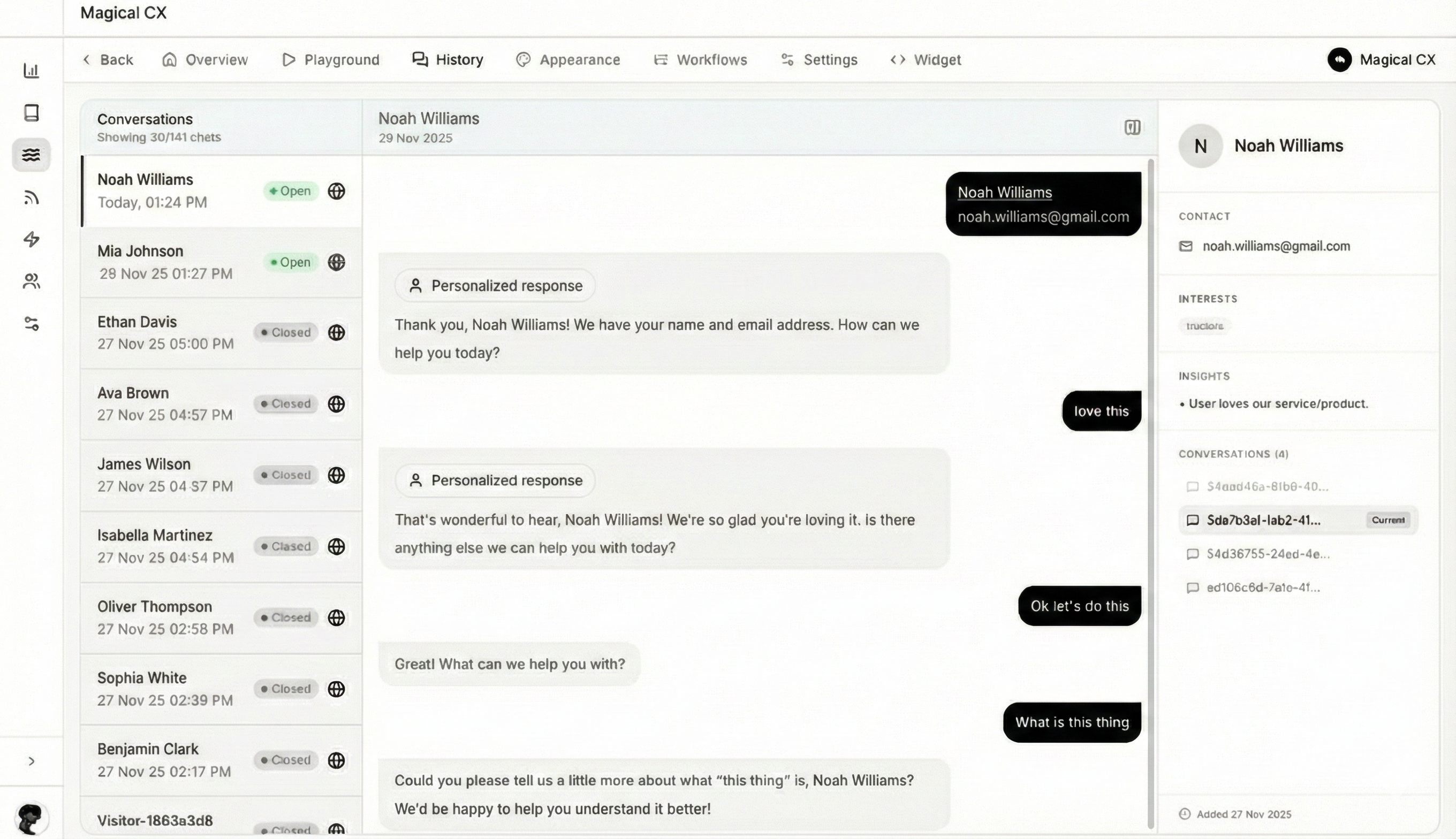
| Positive feedback in chat | "Thank you for the feedback!" | Opportunity-aware reply: "Glad you love it! You can subscribe and save 20% on future orders." | Cross-sell/Subscription |
This comparison makes it clear: a reactive model simply closes tickets, while an empathetic AI actively creates value for both the customer and the business.
You can start implementing this by identifying key moments in the customer journey where an offer would feel like a helping hand.
Here are a few powerful triggers to build around:
By designing your AI with these empathetic, revenue-aware workflows, you create a system that doesn't just solve problems. You build an engine for growth that fosters genuine, lasting customer loyalty.
It’s one thing to talk about an AI-driven customer experience in theory, but seeing it in action is where things get interesting. We’re well past the experimental phase. Businesses across the board are now using AI to fix specific, expensive problems and make both their customers and their finance teams happier.
The key is that they aren't just throwing bots at every problem. They're strategically applying AI to the moments that matter most in the customer journey.
A key driver is shifting customer expectations. Research shows a growing preference for self-service, with a significant 67% of consumers worldwide having used a chatbot for support in the last year. This isn't just about deflecting tickets; it's about meeting customers where they are with speed and efficiency.
Just look at Klarna. Their generative AI assistant now handles two-thirds of all customer service chats—the equivalent workload of 700 full-time agents—and has seen a 25% drop in repeat inquiries, indicating higher resolution quality. If you're curious, it's worth digging into the latest AI chatbot statistics to see just how quickly customers are embracing this technology.
Let's look at how four different sectors are putting this into practice.
For any e-commerce or D2C brand, the post-purchase experience is where you either build a loyal customer or lose one for good. Returns and exchanges, in particular, have always been a huge headache and a major cost center. AI is completely changing that game.
Practical Example:
Imagine a customer just bought a pair of shoes, but they’re the wrong size. The old way involved a clunky online form and a multi-day wait for an email reply.
Now, they just open the chat window on the website. The AI instantly knows who they are and what they ordered. It asks, "I see you ordered a size 9. Would you like to exchange it for a size 8.5 or 9.5, or would you prefer a refund?" By making the exchange process that simple, the AI not only saves the sale but also turns a potential frustration into a surprisingly positive interaction. The customer gets the right product, fast.
In the world of subscriptions, preventing churn is everything. An AI-driven customer experience gives SaaS companies a way to get ahead of the problem instead of just reacting to it. The AI can keep an eye on user behavior, spotting the early warning signs that someone might be losing interest.
Practical Example:
A user on a project management platform hasn't logged in much this week, and they haven't touched any of the new features from the last update. The AI flags this behavior as a churn risk.
Instead of waiting for them to cancel their subscription, the AI sends a perfectly timed in-app message: "Hi Sarah, we noticed you haven't tried the new reporting dashboard yet. Here's a quick 30-second video on how it can help you track project timelines. Want to check it out?" This kind of gentle, targeted nudge reminds users of the value they’re paying for and keeps them hooked.
When it comes to money, trust, security, and accuracy are non-negotiable. AI helps financial institutions provide secure, instant answers to sensitive questions while also spotting opportunities to offer genuinely helpful financial advice or products. Think of it as a highly capable and incredibly secure front-line assistant.
By handling routine but sensitive tasks, AI frees up human financial advisors to focus on complex, high-value consultations. This combination of automated efficiency and human expertise is redefining financial customer service.
Practical Example:
A customer wants to check their account balance and look over recent transactions. They can do this securely through an encrypted chat, where the AI authenticates them before sharing any information.
During the conversation, the AI might notice they make frequent international transfers. It can then offer, "I see you often send money abroad. Our Global Account offers lower transfer fees. Would you like to learn more?" It’s a personalized offer, delivered at the exact moment of need.
Even in B2B, where sales depend on strong human relationships, AI can be a powerful ally. Here, the goal is to automate the repetitive, top-of-funnel work so that your expert sales team can spend their time where it counts: building relationships and closing deals.
Practical Example:
A promising lead fills out a "Request a Demo" form on your website. In the past, this kicked off a manual back-and-forth. A sales rep would have to email them, ask qualifying questions, and then try to pin down a meeting time over several more emails.
Now, an AI takes the handoff. It instantly engages the lead, asks a couple of smart qualifying questions ("What's your team size?" and "What's the main challenge you're hoping to solve?"), and then presents a direct link to the account executive's calendar. This simple automation dramatically speeds up the sales cycle and ensures every single lead gets an immediate, professional response, 24/7.
Jumping into an AI-driven customer experience project can feel like a massive undertaking. But a smart, phased approach turns a giant initiative into a series of manageable, value-adding steps. This is a practical roadmap for business leaders to get started.
Before any AI can work its magic, it needs information. The first, most critical step is to give your AI access to your key data sources.
Actionable Insight: Start by integrating just one or two core systems. For an e-commerce company, this would be your Shopify or Magento store (for order data) and your Zendesk or Gorgias helpdesk (for conversation history). Don't try to connect everything at once. This initial connection is the foundation for a personal and effective AI-driven customer experience.
Your initial integration goals:
With your data connected, map out the customer journeys you want to automate. A common mistake is trying to automate everything. Instead, start with one high-volume, low-complexity task.

Actionable Insight: Identify your single most common support ticket. For most e-commerce brands, it's "Where is my order?" (WISMO). Make this your first workflow. The AI can use the OMS integration to instantly provide tracking info, freeing up dozens of agent hours per week.
Practical Examples of First Workflows:
Getting your AI up and running doesn't have to be a months-long technical slog. Modern platforms offer flexible paths.
Generally, you have two main options:
To go a little deeper on this, check out our guide on getting started with AI-powered customer service.
No AI should handle 100% of customer issues. A great AI strategy knows its own limits. The secret to success is designing a seamless, graceful handoff to a human agent when an issue gets too complex or emotionally charged.
The golden rule of a good handoff is that the customer should never have to repeat themselves. Your agent should get a full transcript of the AI chat, plus the customer’s entire history, so they can step in with complete context and solve the problem.
Actionable Insight: Define clear handoff triggers. For example, if a customer uses words like "frustrated," "angry," or "useless," or if the AI fails to resolve the issue after two attempts, automatically route the conversation to a live agent. This prevents customer frustration from escalating.
An AI is only as valuable as the results it delivers. To prove the ROI of an AI-driven customer experience, you have to focus on the key performance indicators (KPIs) that move the needle. Tracking the right data creates a feedback loop to constantly sharpen your strategy.
Think of it like a car's dashboard. It doesn't just show your speed; it gives you the vital signs you need to keep running smoothly. When you're building your strategy, think about how implementing AI voice agents can significantly elevate customer experience and boost business growth.
Stop counting total chat volume. Instead, focus on the numbers that tell a story about efficiency, happiness, and revenue.
Here are the essential KPIs you should have on your dashboard:
First-Contact Resolution (FCR) for AI: What percentage of issues does your AI handle start-to-finish without human involvement? Actionable Insight: Aim for an initial FCR of 30-40% for your first workflow. As you analyze failed conversations and retrain the AI, you can push this number higher.
Customer Satisfaction (CSAT) with AI: After an AI interaction, use a quick survey ("On a scale of 1-5, how helpful was this?"). Actionable Insight: Don't just look at the average score. Dig into the low scores (1s and 2s) to find specific conversations where the AI failed. This is your most valuable data for improvement.
Reduction in Agent Workload: Track how many fewer routine tickets your human team handles. This proves the AI is freeing up your experts for more valuable work.
Revenue from AI Interactions: Track upsells, cross-sells, or sales saved because of an AI offer. Actionable Insight: Create unique discount codes used only by the AI. This allows you to directly attribute revenue generated during AI-driven support conversations.
A successful AI-driven customer experience doesn't just cut costs; it creates new revenue streams. By tracking the revenue generated from AI-driven offers, you can directly link your support function to business growth.
Ultimately, measuring performance isn't a one-time task. It’s a constant cycle of watching the data, figuring out what it means, and making smart adjustments. This is how your AI stops being just a tool and becomes a true engine for customer loyalty and profit.
Whenever we talk to business leaders about bringing AI into their customer experience, the same handful of questions always pop up. Most of the concerns boil down to cost, complexity, and the impact on both customers and internal teams.
Let's tackle the big questions with some straight-to-the-point answers.
No. The goal isn't replacement; it's augmentation. Think of it as giving your best agents a super-powered assistant that handles the repetitive "Where is my order?" tickets and password resets.
Practical Example: By automating simple queries, a leading retailer reduced their agents' ticket volume by 40%. This didn't lead to layoffs. Instead, they retrained those agents to become proactive "client success specialists" who now focus on personalized outreach to high-value customers, driving repeat purchases. Their role shifted from reactive problem-solving to proactive relationship-building.
This is all about smart conversation design and training. A modern AI isn't a generic chatbot; it's trained on your specific brand guidelines, product docs, and most importantly, the history of your best support conversations.
A great AI doesn't just mimic your brand; it embodies it. By learning directly from your top-performing agents, the AI picks up on the subtle nuances that define your company’s voice, ensuring every interaction feels authentic.
Actionable Insight: Provide the AI with a "style guide" that includes not just what to say, but what not to say. For example: "Avoid formal language like 'Dear sir/madam.' Use friendly, casual phrases like 'Hey there' or 'Happy to help!'"
It used to be, but not anymore. Today's leading AI platforms are built for a smooth setup, plugging directly into the tools you already use.
Practical Example: A mid-sized SaaS company used a modern AI platform with a no-code interface. Their Head of Customer Support, with no technical background, was able to build and launch their first automated workflow (for user password resets) in a single afternoon, integrating it directly with their existing helpdesk software.
AI creates revenue by being smart about when to make an offer. By understanding a customer's history, their current sentiment, and the context of their question, an empathy-first AI knows the perfect moment to suggest a genuinely helpful upsell or cross-sell.
Practical Example: A customer using a photo editing software's free version asks the AI, "How do I remove the background from this image?" The AI replies, "Background removal is a Pro feature. Would you like a free 7-day trial of Pro to try it out right now?" This contextual, helpful offer converts a support query into a high-intent trial user, leading directly to potential revenue.
Ready to see how an empathy-first AI can transform your support into a revenue engine? At MagicalCX, we build AI solutions that understand your customers and your business.
Learn more by visiting our website.


