See your AI teammate in action now
Ready to make support faster, kinder, easier and help customers feel good about choosing you?
PS: Sales improves too...
No credit card required
14 days free trial
DIY or Guided setup
Ready to make support faster, kinder, easier and help customers feel good about choosing you?
PS: Sales improves too...
No credit card required
14 days free trial
DIY or Guided setup
Manish Keswani

Digital customer experience (DCX) isn't just one thing. It's the sum total of every single digital interaction a person has with your company. Think about it: the slick website, the genuinely helpful chatbot, the email that feels like it was written just for you—they aren't separate events. They're all part of one continuous journey, and a great DCX makes every click and conversation feel both effortless and valuable.

Think of your digital customer experience as your brand's handshake. It’s that first impression and every follow-up conversation rolled into one. It happens across your website, mobile app, social media DMs, and any AI-powered support channels you use. A few years ago, just having a website that worked was good enough. Not anymore. Customers expect a whole lot more.
A strong digital experience flows seamlessly from one touchpoint to the next. Imagine someone sees your product on Instagram, clicks over to your app, and finishes their purchase with a single tap. That’s a modern DCX in action—no friction, no frustration, just a smooth path from discovery to checkout.
Let's be blunt: your digital customer experience is now your most important competitive advantage. It's no longer just about having the best product or the lowest price; it's about how easy and pleasant it is to do business with you online. Your customers aren't just comparing you to your direct competitors anymore. They’re comparing you to the best digital services they use every day, like Amazon and Netflix.
When your DCX is firing on all cylinders, people are more likely to buy from you, stick around, and tell their friends about you. A clumsy or frustrating experience, on the other hand, is a one-way ticket to your competition. The stakes have never been higher, and patience for disconnected, impersonal interactions is at an all-time low.
A great digital customer experience anticipates a user's needs before they even have to ask. It's about proactive solutions and making the customer feel understood at every digital touchpoint, turning a simple transaction into a lasting relationship.
The hard truth is that most companies are falling behind. According to Forrester's Global Customer Experience Index, 21% of brands saw their CX rankings decline in 2025, while only a meager 6% improved. This isn't just a small dip; it's a clear signal that a huge gap exists between what customers expect and what businesses are actually delivering. It underscores the urgent need for better, more empathetic digital solutions. Discover more insights from Forrester's 2025 CX Index.
To truly understand this shift, let's compare the old way of thinking with the new.
This table contrasts outdated approaches with modern, customer-centric strategies to highlight the evolution of DCX.
| Aspect | Traditional Approach (The Past) | Modern Approach (The Future) |
|---|---|---|
| Channel Focus | Siloed and separate (website, app, social are different worlds) | Omnichannel and unified (a single, consistent conversation everywhere) |
| Communication | One-way broadcast (company talks, customer listens) | Two-way dialogue (conversational, interactive, and responsive) |
| Personalization | Generic and rule-based (e.g., "Hello, [First Name]") | Deeply contextual and predictive (understands user history and intent) |
| Support Model | Reactive (waits for the customer to report a problem) | Proactive and anticipatory (solves issues before they happen) |
| Core Metric | Clicks and conversions | Customer lifetime value and loyalty |
The takeaway is clear: the game has changed. Moving from a traditional, siloed mindset to a modern, interconnected one is no longer optional—it's essential for survival and growth.
If you want to build a digital journey that not only satisfies customers but actively delights them, you need to bake three core principles into your strategy. These are the non-negotiables that separate the leaders from the laggards.
Effortless Interaction: Customers must be able to find what they need, buy a product, or get help with the least amount of friction possible. Actionable Insight: Audit your checkout process by trying to complete a purchase on both desktop and mobile. If it takes more than three clicks after adding an item to a cart, it's too long.
Deep Personalization: This goes way beyond just using someone's first name in an email. True personalization means using data to offer genuinely relevant product recommendations, tailored content, and support that acknowledges their entire history with your brand. Practical Example: A streaming service suggesting a new show based not just on what you've watched, but also on shows you started but didn't finish.
Omnichannel Consistency: The experience has to feel like one experience, whether someone is on your website, messaging you on WhatsApp, or talking to a chatbot. The conversation, and all its context, must carry over flawlessly from one channel to the next.
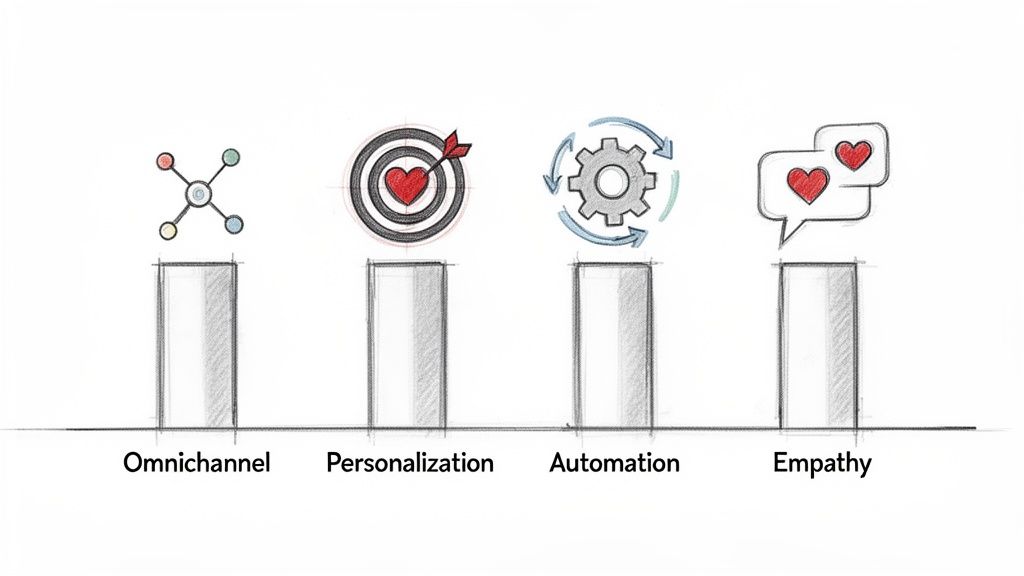
A truly remarkable digital customer experience doesn't just happen. It’s carefully built on a foundation of four interconnected pillars that work together to create a journey that feels seamless, smart, and genuinely human.
Get these elements in sync, and your customers feel seen, heard, and valued every step of the way. But if even one pillar is weak, the whole structure can feel wobbly, leading to the kind of disjointed, frustrating interactions that send customers running to your competitors.
Let's break down exactly what these four pillars are and how they come together to create a world-class DCX.
First up is omnichannel consistency. This is all about making sure every interaction feels like one continuous conversation, no matter where it takes place. A customer shouldn't have to repeat their life story when they switch from a website chatbot to a support email or a social media DM.
Think of it like an ongoing chat with a friend that you can pause and pick back up days later on a different app, without ever losing context. That’s the goal. With around 75% of consumers using multiple channels to complete a single purchase, a unified approach isn't a luxury—it's essential.
Practical Example (E-commerce): A shopper adds a pair of shoes to their cart on your mobile app but gets sidetracked. Later, they hop on their laptop and visit your website. A great omnichannel experience means those shoes are right there in the cart, waiting for them. If they then message your brand on WhatsApp about sizing, the AI or agent who replies already knows exactly which product they’re talking about.
Next, we have proactive personalization. This goes way beyond just plugging a customer's first name into an email. It’s about using what you know about them to anticipate their needs and offer up the right solution before they even have to ask. This is what shifts the experience from reactive to predictive.
Doing this well requires a real understanding of customer behavior, purchase history, and browsing patterns. When it clicks, customers feel like you actually get them. It's no wonder a staggering 66% of consumers say they’d ditch a brand if their experience felt impersonal.
The best personalization makes the customer feel uniquely understood, not just tracked. It's the difference between a generic "You might also like..." and a recommendation so spot-on it feels like it was picked just for them.
Actionable Insight: Set up a "back in stock" notification that not only alerts the customer but also automatically reserves the item in their cart for 24 hours. This proactive step turns a simple alert into a valuable, personalized service.
The third pillar is seamless automation. And the key word here is "seamless." Great automation works behind the scenes, flawlessly handling routine tasks and freeing up your human agents to focus on the complex, high-stakes problems. It's the invisible engine that makes a digital experience feel fast and effortless.
Good automation isn't about replacing people; it's about empowering them. By automating things like order tracking, password resets, or simple returns, you can give customers instant answers 24/7. This dramatically reduces customer effort while also cutting down on operational costs.
Here’s where seamless automation really shines:
Practical Example (SaaS): A user is having trouble setting up a new feature in your software. Instead of making them file a ticket, an intelligent automated workflow guides them through the process step-by-step with interactive prompts and tooltips, solving their issue on the spot.
Finally, the fourth and arguably most important pillar: empathetic intelligence. This is what ensures that every single interaction—whether with a sophisticated AI or a human agent—feels respectful, helpful, and understanding. Technology can be incredibly efficient, but without empathy, it just feels cold.
Empathetic intelligence is the ability to understand the context and emotional tone behind a customer's words. It’s recognizing frustration and responding with patience, or sensing excitement and sharing in that feeling. An AI built with empathetic intelligence, like the one powering MagicalCX, can adapt its language and actions to match the customer's state of mind.
This is the pillar that ties everything else together. It makes sure your omnichannel strategy, personalization, and automation are all working toward one goal: making the customer feel like a valued person, not just another number. In the end, that human-centric focus is the ultimate differentiator.
A great digital customer experience isn't just a "nice-to-have"—it's a direct engine for business growth. When you invest in a smart, seamless journey for your customers, the payoff shows up right on your balance sheet. This is how you transform customer experience from a cost center into your most powerful revenue driver.
The logic is simple: happy customers who find it easy to do business with you buy more, stay longer, and tell their friends.
The entire competitive landscape has shifted. The battle for customer loyalty is no longer won on product features or pricing alone; it’s won on the quality of every single interaction. Consider this: by 2025, an estimated 89% of businesses will compete primarily on customer experience. And with 70% of consumers ready to walk away after just two bad experiences, the financial risk of a clunky digital journey is staggering. Learn more about the customer experience statistics driving business strategy.
A top-tier digital experience directly fuels two of your most critical metrics: customer lifetime value (LTV) and churn. When interactions are effortless and personalized, customers feel seen and understood. That feeling makes them far more likely to come back again and again.
On the flip side, a frustrating experience actively repels them. A confusing checkout process? That's an abandoned cart. A support bot that goes in circles? That’s a cancelled subscription. Every point of friction is a hole in your revenue bucket.
Practical Example: By analyzing user session recordings, a travel company noticed many users dropped off when asked for passport details during initial booking. They moved this step to post-booking, simplifying the flow and increasing completed reservations by 15%.
A frictionless digital experience doesn't just prevent churn; it creates brand advocates. It transforms a transactional relationship into one built on trust and reliability, making customers less price-sensitive and more loyal over time.
Beyond just making money, a well-designed DCX also saves you a ton of it. Think about all the repetitive questions your support team answers every day—"Where's my order?", "How do I reset my password?", "What's your return policy?".
By using intelligent automation to handle these common queries, you free up your human agents to tackle the complex, high-stakes issues that truly require a human touch.
This creates a powerful one-two punch:
Actionable Insight: Identify your top five most common support queries from the last quarter. Create an automated workflow or chatbot script for each one. This single action can often deflect 20-30% of your total support volume.
To prove the connection between your DCX efforts and real-world results, you have to track the right numbers. These Key Performance Indicators (KPIs) give you a clear, data-backed report card on your customer experience and its impact on the business.
Here are the essential KPIs you should be watching like a hawk:
Tracking these KPIs is the only way to know what's working and where you need to focus your improvements. To dive deeper into using these metrics, check out our guide on measuring customer service performance.
The talk about AI in customer support isn't about clunky, rule-based chatbots anymore. The best digital customer experience strategies are now built on something new: empathy-first AI. This isn't just about spitting out automated replies. It’s about scaling genuine understanding and creating interactions that feel human, helpful, and emotionally intelligent.
Think about it: generic automation can answer a question, but it almost always misses the feeling behind it. Empathy-first AI, the kind of technology that powers MagicalCX, is built to understand the full picture—the context, the customer's intent, and even their sentiment. This allows it to create conversations that are not just accurate but also feel true to your brand's unique voice, building trust instead of frustration with every interaction.
Traditional chatbots are fundamentally script-followers. They spot keywords and serve up a pre-written answer, which is why they often get stuck in frustrating loops when a customer's question doesn't fit perfectly in a box. That’s the exact opposite of a great digital customer experience.
Empathy-first AI operates on a completely different level. It looks at the entire conversation to get a real handle on the customer's goal and their emotional state. This allows it to adapt its tone and approach on the fly, delivering a response that is both technically correct and emotionally in-tune. We take a much deeper look into the importance of empathy in customer service in our detailed article.
This deeper grasp of the situation unlocks some incredible possibilities:
Let's make this concrete. Imagine a customer for an online clothing store types, "This jacket I ordered is too small and I'm so disappointed."
A basic chatbot might just say: "To initiate a return, please visit our returns portal."
An empathy-first AI would respond with something much better: "I'm so sorry to hear the jacket didn't fit as expected; that's definitely frustrating. I see we have the next size up in stock. Would you like me to process an exchange for you right now? It will ship out today."
This shift from a transactional answer to an empathetic solution is the core of modern AI-powered support. It’s about using technology to scale the kind of thoughtful, personalized service that was once only possible with your best human agents.
And the move toward this kind of AI is picking up serious momentum. In 2025, CX leaders are investing heavily in this space: 24% are focused on CX automation, 20% on AI/ML for operations, and 18% on conversational AI. But here’s the catch: while 67% of consumers are open to using AI for service, 58% still feel uncomfortable with it. This highlights just how critical an empathy-first, hybrid approach is for building trust. You can dive into the full report on the global state of customer experience for more details.
The smartest brands aren't shooting for 100% automation. They're building a hybrid model where AI and human agents work in tandem, each playing to their own strengths.
The AI handles the bulk of routine questions with incredible speed and accuracy. This frees up your human agents to focus on the most sensitive and complex cases—the ones that truly need a nuanced, human touch.
Actionable Insight: Define clear escalation rules for your AI. For instance, if a customer uses words like "furious" or "unacceptable," or if they ask to speak to a human twice in one conversation, the AI should automatically and immediately transfer them to a live agent with full context.
Putting together a great digital customer experience isn't about wishful thinking—it requires a solid, actionable plan. Let's break down the process into five clear phases. This is a practical roadmap for any business that wants to take its customer interactions from just "functional" to genuinely memorable.
Think of this as a continuous loop, not a one-and-done project. Each phase builds on the last, helping you create a resilient, intelligent system that actually adapts to what your customers need.
You can't fix a journey you don't understand. The very first step is to sit down and meticulously map out every single digital touchpoint a customer has with your brand. This means everything from their first click on your website to a post-purchase support chat.
Actionable Insight: Don't just brainstorm this in a boardroom. Use tools like heatmaps and session recording software to see where users are actually clicking, getting stuck, and dropping off. Pair this quantitative data with qualitative feedback from customer surveys and support tickets to understand the "why" behind their actions.
A choppy digital experience is almost always a symptom of siloed data. Customer information is often scattered everywhere: in your CRM, on your e-commerce platform, and within your support software. To build a smooth, consistent journey, you have to bring all that information together.
Integrating these systems creates a single customer view—a unified profile that tells you the complete story of each person's history with your company. This unified data is the bedrock of real personalization. It lets you tailor every interaction based on a customer's entire relationship with you, not just their last click.
A single customer view turns your support from reactive to contextual. Instead of asking a customer to repeat their issue, you can greet them with a full understanding of their past purchases, previous support tickets, and recent website activity.
This flowchart shows how unifying your data and intelligence can lead to much faster, more effective customer support.
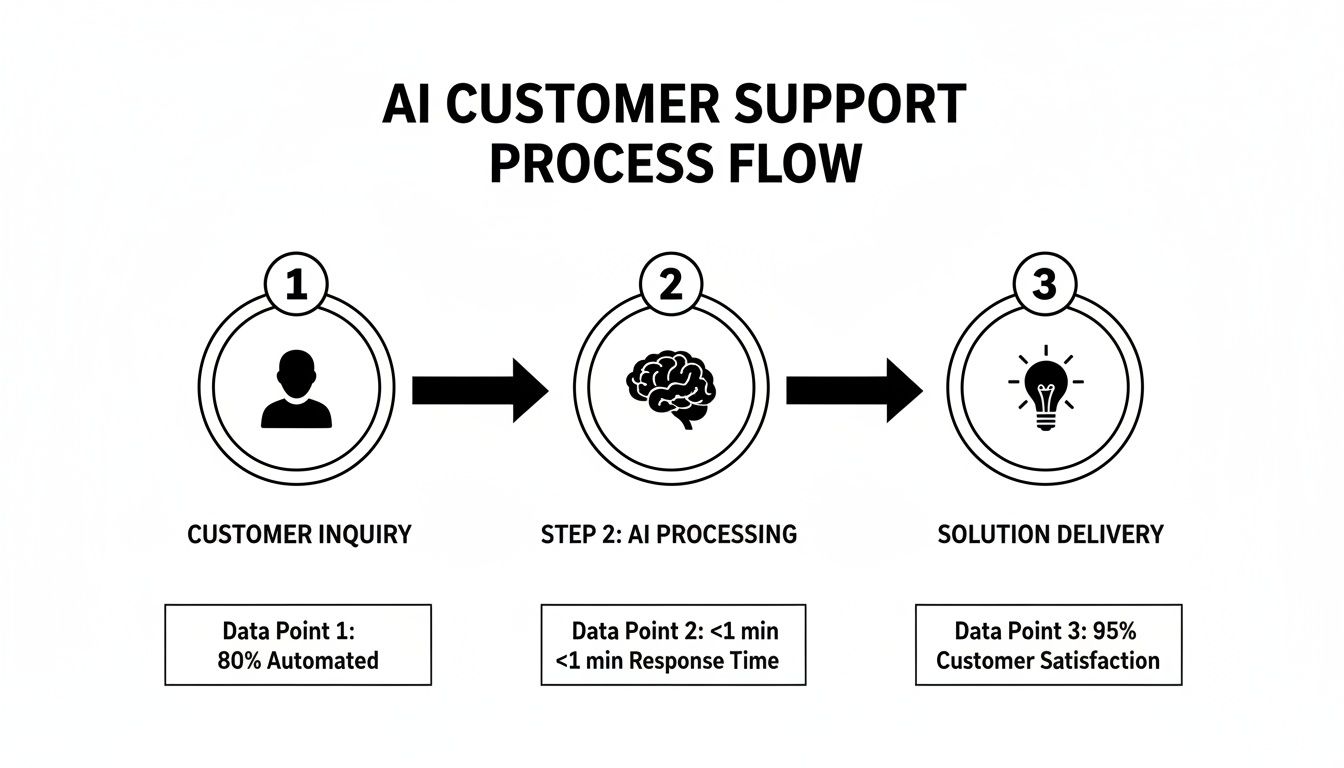
This simple path from a customer's question to an AI-powered solution really drives home the power of an intelligent, automated system in delivering immediate value.
Once you have a clear journey map and unified data, you're ready to bring in intelligent automation. The trick is to start small. Focus on the high-volume, low-complexity tasks that are eating up your team's time, like order status checks, password resets, and return requests.
Automating these common questions accomplishes two very important things:
Practical Example: A telecommunications company could deploy a chatbot that authenticates a user and then allows them to check their data usage or pay their bill directly within the chat window, deflecting a high volume of simple calls.
When it comes to nuanced or emotionally charged issues, your human agents are your most valuable resource. A smart DCX strategy gives them the tools and insights they need to shine. This means giving them dead-simple access to that unified customer profile you built back in Phase 2.
When an agent can see a customer's entire history in one place, they can solve problems faster and with more empathy. They spend less time hunting for information and more time building relationships. Of course, choosing the right platform is key; for a look at your options, you can explore various customer experience management tools in our comprehensive guide.
Finally, a world-class digital customer experience is never "done." Customer expectations are a moving target, so your strategy has to be, too. The last phase is all about creating a system of continuous testing and iteration.
Keep a close eye on key metrics like Customer Effort Score (CES) and first-contact resolution rates. Actively collect feedback through surveys and direct conversations. A self-learning system, like an empathy-first AI, can automatically refine its own responses based on the outcomes of thousands of interactions, getting smarter and more helpful over time. This creates a virtuous cycle of improvement, ensuring your DCX strategy remains a powerful competitive advantage.
Knowing what not to do is just as important as having a solid plan. Even the most ambitious digital customer experience projects can stumble if they fall into a few common traps. These mistakes can quickly unravel all your hard work, leaving you with frustrated customers and wasted resources.
A resilient strategy is one that anticipates these issues from the get-go. Let’s walk through the most common missteps companies make and, more importantly, how you can steer clear of them.
One of the biggest mistakes we see is buying shiny new AI or automation tools without a clear purpose. A company might sink a ton of money into a sophisticated chatbot platform because it's the "in" thing, only to find it gives clunky answers and infuriates users. Instead of reducing support tickets, they actually go up. This tech-first approach is almost always a dead end.
The Solution: Always start with the problem, not the product. Begin by mapping out your customer journey to find the exact points of friction. Once you know where the real pain is, then you can look for technology that solves that specific problem. This ensures every tool you bring in has a clear job to do: improving the digital customer experience.
Another classic pitfall is treating each channel—your website, app, social media—like its own little island. Think about it: a customer might carefully explain their issue to a chatbot, then get handed off to an email agent who opens with, "So, how can I help you?" Forcing customers to repeat themselves is a surefire way to create a disjointed and deeply annoying journey.
The Solution: You have to unify your customer data into a single, accessible view. An omnichannel platform ensures that the conversation history travels with the customer, no matter how they contact you. This creates one continuous conversation, making the experience feel connected and respectful of their time.
A truly connected experience means the conversation picks up right where it left off, every single time. It’s the difference between making a customer feel like a stranger at every turn versus a known and valued partner.
In the race for efficiency, it's easy to go too far with automation and strip the humanity right out of your support. Picture a customer dealing with a sensitive billing error, stuck in an endless automated phone menu with no way to reach an actual person. This kind of impersonal, robotic experience can turn a simple problem into a lost customer.
The Solution: The sweet spot is a hybrid model where automation and your human team work hand-in-hand.
This balanced approach gives you efficiency without sacrificing the empathy that builds real, lasting loyalty.
Finally, a huge number of companies collect feedback through surveys like NPS and CSAT... and then let the data collect digital dust. They look at the scores but never dig into the comments to understand the "why" behind them. This is a massive missed opportunity to find and fix the very things that are causing friction for your customers.
The Solution: Treat feedback like an actionable roadmap for improvement. Create a closed-loop system where negative feedback automatically triggers a follow-up from your team. Use the insights from this data to prioritize what you fix next, turning customer complaints into your most valuable source of strategic direction.
It's only natural to have questions when you're working on something as important as your digital customer experience. Here are some of the most common ones we hear, with straightforward answers to help you build your strategy.
Before you change a single thing, you need to map your existing customer journey. Seriously. You can't fix what you don't fully understand, and that means seeing your brand exactly as your customers do right now.
Get granular here. Trace every digital touchpoint a customer has with you—from the social media ad that first caught their eye to your website, their email exchanges with support, and every step in between. Laying it all out like this will immediately reveal the friction points, the dead ends, and the frustrating moments that cause people to drop off. This journey map is the bedrock of your entire strategy.
A journey map isn't just a flowchart; it's a tool for building empathy. It forces you to see your digital ecosystem through your customers' eyes, revealing the small frustrations that often lead to big problems.
You can absolutely go toe-to-toe with the big players. The trick is to stop trying to match their budgets and start focusing on your natural strengths: agility and personalization.
Instead of spreading yourself thin across a dozen channels, pick a few and make them exceptional. Modern, affordable tools can help you deliver incredibly personal and consistent support. Use your smaller size to build real relationships. When a customer feels like they're talking to a person who remembers them and understands their history, that's something a corporate giant struggles to replicate. That personal connection is how you win.
Measuring the return on your DCX efforts isn't about a single magic number. It's about tracking a handful of key metrics that, together, paint a clear picture of revenue growth, cost savings, and customer happiness.
Ready to transform your support from a cost center into a revenue driver? MagicalCX uses empathy-first AI to create human-like conversations that build loyalty and boost your bottom line. Discover how MagicalCX can elevate your digital customer experience today.


