See your AI teammate in action now
Ready to make support faster, kinder, easier and help customers feel good about choosing you?
PS: Sales improves too...
No credit card required
14 days free trial
DIY or Guided setup
Ready to make support faster, kinder, easier and help customers feel good about choosing you?
PS: Sales improves too...
No credit card required
14 days free trial
DIY or Guided setup
A guide to the 12 best AI chatbot platforms for business in 2026, covering ranked comparisons, key features, pricing models, integrations, use cases, and ROI.
Manish Keswani
Summary by MagicalCX AI
In 2026, the best business chatbots are agentic, omnichannel systems that remember customer context and take actions like issuing a 10% save offer or processing returns, turning support from ticket deflection into measurable retention and revenue lift.
Choosing the best AI chatbot for your business is no longer about just deflecting tickets. Today’s leading platforms act as intelligent agents that remember customer history, take action across systems to solve problems, and even identify revenue opportunities. But with dozens of options, how do you separate powerful, empathy-driven AI from simple scripted bots?
This guide cuts through the noise. We provide an in-depth, ranked comparison of the top 12 AI chatbot platforms, focusing on actionable insights and practical use cases. For a broader perspective on how various AI agents contribute to business growth and team augmentation, going beyond just chatbots, consider reading this guide on scaling with AI agents for business.
Here, you will find a detailed breakdown of each platform to help you make a confident decision. We analyze key features like conversational memory, omnichannel support, and seamless human handoff. You'll get practical examples for e-commerce, SaaS, and contact centers, helping you match the right tool to your specific operational needs and confidently calculate your potential ROI.
We've done the heavy lifting, comparing each solution's strengths, weaknesses, and ideal use cases. Each review includes direct links and screenshots to give you a clear view of the user experience. Let's find the chatbot that will not only answer questions but actively drive your business forward.
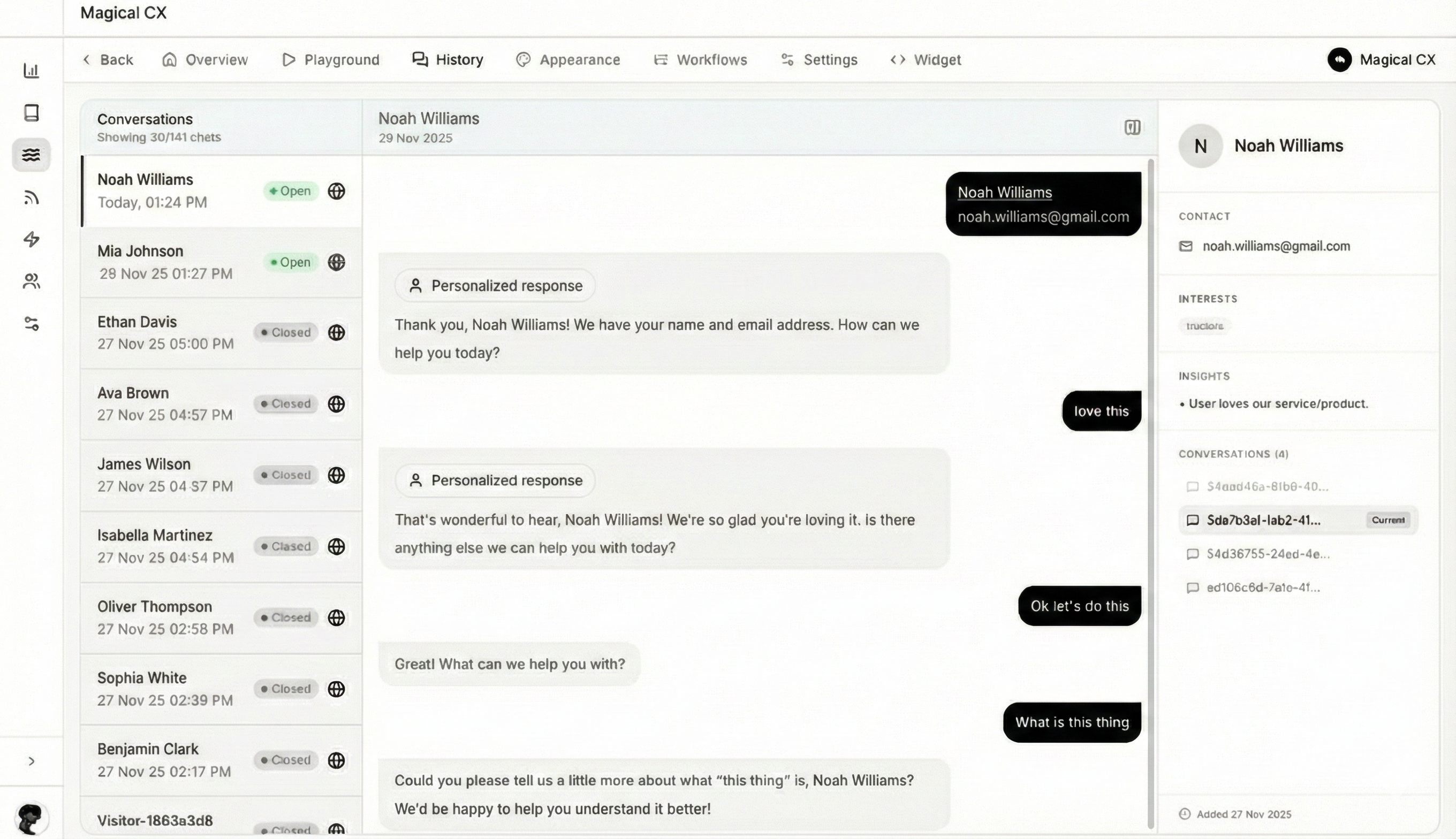
MagicalCX earns its top spot as a standout choice for the best AI chatbot for business by fundamentally reframing customer support from a cost center into a revenue-positive, relationship-building engine. It achieves this through a powerful combination of empathetic, human-like conversation and intelligent, proactive actions. Unlike many chatbots that simply answer FAQs, MagicalCX is engineered to understand context, remember past interactions, and take initiative within the conversation to solve problems and create value.
At the core of the platform is the agentic EFRO™ engine, which intelligently decides when to offer a timely discount to prevent churn, suggest a relevant product upgrade, or apply a "save" to an at-risk subscription. For an e-commerce brand, this means the chatbot can autonomously offer a 10% discount on a future purchase to a customer experiencing a shipping delay, directly converting a negative experience into a positive, revenue-driving one. For SaaS companies, this translates into an actionable insight: the chatbot can detect when a user repeatedly asks about a feature in a higher-tier plan and proactively offer a trial upgrade, complete with a direct link to activate it.
Another significant strength is its true omnichannel orchestration. MagicalCX unifies conversations from web chat, email, WhatsApp, Instagram, and Messenger into a single, cohesive profile. This eliminates the frustrating experience where a customer has to repeat their issue on different channels. A practical example: a customer starts a chat on Instagram about a faulty product, then sends a follow-up email with photos. A support agent taking over sees the full, unified history and can immediately process a replacement without asking the customer to repeat themselves, dramatically reducing resolution time.
MagicalCX offers a flexible setup process, providing a DIY-friendly interface for teams that want to self-manage or a comprehensive, white-glove onboarding service at no extra cost. This removes a common barrier to adoption for SMBs and mid-market companies without dedicated IT resources.
Live dashboards provide actionable insights, surfacing friction points in customer journeys, common contact reasons, and overall relationship health. This data empowers leaders to make informed operational decisions rather than guessing where problems lie. For instance, if the dashboard shows a spike in questions about a specific feature after a new software update, the product team has immediate, actionable feedback to improve the user interface or create a new help article.
Best For: E-commerce, D2C, SaaS, and subscription businesses focused on maximizing customer lifetime value and transforming support into a scalable, empathetic, and revenue-generating channel.
Visit MagicalCX to Start a Free Trial
Intercom offers a comprehensive customer service platform supercharged by its AI agent, Fin. It's a strong contender for the best AI chatbot for business, particularly for support teams that want an all-in-one solution that combines a modern shared inbox, robust automation, and a sophisticated AI agent with transparent pricing. Fin is designed to provide complete, accurate answers by drawing from a company's existing support content, such as help center articles and public documentation.
Unlike many competitors that charge based on usage or sessions, Intercom's Fin AI Agent has a unique resolution-based pricing model. This means you only pay when Fin successfully resolves a customer's query without human intervention. This predictable billing structure makes it much easier to model ROI and forecast costs, a significant advantage for businesses managing tight budgets. An actionable insight here is to regularly audit Fin's "unresolved" conversations to identify gaps in your knowledge base, turning failed automations into a to-do list for content improvement.
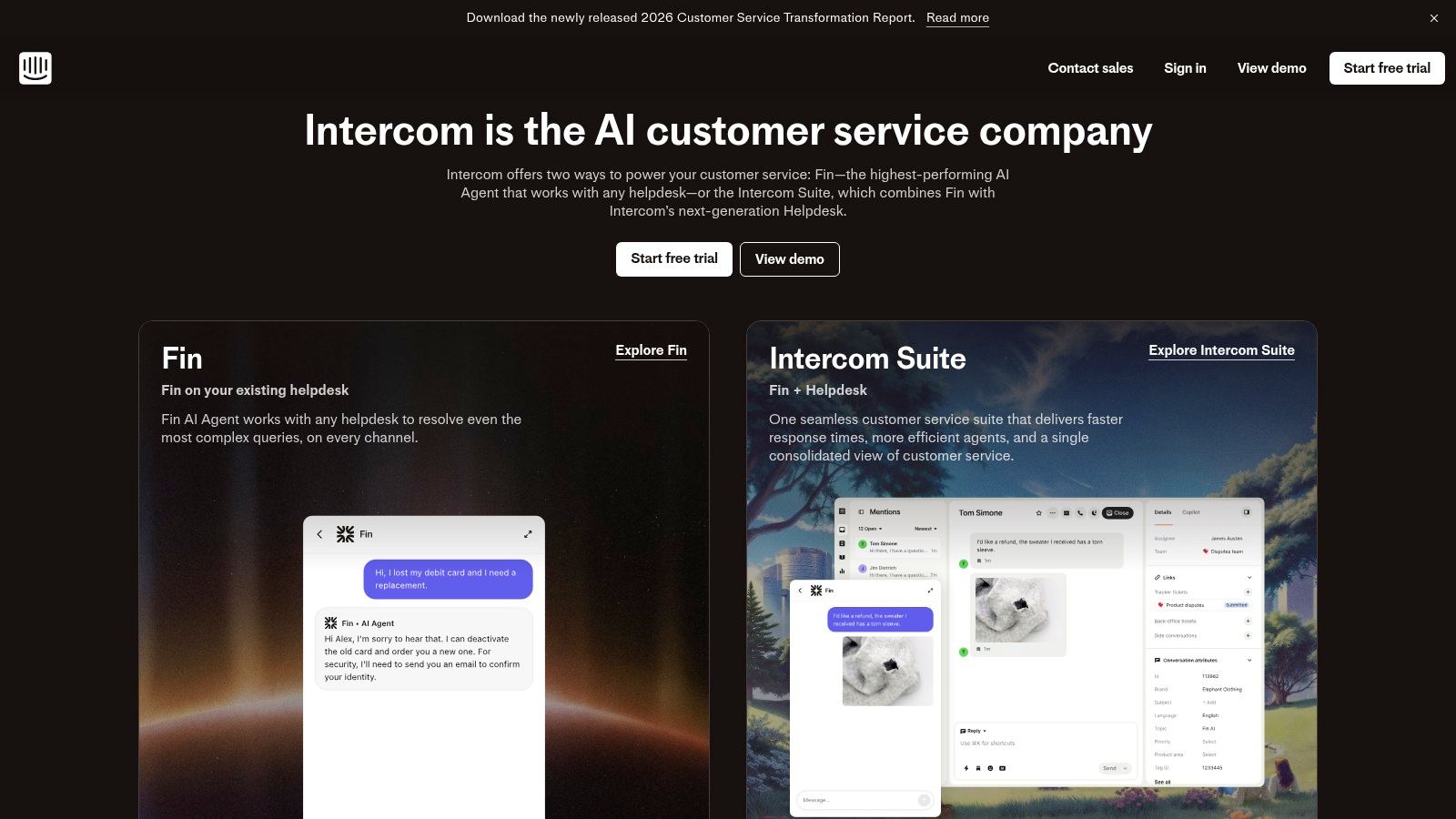
Intercom excels in providing an integrated ecosystem. Its omnichannel support covers chat, email, SMS, and WhatsApp, ensuring a consistent customer experience across all touchpoints. The platform is also highly flexible; Fin can operate natively within the Intercom Messenger or be plugged into third-party helpdesks like Zendesk and Salesforce, allowing companies to enhance their existing tech stack without a complete overhaul.
| Pros | Cons |
|---|---|
| Transparent per-resolution AI pricing simplifies ROI calculation. | Fin usage is an incremental cost on top of platform seat pricing. |
| Quick setup with broad omnichannel support. | Minimum commitments may apply when using Fin on external helpdesks. |
| Scales from SMBs to enterprise with advanced security and compliance options (SSO, HIPAA). |
Website: https://www.intercom.com
Zendesk is a mature, enterprise-grade customer service suite that layers powerful AI capabilities onto its robust platform. Its approach includes an agent-assist tool, "Copilot," and more advanced, autonomous AI agents available as add-ons. This makes it a formidable choice for the best AI chatbot for business, especially for mid-market and enterprise companies looking to infuse AI into established, complex support operations without replacing their core system.
The platform's strength lies in its ecosystem. Zendesk doesn't just offer a chatbot; it provides a full suite of AI tools for quality assurance (QA), workforce management (WFM), and deep analytics. Many of its Suite plans include unlimited access to Copilot for agents, a distinct advantage for teams focused on augmenting human performance. An actionable insight for managers is to use Copilot's suggested replies as a training tool for new agents, helping them learn the correct tone and find the right information faster, thereby reducing ramp-up time.
Zendesk’s integrated platform and massive marketplace of over 1,200 apps allow for deep customization. The AI offerings are designed to enhance existing workflows, from providing agents with real-time response suggestions via Copilot to fully automating resolutions for common issues. This holistic approach supports the entire customer service lifecycle, a key component of modern AI-powered customer service strategies.
| Pros | Cons |
|---|---|
| Strong enterprise footprint with robust security and governance. | Advanced AI agent pricing is not public and requires contacting sales. |
| Rich ecosystem with a large marketplace for extensive integrations. | Total cost can increase significantly with multiple AI add-ons. |
| Clear agent-assist pricing with unlimited Copilot in some bundles. | The platform can be complex to set up for smaller teams. |
Website: https://www.zendesk.com
Salesforce offers a powerful, enterprise-grade AI layer for its Service Cloud, designed for businesses that need to leverage deep CRM data for complex customer service workflows. Its AI, often part of the Einstein 1 Platform, is a top-tier option for organizations already embedded in the Salesforce ecosystem. The platform moves beyond simple chatbots to create sophisticated, data-driven automated agents that can handle intricate, multi-step processes.
A key differentiator for Salesforce is its flexible consumption-based pricing. Customers can choose a per-conversation model or purchase "Flex Credits" that can be used across various AI capabilities, including bots, analytics, and generative AI features. This allows companies to align spending with their specific consumption patterns. An actionable insight for businesses is to use Flex Credits to trial different AI features—like generative case summaries for agents one month and a customer-facing bot the next—to determine which application provides the highest ROI before committing to a specific model. This flexibility can be complex, but an AI vs. human support ROI calculator can help model potential costs.
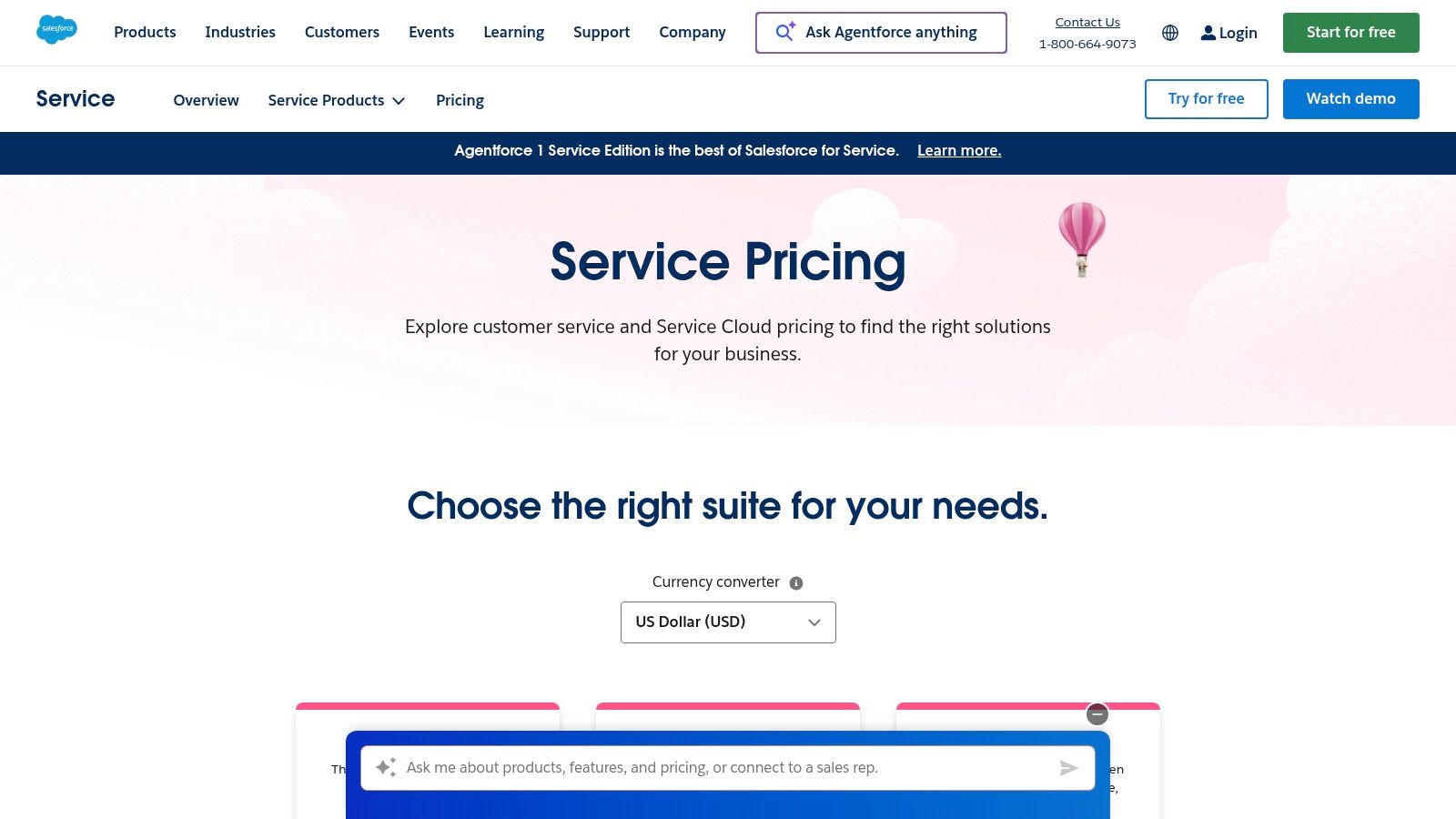
Salesforce’s strength lies in its native integration with Service Cloud, allowing the AI chatbot to access rich customer history and context directly from the CRM. This enables highly personalized and complex automated workflows. With industry-specific editions and bundled credit offerings, it provides tailored solutions for sectors like finance, healthcare, and manufacturing, making it one of the best AI chatbot for business options for large, specialized enterprises.
| Pros | Cons |
|---|---|
| Deep CRM integration provides rich contextual data for workflows. | Pricing can be complex to estimate across different models and add-ons. |
| Flexible buying models (per conversation or credits) fit various needs. | Key AI features are often sold as separate add-ons. |
| Tailored solutions available for specific industries. |
Website: https://www.salesforce.com/service/pricing/
Freshworks provides a user-friendly omnichannel messaging platform, Freshchat, powered by its Freddy AI agents and Copilot. It stands out as one of the best AI chatbot for business options for small to mid-market teams that prioritize rapid implementation and a straightforward, session-based AI pricing model. Freddy AI is designed to handle customer queries by leveraging existing knowledge bases, automating resolutions, and providing agents with AI-powered assistance.
The platform's pricing is structured around AI-powered sessions, where a session is a continuous conversation between the bot and a user. Higher-tier plans include a starter pack of 500 AI sessions per month, with the option to purchase additional session packs as needed. This model offers predictability for businesses starting with AI. An actionable insight for teams is to analyze the bot analytics to see which topics consume the most sessions. If "pricing questions" are using 40% of your AI sessions, it's a clear signal to make your website's pricing page more prominent and easier to understand, reducing bot usage and costs.
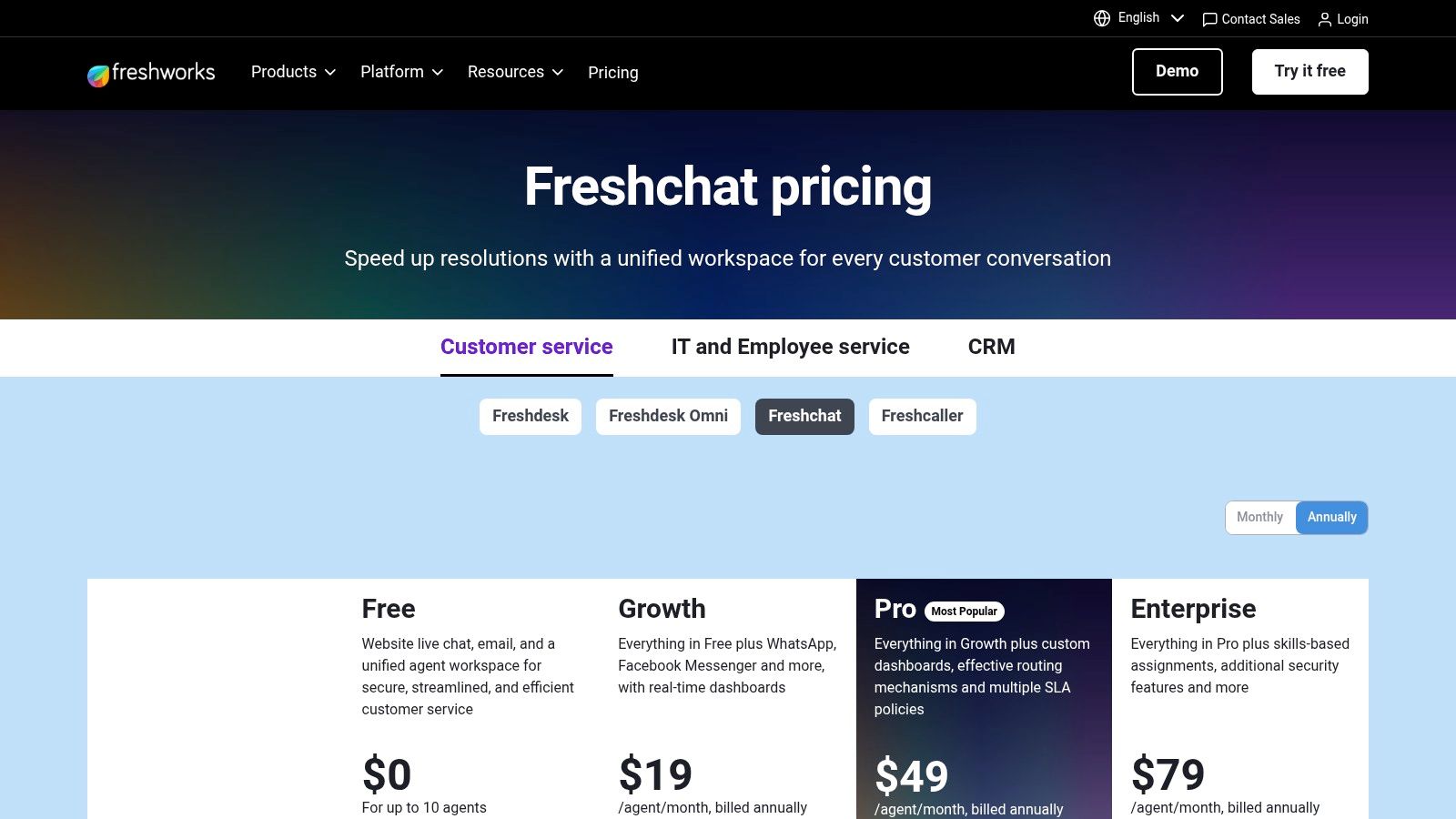
Freshworks integrates live chat, an omnichannel inbox, and robust automation into a single, cohesive interface. The platform's ease of use is a significant draw, with clear documentation and a modular approach that allows businesses to add features like Freddy AI agents and Copilot as they grow. The focus is on getting teams up and running quickly to see immediate value.
| Pros | Cons |
|---|---|
| Competitive entry pricing with a quick and intuitive setup. | Overage session packs can introduce variable and unexpected costs. |
| Session-based AI pricing makes short-term cost forecasting simple. | AI sessions may expire at the end of each billing cycle. |
| Good documentation and modular add-ons for gradual scaling. |
Website: https://www.freshworks.com/live-chat-software/pricing/
Tidio offers an approachable and highly visual platform, making it a strong candidate for the best AI chatbot for business, especially for SMBs in e-commerce and SaaS. Its AI agent, Lyro, is designed for rapid deployment, allowing non-technical teams to build powerful conversational flows using a drag-and-drop visual builder. This focus on ease of use and affordability provides a low-friction entry point for businesses aiming to automate customer support without a steep learning curve or significant upfront investment.
The platform stands out with its flexible and accessible pricing, including a free tier for basic live chat and low-cost plans that introduce AI capabilities. This pay-as-you-grow model allows businesses to test the waters and scale their automation efforts as their needs evolve. A practical way to start is by using the free plan to manually chat with customers, noting the top 5 most common questions. Then, upgrade to a paid plan and use the visual builder to create a simple bot that answers just those five questions, providing an immediate and measurable reduction in your team's workload.
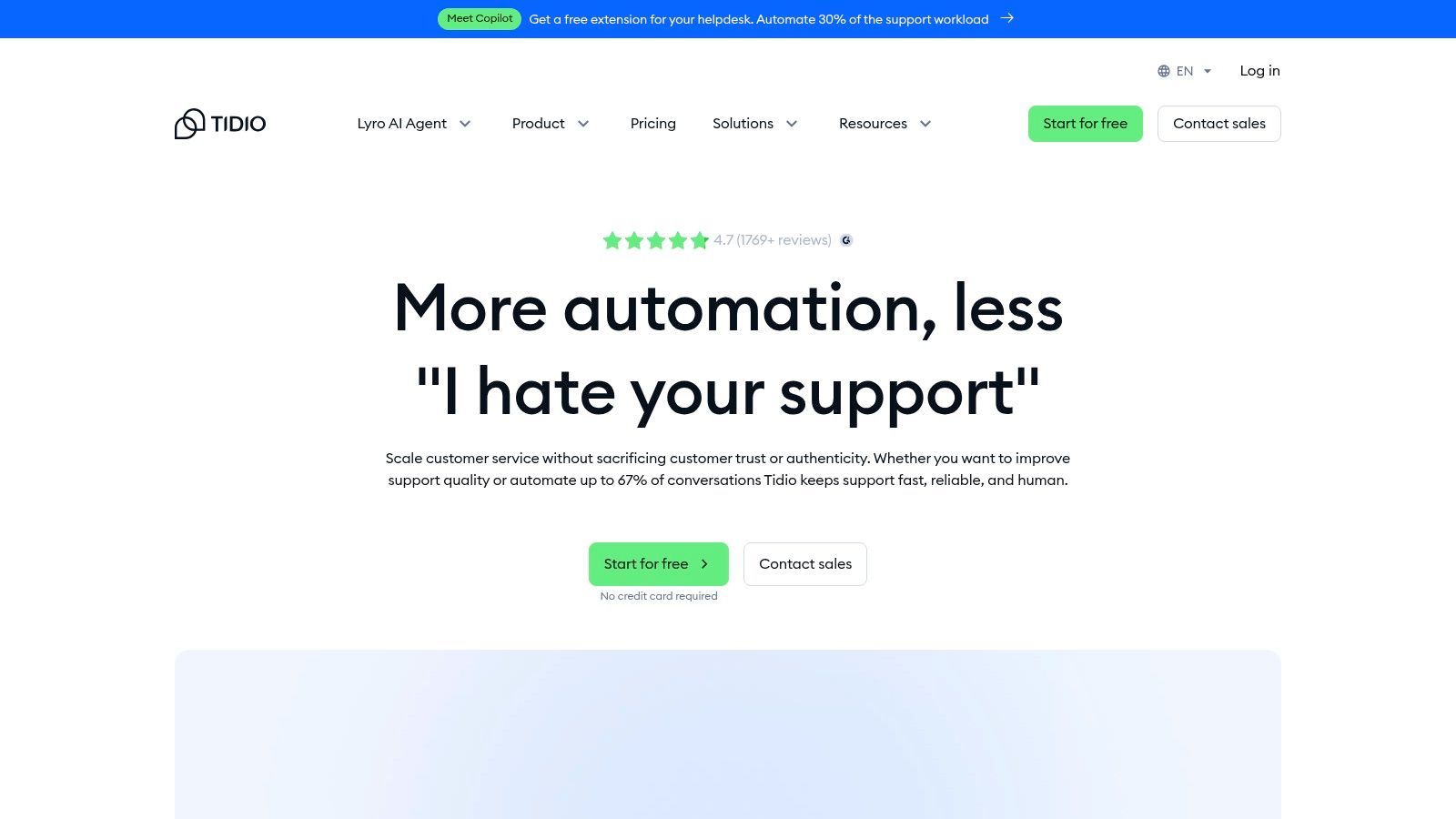
Tidio’s strength lies in its simplicity and speed to value. The platform comes packed with numerous integrations and pre-built templates for common automation scenarios like lead generation, cart abandonment, and FAQ handling. This allows teams to launch effective bots in minutes, not weeks. The visual flow builder is a key differentiator, demystifying the process of creating complex conversational logic.
| Pros | Cons |
|---|---|
| Quick, approachable setup is ideal for non-technical teams. | Advanced analytics and higher AI quotas require upper pricing tiers. |
| Affordable entry pricing and clear, scalable upgrade paths. | Best suited for SMB/mid-market rather than deep enterprise governance. |
| The visual flow builder simplifies bot creation and management. |
Website: https://www.tidio.com
LivePerson's Conversational Cloud is an enterprise-grade platform built for large-scale, complex deployments. It stands out as a strong candidate for the best AI chatbot for business in regulated industries like finance and healthcare, offering robust AI safety, governance, and orchestration across both messaging and voice channels. The platform is designed for large brands that require deep customization, extensive security protocols, and the ability to manage conversations across a vast, global customer base.
A key differentiator is its focus on enterprise governance and safety. LivePerson provides sophisticated AI guardrail capabilities, ensuring that conversations remain compliant, on-brand, and secure. An actionable insight for compliance teams is to use these guardrails to create "blocklists" of sensitive terms (like social security numbers) and "allowlists" of approved legal disclaimers. This ensures the AI automatically redacts sensitive data and includes necessary disclosures in conversations, reducing legal risk.
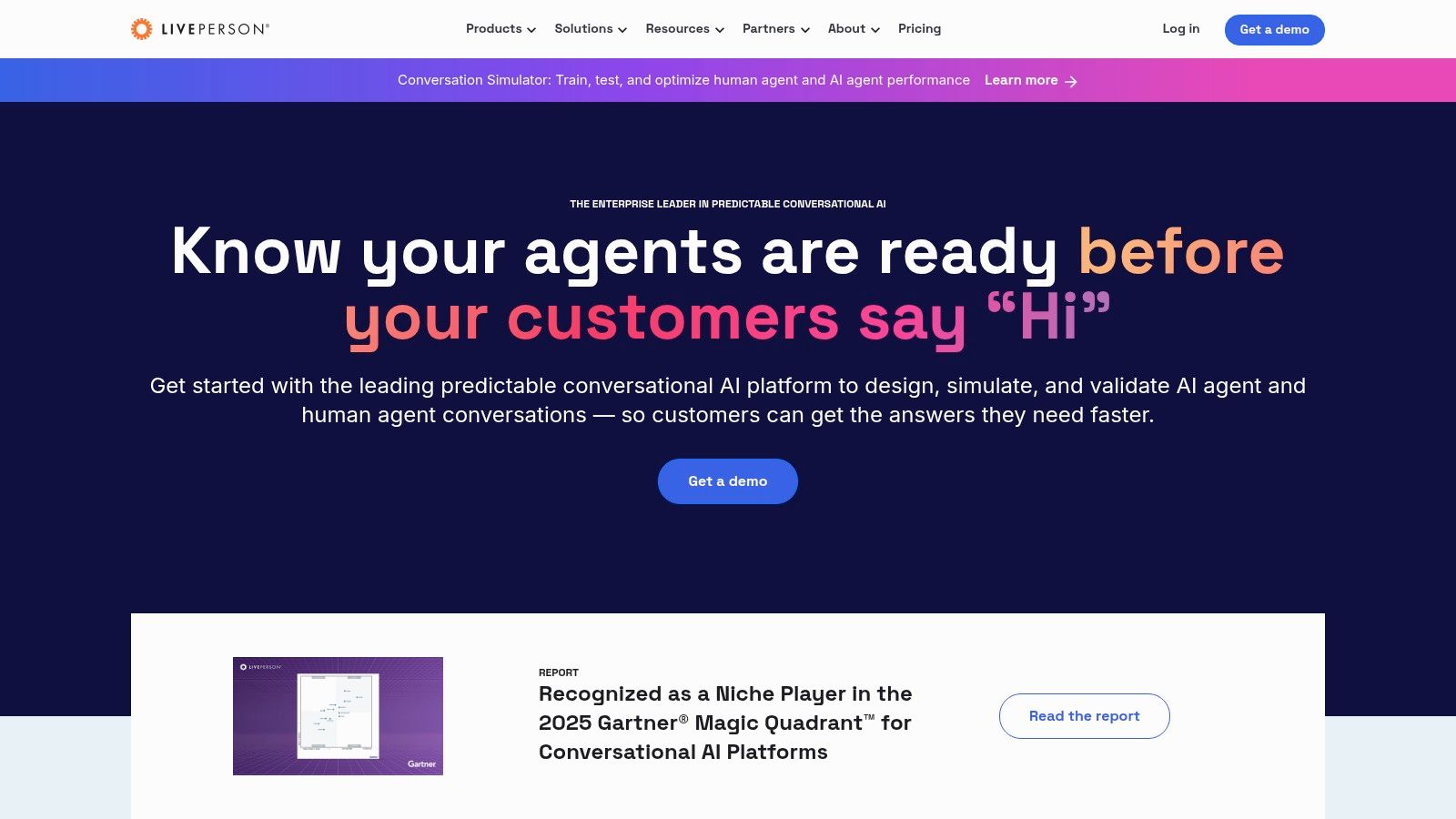
LivePerson excels at orchestrating complex customer journeys across both digital and voice channels. Its Conversational Cloud unifies interactions from web chat, SMS, WhatsApp, and even voice calls into a single thread. The platform includes powerful builder tools, advanced analytics, and developer APIs, allowing for deep integration into existing enterprise systems and workflows. Its marketplace offers pre-built solutions to accelerate deployment.
| Pros | Cons |
|---|---|
| Enterprise-grade security, governance, and AI safety features. | No public pricing; requires sales engagement and custom quoting. |
| Proven scalability with a long track record serving major global brands. | Implementation is typically more complex than SMB-focused tools. |
| Flexible packaging and pay-as-you-go options are available for trials. |
Website: https://www.liveperson.com
Ada is an agentic AI platform designed for enterprise-level customer service automation across digital, email, and phone channels. It positions itself as a strong contender for the best AI chatbot for business by focusing on "reasoning-based agents" that go beyond simple scripted flows. This approach allows Ada's bots to understand complex user intent, orchestrate multiple AI models, and take action by connecting to business systems, making it a powerful choice for high-volume CX teams.
The platform's core strength lies in its no-code integration and action-taking capabilities. Ada enables teams to build deep automations that connect to knowledge bases, CRMs, and other backend systems without requiring extensive developer resources. A practical way for a CX team to leverage this is by building an "Order Modification" bot. Using the no-code connectors, the bot can authenticate the user, pull their recent order from Shopify, present modification options (e.g., change size, color, or shipping address), and write the changes back to the Shopify API, fully resolving the request without ever creating a human-handled ticket.
Ada's enterprise focus is evident in its robust feature set, including support for over 50 languages, advanced analytics, and seamless human handoffs with ticket syncing. The platform is built to handle complexity and scale, allowing businesses to automate entire customer journeys. Its emphasis on measurement helps teams track key metrics like resolution rates and CSAT to continuously improve performance.
| Pros | Cons |
|---|---|
| Enterprise-grade capabilities for deep, complex automation. | Pricing is not published and follows a sales-led, custom model. |
| Strong focus on analytics and CX improvement loops (CSAT/resolution). | Implementation requires significant planning and stakeholder involvement. |
| Powerful no-code connectors for integrating with business systems. | Might be overly complex for small businesses with basic needs. |
Website: https://www.ada.cx
Drift is a conversational marketing and sales platform designed specifically for B2B revenue acceleration. It positions its AI chatbot not just as a support tool but as a proactive engine for generating qualified pipeline. By engaging high-intent website visitors with personalized conversations, Drift aims to shorten the sales cycle, qualify leads in real time, and book meetings for sales teams automatically, making it a powerful tool for go-to-market strategies.
The platform’s core strength lies in its GTM-centric conversational flows. Drift uses AI-powered "Playbooks" to identify and engage target accounts, ask qualifying questions, and route conversations to the right sales representative instantly. An actionable insight for marketing teams is to create different Playbooks for different website pages. For a pricing page visitor, the bot can be direct: "See a plan you like? Let's book a 15-minute demo with an expert now." For a blog reader, it can be softer: "Enjoying the article? We have an ebook on this topic you might find useful."
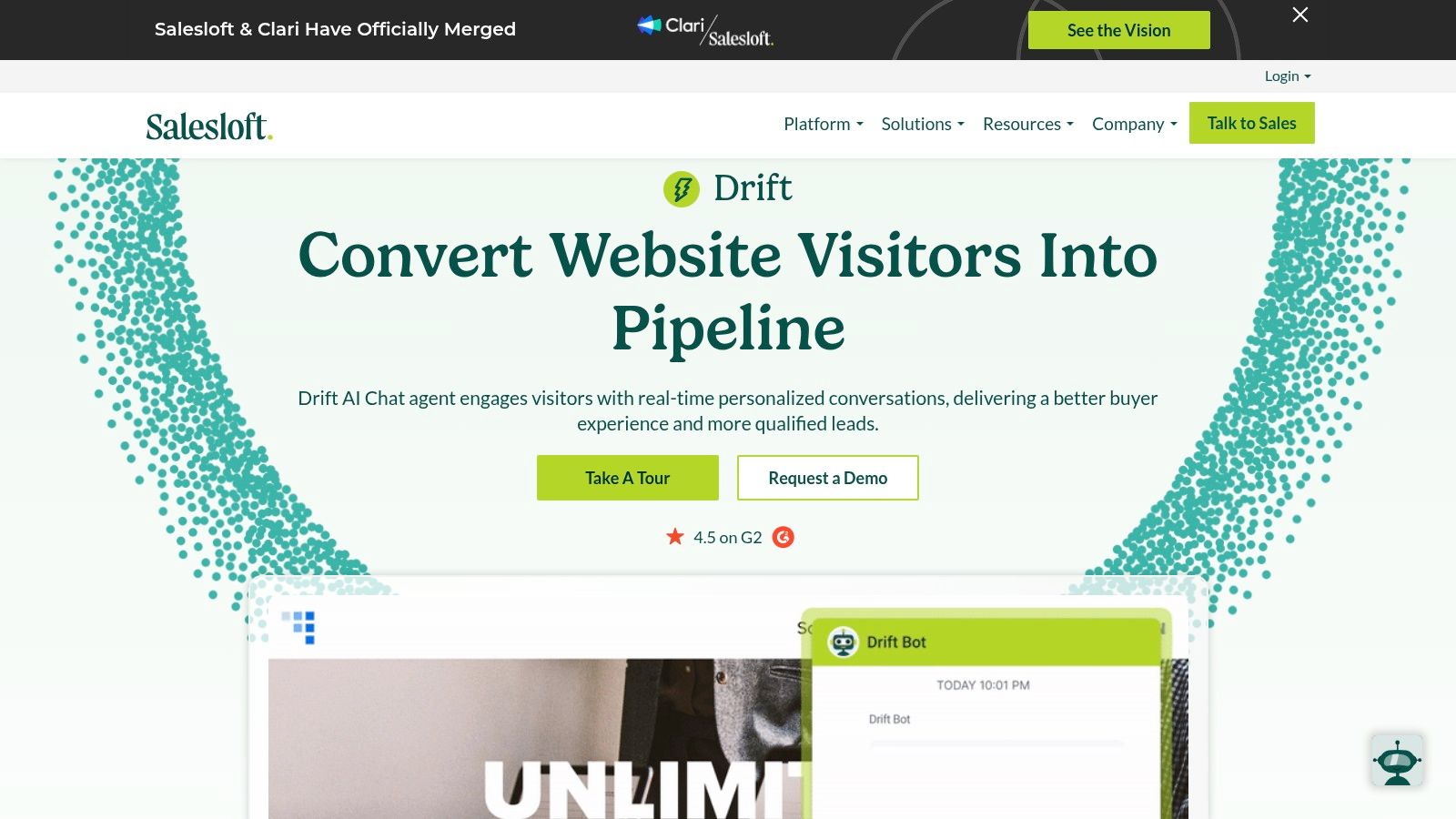
Drift excels at creating a seamless buying experience that replaces static forms with interactive dialogue. Its deep integrations with CRMs like Salesforce and marketing automation platforms like HubSpot enable sophisticated account-based marketing (ABM) campaigns. Features like Fastlane accelerate the journey for known target accounts, allowing them to bypass forms and book meetings instantly.
| Pros | Cons |
|---|---|
| Proven impact on pipeline and meeting conversion for B2B teams. | Pricing is not publicly listed and typically requires contacting sales. |
| Native go-to-market features around routing and scheduling. | Less focused on help-desk or traditional customer support workflows. |
| Strong ABM capabilities and deep CRM integrations. | Can be a significant investment compared to support-focused chatbots. |
Website: https://www.drift.com
HubSpot Service Hub offers a powerful combination of live chat and a no-code chatbot builder that is deeply integrated with its renowned CRM. This makes it a compelling option for businesses already invested in the HubSpot ecosystem or those seeking a unified platform for marketing, sales, and service. The platform’s strength lies in leveraging rich CRM data to personalize conversations and automate service workflows, making it a strong candidate for the best AI chatbot for business for teams prioritizing a single source of customer truth.
The platform's pricing is structured in per-seat, tiered plans (Starter, Professional, and Enterprise), allowing businesses to scale features as they grow. An actionable insight is for users of the HubSpot marketing hub to create chatbot flows that are triggered by specific marketing activities. For example, if a contact clicks a link in a promotional email for "Product X," you can build a chatbot flow that greets them on the website with, "Welcome back! I see you're interested in Product X. Can I answer any questions about its features?"
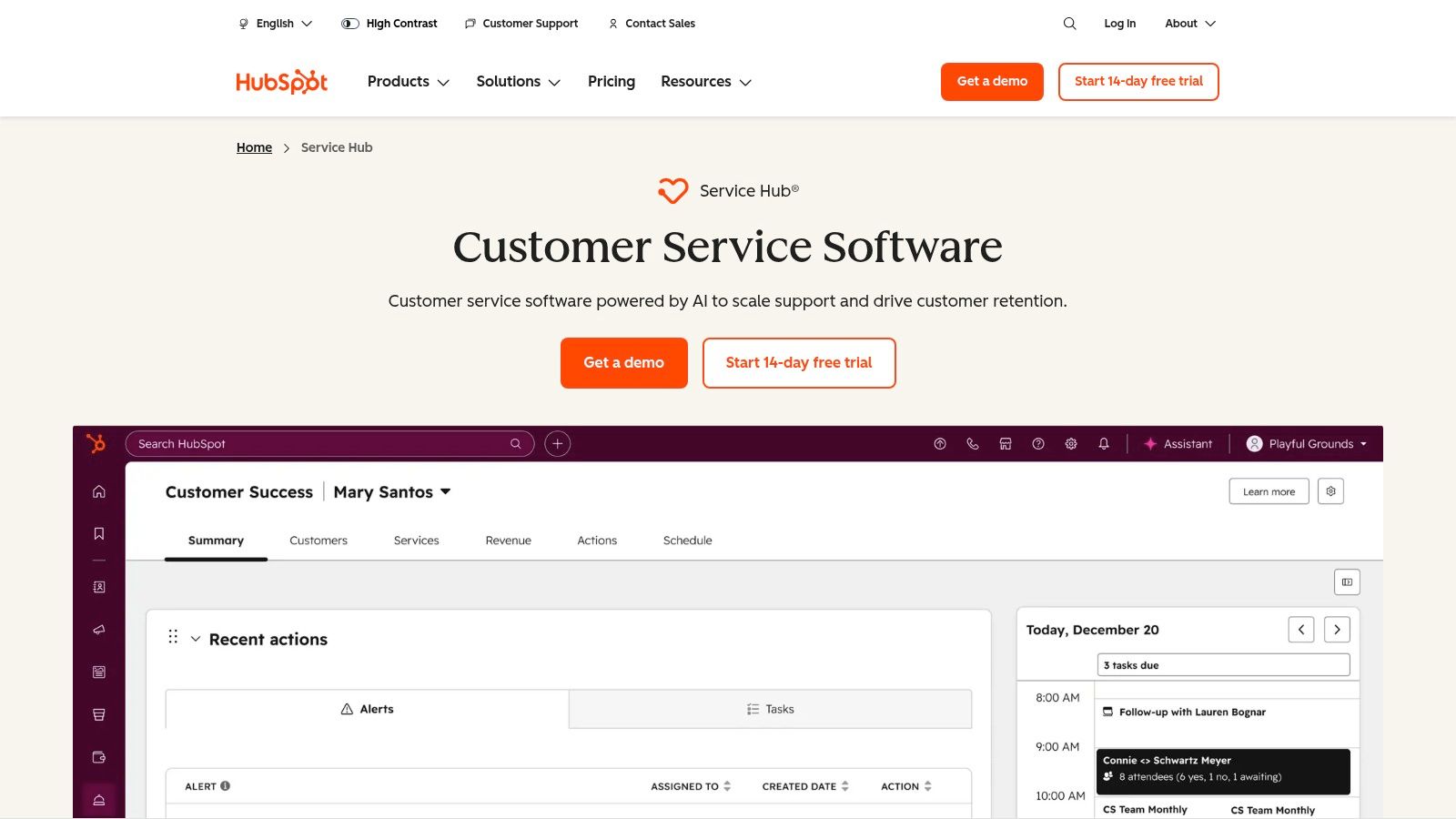
HubSpot excels by unifying the entire customer journey. Its chatbot builder is exceptionally user-friendly, allowing teams to create automated conversation flows without any coding knowledge. The tight integration means every chat interaction is logged against a contact record in the CRM, giving agents full context. HubSpot also provides an extensive app marketplace and excellent documentation, making it easy to learn and extend the platform's functionality.
| Pros | Cons |
|---|---|
| Single-vendor stack ensures CRM context is available in every chat. | Costs can rise significantly as users and feature needs grow. |
| Easy adoption curve with strong documentation and training resources. | Some advanced AI features are limited to higher Service Hub tiers. |
Website: https://www.hubspot.com/products/service
Gorgias is an e-commerce-focused helpdesk built specifically for Direct-to-Consumer (D2C) brands, especially those on platforms like Shopify. It provides an omnichannel support solution supercharged by an AI Agent, making it a powerful contender for the best AI chatbot for business in the retail sector. The platform excels at automating common e-commerce workflows, from order status inquiries to return requests, directly within the chat interface.
Similar to some competitors, Gorgias offers a per-resolution pricing model for its AI Agent. This means you are only charged when the chatbot successfully resolves a customer's issue. An actionable insight for e-commerce managers is to use the Gorgias dashboard to identify the top 3-5 automated resolution types (e.g., order status, return policy, shipping costs). If these five categories account for 80% of your resolutions, you can confidently calculate your ROI by multiplying the number of resolutions by your average cost-per-ticket for human agents. This provides a clear business case for scaling AI usage.
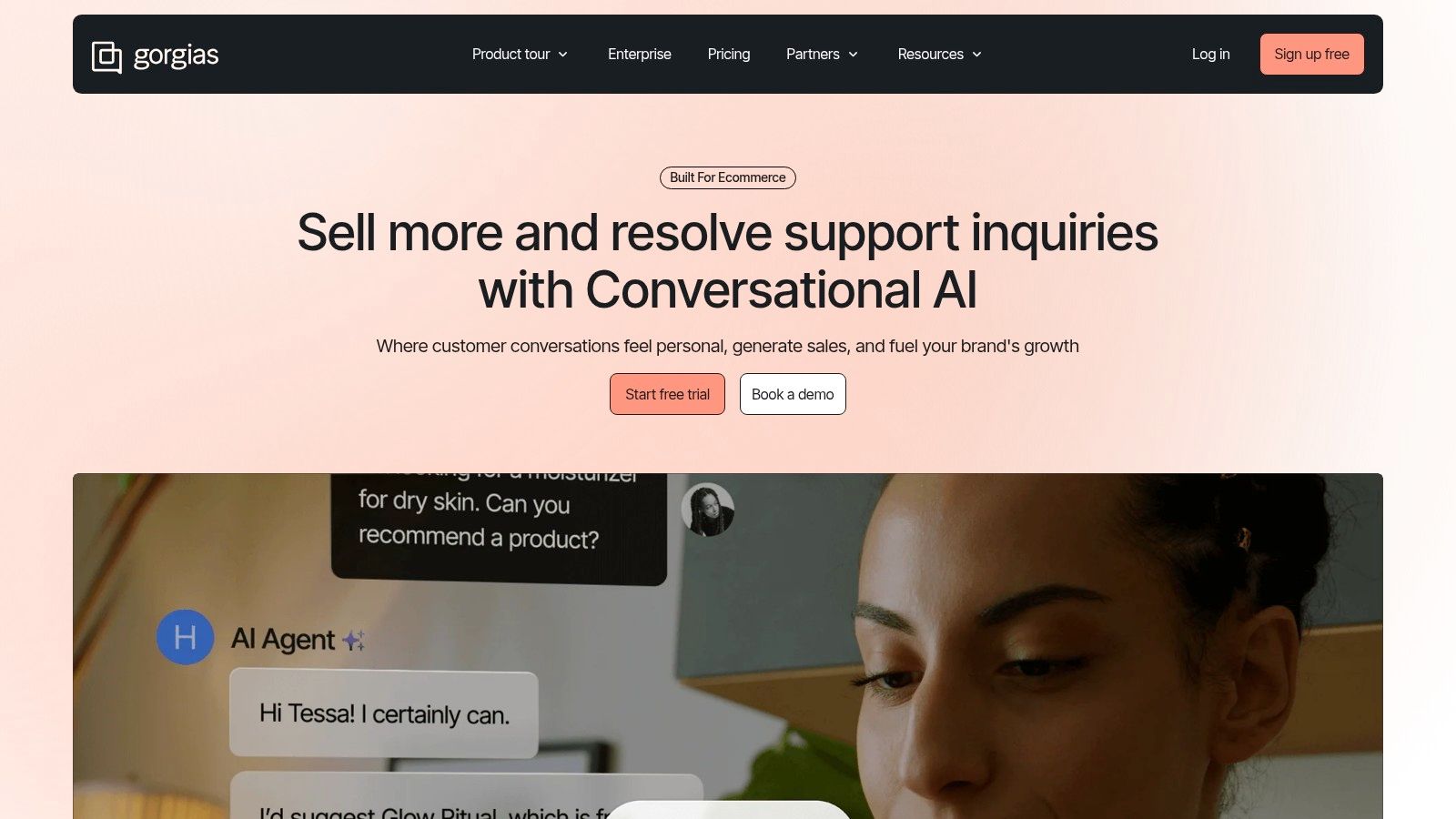
Gorgias's strength lies in its deep, native integrations with the e-commerce ecosystem. It connects seamlessly with over 150 apps, including Shopify, Recharge, and Yotpo, allowing the AI to pull and push data to automate complex tasks. Its omnichannel capabilities cover email, chat, and social media, with add-ons available for SMS, WhatsApp, and voice to create a unified customer view.
| Pros | Cons |
|---|---|
| Ecommerce-native actions and macros speed up order and returns workflows. | Primarily targeted at D2C/e-commerce, making it less ideal for other industries. |
| Clear per-resolution AI pricing aligns automation to support outcomes. | Core seat/plan pricing varies by package, and AI is an additional cost. |
Website: https://www.gorgias.com
For businesses starting their research, G2’s chatbots category is an essential, vendor-agnostic discovery hub. Instead of being a single product, it's a comprehensive marketplace featuring peer reviews, detailed feature filters, and objective grid reports. This makes it an invaluable resource for creating a vendor shortlist and validating which is the best AI chatbot for business based on real-world user sentiment and feature-level comparisons.
G2 aggregates user data into powerful visual tools like its Grid Reports, which plot vendors based on market presence and customer satisfaction. An actionable insight is to not just look at the "Leaders" quadrant. Use the filters to search for solutions specific to your company size (e.g., "Small Business") and check the "High Performers" quadrant. These are often newer, more innovative tools with high customer satisfaction that might be a better fit than a large, complex enterprise solution.
G2 excels at helping stakeholders build a data-backed business case for a new tool. The platform offers a directory of chatbot and AI agent tools that can be filtered by specific criteria such as company size, industry, and required integrations. This functionality enables teams to move from broad exploration to a focused shortlist efficiently.
| Pros | Cons |
|---|---|
| Neutral marketplace to compare dozens of vendors quickly. | Sponsored placements can influence vendor visibility and require scrutiny. |
| Helpful peer reviews and benchmarking provide valuable social proof. | Review quality can vary; details should always be confirmed on vendor sites. |
| Grid reports offer a clear visual for market leader comparison. |
Website: https://www.g2.com/categories/chatbots
| Product | Core features | UX / Quality ★ | Pricing / Value 💰 | Target audience 👥 | Unique selling points ✨ |
|---|---|---|---|---|---|
| MagicalCX 🏆 | EFRO™ agentic engine, conversational memory, omnichannel, guided workflows | ★★★★★ (98%+ claimed) | 💰 Contact sales — 14‑day free trial (no CC) | 👥 D2C/e‑commerce, SaaS, contact centers, SMB/mid‑market, FinTech | ✨ HumanlyClear™ replies, self‑learning, seamless human handoff, DIY or white‑glove |
| Intercom | Fin AI, shared inbox, omnichannel, plug‑in to helpdesks | ★★★★☆ | 💰 Per‑resolved conversation (AI) + seat | 👥 SMB → enterprise support teams | ✨ Resolution‑based AI pricing, fast setup, broad channels |
| Zendesk | Suite + Copilot, QA, WFM, large marketplace | ★★★★☆ | 💰 Tiered bundles; AI as add‑ons | 👥 Mid‑market & enterprise ops | ✨ Enterprise security, extensive integrations |
| Salesforce (Agentforce) | Agentforce, CRM‑native context, consumption/credit models | ★★★★☆ | 💰 Consumption/credits or per‑conv.; sales quote | 👥 Enterprise with deep CRM needs | ✨ Deep CRM context, flexible buying models |
| Freshworks (Freddy) | Freshchat, Freddy AI sessions, omnichannel | ★★★★☆ | 💰 Session‑based packs; competitive entry | 👥 SMB to mid‑market teams | ✨ Predictable session pricing, quick time‑to‑value |
| Tidio | Lyro AI, visual flow builder, integrations | ★★★☆☆ | 💰 Free & low‑cost tiers, pay‑as‑you‑grow | 👥 SMB/e‑commerce, non‑technical teams | ✨ Affordable entry, fast deployment, visual flows |
| LivePerson | Conversational Cloud (voice+messaging), APIs, safety tools | ★★★★☆ | 💰 Custom quoting; pay‑as‑you‑go options | 👥 Large brands, regulated industries | ✨ Enterprise scale, strong guardrails & extensibility |
| Ada | Reasoning agents, no‑code connectors, multi‑channel automation | ★★★★☆ | 💰 Sales‑led pricing | 👥 High‑volume CX teams, enterprise | ✨ No‑code action taking, 50+ languages, deep automation |
| Drift | Playbooks, ABM, routing, meeting scheduling | ★★★★☆ | 💰 Contact sales (enterprise focus) | 👥 B2B revenue/marketing & sales teams | ✨ GTM‑centric features, proven pipeline impact |
| HubSpot (Service Hub) | Live chat, no‑code bots, CRM‑native automations | ★★★★☆ | 💰 Per‑seat tiered pricing; scales with users | 👥 Teams wanting unified CRM + service stack | ✨ Strong training/docs, easy adoption, single‑vendor |
| Gorgias | Shopify‑centric helpdesk, AI per‑automated‑resolution | ★★★☆☆ | 💰 Per‑automated‑resolution + seat tiers | 👥 D2C/e‑commerce brands | ✨ Ecommerce actions & macros, deep commerce integrations |
| G2 (Chatbots) | Vendor directory, peer reviews, filters, grid reports | ★★★★☆ | 💰 Free to browse; sponsored placements | 👥 Buyers shortlisting & validation teams | ✨ Peer reviews, side‑by‑side comparisons, discovery tool |
Selecting the best AI chatbot for business is a pivotal decision, one that extends far beyond technology procurement. It's a strategic choice that directly influences your customer relationships, operational agility, and bottom line. As we've explored with tools from Intercom to Gorgias, the market is filled with powerful solutions, but the "best" platform is the one that aligns perfectly with your unique business model, customer journey, and long-term vision.
The key takeaway is this: your primary business goal dictates your ideal tool. A platform like Drift excels for B2B sales teams laser-focused on converting website traffic into qualified leads. For a Shopify store owner, the deep e-commerce integrations of Gorgias are non-negotiable for managing order inquiries and returns efficiently.
However, if your objective is more transformative-to evolve your support function from a reactive cost center into a proactive, empathy-driven revenue engine-the criteria shift. This is where a solution like MagicalCX carves out its unique value proposition. Its deep investment in conversational memory, agentic capabilities that solve problems autonomously, and a HumanlyClear™ approach are designed to build lasting customer relationships, not just close tickets.
Moving from analysis to action requires a structured approach. Avoid getting swayed by impressive demos alone and instead, ground your decision in your specific operational reality.
1. Identify Your Core Use Case: Before you sign any contract, pinpoint the single most important problem you need to solve.
2. Run a Targeted Pilot Program: A free trial is your most valuable evaluation tool. Don't just test generic features; run a pilot program focused on your top 2-3 most frequent and time-consuming customer issues.
3. Evaluate the Implementation Lift: A powerful tool that takes six months and a dedicated developer to implement may not be the right fit for your team.
Choosing the best AI chatbot for business means finding a partner, not just a product. It's about investing in a platform that will grow with you, adapt to your customers' needs, and consistently deliver value in every conversation. The right choice will feel less like software and more like an extension of your most capable and empathetic team members.
Ready to see how an AI partner can transform your customer support from a cost center into a relationship-building engine? MagicalCX is built for businesses that believe every customer interaction is an opportunity to build loyalty and drive revenue. Experience the future of empathetic, autonomous support with MagicalCX today.