See your AI teammate in action now
Ready to make support faster, kinder, easier and help customers feel good about choosing you?
PS: Sales improves too...
No credit card required
14 days free trial
DIY or Guided setup
Ready to make support faster, kinder, easier and help customers feel good about choosing you?
PS: Sales improves too...
No credit card required
14 days free trial
DIY or Guided setup
This article covers the top 10 benefits of AI in customer service for 2026, including 24/7 support, cost reduction, FCR, personalization, and omnichannel context.
Manish Keswani
Summary by MagicalCX AI
In 2026, customer service teams that deploy context-aware, omnichannel AI can cut support labor costs by 40–60% while boosting first-contact resolution from 60–70% to 85–95%, turning support from a cost center into a measurable growth lever.
Customer service has evolved far beyond simple, scripted chatbots. The most significant benefits of AI in customer service today stem from systems that do more than just answer questions; they understand context, remember past interactions, and act with a level of insight that feels genuinely helpful. This shift is transforming support from a necessary cost center into a powerful engine for revenue growth and customer loyalty. But how does this translate into tangible business results?
This article moves past the abstract hype to deliver a comprehensive, actionable roundup of the 10 most impactful benefits your organization can achieve with modern AI. We'll break down each advantage with practical implementation steps, real-world examples from diverse industries like e-commerce, SaaS, and FinTech, and the specific key performance indicators (KPIs) you should use to measure your success. You will learn not only what these benefits are but precisely how to realize them.
We will also explore how empathy-first AI platforms, such as MagicalCX, leverage capabilities like conversational memory, agentic actions, and seamless omnichannel orchestration to deliver these outcomes. Forget generic advice; this guide is designed for customer support leaders and operations teams who need to modernize their workflows, reduce agent burnout, and scale exceptional experiences. Get ready to discover how to implement these strategies to solve customer issues instantly, proactively prevent problems, and build stronger, more profitable relationships.
In today's global, always-on economy, customers expect support on their schedule, not just during traditional business hours. One of the most significant benefits of AI in customer service is its ability to eliminate wait times and operate continuously, providing instant acknowledgment and resolution to inquiries 24/7. This constant availability transforms the customer experience from a reactive, time-bound process to a proactive, immediate one.
Unlike human teams constrained by shifts and time zones, AI systems work tirelessly. For e-commerce and D2C brands, this means a customer browsing at 2 a.m. can get an instant answer about shipping policies, preventing cart abandonment. For global SaaS companies, a user in a different hemisphere can resolve a minor onboarding issue without waiting for the support team to come online. A practical example is an online retailer using an AI chatbot to handle "Where is my order?" (WISMO) requests at any time, instantly providing tracking details by integrating with their shipping provider's API.
The backbone of this constant availability and rapid response often lies in advanced AI chatbots, capable of handling inquiries around the clock. By automating responses to common questions, businesses can significantly reduce their support backlog and free up human agents for more complex, high-value interactions.
Beyond enhancing the customer experience, AI directly impacts the bottom line by drastically reducing labor expenses. By automating routine inquiries and repetitive tasks, AI allows businesses to handle significantly higher interaction volumes without a proportional increase in headcount. A single AI system can manage the workload of multiple human agents, which translates directly into savings on salaries, benefits, training, and overhead. For scaling companies, this is a critical benefit of AI in customer service, with many achieving 40-60% reductions in support-related costs.
This efficiency is particularly impactful for businesses with fluctuating demand. A travel booking site, for example, can leverage AI to manage a surge in flight cancellation queries due to a storm, without the expense of calling in extra staff. Similarly, contact centers have seen staffing reductions of up to 40% while simultaneously improving First Contact Resolution (FCR) rates because AI handles tier-1 questions, freeing human experts for complex issues.
The financial benefits compound over time. An AI like MagicalCX's self-learning engine continuously improves with each interaction, becoming more efficient without additional investment. This creates a revenue-positive operation that pays for itself through direct cost savings and indirect gains from improved customer retention. For a deeper dive, explore our guide on how to reduce customer service costs with intelligent automation.
One of the most powerful benefits of AI in customer service is its ability to resolve issues on the very first interaction. High First Contact Resolution (FCR) rates are a hallmark of an efficient and satisfying customer experience, as they eliminate the frustration of being passed between agents or departments. AI achieves this by acting as a single, all-knowing point of contact, equipped with immediate access to comprehensive knowledge bases and real-time customer data.
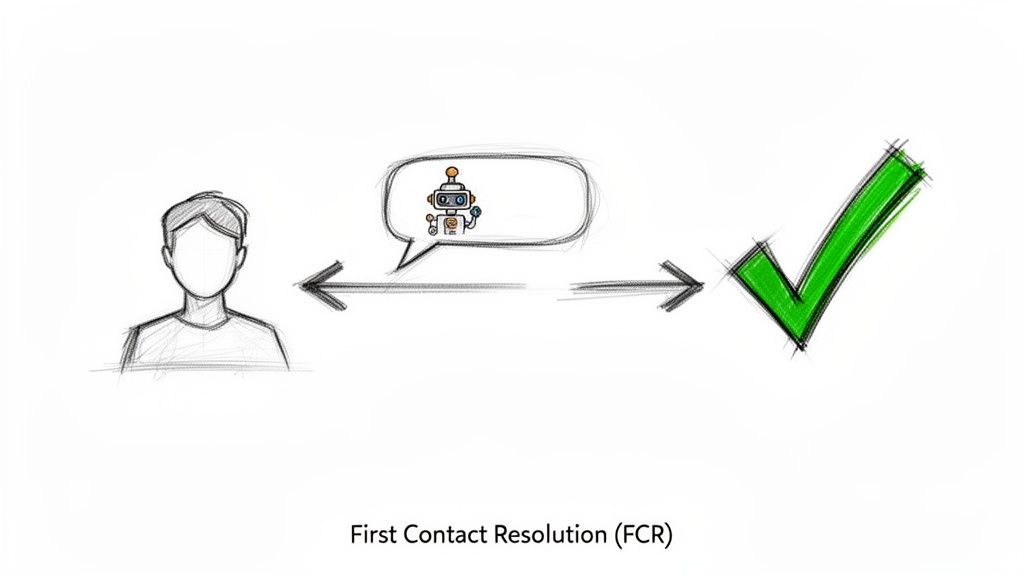
This capability dramatically reduces the need for escalations. For example, a SaaS user can resolve a complex account permissions issue instantly because the AI can query the backend, confirm their subscription tier, and guide them through the specific steps to add a new user. Similarly, an e-commerce customer can process a return or exchange in a single conversation, with the AI generating the shipping label and confirming inventory for the new item.
MagicalCX’s platform excels here by providing its AI with 360° integrated customer profiles. This complete context-from purchase history to previous support tickets-empowers the AI to deliver accurate, definitive resolutions from the outset. This is a key reason why businesses see FCR rates jump from industry averages of 60-70% to an impressive 85-95%, transforming their support from a multi-step process into a single, seamless interaction. For a deeper dive into this metric, you can learn more about how to improve first call resolution on our blog.
Beyond resolving individual tickets, one of the most transformative benefits of AI in customer service is its ability to convert countless interactions into a strategic asset. AI systems analyze conversations in real-time, extracting valuable data on customer sentiment, behavior, pain points, and preferences. This process turns your support function from a cost center into a powerful intelligence hub, providing leadership with actionable insights to guide business strategy.
Instead of relying on anecdotal evidence or quarterly surveys, businesses can tap into a continuous stream of data. For an e-commerce brand, AI might reveal that 30% of refund requests mention "item arrived damaged," directly informing a review of packaging materials or shipping partners. A SaaS company could use AI-powered analysis to discover that mentions of a competitor's new feature have increased by 500% in the last month, signaling a competitive threat that requires an immediate response from the product team.
This data democratizes customer understanding across the organization. MagicalCX’s live dashboards and weekly reports surface critical friction points and contact patterns, enabling product, marketing, and operations teams to make data-driven decisions. Leaders can identify emerging issues before they escalate, understand what drives loyalty, and build a product roadmap based on genuine customer needs, not assumptions.
Generic, one-size-fits-all support no longer meets customer expectations. A key benefit of AI in customer service is its ability to deliver hyper-personalized experiences across millions of interactions simultaneously. By leveraging integrated customer data, AI can recognize individuals, recall their history, and tailor every conversation, making each customer feel uniquely understood and valued. This transforms support from a transactional process into a relationship-building opportunity.
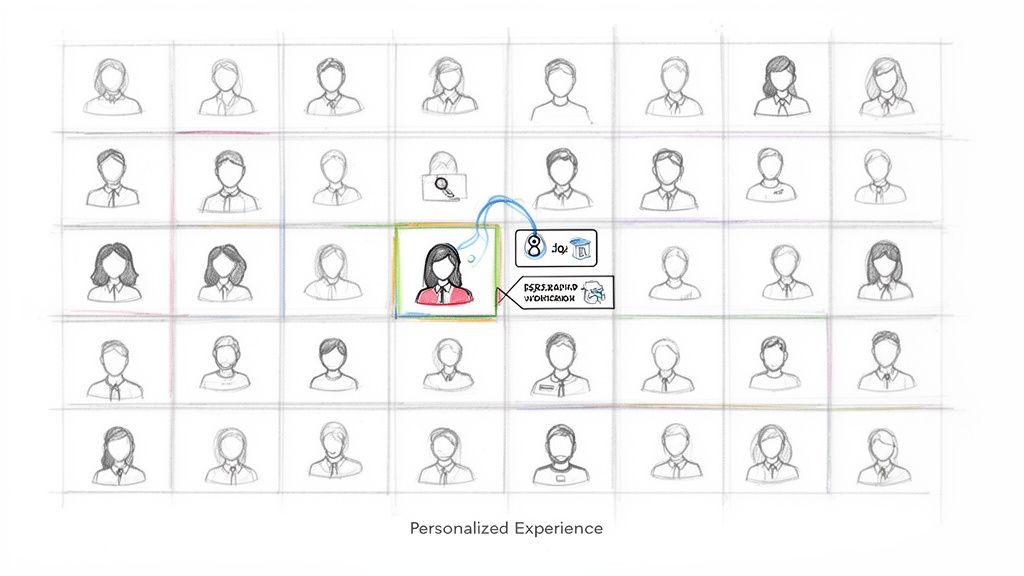
For e-commerce and D2C brands, this level of personalization directly correlates with higher conversion rates, increased loyalty, and greater customer lifetime value. For instance, an AI can greet a returning customer with, "Welcome back, Sarah! I see you recently bought the Trail Blazer hiking boots. Are you looking for care instructions or perhaps some recommended waterproof socks?" Mastering personalized customer service for e-commerce growth at scale is a significant competitive advantage.
The engine behind this capability is conversational memory. Systems like MagicalCX's EFRO Engine use this memory to ensure the AI knows a customer's entire journey, from their first purchase to their most recent support ticket. This allows the AI to provide context-aware, empathetic responses that feel like speaking with a top-tier agent who knows the customer's history inside and out. Learn more about creating a truly personalized customer experience to drive meaningful engagement.
Modern customers engage with brands across a multitude of channels, from web chat and email to social media DMs and SMS. A significant benefit of AI in customer service is its ability to unify these touchpoints, eliminating the frustration customers feel when they have to repeat themselves. AI-powered omnichannel orchestration ensures a conversation can start on one channel and seamlessly continue on another without losing a shred of context, creating a single, continuous dialogue.

This unified approach is critical for building trust and reducing customer effort. For instance, a D2C customer might first inquire about a return via an Instagram DM, then switch to WhatsApp for a faster exchange. An AI system with omnichannel memory ensures the agent on WhatsApp sees the full Instagram conversation history, preventing the customer from restating their order number and issue.
This capability transforms fragmented interactions into a cohesive and intelligent customer journey. MagicalCX's omnichannel orchestration and conversational memory are central to this, maintaining a persistent customer profile across all channels. This ensures that whether a customer reaches out via web chat or text, they receive a consistently informed and empathetic response, making the support system feel like one unified, intelligent entity.
Traditional customer service is reactive; it waits for a problem to arise before acting. A key benefit of AI in customer service is its ability to shift this model from reactive to proactive. By analyzing customer behavior, historical data, and engagement patterns, AI can predict potential issues and trigger interventions before the customer even realizes there's a problem, transforming support into a powerful retention engine.
This predictive capability is a game-changer for businesses focused on long-term customer relationships. For SaaS companies, an AI can detect that a user has logged in three times but failed to complete the onboarding setup. It can then proactively trigger an in-app message: "Hi Alex, it looks like you're stuck on connecting your calendar. Here's a 30-second video that shows you how." This turns a potential churn moment into a successful activation.
The foundation of this predictive power lies in AI engines that can calculate relationship health scores and identify subtle churn signals. Instead of simply solving problems, this technology allows businesses to build loyalty by demonstrating they understand and anticipate customer needs. MagicalCX's self-learning engine, for instance, is designed to spot these early warnings and enable timely, personalized outreach that feels helpful, not intrusive.
Human agents, with their unique personalities and communication styles, can create brand experiences that vary from one interaction to the next. One of the key benefits of AI in customer service is its ability to enforce a consistent brand voice, ensuring every customer engagement reinforces your brand’s identity. This eliminates the risk of agents misrepresenting brand values or using off-brand language, which is crucial for building trust and recognition.
This consistency is vital across all industries. A D2C luxury brand, for instance, can ensure its sophisticated, premium tone is maintained in every support ticket. An AI can be programmed to use phrases like "Certainly, we would be delighted to assist you" instead of "Sure, no problem." For fintech companies, an authoritative and trustworthy tone is non-negotiable for maintaining credibility. AI applies your brand guidelines with perfect precision.
Tools like MagicalCX's HumanlyClear conversations are designed to deliver responses that feel like your best agents: clear, emotionally attuned, and perfectly on-brand. By training the AI on your specific brand guidelines, vocabulary, and desired personality traits, you ensure that whether the AI is answering a simple query or handling a sensitive complaint, the voice remains unwaveringly consistent.
Many customer support interactions involve multi-step processes like returns, plan changes, or complex billing inquiries. These journeys traditionally require significant manual handling by agents or force customers to navigate clunky self-service forms. One of the most advanced benefits of AI in customer service is its ability to automate these complex journeys through intelligent, guided workflows. This approach transforms convoluted processes into simple, conversational interactions.
AI-powered guided workflows walk customers through each required step, collecting necessary information, validating data in real-time, and executing actions on the backend. For an e-commerce brand, this means an AI can handle a product exchange from start to finish, confirming the new item's availability in your inventory system and generating a return label via an API call to your shipping provider—all without any human intervention. For a SaaS company, a customer can upgrade their subscription plan conversationally, with the AI handling proration calculations and feature activation automatically.
This intelligent automation ensures 100% data accuracy and consistent process execution, dramatically increasing resolution rates for tasks that historically demanded high human involvement. It elevates the customer experience by making complex actions feel effortless and immediate.
A key benefit of AI in customer service is its profound impact on the human side of support operations. By automating high-volume, repetitive inquiries, AI frees human agents from mundane tasks, allowing them to focus on complex, high-stakes interactions that require empathy, critical thinking, and genuine connection. This shift not only reduces stress and burnout but also transforms the support center from a cost center into a strategic, revenue-positive function.
When agents are no longer bogged down by password resets or order status lookups, their roles become more engaging and fulfilling. They can dedicate their expertise to solving intricate problems, like helping a customer choose the right software package for their business needs or de-escalating a frustrated customer. This leads to higher job satisfaction and lower agent turnover. For instance, a contact center that automated 60% of its tier-1 queries saw agent turnover drop by 25% within a year because the work became more interesting.
Simultaneously, AI can actively contribute to revenue. For example, when a customer of a D2C brand asks to cancel their subscription, instead of simply processing it, the AI can be programmed to first ask why, and based on the answer ("It's too expensive"), proactively offer a one-time 20% discount to retain them. This single action can convert 8-12% of potential churners, directly protecting revenue.
| Feature | 🔄 Implementation Complexity | ⚡ Resource & Speed | 📊 Expected Outcomes | Ideal Use Cases | ⭐ Key Advantages / 💡 Tips |
|---|---|---|---|---|---|
| 24/7 Availability and Instant Response Times | Medium — channel integration, prompt engineering, escalation rules | Low incremental staffing, continuous API/compute costs, ⚡ sub‑second replies | Lower ART, ↑CSAT 20–30%, reduced abandonment | Global e‑commerce, SaaS, D2C needing immediate support | ⭐ High responsiveness; 💡 set clear escalation triggers, use conversational memory |
| Significantly Reduced Operational Costs | High upfront implementation; integrations and governance | Reduces headcount needs and per‑interaction cost over time; requires monitoring | 40–60% labor cost reduction, ROI in 6–12 months | Scaling SMBs, contact centers, seasonal businesses | ⭐ Strong cost efficiency; 💡 run cost‑benefit analysis, track CPI and payback |
| Improved First Contact Resolution (FCR) and Reduced Escalations | Medium–High — knowledge base and CRM integration, guided flows | Ongoing KB maintenance speeds resolutions, reduces handoffs | FCR 85–95%, fewer escalations, lower repeat contacts | SaaS, e‑commerce returns, fintech transactional support | ⭐ High resolution quality; 💡 keep KB current, audit AI accuracy frequently |
| Enhanced Customer Insights and Actionable Data for Business Strategy | Medium — data pipelines, analytics setup, privacy controls | Requires analytics/BI resources and reporting cadence | Actionable trends, reduced churn, informed product/marketing decisions | Product teams, marketing, exec strategy for data‑driven orgs | ⭐ Strategic impact; 💡 build stakeholder dashboards, ensure privacy compliance |
| Personalized Customer Experiences at Scale | High — unified profiles, realtime data, consent management | Significant data infrastructure; improves conversion velocity | ↑CLV 25–40%, higher conversion & retention, better upsell rates | E‑commerce, D2C, subscription services prioritizing personalization | ⭐ Strong revenue uplift; 💡 be transparent, audit fairness, provide preference controls |
| Seamless Omnichannel Support with Consistent Context | High — many third‑party integrations and channel handling | Ongoing integration effort; preserves context across channels, reduces repeats | Improved FCR, lower friction, higher customer preference for support | Brands with multi‑channel customers, global support operations | ⭐ Consistent experience; 💡 map channels to segments and preserve context on escalation |
| Proactive and Predictive Support That Prevents Issues | High — predictive models, thresholds, opt‑out controls | Requires ML resources and monitoring; ⚡ prevents escalation by early intervention | Reduces churn 15–30%, higher NPS, fewer support incidents | SaaS/subscription, high‑churn services, usage‑driven products | ⭐ Retention impact; 💡 start with high‑confidence signals, allow opt‑outs, track false positives |
| Consistent Brand Voice and Tone Across All Interactions | Medium — define voice rules, templates, enforcement | Low ongoing compute; requires governance and periodic updates | Stronger brand trust, fewer messaging errors, consistent customer perception | D2C, luxury, regulated brands needing strict messaging control | ⭐ Brand trust & consistency; 💡 document voice guide and audit interactions regularly |
| Guided Workflows That Automate Complex Customer Journeys | High — workflow design, data validation, edge‑case handling | Automates multi‑step tasks, ⚡ reduces time‑to‑completion 60%+, needs integration | Higher completion rates, 85–95% automation for some tasks, lower support volume | Returns, billing, onboarding, plan changes, dispute resolution | ⭐ Reliable process automation; 💡 design fallbacks, measure completion and optimize drop‑offs |
| Reduced Agent Burnout, Improved Team Satisfaction, and Revenue Impact | Medium — change management, training, attribution systems | Shifts routine work from agents, improves efficiency, needs analytics for revenue attribution | ↓Turnover 20–40%, ↑agent satisfaction, ↑ARPU and retention | Large contact centers, high‑volume support teams seeking revenue lift | ⭐ Better morale + revenue; 💡 involve agents in design, avoid aggressive upsells, track satisfaction metrics |
The journey through the core benefits of AI in customer service reveals a fundamental shift in how businesses can and should operate. We've moved beyond the initial novelty of chatbots handling simple FAQs. The true evolution lies in transforming your customer service function from a reactive cost center into a proactive, intelligent, and powerful growth engine for your entire organization.
As we've explored, the impact is multifaceted. From providing instant, 24/7 support that meets modern customer expectations to drastically reducing operational costs through automation, the foundational advantages are clear. Yet, the most significant transformation occurs when AI elevates the human element rather than just replacing it. By improving First Contact Resolution, we not only satisfy customers but also free up our expert agents to tackle the complex, high-value interactions that truly define a brand.
The most crucial takeaway is that the goal isn't just automation; it's intelligent augmentation. The real value is unlocked when AI handles the repetitive tasks, gathers crucial data, and provides agents with the context they need to deliver truly empathetic and personalized support.
Consider the leap from simply resolving a ticket to proactively preventing the next one. This is made possible by harnessing AI-driven analytics to understand customer behavior, predict potential issues, and engage with tailored solutions before frustration sets in. This proactive stance, combined with the ability to maintain a consistent brand voice and seamless context across every channel, is what separates satisfactory service from a memorable, loyalty-building experience.
Key Insight: The ultimate benefit of AI in customer service isn't just about answering questions faster. It's about understanding the unasked questions and creating an ecosystem where customer needs are anticipated and met with minimal effort from their side.
Implementing these concepts can seem daunting, but the path forward is a series of strategic, incremental steps. Instead of a complete overhaul, focus on a phased approach that delivers immediate value and builds momentum.
Here are your next steps:
By embracing this strategic approach, you're not just adopting new technology. You are fundamentally redesigning your customer relationships for the modern era, building a resilient, scalable, and deeply human-centric support operation that drives retention and fuels sustainable growth.
Ready to transform your customer service from a cost center into your most valuable growth asset? Explore how MagicalCX leverages an empathy-first AI with conversational memory and agentic actions to deliver the powerful benefits discussed in this article. Discover the future of customer experience at MagicalCX and start building more meaningful connections today.


