See your AI teammate in action now
Ready to make support faster, kinder, easier and help customers feel good about choosing you?
PS: Sales improves too...
No credit card required
14 days free trial
DIY or Guided setup
Ready to make support faster, kinder, easier and help customers feel good about choosing you?
PS: Sales improves too...
No credit card required
14 days free trial
DIY or Guided setup
A guide to the top 12 Chatbase alternatives for 2026, covering feature comparisons like omnichannel support, conversational memory, integrations, agent handoff, privacy, and analytics.
Manish Keswani

Summary by MagicalCX AI
Businesses typically outgrow Chatbase when they need enterprise-grade omnichannel memory, source-grounded answers to reduce hallucinations, and measurable support ROI like Intercom Fin’s $0.99-per-successful-resolution pricing instead of a basic website-only Q&A bot.
While Chatbase offers a quick way to build a GPT-based chatbot from your data, many businesses find they quickly outgrow its capabilities. You might need more advanced conversational memory, omnichannel support, or deeper integrations with your existing helpdesk and CRM. The search for a chatbase alternative often begins when you require a solution that can handle complex customer queries with greater accuracy and less "hallucination," while also providing actionable insights to your team.
This guide provides a detailed breakdown of the top platforms that can replace and often surpass Chatbase's functionality. We move beyond simple feature lists to give you an honest assessment of each tool’s strengths and limitations. You'll find direct comparisons on critical features like agent handoff, privacy controls, and proactive engagement capabilities, complete with screenshots and direct links for each option. For instance, we'll show you exactly how one platform can turn a simple "Where is my order?" query into an upsell opportunity, while another can guide a user through a complex software setup process.
To grasp the full potential of these platforms, it helps to understand the broader category of AI knowledge management tools that many of them fall into. Our analysis focuses on practical use cases, helping you identify the best fit for your specific needs, whether you're a D2C brand, a SaaS company, or a high-touch B2B service. Consider this your definitive resource for finding a chatbot solution that scales with your business.
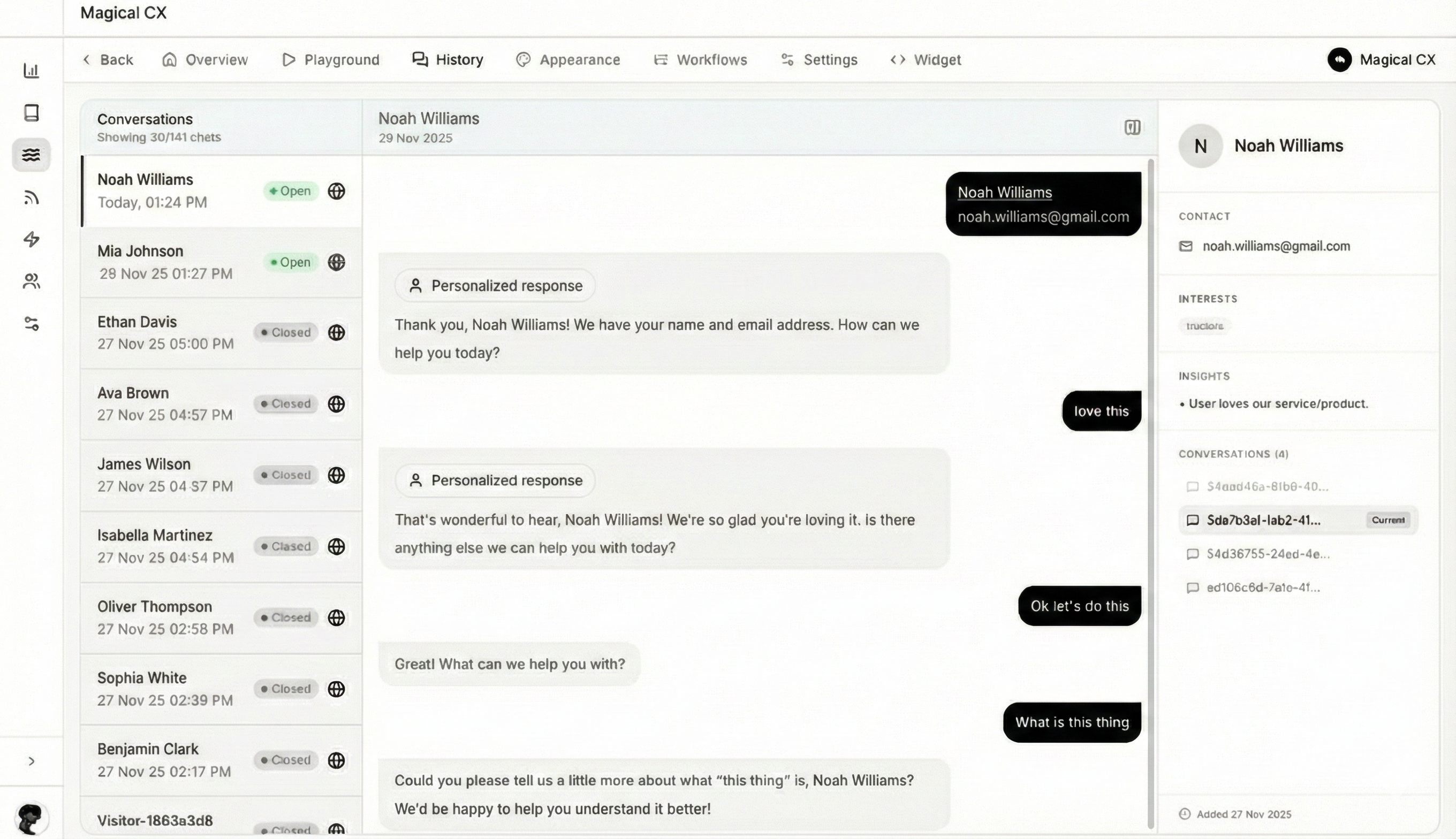
MagicalCX positions itself as a strong, well-rounded Chatbase alternative, designed for businesses that prioritize empathetic customer interactions alongside revenue growth. Its core philosophy revolves around turning customer support from a cost center into a scalable, profit-positive function. The platform achieves this by combining a context-aware AI with a conversational tone that feels genuinely human, aiming to build trust and resolve issues effectively on the first contact.

What sets MagicalCX apart is its persistent, omnichannel conversational memory. A customer can start a conversation on your website's live chat, follow up via WhatsApp, and later respond to an email, and the AI retains the entire history. This eliminates the common frustration of customers having to repeat themselves. Furthermore, its EFRO Engine (Empathy-First, Revenue-Optimized) intelligently identifies moments to suggest relevant product upgrades, special offers, or plan changes, but only when it adds real value to the customer's situation. For instance, if a SaaS user frequently asks about features in a higher-tier plan, the AI can proactively explain the benefits and guide them through an upgrade.
The platform is engineered for operational excellence, featuring guided workflows for complex processes like returns or onboarding, seamless human agent handoffs that preserve all context, and integrated 360° customer profiles. Deployment is notably flexible; you can either use its DIY-friendly setup or opt for a full white-glove implementation at no extra cost. This flexibility makes it an accessible option for both technically-savvy teams and those who prefer a guided start. If you're exploring the benefits of a more relationship-focused approach, you can learn more about how AI-powered customer service can be implemented.
| Feature | MagicalCX |
|---|---|
| Best For | D2C brands, SaaS/subscription businesses, and contact centers aiming to blend empathetic support with revenue opportunities. |
| Key Advantage | Omnichannel conversational memory and an engine that finds appropriate moments for upselling without sacrificing trust. |
| Pricing | Not public. Requires a demo to receive a custom quote. Offers a 14-day free trial with no credit card needed. |
| Website | Visit MagicalCX |
CustomGPT.ai is a no-code platform designed for building branded AI assistants grounded in your specific business content. It stands out as a strong Chatbase alternative for teams that need precise control over data ingestion, response accuracy, and enterprise-level governance. The platform’s core strength lies in its "anti-hallucination" technology, ensuring every answer is based strictly on your provided sources and includes citations for verification.

This makes it a reliable choice for organizations where accuracy is non-negotiable, such as in regulated industries or for complex technical support. The platform also offers a robust RAG (Retrieval-Augmented Generation) API and scalable vectorization, appealing to developers who want to integrate custom AI into their existing systems. To get a better sense of how this technology fits into a broader strategy, you can find a helpful comparison in this guide on the best AI chatbots for customer service.
CustomGPT.ai is an excellent fit for businesses needing a trustworthy, scalable AI assistant. The 7-day free trial allows you to test its response quality with your own content before committing. While its entry-level pricing is higher than some competitors, the emphasis on accuracy and control provides significant value for teams prioritizing reliability.
DocsBot AI is a powerful platform for creating AI agents trained on an extensive range of business content. It excels as a Chatbase alternative for organizations that need to draw information from diverse sources, offering ingestion from over 37 platforms like Notion, Zendesk, Salesforce, and even YouTube. Its main draw is the ability to consolidate scattered knowledge into a single, reliable AI assistant that can be deployed across widgets, APIs, and integrations like Zapier.

The platform focuses on both automated support and deeper analysis. With features for scheduled source refreshes and advanced conversation analytics, businesses can ensure their bot stays current and provides valuable insights into customer queries. For teams in regulated sectors, DocsBot AI provides enterprise-grade compliance options, including SOC 2 Type II and GDPR readiness, making it a secure choice. You can learn more about its capabilities at https://docsbot.ai.
DocsBot AI is a strong contender for businesses needing a versatile, secure, and easy-to-budget AI assistant. While some features like the unbranded widget are reserved for higher tiers, the platform's extensive integration options and compliance focus offer considerable value for teams that prioritize data breadth and security.
SiteGPT is a website-centric chatbot builder designed for rapid deployment and ease of use, making it an effective Chatbase alternative for businesses focused on lead generation and support. Its core function is to crawl website URLs or sitemaps to create a knowledge base, but it also supports files and integrations with sources like Zendesk, YouTube, and GitBook. This allows businesses to train a bot on their existing public-facing content with minimal setup.

The platform is built for speed and simplicity. You can have a chatbot embedded on your site quickly via a simple code snippet. It offers scheduled content synchronization (daily, weekly, or monthly depending on the plan) and on-demand retraining, ensuring the bot stays current with your latest website updates. This automated maintenance makes it a practical "set and forget" solution for small teams.
SiteGPT is ideal for businesses that need a quick, no-fuss chatbot primarily based on their website content. While it lacks some of the deep enterprise governance features of larger platforms, its straightforward approach and focus on web-based knowledge make it a strong contender for marketing and support automation. The availability of webhooks and an API on higher tiers also provides a path for future integration.
Chatling is a no-code chatbot builder that serves as a powerful Chatbase alternative by combining traditional intent flows with modern RAG capabilities. It distinguishes itself with a visual flow editor and multi-model support, allowing you to choose from over 30 different AI models from OpenAI, Anthropic, and Google. This flexibility means you can switch models based on your specific needs for speed, cost, or reasoning ability without being locked into a single provider.
The platform is designed to handle a variety of business workflows, from marketing and sales to customer support. Its ability to execute actions, capture leads, and accept voice input makes it a versatile tool. Features like autosyncing knowledge base sources and a clear analytics dashboard help teams maintain and monitor their chatbot's performance with minimal effort.
Chatling is a strong choice for businesses that want granular control over their AI model and conversation design. While its credit-based system requires some monitoring, the straightforward annual pricing and flexible add-ons provide a clear path to scale. The blend of a visual editor and advanced AI features makes it accessible yet powerful.
Botpress is a complete AI agent platform designed for developers and teams who need deep control over their chatbot's logic and behavior. Positioned as a powerful Chatbase alternative, it offers a visual "studio" for building complex, multi-step automations alongside robust knowledge base capabilities. This makes it ideal for organizations that want to go beyond simple Q&A and create sophisticated conversational flows with custom integrations and business logic.
The platform's strength is its flexibility, combining a low-code visual builder with a developer-friendly SDK and APIs for full extensibility. Teams can ingest content from websites and documents into a knowledge base, which features an optimizer to auto-summarize information for better retrieval quality. Its combination of a collaborative studio, channel connectors, and governance tools provides a scalable framework for building and deploying highly customized AI agents.
Botpress is a great match for technical teams needing more than a basic no-code solution. While its usage-based pricing for AI tokens requires monitoring and the learning curve is steeper than simpler tools, its depth and flexibility are significant assets for creating advanced, task-oriented AI agents.
Intercom is a well-known customer communications platform, and its Fin AI Agent serves as a powerful Chatbase alternative for businesses that need AI integrated directly into a mature help desk ecosystem. Fin is designed to resolve customer questions instantly across live chat, email, and social channels like WhatsApp. Its key advantage is its connection to Intercom’s full suite of tools, including a shared inbox, ticketing system, and knowledge base.
Fin can also be purchased as a standalone product to work with other help desks like Zendesk or Salesforce. This flexibility allows teams to add advanced AI capabilities without overhauling their existing support stack. The model is priced at $0.99 per successful resolution, offering a predictable cost structure tied directly to performance. To understand how this fits into the broader market, you can explore this guide on what defines a modern AI agent platform.
Intercom with Fin is ideal for teams already invested in a robust help desk environment or those looking for a top-tier AI that can plug into their current system. While it requires at least one paid Intercom seat to use natively, its predictable pricing and deep integration present a compelling case for businesses focused on operational efficiency and a unified customer experience.
Zendesk AI integrates powerful AI capabilities directly into its well-established customer experience suite. It stands out as a strong Chatbase alternative for large organizations already invested in the Zendesk ecosystem or those needing an all-in-one solution that combines ticketing, a knowledge base, and omnichannel messaging. The platform's strength lies in its ability to deploy AI agents and an agent-facing Copilot within a unified workspace, connecting automated conversations to human-led support and back-end ticketing without friction.
This makes Zendesk a solid choice for enterprise-level support teams that need robust governance, extensive app integrations, and a single source of truth for all customer interactions. The optional Advanced AI Agents and Copilot are priced as add-ons, allowing businesses to scale their AI investment as their needs grow. For teams wanting to unify their support stack, Zendesk offers a cohesive environment where automation and human agents work together.
Zendesk AI is best suited for larger organizations seeking to embed AI into their existing, complex support operations. While its Advanced AI Agents require enterprise packaging and sales engagement, the core suite and standard AI features offer a powerful, integrated alternative to standalone chatbot builders.
Tidio is a popular all-in-one customer service platform designed for small and medium-sized businesses, combining live chat, chatbots, and helpdesk tools. Its AI agent, Lyro, functions as a powerful Chatbase alternative by learning from your knowledge base to answer customer questions instantly. It stands out with a generous free tier that includes 50 AI-powered conversations per month, making it exceptionally accessible for startups and growing teams.

The platform is designed for rapid implementation, allowing businesses to deploy an AI-powered agent without technical expertise. As teams scale, Tidio offers transparent pay-per-conversation quotas, which simplifies budgeting. The combination of a drag-and-drop workflow builder and an AI agent provides a flexible approach to automation, handling both simple, rule-based tasks and complex, knowledge-based inquiries. You can learn more about how this works on the Tidio website.
Tidio is an excellent choice for SMBs looking for a budget-friendly and easy-to-use solution that can scale. While advanced features like SSO are gated behind higher-priced plans, its core offering provides significant value for teams aiming to automate support efficiently.
Zowie is an AI customer service platform designed specifically for ecommerce and D2C brands that want to move beyond simple chatbots. It positions itself as a powerful Chatbase alternative for businesses focused on measurable outcomes like increased conversions and reduced support costs. The platform's main advantage is its deep integration with ecommerce ecosystems and its focus on automating entire customer journeys, not just answering questions.
With a suite that includes AI agent automation, a workflow "Orchestrator," and quality assurance tools, Zowie is built for high-volume retail environments. It automates common inquiries across channels like chat, email, and social media, directly connecting to systems like Shopify and Magento to handle order status checks, returns, and product recommendations without human intervention. The emphasis on tangible KPI impact is evident in their sales process, which often includes case studies demonstrating ROI.
Zowie is an excellent fit for scaling ecommerce brands that need a robust, outcome-driven automation solution. While the custom packaging and sales-led model require a longer procurement cycle than some competitors, it provides a high-touch partnership focused on delivering measurable results.
Ada is an enterprise-grade AI customer service platform designed for large organizations that need to automate conversations across messaging, voice, and email. It positions itself as a robust Chatbase alternative for companies with high-volume support needs, offering vertical-specific playbooks and extensive governance controls. The platform’s core value is its ability to provide a unified AI stack for both digital and voice channels, managed under a commercial model tied directly to automated resolutions.
This approach makes Ada a serious contender for enterprises in regulated industries or those managing complex, multi-channel customer interactions. For example, a financial services company could use Ada to handle routine account inquiries via its app, website, and phone line from a single, compliant automation engine. The platform is not built for small teams; access requires sales engagement to develop a custom, usage-based pricing plan aligned with enterprise-level service agreements (SLAs).
Ada is best suited for established organizations that need a powerful, compliant, and scalable AI solution. While the requirement for a sales consultation and its enterprise focus make it inaccessible for smaller businesses, its proven implementation experience and combined voice/digital capabilities offer significant advantages for large-scale operations.
Forethought provides an AI support platform that goes beyond simple knowledge base chatbots, offering a multi-agent system designed for complete customer service automation. As a Chatbase alternative, its strength is its unified approach, combining omnichannel AI agents, a copilot for human agents, and AI-powered quality assurance into a single ecosystem. This integrated model helps support teams automate resolutions, assist live agents, and analyze performance without switching between tools.
The platform is built for enterprise-scale operations, with a focus on demonstrating tangible impact through proof-of-value engagements. Forethought's ability to detect knowledge gaps and automatically generate help articles makes it a dynamic solution for teams needing to keep their knowledge base current.
Forethought is a strong contender for large support teams that need a holistic AI platform rather than just a chatbot builder. Its sales-quoted pricing and enterprise focus mean it may not suit very small teams, but for organizations ready to invest in a comprehensive system, it provides a powerful, well-rounded toolset. You can learn more and request a demo on their website at forethought.ai.
| Product | Core features ✨ | UX / Quality ★ | Price / Value 💰 | Target audience 👥 | Why choose / Unique selling point 🏆 |
|---|---|---|---|---|---|
| MagicalCX 🏆 | Omnichannel memory, EFRO Engine, guided workflows, seamless human handoff | 4.9/5 ★; +98% accuracy; 99.9% SLA | Free demo + 14‑day trial; pricing via demo 💰 | E‑commerce/D2C, SaaS, contact centers, SMBs 👥 | Remembers like CRM, acts like agent, converts from support 🏆 |
| CustomGPT.ai | No‑code source‑grounded assistants; RAG & vectorization ✨ | Source‑citing accuracy; enterprise controls ★ | Planed limits; mid‑to‑enterprise entry price 💰 | Teams needing governance & fine ingestion control 👥 | Precise, source‑backed answers with strong governance 🏆 |
| DocsBot AI | 37+ ingestion sources; widgets & analytics ✨ | SOC 2 Type II option; analytics ★ | Clear plan tiers with message/page caps 💰 | Compliance‑sensitive teams, enterprises 👥 | Deep research agents + enterprise compliance focus 🏆 |
| SiteGPT | URL/sitemap crawl; fast embed deployment ✨ | Simple UX for quick setup ★ | Lower entry price; volume tiers 💰 | SMBs, small e‑commerce sites, fast deploys 👥 | Fast site crawling + low‑cost lead gen/support solution 🏆 |
| Chatling | Visual flow builder; multi‑model & autosync KB ✨ | Flexible model choices; dashboard ★ | Annual pricing; credit metering (watch usage) 💰 | Marketing, sales, support teams needing multi‑channel 👥 | Visual flows + multi‑model flexibility for diverse workflows 🏆 |
| Botpress | Developer studio, KB optimizer, SDKs ✨ | Powerful but steeper learning curve ★ | Usage/token costs; flexible for self‑host 💰 | Dev teams building custom, complex automations 👥 | Deep extensibility & developer tooling for custom agents 🏆 |
| Intercom (Fin) | Omnichannel messenger + Fin per‑resolution option ✨ | Mature inbox UX; broad integrations ★ | $0.99 per resolved conversation (Fin) 💰 | Mid‑market to enterprise with helpdesk needs 👥 | Predictable per‑resolution pricing + rich helpdesk ecosystem 🏆 |
| Zendesk AI | Suite + Copilot add‑ons; extensive marketplace ✨ | Enterprise governance & integrations ★ | Add‑on pricing; enterprise packages 💰 | Large support orgs, enterprises 👥 | End‑to‑end CX stack with enterprise governance 🏆 |
| Tidio (Lyro) | Live chat, drag‑drop flows, Lyro agent ✨ | SMB‑friendly UX; quick setup ★ | First 50 convos free; pay‑per‑conversation 💰 | Small & growing SMBs, startups 👥 | Budget‑friendly AI conversations + easy rollout 🏆 |
| Zowie | Ecommerce workflows, QA & orchestrator ✨ | KPI case studies; sales‑led support ★ | Custom quotes; sales‑led pricing 💰 | Ecommerce & D2C brands, retail teams 👥 | Purpose‑built ecommerce automation with measurable KPIs 🏆 |
| Ada | Omnichannel agents (voice + digital); compliance ✨ | Strong enterprise SLAs & compliance ★ | Usage‑based, sales‑quoted pricing 💰 | High‑volume enterprises, regulated industries 👥 | Combined voice & digital automation with enterprise trust 🏆 |
| Forethought | Multi‑agent system: agentic copilot + AI QA ✨ | Proof‑of‑value engagements; enterprise fit ★ | Sales‑quoted; ROI/deflection models 💰 | Enterprise support orgs seeking QA & copilot 👥 | Unified automation + QA with knowledge‑gap detection 🏆 |
The journey to find the right AI chatbot support doesn't end with a single choice; it's about finding a platform that grows with your business and truly understands your customers. While Chatbase provides a solid entry point for basic knowledge base bots, the alternatives we've explored offer specialized capabilities that can significantly improve your customer experience, agent efficiency, and bottom line. From the deep conversational memory of MagicalCX to the developer-centric flexibility of Botpress, the ideal solution depends entirely on your specific operational needs and strategic goals.
Making the right selection requires a clear-eyed assessment of your current pain points. Are you a D2C brand struggling with repetitive "Where is my order?" inquiries? Tools like MagicalCX or Zowie, with their strong e-commerce integrations and agent action capabilities, are built for that exact scenario. For a SaaS company, the priority might be accurate technical support sourced from complex documentation, making a solution like DocsBot AI or SiteGPT a more logical fit. Large contact centers, on the other hand, will prioritize tools like Zendesk AI or Forethought that integrate seamlessly into existing agent workflows to reduce handle times.
Before committing, take a moment to reflect on these critical factors:
Ultimately, the best chatbase alternative is not just a piece of software; it's a strategic partner in your customer service operations. Start with a small, well-defined pilot project. Test the bot with your internal team and a small group of real customers. Measure its performance against clear metrics like deflection rate, customer satisfaction, and first-contact resolution. For those whose needs extend beyond simple website chat to interacting with complex documents, you might also want to explore a ChatPDF Alternative to see how different tools handle structured and unstructured data in files. This iterative, data-driven approach will ensure you select and implement a solution that delivers lasting value.
Ready to move beyond basic Q&A and empower your support with an AI agent that takes real action? MagicalCX is designed for businesses that need more than a simple knowledge base bot, offering deep e-commerce integrations and powerful agent actions out of the box. See how you can reduce ticket volume and improve customer loyalty by visiting MagicalCX.