See your AI teammate in action now
Ready to make support faster, kinder, easier and help customers feel good about choosing you?
PS: Sales improves too...
No credit card required
14 days free trial
DIY or Guided setup
Ready to make support faster, kinder, easier and help customers feel good about choosing you?
PS: Sales improves too...
No credit card required
14 days free trial
DIY or Guided setup
A guide to choosing an AI agent platform, covering key capabilities, platform types, real-world use cases, evaluation criteria, and a phased implementation roadmap.
Manish Keswani
Summary by MagicalCX AI
The right AI agent platform is one that can take agentic actions across your core systems with persistent memory and omnichannel orchestration, because the AI agent market is projected to grow from $7.1B in 2025 to $54.83B by 2032 at a 33.91% CAGR as businesses shift from scripted chatbots to autonomous task execution.
So, what exactly is an AI agent platform? It's a sophisticated system designed to build, launch, and oversee autonomous AI agents. We're not talking about simple chatbots here. These agents are built to handle complex, multi-step tasks and make decisions across your various business systems, essentially acting as intelligent, proactive workers for your operations.
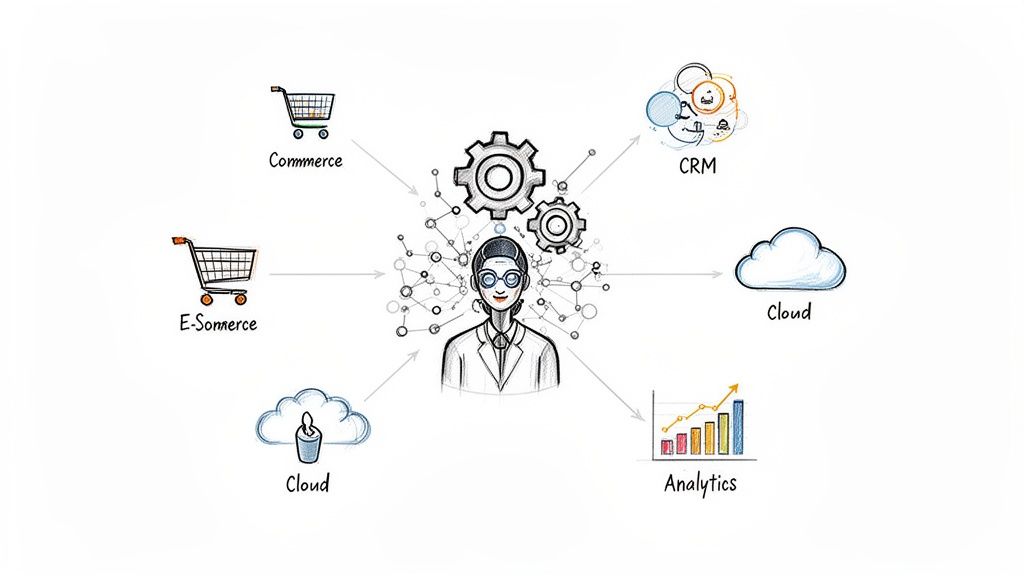
At its heart, an AI agent platform is the command center where you create, train, and manage these autonomous agents. It's helpful to think of it less like a script-following bot and more like a skilled digital employee—one that can reason, plan, and see a task through from start to finish.
This kind of technology is quickly becoming a must-have for businesses trying to deliver personalized customer experiences at scale. Built on modern Large Language Models (LLMs), these agents get the full picture—they understand context, remember past conversations, and, most importantly, take action. For example, a customer doesn't just get information about a return policy; the AI agent can actually start the return process, update your inventory system, and schedule a package pickup, all within a single, natural conversation.
The real difference comes down to execution versus reaction. A traditional chatbot is programmed to give answers based on a script. They're stuck in a closed loop and tend to fall apart the moment a customer asks something unexpected.
An AI agent, on the other hand, breaks out of that box. It operates as an intelligent engine with clear goals. To fully appreciate what this means for the future, it's worth exploring the idea of the agent-driven internet.
Here’s a quick breakdown of how they stack up with a practical example:
| Feature | Traditional Chatbot | AI Agent Platform |
|---|---|---|
| Primary Function | Answers predefined questions and provides information. | Executes complex, multi-step tasks and makes decisions. |
| System Interaction | Limited to its own knowledge base or simple API calls. | Integrates deeply with multiple systems (CRM, ERP, etc.). |
| Decision Making | Follows a rigid, pre-programmed script or decision tree. | Uses reasoning and planning to achieve a specific goal. |
| Example | "Our return policy allows returns within 30 days." | "I've started your return for order #12345. A shipping label is on its way to your email." |
This move from reactive responses to proactive problem-solving isn't just a small trend; it’s a massive market shift. Current projections show the global AI agent market is on track to grow from USD 7.1 billion in 2025 to a staggering USD 54.83 billion by 2032. That's a compound annual growth rate of 33.91%, fueled by a clear need for smarter automation in day-to-day business.
For companies in e-commerce, SaaS, or FinTech, this is a game-changer. It’s an opportunity to turn a support center from a cost sink into a strategic, revenue-generating part of the business. By automating complex processes with human-like understanding, an AI agent platform delivers a real competitive edge. To learn more, check out our guide on how to select from the best AI-powered customer service platforms.
To really get what an AI agent platform brings to the table, you have to look beyond a simple feature checklist. The true power is in a few core capabilities that work in harmony, allowing these agents to operate less like tools and more like intelligent members of your team. This isn't just a small step up from chatbots; it's a completely different way for businesses to automate complex work and engage with customers.
Each capability is a building block for the next, creating a system that can understand context, remember past interactions, and act on its own. Without these pillars, an "agent" is just a chatbot with a fancier title. Let's break down what these essential functions are and why they're so critical for your operations.
The single most important feature of a true AI agent is its ability to take agentic actions. This means the agent doesn’t just spit out information; it actively gets things done by integrating with the software you already use. It’s the difference between telling a customer, "you can track your order on our website," and actually saying, "I've checked for you—your order is out for delivery and should be there by 3 PM today."
This all hinges on deep, secure API connections to your core business systems, including:
Imagine a customer wants to exchange a shirt for a different size. An AI agent dives into the inventory system to see if the new size is in stock, pulls the customer's address from the CRM, and generates a return label through your shipping platform. All of this happens in one smooth conversation, instantly solving the problem and preventing another support ticket.
An agent is only as good as what it can remember. With persistent conversational memory, an agent holds onto context not just during one chat, but across multiple conversations and channels over time. It remembers a customer's purchase history, previous support issues, and preferences, which makes for a continuous and deeply personal experience.
This completely eliminates that frustrating loop where customers have to explain their situation over and over again. For example, if a customer asks about a product's warranty via web chat on Monday, the agent can send a proactive email on Wednesday asking, "Did you get the warranty information you needed for the Model X headphones?" This shows the agent remembers the context and is genuinely helpful.
A platform without persistent memory forces every customer interaction to start from zero. True context-awareness is what transforms a generic response into a genuinely helpful and empathetic conversation, making customers feel understood and valued.
Today’s customers bounce between channels—web, email, WhatsApp, social media—and they expect you to keep up. Omnichannel orchestration is what allows an agent to provide a consistent, connected experience everywhere. The conversation and customer data are unified, so a chat that starts on Instagram can be picked up seamlessly over email without losing a single detail.
A practical example: a customer sends a DM on X (formerly Twitter) about a billing error. The agent recognizes the issue requires sharing sensitive information and seamlessly offers to continue the conversation over a secure email channel, carrying over the entire chat history so the customer doesn't have to repeat themselves. To see what goes into building this, you can explore some specific AI Agent features that enable this level of integration. A solid AI agent platform centralizes all these interactions, creating a single source of truth for every customer conversation.
Below is a quick breakdown of these must-have capabilities and the direct impact they have on both your business and your customers.
Essential AI Agent Platform Capabilities
| Capability | Technical Description | Business Impact Example |
|---|---|---|
| Agentic Actions | Utilizes API integrations to execute tasks in third-party systems like CRMs, ERPs, and e-commerce platforms. | An agent processes a customer's refund request by directly connecting to Stripe and the company's order management system, no human needed. |
| Persistent Memory | Maintains a unified conversational history for each user across all sessions and channels, stored in a vector database. | A customer who previously asked about a product's warranty on web chat gets a personalized follow-up via email a week later. |
| Omnichannel Orchestration | Centralizes and syncs conversations from various channels (web, SMS, social media, email) into a single customer profile. | A user starts a support query on WhatsApp and finishes it via email, with the agent having full context of the entire interaction. |
These three pillars are what separate a basic chatbot from a truly autonomous AI agent capable of delivering real business value.
Choosing the right AI agent platform isn't a one-size-fits-all exercise. The market is full of options, and they fall into a few distinct categories, each built for different business needs, technical skills, and operational goals. If you pick the wrong one, you could be stuck with expensive custom development, a painfully slow rollout, and a disappointing return on your investment.
To get it right, you need to understand the main flavors of platforms out there. By weighing their strengths and weaknesses, you can find a solution whose architecture actually matches what you need for integration, scale, and getting value quickly. We'll break down the three primary types: Generalist Platforms, DIY Frameworks, and Specialized CX Platforms.
Think of generalist platforms as a versatile toolkit. They offer a wide array of AI and machine learning tools you can adapt to almost any task, from automating internal IT tickets to answering basic customer questions. While they provide a ton of flexibility, it comes at a price.
This adaptability means they aren't pre-trained for your specific industry or function. You get the building blocks, but it's your team's job to put them together. For example, you could use one to build a simple FAQ bot for your website, but teaching it to handle a complex e-commerce return would require significant custom development and data training from your team.
If you have a deep bench of engineering talent, DIY frameworks give you the most control imaginable. These are essentially open-source libraries and toolkits that provide the raw code for building an AI agent from the ground up. It’s like being handed a crate of engine parts and told to build a car.
This route gives you complete authority over every single detail, from the language models you use to the specific logic the agent follows. But it's also the most demanding path by far. You’ll need a team of skilled developers, a solid grasp of AI principles, and a major investment in both time and infrastructure.
The reality is, you trade speed and efficiency for that control, making it an unrealistic choice for most businesses that just want to improve their customer experience. The market is already shifting toward more accessible solutions. Gartner predicts that by the end of 2026, 40% of enterprise applications will have task-specific agents built-in, pushing the industry toward specialized, deployable platforms. You can dive deeper into this trend in the full AI agent market report.
This is where platforms like MagicalCX come in. Specialized CX platforms are purpose-built for one specific job: customer experience. They arrive pre-trained on massive datasets from industries like e-commerce, SaaS, and FinTech, and that specialization is their biggest strength.
These platforms are designed for quick deployment and immediate impact. Because their models already understand the language and logic of customer support—like how to process a return, manage a subscription, or handle a billing question—they deliver much higher accuracy right out of the box. For instance, a specialized platform already knows what "WISMO" ("Where Is My Order?") means and can immediately jump into action to check an order's status without needing weeks of training.
While DIY frameworks offer ultimate control, specialized CX platforms deliver higher out-of-the-box accuracy on support queries by leveraging pre-trained, industry-specific language models. This focus on a specific function accelerates time-to-value and reduces the need for constant, manual fine-tuning.
This decision tree visualizes how core capabilities like agentic actions, persistent memory, and omnichannel support are central to choosing the right platform for your needs.
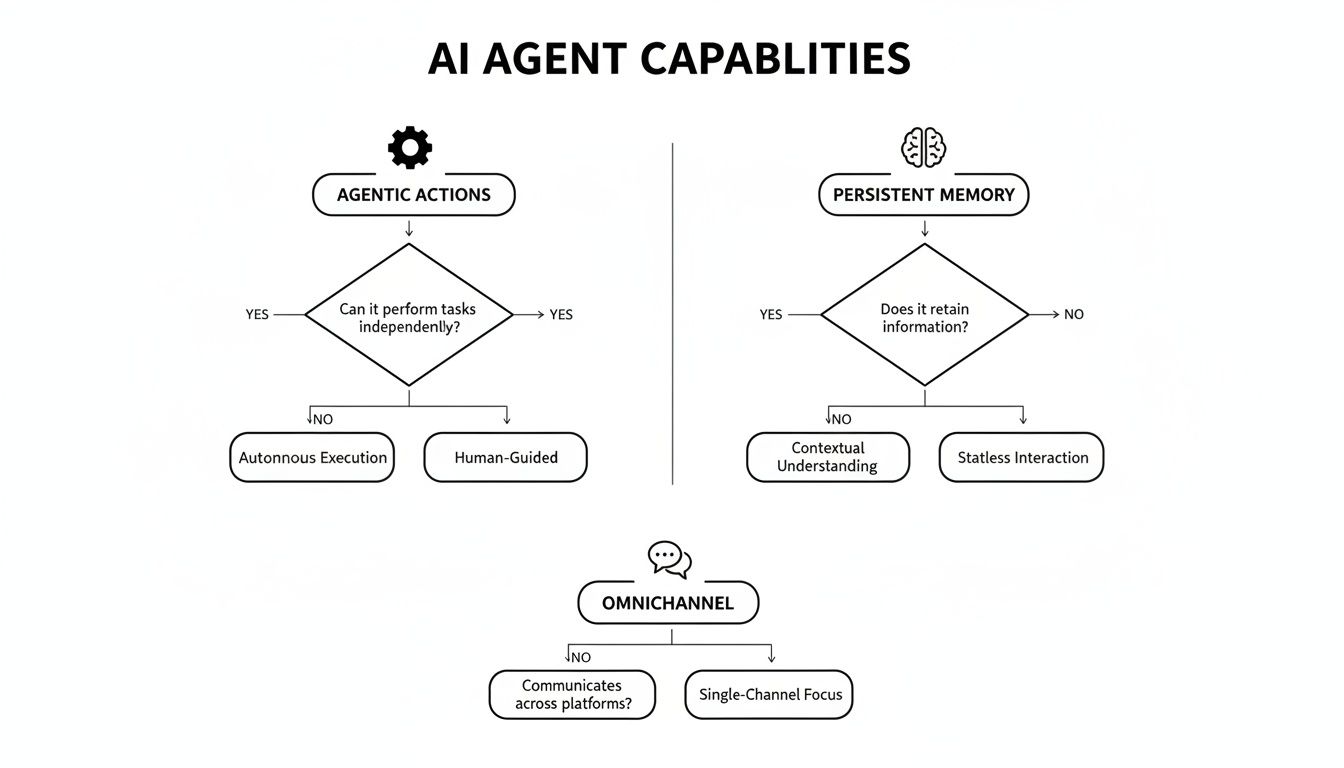
The flowchart makes it clear: a truly effective AI agent platform has to be able to act, remember past interactions, and communicate across every channel to solve customer problems efficiently.
Here’s a head-to-head comparison to clarify the differences and help you decide based on what your business actually needs.
Comparing Platform Types by Business Need
| Criteria | Generalist Platform | DIY Framework | Specialized CX Platform |
|---|---|---|---|
| Time-to-Value | Months to a year. Needs extensive data training and workflow building. | Longest (often over a year). Involves building from scratch. | Days to weeks. Pre-trained models and built-in integrations accelerate launch. |
| Technical Skill | High. Requires data scientists and AI engineers for customization. | Expert. Needs a dedicated team of highly skilled developers. | Low. Designed for CX and ops teams with no-code or low-code interfaces. |
| Cost of Ownership | High. Includes licensing, development, and ongoing maintenance costs. | Very High. Driven by steep internal resource and infrastructure costs. | Predictable. Often a subscription model with clear pricing and lower setup fees. |
| Use Case Fit | Broad, but requires significant adaptation for specific CX workflows. | Fully customizable, but all workflows must be built from the ground up. | Optimized for CX. Excels at industry-specific tasks like order management. |
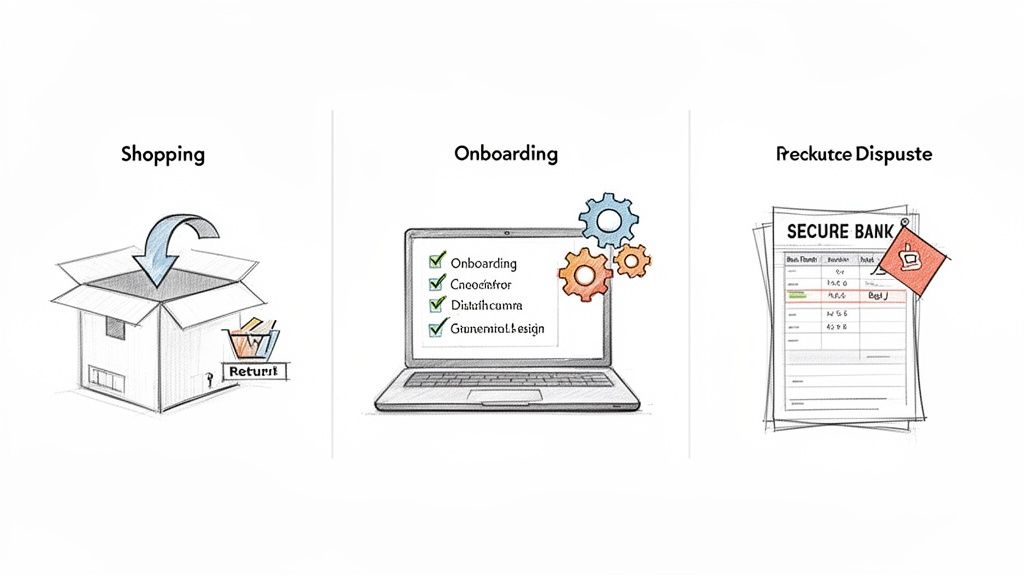
The true power of an AI agent platform really clicks when you see it in action. These aren't just theoretical concepts; they're workhorses built to solve messy, real-world business problems. By automating complex workflows from end to end, they directly boost efficiency, make customers happier, and drive key metrics like retention and revenue.
To make this concrete, let's walk through what this looks like in three very different industries. Each scenario highlights how an AI agent does more than just answer questions. It actually executes tasks that used to demand a ton of manual effort, turning a routine support request into a smooth, positive experience for everyone involved.
For any e-commerce brand, managing returns is a huge operational headache, often requiring people to jump between different systems and manually key in data. An AI agent platform can take this entire process and put it on autopilot.
Let's say a customer bought three things—a shirt, jeans, and a jacket. They need to return the shirt and exchange the jacket for a new size.
This entire sequence unfolds in a single, natural conversation. What was once a frustrating multi-step process is now resolved in minutes. You can dive deeper into these strategies in our article on conversational AI for e-commerce.
Getting onboarding right is everything for a SaaS company. It's the make-or-break period for long-term customer retention. An AI agent can become a proactive guide, heading off common problems and helping new users find that "aha!" moment much faster.
Imagine someone just signed up for your project management tool. Instead of just dropping them into a blank dashboard, the AI agent kicks off a guided setup.
This kind of proactive help smooths out the learning curve and makes sure users actually adopt the product, dramatically cutting the risk of them churning out in the first few weeks.
An effective AI agent platform doesn't just wait for customers to report problems. It actively monitors user behavior to identify friction points and offers assistance before the user even thinks to ask for help, turning onboarding from a passive checklist into an active, guided journey.
In the world of finance, security and precision are non-negotiable. Handling transaction disputes is a delicate process that demands flawless data handling and sticking to strict rules. An AI agent platform is built for this kind of high-stakes work.
Picture a customer who sees an odd charge on their credit card statement and contacts their bank through its secure mobile app.
Choosing an AI agent platform isn't just another software purchase—it's a decision that will shape your customer relationships and operational backbone for years to come. If you rush it, you could end up with a clunky tool that drains resources, frustrates your team, and delivers a disjointed customer experience. You have to look past the slick demos and get into the weeds.
A methodical evaluation is your best defense against a bad fit. It’s all about asking the right questions to make sure the platform can actually do what you need it to, day in and day out. By breaking it down, you can make a decision you feel confident about.
First things first: will this platform actually work with your current setup? Technical compatibility is a deal-breaker. If it doesn’t integrate cleanly into your existing tech stack, the AI agent will be powerless to do anything truly useful.
Here’s what to dig into:
Once you've ticked the technical boxes, it's time to think about how this platform will fit into your team's daily life and help you hit your business goals. A great platform should make your team’s job easier, not add another layer of complexity.
Thinking about the bigger picture is key. For more on this, check out our guide on the best customer experience management tools and see how these platforms fit into a wider strategy.
A truly valuable AI agent platform provides more than just automation; it delivers actionable insights. The analytics dashboard shouldn't just track resolved tickets—it should reveal customer friction points, highlight emerging trends, and identify opportunities for proactive service.
To help you systematically compare your options, use a checklist. This forces you to move beyond feature lists and focus on what truly matters for your business.
This checklist is designed to help you methodically compare platforms based on the critical requirements that will determine success.
| Evaluation Criteria | Key Questions to Ask | Why It Matters |
|---|---|---|
| Ease of Implementation | Can our non-technical team build and manage agent workflows? Ask for a live demo where you try to build a simple workflow. | A low-code or no-code interface reduces dependency on developers and speeds up your time-to-value. |
| Analytics and Reporting | What kind of insights can we gain from the analytics dashboard? Can it identify the top 5 reasons customers contact us? | Sophisticated reporting helps you understand contact patterns and continuously improve both agent performance and the overall customer journey. |
| Human-in-the-Loop | How seamless is the handoff from an AI agent to a human? Does the human agent see the full transcript instantly? | The system must preserve the full conversation context to ensure a smooth transition, preventing customer frustration. |
| Pricing and ROI | Is the pricing model transparent and scalable? Can the vendor help model a clear return on investment based on our ticket volume? | A predictable cost structure and a clear path to ROI are essential for getting stakeholder buy-in and justifying the investment. |
By working through these questions, you’ll be in a much stronger position to choose a partner, not just a product—one that can grow with you and deliver real, measurable results.
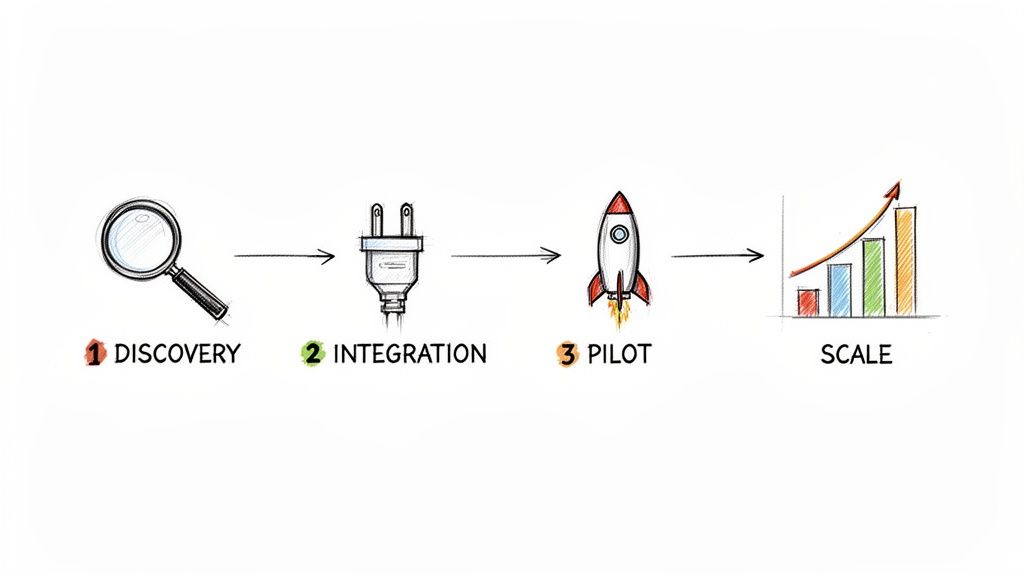
Rolling out an AI agent platform isn't an overnight project. It’s a strategic initiative that demands a clear, structured plan to manage the transition, minimize risk, and see a return on your investment quickly. A phased approach is the only way to go, breaking down a complex deployment into manageable stages where each step builds on the last.
Think of it as moving from identifying your biggest headaches to methodically testing and expanding the solution. By following a roadmap, you get everyone on the same page, set achievable goals, and make sure the platform starts delivering real value right from the start.
The first phase is all about finding the biggest and best opportunities for automation. Don't try to boil the ocean by automating everything at once. Instead, go for the low-hanging fruit—those repetitive, soul-crushing tasks that drain your support team's time and leave customers waiting.
Actionable Insight: Pull a report from your helpdesk software (like Zendesk or Intercom) that shows ticket volume by tag or category. This will immediately show you the most common issues.
Focusing on these high-volume problems guarantees you’ll immediately lighten your team's workload. The goal here is to set concrete metrics, like a plan to cut first-response time by 50% or automate 30% of all incoming queries within the first three months.
Once you know what you want to achieve, it's time to connect the dots—literally. This is where your AI agent gets the data it needs to actually do things. This phase is all about securely integrating the platform with your most critical business systems.
Typically, this means hooking into your Customer Relationship Management (CRM) system, your e-commerce platform (like Shopify or Magento), and your helpdesk software. These connections let the AI agent pull up customer history, check order details, and log every interaction automatically. A platform like MagicalCX makes this much easier with pre-built connectors that can drastically reduce the technical lift.
Never go for a big-bang launch. Before you unleash your AI agent on all your customers, run a controlled pilot program. This is your chance to test its performance, get real-world feedback, and iron out any kinks in a low-risk environment.
A classic mistake is to launch the AI agent on every channel at once. A much smarter move is to start with a single, high-traffic channel, like your website's live chat. This gives you a focused feedback loop to fine-tune responses and workflows before you expand.
During the pilot, keep a close eye on the agent’s accuracy and how smoothly it hands off complex issues to a human. Get feedback from both your customers and your own support team to find any friction points. This iterative testing is absolutely essential for building trust in the new system.
With a successful pilot under your belt, it's time to scale. This means you can start methodically expanding the agent's duties and rolling it out across other channels, like email or social media DMs.
But this final stage is never really "done." It becomes an ongoing cycle of monitoring performance and looking for ways to improve. Use the platform’s built-in analytics to track your KPIs and uncover new tasks ripe for automation. As the AI agent takes over more of the routine work, your human team is freed up to handle the complex, high-value conversations that build lasting customer relationships.
It's natural to have questions when you're looking at bringing a new kind of technology into your operations. An AI agent platform is a big step up from traditional tools, so getting a handle on the specifics is the best way to see what's possible. Let's dig into some of the most common questions we hear.
These answers should clear up the practical differences between a true AI agent and an old-school chatbot, what you actually need to get started, and how to measure the impact on your bottom line.
The biggest difference comes down to one word: action. A traditional chatbot is designed to provide information. It follows a script, a bit like a phone tree, and pulls answers from a knowledge base. If you ask a question it hasn't been programmed for, it usually hits a dead end.
An AI agent, on the other hand, is built to do things. It plugs directly into your business systems—your CRM, order management, or inventory software—and can carry out complex, multi-step tasks all on its own. So, instead of just telling a customer about your return policy, an AI agent can actually start the return, create the shipping label, and update your inventory, all in one seamless conversation.
To get an AI agent up and running effectively, you'll need historical data from your customer interactions. Think chat transcripts, support emails, and old helpdesk tickets. This is the raw material the agent learns from—it's how it picks up your brand's unique voice, understands common customer problems, and learns the right way to solve them.
A lot of people think they need perfectly clean, perfectly organized data to even start. That's a common myth. While better data always helps, a good AI agent platform is smart enough to work with the messy, unstructured conversational logs you already have. It can find the patterns and build its own knowledge without you needing to do a ton of manual cleanup first.
Figuring out the return on investment for an AI agent platform means looking at both what you save and what you gain. The best way to track this is by focusing on a few key areas:
Ready to turn your customer support from a cost center into a growth driver? See how MagicalCX uses an empathy-first AI agent platform to automate sophisticated workflows and deliver truly human-like experiences. Get started with MagicalCX today.


