See your AI teammate in action now
Ready to make support faster, kinder, easier and help customers feel good about choosing you?
PS: Sales improves too...
No credit card required
14 days free trial
DIY or Guided setup
Ready to make support faster, kinder, easier and help customers feel good about choosing you?
PS: Sales improves too...
No credit card required
14 days free trial
DIY or Guided setup
A guide to customer retention software in 2026, covering core features like churn prediction, segmentation, lifecycle automation, messaging, analytics, KPIs, and implementation.
Manish Keswani

Summary by MagicalCX AI
Customer retention software can deliver outsized ROI because a 5% lift in retention boosts profits by 25% to 95%, and AI-driven, proactive support workflows can cut attrition by up to 25% by flagging churn risk early and automating personalized outreach.
Customer retention software is a set of tools designed to help you keep the customers you’ve worked so hard to win. It shifts your entire approach from reacting to problems to proactively building loyalty, ensuring your customers stick around for the long haul.
Think of your business as a bucket you're always trying to fill with new customers. Without the right strategy, that bucket is riddled with tiny, invisible holes. Valuable customers—and the revenue they bring—are constantly leaking out, often faster than you can pour new ones in. Customer retention software is what you use to find and plug those leaks, once and for all.
For too long, the business world has been obsessed with customer acquisition. But the numbers don't lie: it costs a whole lot more to land a new customer than it does to keep an existing one happy. The smart move is to stop just refilling a leaky bucket and finally start repairing it for sustainable, predictable growth.
The business case for focusing on retention is rock-solid. Classic research has shown time and again that even a small improvement here can have an outsized impact on your bottom line.
A mere 5% increase in customer retention can boost profits by a staggering 25% to 95%. This isn't just a nice-to-have metric; it's one of the most powerful financial levers you can pull.
This isn't just an old business school lesson—it's a modern reality that companies are waking up to. The market for these tools is booming as a result. Projections show the customer retention software market hitting $11.2 billion in 2025 and surging to $22.0 billion by 2033.
To see how this plays out across different sectors, just look at the average retention rates. The differences are stark and show just how much room for improvement there is.
This table shows the average customer retention rates across key industries, highlighting the disparity and showing where the biggest opportunities for improvement lie.
| Industry | Average Retention Rate | Typical Customer Lifetime |
|---|---|---|
| Media & Entertainment | 25% | 6-12 months |
| Retail (General) | 63% | 1-2 years |
| Financial Services & Banking | 78% | 5-10 years |
| SaaS (Software as a Service) | 81% | 2-4 years |
| Professional Services | 84% | 3-5+ years |
As you can see, a customer's "stickiness" varies wildly. But in every single industry, a higher retention rate directly translates to a healthier business.
Too many businesses treat customer retention as a last-ditch effort—a frantic scramble to save a customer who has already mentally checked out. That's a losing game. Modern retention software is built to get you ahead of the problem before it even starts.
To truly appreciate why this is so critical, it's important to understand the real customer retention meaning for B2B SaaS. By adopting these tools, you can build a powerful client retention program that stops you from constantly putting out fires and instead helps you build a fire-proof foundation for your business.
When you hear “customer retention software,” don’t picture a single, monolithic program. Think of it more like a specialist’s toolkit, with each tool designed to build stronger, more proactive relationships with your customers. Instead of just putting out fires when a customer is upset, these platforms help you prevent the fires from starting in the first place.
Getting this right is the difference between constantly spending to acquire new customers and building a stable, growing business. The journey looks something like this:

As you can see, retention is the bridge that turns one-time buyers into long-term partners. It plugs the "leaky bucket" of customer acquisition and sets the stage for real growth. Let's pull back the curtain on the core capabilities that make this happen.
Imagine having an early warning system for your entire customer base. That’s churn prediction. It uses AI to spot subtle changes in customer behavior—things like logging in less often, using fewer features, or a sudden quiet on the support front—to flag accounts at risk of leaving long before they’ve made up their mind.
This isn't just a gut feeling. The software calculates a customer health score for every account, giving you a live, dynamic rating of their engagement and satisfaction.
Great retention is never one-size-fits-all. Advanced segmentation acts like a master organizer for your customer data, grouping users into specific, meaningful clusters based on what they have in common.
This goes way beyond basic demographics. You can build segments around buying habits, which product features they use most, their subscription level, or where they are in their customer journey.
Actionable Insight: Stop sending generic email blasts. For instance, create a segment of "power users" who have logged in 20+ times this month and send them an exclusive preview of a new feature. For a segment of "at-risk" users who haven't logged in for 30 days, send a "We miss you!" offer with a small discount.
Think of lifecycle orchestration as a dedicated tour guide for every single customer. It automates the entire experience, from their very first day as a new user all the way to becoming a loyal brand advocate, ensuring they get the right touchpoint at each critical milestone.
This powerful feature is what ties all your communication channels into one seamless strategy. If you're aiming to build those kinds of connected experiences, it helps to first understand the mechanics of an omnichannel customer service platform.
All these features find their voice through personalized messaging. This is where you craft emails, push notifications, and in-app messages that feel like they were written for an audience of one. By using dynamic content, you can automatically pull in a customer’s name, reference their last order, or celebrate a usage milestone.
And how do you know if any of it is working? That’s where a solid analytics and reporting dashboard comes in. It provides a crystal-clear view of your efforts by tracking the metrics that matter:
This data gives you the hard evidence you need to see which campaigns are hitting the mark and where you need to fine-tune your strategy for better results. For example, if your analytics show a campaign to re-engage lapsed customers has a high open rate but a low conversion rate, you know the message is compelling but the offer isn't. That’s an actionable insight you can use to adjust the discount and improve results.
A platform full of features is just a tool. Its real value comes to life when you see how it solves actual business problems and, more importantly, drives measurable growth. This is where we move past the technical specs and talk about what this software actually does for you and your bottom line.

So, what does this look like on the ground? Let's get specific.
Any good software should be a problem-solver. For customer retention tools, that means zeroing in on those make-or-break moments in the customer journey where you can step in and make a real difference.
For a SaaS company: Think about the critical onboarding period. The software can automatically trigger a helpful email sequence if a new user hasn't logged in for three days. It could also alert a customer success manager to reach out personally if a key feature—one that typically leads to long-term adoption—hasn't been used within the first week. Another practical example is identifying customers whose usage indicates they're ready for an upgrade and automatically triggering an in-app message highlighting the benefits of the next tier.
For an e-commerce brand: One of the most powerful plays is automating a campaign to win back customers who’ve gone quiet. If someone hasn't bought anything in 90 days, the system can automatically send a personalized "we miss you" offer on products they've browsed before. To be more specific, it could offer 20% off the exact pair of running shoes they viewed last, turning a generic blast into a highly relevant offer.
In both cases, customer retention software allows you to stop playing defense and start playing offense. You’re no longer just reacting to problems; you’re proactively creating loyalty.
If you're going to invest in this kind of technology, you absolutely have to know if it's working. That's where Key Performance Indicators (KPIs) come in. These metrics are your scorecard. Without them, you’re flying blind.
Actionable Insight: The point isn't just to have data; it's to have data that tells a story. For example, if you see your CLV is increasing but your Churn Rate is flat, it means your retention efforts are successfully getting existing customers to spend more, even if you aren't losing fewer of them. This tells you to focus next on reducing churn.
Here are the essential KPIs you need to be tracking:
Of course, what's "good" varies. SaaS retention rates, for example, can hover around 77%, while e-commerce often sees rates closer to 38%, according to this industry report on average customer retention rates. That gap is exactly why retention software is so crucial, especially when you consider that repeat customers spend 67% more than new ones.
These numbers aren't just for quarterly reports; they’re your roadmap. Watching them closely tells you which strategies to double down on and which ones to rethink. For a deeper look at the metrics that are particularly important for software companies, you should check out our guide on essential SaaS customer success metrics.
With so many tools on the market, picking the right customer retention software can feel like an impossible task. But it's not a guessing game. By approaching it with a clear roadmap, you can cut through the noise and find a platform that actually moves the needle for your business.
The secret isn't finding a "perfect" all-in-one solution. It’s about finding the right tool for your team, your customers, and your specific goals. You have to start with a solid evaluation framework before you even talk to a single salesperson. This ensures you're scoring vendors based on your priorities, not their polished talking points.
Before you get pulled into demos, it’s smart to build a checklist. This simple step helps you compare different platforms on a level playing field, focusing on what genuinely impacts your day-to-day operations and long-term goals.
Think of it like buying a new car. You wouldn't just look at the spec sheet. You'd get in, adjust the seat, see if your phone connects easily, and check if it actually fits in your garage. The same logic applies here.
Actionable Insight: The most powerful platform is useless if it's too complicated for your team to use or if it doesn't talk to your other critical systems. For example, if your sales team lives in Salesforce, a retention tool without a deep, bi-directional Salesforce integration will create more work, not less. Adoption is everything.
Use this checklist to give each potential vendor a score. It’s a straightforward way to make a decision based on data, not just a gut feeling.
Use this checklist to compare different customer retention software solutions based on critical features and business needs.
| Evaluation Criteria | What to Look For | Your Rating (1-5) |
|---|---|---|
| Integration Capabilities | Does it connect seamlessly with your CRM (Salesforce, HubSpot), helpdesk (Zendesk, Intercom), and billing systems (Stripe, Chargebee)? Look for native, well-documented integrations. | |
| Data Requirements & Import | How complex is the data setup? Can you start with basic data and add more later, or does it require a massive initial lift? Ask them: "Can we go live just by connecting our Stripe and HubSpot accounts?" | |
| Ease of Use & Adoption | Is the interface intuitive for non-technical users? Can a marketing manager build a new automation workflow without needing an engineer? | |
| Scalability & Pricing | Does the pricing model align with your growth (e.g., per contact, per user)? Will your costs spiral if you double your customer base? Can the platform handle more data and users as your business expands? | |
| Support & Onboarding | What level of support is included? Do they offer a dedicated onboarding specialist, or just point you to documentation? Ask about their average response time for support queries. |
Once you've done your homework and chosen a partner, you'll be in a great position to move forward with confidence.
After you’ve picked your software, the real work starts. A phased implementation plan is the best way to avoid getting stuck and to build momentum right out of the gate. The goal is to score some early wins that prove the tool's value, rather than trying to do everything at once.
First things first: what problem are you actually trying to solve? Get specific. Are you trying to cut down on first-month churn for new signups by 10%? Or maybe you want to boost repeat purchases from your most loyal customers by 15%? Your primary goal will shape every decision you make during setup.
Any software is only as good as the data you feed it. Now is the time to pull together customer information from your CRM, billing system, and support tools. A practical first step is to export customer lists from each system and use a simple spreadsheet function (like VLOOKUP) to identify and merge duplicate records.
Don't try to automate your entire customer journey on day one. Pick one or two high-impact workflows that align with the goal you set in the first step. A great starting point is an automated win-back campaign for customers who've gone quiet for 90 days, or a simple onboarding sequence for new trial users that sends a new tip every two days for a week.
Introduce the new tool to your customer-facing teams, but frame it around how it makes their lives easier. Show them how it provides instant context on a customer’s health score or automates tedious follow-ups. For example, show a support agent how they can see a customer's entire purchase history and recent complaints in one click, without switching tabs.
It’s time to go live with your pilot project. Keep a close eye on the results and compare them to the goals you defined earlier. Use the platform’s built-in analytics to see what’s working, get feedback from your team, and fine-tune your approach. This cycle of launching, measuring, and optimizing is the key to getting long-term value from your investment.

While most platforms are good at collecting data, an empathy-first approach changes the game for customer retention software. It’s not just about tracking metrics; it's about understanding the human story behind each interaction. This is where a tool like MagicalCX comes in, turning what is often a cost center—customer support—into a powerful driver for loyalty.
Instead of just logging clicks and purchases, this approach helps you decode the emotional state of your customers. It's the difference between knowing a customer contacted you five times and understanding they're getting increasingly frustrated with a recurring problem. That deeper insight is what allows you to offer proactive, emotionally intelligent solutions that build real, lasting relationships.
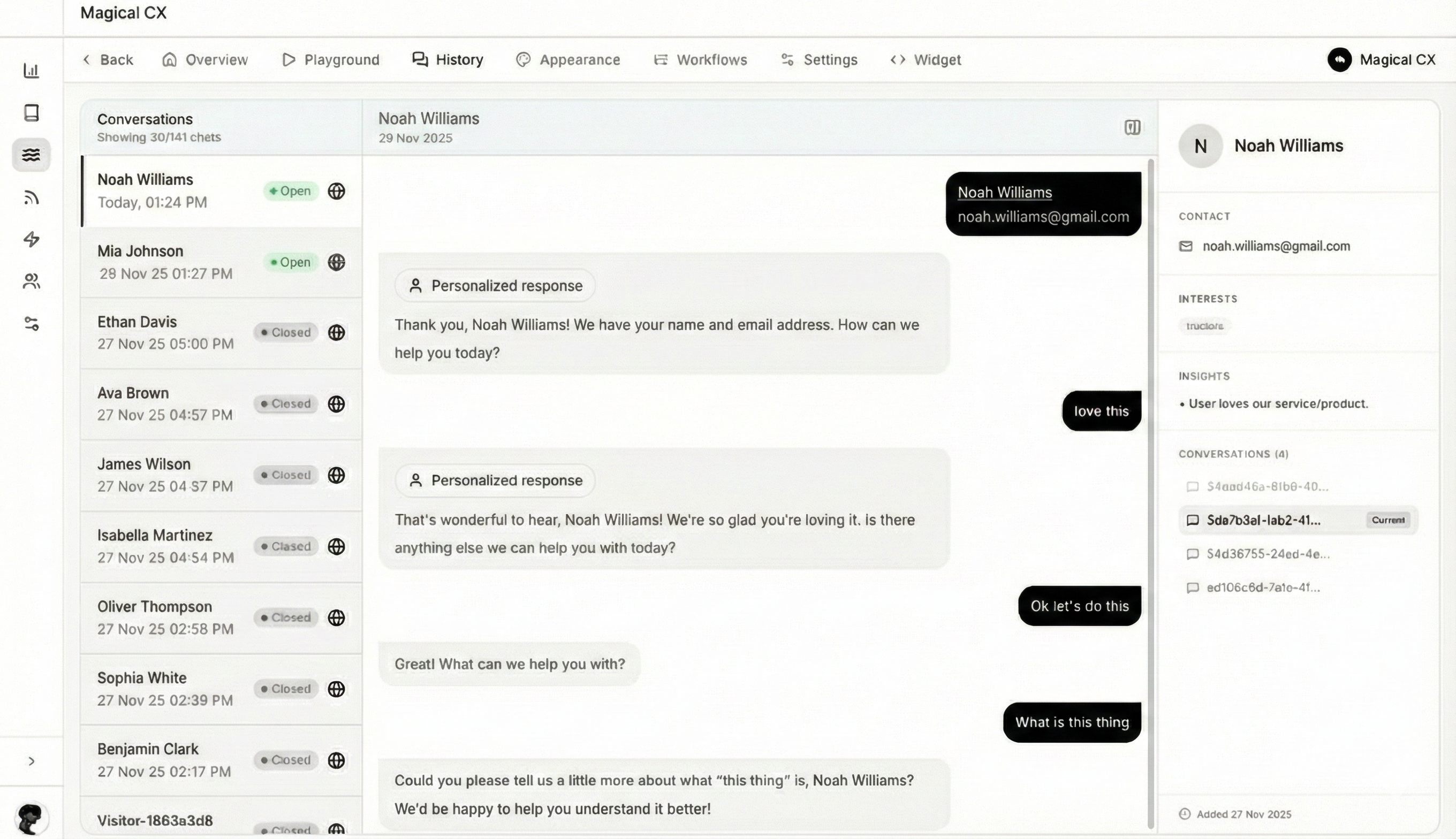
What if your agents remembered every conversation, purchase, and preference a customer has ever mentioned? That’s the entire idea behind Conversational Memory. It weaves together a continuous, context-rich dialogue, so your customers never have to repeat their story.
This feature ensures that every new interaction picks up precisely where the last one ended, even if it’s on a different channel. If a customer starts a chat on your website about a late delivery and then emails you a day later, MagicalCX's memory gives the next agent the full picture instantly. It stitches fragmented conversations into a single, seamless narrative that makes customers feel truly heard and valued.
This isn't just about solving issues faster; it's about strengthening that all-important emotional connection to your brand.
So many customer headaches come from processes that are common but can feel complicated, like starting a return, changing a subscription, or updating billing info. MagicalCX uses Agentic Actions and Guided Workflows to automate these journeys from beginning to end.
Think of it as a personal GPS for your customer. The platform anticipates what they need and walks them through each step, turning a potentially high-effort, multi-step process into a simple, automated one.
Actionable Insight: Instead of forcing customers to dig through confusing FAQs or wait for an agent, Guided Workflows empower them to solve their own issues right away. For example, a customer who types "I need to return this" into a chat can be automatically guided through generating a shipping label and scheduling a pickup, without any human agent involvement.
At its core, MagicalCX is powered by its EFRO (Empathy, Fairness, Revenue, and Opportunity) Engine. This is the secret sauce that intelligently balances genuine empathy with smart business goals. It analyzes every situation to pinpoint the perfect moment to offer a solution, a discount, or an upsell.
The engine ensures that any offer you make feels fair and genuinely helpful to the customer. For example, it can detect rising frustration in a customer’s messages and proactively offer a small discount to de-escalate the situation and save the relationship—often before the customer even thinks to ask.
AI is becoming a massive force in customer service, with the market projected to hit $47.82 billion by 2030. MagicalCX is a prime example of this, using its predictive power to forecast churn risk, enable proactive upsells, and help slash attrition by up to 25% when built into support workflows. You can learn more about the rapid growth of the customer retention market to see why this is so critical.
This intelligent balance turns what used to be a pure cost center—customer support—into a dynamic engine for both retention and revenue. By marrying empathy with smart automation, platforms like MagicalCX don't just solve problems; they create experiences that keep customers coming back for more.
Alright, you understand what customer retention software is and why it matters. But knowing is one thing; doing is another. Let’s get practical and turn that understanding into a concrete plan.
Think of this as your roadmap for making a smart investment. Following these four steps will help you build a solid business case, choose the right platform for your needs, and actually see a real impact on customer loyalty and your bottom line.
You can't fix a problem if you don't know how big it is. Before you even think about looking at software, you need to get a clear picture of where you stand right now. This means calculating two key metrics that will act as your "before" snapshot.
With your baseline numbers in hand, it’s time to play detective. Where, exactly, are your customers leaving? You need to trace the customer journey from their very first touchpoint to their most recent one and find the specific moments where they lose interest or decide to leave for good.
Actionable Insight: A common "leak" for SaaS companies is the drop-off after a free trial ends. For e-commerce, it's often the gap between the first and second purchase. Dig into your own data—like Google Analytics Goal Funnels or support ticket themes—to find your two biggest friction points. These are the problems you'll focus on when you start talking to vendors.
Now you're ready to start shopping. You have your baseline metrics and you know the specific problems you need to solve. Use the evaluation checklist from the previous section to build a shortlist of two or three customer retention software providers that look like a strong match.
Actionable Insight: When you schedule demos, don't just sit back and watch a generic presentation. Take control. Tell them, "Our biggest leak is customers not making a second purchase. Show me exactly how your tool would automate a campaign to solve this specific problem."
Once you’ve chosen a partner, resist the urge to try and fix everything at once. The best approach is to start with a small, focused pilot project that can give you a quick, measurable win. This lowers your risk and helps you build momentum and get buy-in from the rest of the team for a bigger rollout later.
A practical pilot project could be an automated win-back campaign targeting customers who haven't made a purchase in 90 days. Define success upfront: for example, "achieve a 5% reactivation rate from this campaign within the first 60 days." As you design your pilot, think about incorporating proven customer retention strategies for ecommerce growth to get the most out of your efforts.
By pairing the right technology with a strategy that puts the customer first, you can stop hoping for loyalty and start making it your strongest competitive advantage.
When you're looking into customer retention software, a lot of questions pop up. It’s a big decision. Here are some straightforward answers to the questions we hear most often, to give you the clarity you need.
You'll likely see some early wins within the first 90 days. Don't expect a complete turnaround overnight, but you should notice positive signs. For example, a pilot win-back campaign might reactivate 50 customers in the first month, providing an immediate revenue bump.
The real, hard-dollar ROI, however, takes a bit longer to prove out. We're talking about a measurable drop in churn or a clear increase in Customer Lifetime Value (CLV). That typically comes into focus within 6 to 12 months, once the software has enough data to work its magic and your automated campaigns have had time to mature.
Absolutely. In fact, you could argue it's even more crucial for small businesses. When you're smaller, every single customer accounts for a bigger piece of your revenue pie. Losing even a few can really sting.
Actionable Insight: Don't think of this as a tool just for massive corporations. Modern retention platforms let a small e-commerce brand with a two-person team automate the kind of personalized post-purchase follow-up that used to require a dedicated marketing department.
You can get started with less than you think. At a minimum, you just need basic customer information from your CRM (like names and contact details) and their purchase history. That’s your foundation.
To really tap into the more advanced features, like predicting which customers are about to leave, you'll want to connect more data over time. Think about adding:
The best systems grow with you. They get smarter and more effective as you feed them more complete information.
Not at all. It makes them better—and frankly, makes their jobs more rewarding. Good retention software automates the tedious, repetitive tasks that burn out your best agents.
For example, instead of manually answering "Where is my order?" tickets all day, the software can automate that response. This frees your agents up to handle complex issues, like helping a frustrated customer troubleshoot a difficult problem or proactively reaching out to a high-value client whose usage has dropped.
Ready to turn your customer support from a cost center into a retention machine? See how MagicalCX uses an empathy-first approach to build lasting loyalty. Explore the platform.