See your AI teammate in action now
Ready to make support faster, kinder, easier and help customers feel good about choosing you?
PS: Sales improves too...
No credit card required
14 days free trial
DIY or Guided setup
Ready to make support faster, kinder, easier and help customers feel good about choosing you?
PS: Sales improves too...
No credit card required
14 days free trial
DIY or Guided setup
A guide to e-commerce automation, covering marketing workflows, cart recovery, AI recommendations, order processing, inventory sync, shipping updates, and AI customer support.
Manish Keswani
Summary by MagicalCX AI
E-commerce automation turns a manual store into a scalable system by recovering revenue from the nearly 70% of carts that are abandoned and, when paired with AI-driven personalization, can help brands generate up to 40% higher revenue than competitors.
At its heart, e-commerce automation is about using smart technology to take over the repetitive, time-sucking tasks that come with running an online store. Think of it as a tireless digital assistant working around the clock, handling everything from marketing emails and order processing to keeping your inventory numbers straight. The real goal here is to boost efficiency, slash errors, and free up your team to focus on what actually grows the business.
Let's use an analogy. Imagine your e-commerce store is a bustling new restaurant. When you first open, you (the head chef) can personally cook every single dish to perfection. But as your reputation grows, the orders start flying in. Suddenly, you’re overwhelmed. Orders get mixed up, customers wait too long, and the quality starts to dip. This is exactly what happens when an online business grows without the right systems in place.
E-commerce automation is like hiring a full, expert kitchen crew and installing a state-of-the-art ordering system all at once. It's the tech that grabs an order the second it comes in, sends it to the right station, automatically deducts ingredients from your inventory, and even texts the customer when their order is ready for pickup. It doesn't replace the chef—it empowers you to focus on creating amazing new dishes and delivering an incredible experience.
When you get right down to it, automation is less about saving a few minutes here and there and more about building a business that can actually scale. If you're stuck doing everything by hand, your growth is capped by the number of hours in a day and the people you can hire. Every new order just adds to the mountain of manual work, creating bottlenecks that inevitably lead to unhappy customers.
Automation shatters that ceiling. It builds systems that can handle a surge in volume without requiring more human effort. It's the difference between your team manually copy-pasting shipping addresses for 100 orders versus a system that does it instantly for 10,000. That kind of operational freedom is what separates businesses that plateau from those that achieve sustainable growth.
The numbers back this up. The global e-commerce automation market was valued at $10.5 billion in 2024 and is expected to rocket to $28.5 billion by 2032. This isn’t just a trend; it's a fundamental shift in how successful brands operate.
To truly understand its impact, you have to see that e-commerce automation isn't just one piece of software. It’s a strategy you apply across the entire business. We'll dive deep into this throughout the guide, but it generally breaks down into four critical areas:
Let’s take a look at where automation can really move the needle. The table below breaks down the core areas where manual tasks hold businesses back and how automated solutions create direct value.
| Business Area | Common Manual Task | Automated Solution | Primary Benefit |
|---|---|---|---|
| Marketing and Sales | Sending one-off emails, manually segmenting lists | Automated email flows, cart abandonment sequences | Increased conversions and higher customer lifetime value |
| Order Management | Manually checking payments, creating invoices | Instant payment verification, auto-generated invoices | Faster order processing and fewer administrative errors |
| Fulfillment & Inventory | Manually updating stock levels, printing labels | Real-time inventory sync, batch shipping label printing | Reduced overselling and dramatically improved efficiency |
| Customer Support & CX | Answering the same questions repeatedly | AI chatbots for FAQs, automated ticket routing | Faster response times and improved customer satisfaction |
As you can see, the goal is always to replace a repetitive, error-prone manual task with a reliable, scalable system. Now, let’s quickly break down what this means in practice.
By weaving automation into these key pillars, you build a business that's not just more efficient, but also more resilient and ready to deliver a world-class customer experience at scale.
A great e-commerce business does more than just list products; it actively guides customers from the moment they land on your site to the final click of the “buy” button. E-commerce automation is what makes this guidance possible. It’s the engine that creates timely, personal interactions that build real relationships and, ultimately, drive sales.
Think of it as the difference between a static, silent storefront and a dynamic shopping assistant that works for you 24/7.
The journey starts the second a potential customer arrives. Instead of greeting everyone with the same generic homepage, automation lets you roll out a personalized welcome mat. By looking at browsing behavior, past purchases, or even what someone’s looking at right now, you can make your store feel like it was designed just for them.
One of the most immediate and powerful ways to use automation is to tackle cart abandonment. It’s a huge opportunity. Nearly 70% of all online shopping carts are left behind, which means a massive pool of potential revenue is just sitting there.
A generic "You forgot something!" email is better than nothing, but a truly effective strategy feels less like a sales pitch and more like a helpful nudge.
This is where automated workflows shine. You can set up a sequence of emails that are triggered the moment a cart is abandoned, each designed to bring the customer back. Here is an actionable sequence you can implement:
A great abandoned cart sequence isn't just about recovering a sale; it's about understanding why the customer paused and solving their problem. This turns a potentially lost customer into a positive brand interaction.
That level of personalization is what makes all the difference. By automatically showing the exact products they were considering, you jog their memory and make it incredibly easy to pick up right where they left off.
Beyond just recovering lost sales, e-commerce automation can actively create new ones through smart product recommendations. This is the digital version of a fantastic salesperson who just gets a customer’s style.
AI recommendation engines analyze what a user is doing in real-time to serve up suggestions that are incredibly relevant. This is way more sophisticated than the old "customers who bought this also bought..." logic.
You can dive deeper into how this works by exploring what a truly personalized customer experience involves. These recommendations spark a sense of discovery, helping people find products they didn't even know they wanted, which is a win-win: it boosts your average order value and makes shopping genuinely more fun.
Your relationship with a customer shouldn’t stop once the order is confirmed. Automated email campaigns are your best tool for building long-term loyalty and encouraging repeat business. These aren’t just random promotional blasts; they're smart, targeted sequences triggered by what a customer actually does.
Actionable Automated Email Campaigns
By automating these key touchpoints, you make sure no customer ever falls through the cracks. You’re building a consistent, engaging conversation that nurtures real relationships and drives revenue around the clock—all while capturing sales you would have otherwise missed.
The moment a customer clicks "buy," a new race begins. This one isn't about marketing or conversion; it's about operational speed, accuracy, and efficiency. This is the post-purchase journey, and it's where e-commerce automation turns a series of manual chores into a smooth, self-running system. The goal? A flawless trip from your warehouse to your customer's doorstep.
This flow shows how automation can step in at key moments to guide a customer from their first click all the way through to recovering a potentially lost sale.
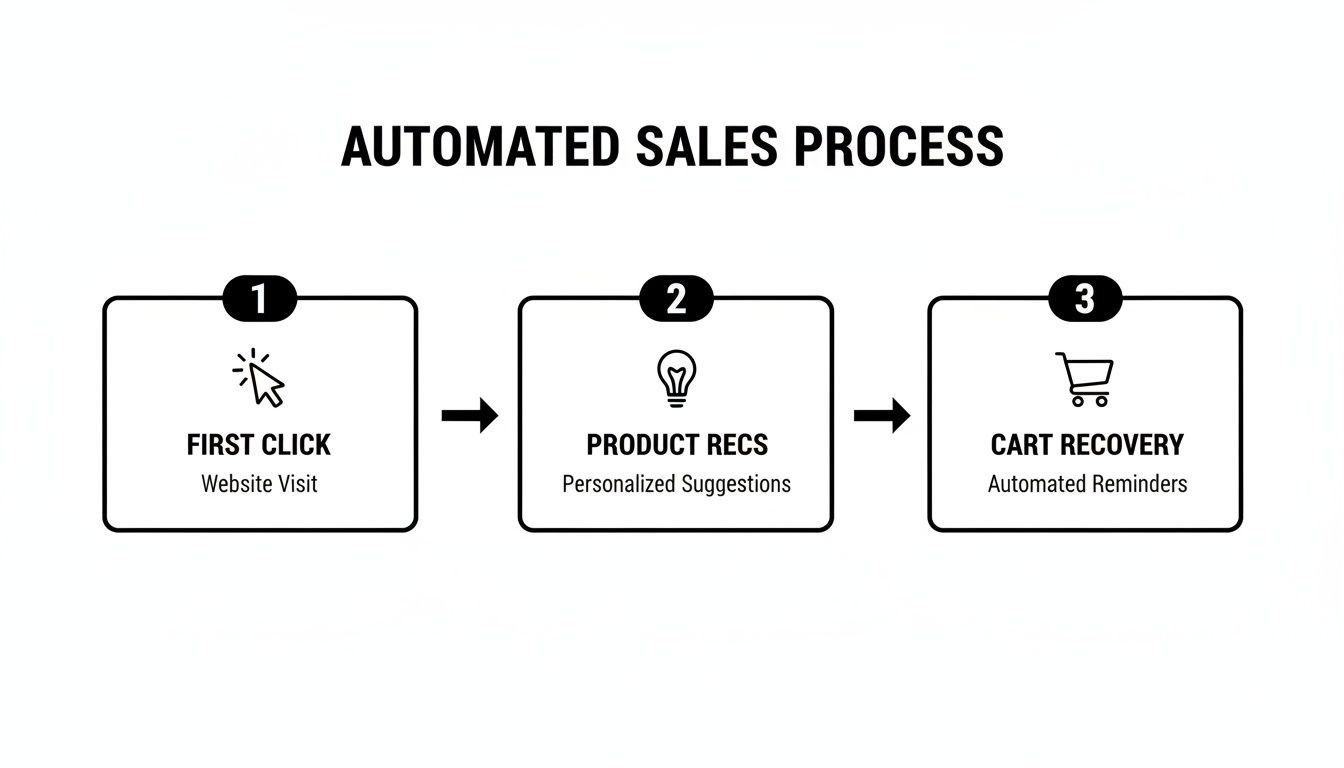
It’s all about strategically engaging customers at those critical decision points to make sure you're not leaving money on the table.
There are few mistakes more damaging in e-commerce than overselling. It happens when your stock levels fall out of sync across your website, social media shops, and third-party marketplaces. Manual updates are just too slow and clumsy, leading to that awful moment when a customer buys something you don't actually have.
Automated inventory management completely eliminates this headache. Think of it as a single source of truth for your stock.
This constant synchronization keeps your availability accurate everywhere, all the time. The risk of selling an out-of-stock item drops to nearly zero, protecting both your revenue and your hard-earned reputation. It also saves you from the logistical nightmare of canceling orders and processing refunds.
Once an order is confirmed, a precise chain of events has to unfold perfectly. Handling this manually is a massive bottleneck, slowing everything down and opening the door to expensive errors. Automated order processing takes over the second a purchase is made.
An automated order processing system doesn't just work faster—it works smarter. It removes the guesswork and tedious data entry, allowing your team to focus entirely on getting packages out the door.
A typical automated workflow kicks off several key actions without any human intervention:
By letting software handle these tasks, you dramatically shorten the time between a customer's click and a package leaving your warehouse. In a world where customers expect fast shipping, that speed is a serious competitive advantage.
After placing an order, every customer has the same question: "Where's my stuff?" Answering it proactively is one of the best ways to reduce customer anxiety and slash the number of support tickets you receive. Automation makes this communication completely effortless.
Automated shipping and tracking notifications are triggered at key milestones in the delivery journey, keeping the customer in the loop without your team having to lift a finger.
This steady stream of helpful communication builds trust and creates a genuinely positive post-purchase experience. It turns what could be customer anxiety into confidence, showing them you're on top of their order every step of the way. More importantly, it dramatically reduces the "Where is my order?" (WISMO) questions that can bury a support team.
Customer service isn't what it used to be. It’s no longer about just closing tickets and answering basic questions. Today, it’s about creating genuinely positive, memorable experiences that build loyalty and turn your support team from a cost center into a powerful tool for customer retention. This is where modern AI comes in, giving e-commerce automation a human-like touch that can operate at a scale we couldn't have imagined just a few years ago.
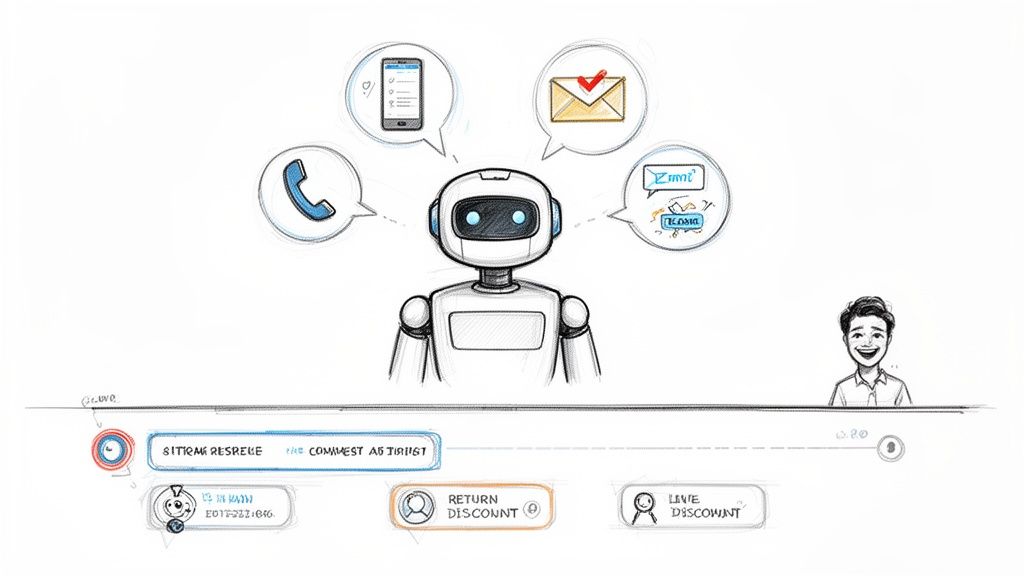
This isn't just a trend; it's a massive shift. The momentum behind AI-driven support is undeniable. A full 62.84% of businesses now list AI as their top priority for growth. And for good reason—over 51% of companies that have already put AI to work are creating intensely personalized shopping experiences, leading to 40% higher revenues than their competitors who are lagging behind. For more on this, check out these key e-commerce statistics shaping the industry.
Remember the old chatbots? They were clunky, frustrating, and could barely handle anything beyond a few keywords. Ask "What's your return policy?" and you'd get a pre-canned answer. Anything more complicated, and you'd hit a dead end. Today's AI systems are a different breed entirely. They don't just find answers; they get things done.
This leap forward is all about agentic actions. Instead of just telling a customer how to initiate a return, a modern AI can actually process it for them, right there in the chat window.
This turns what used to be a frustrating, multi-step chore for the customer into one quick, simple conversation. The AI is acting as a capable agent, not just a glorified, interactive FAQ page.
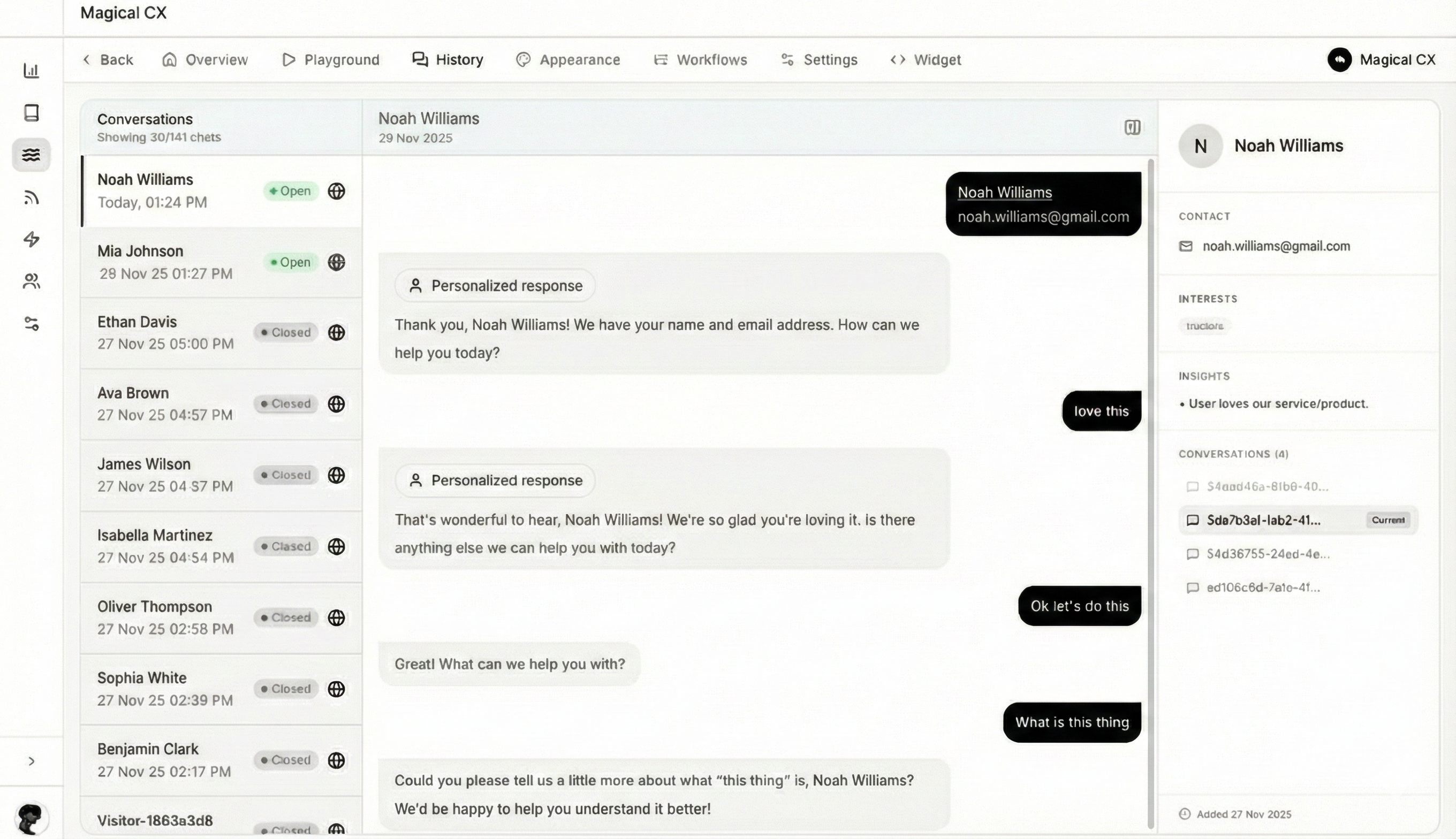
What's one of the biggest annoyances in customer service? Repeating yourself. When a customer moves from a web chat to an email, they shouldn't have to start the entire conversation over. AI-powered automation solves this with something called conversational memory.
An AI with conversational memory keeps a running, unified log of every single interaction a customer has with your brand, no matter what channel they use. This makes for incredibly rich, context-aware support that feels personal because it is personal.
Conversational memory is what separates a generic bot from a true digital assistant. It’s the ability to remember a customer’s history and use that knowledge to provide proactive, empathetic support that solves not just the immediate question, but the underlying need.
Let's see it in action. Imagine a customer bought running shoes from you last month after asking a few questions about options for a narrow fit. Today, they're back on your site, looking at a different pair, and they open a chat.
That one small, context-aware interaction completely changes the feel of the conversation. It shows you know your customer, saves them time, and builds a sense of genuine care. Implementing this type of intelligence can dramatically improve your contact center operations by cutting down on repeat questions and resolving issues the first time.
The modern customer journey is all over the place. Someone might see your ad on Instagram, browse your site on their laptop, and then ask a question via WhatsApp. Omnichannel orchestration is the automation that stitches all these different touchpoints into one seamless, coherent experience.
This means your AI doesn't live in a single channel; it manages the conversation fluidly across all of them.
This intelligent routing eliminates dropped conversations and information silos. From the customer's perspective, it just feels like one continuous conversation with your brand, no matter how they choose to reach out. This is how smart e-commerce automation delivers the kind of proactive, deeply personalized service that solves complex problems in an instant.
It's one thing to talk about automation in theory, but seeing it work in the real world is where the lightbulb really goes on. The smartest automation strategies aren't just copy-pasted; they're shaped to solve the unique headaches of a specific business model.
Let's look at three practical blueprints for D2C brands, subscription services, and B2B companies to see how it’s done.
If you run a direct-to-consumer (D2C) fashion brand, you know that returns and exchanges are an absolute beast to manage. It's a constant, hands-on grind that can easily swamp your support team, leaving customers waiting and getting more frustrated by the minute.
The fix? A self-service returns portal. Instead of forcing a customer to fire off an email and wait, they just pop their order number and email into a page on your site.
For subscription companies, churn is public enemy number one. The real challenge isn't just dealing with cancellations but spotting the customers who are quietly drifting away before they hit the "cancel" button.
This is where automation becomes your early-warning system. By keeping an eye on customer behavior, you can set up automated check-ins and smart offers to pull them back in.
A smart automated check-in isn't just a generic "How's it going?" email. It's a data-driven interaction that uses a customer's actual behavior to offer a genuinely helpful solution, turning a potential cancellation into a moment of retention.
Practical Example: You run a coffee subscription service. A customer has skipped their last two monthly shipments. This action triggers an automated workflow. An email is sent with the subject, "Having trouble finding the perfect brew?" The body of the email offers a free consultation call with a "coffee expert" to adjust their subscription preferences or offers a sample pack of new roasts in their next box. This proactive outreach can prevent a cancellation before it happens.
In the B2B world, especially for suppliers, the quoting process can be painfully slow. A potential buyer asks for a price on a standard part, and a sales engineer has to crunch the numbers and create a formal quote. This can take hours, if not days.
Every minute of delay is an open invitation for a competitor to swoop in. An automated quoting system flips the script by giving instant answers for standard requests.
To make this even clearer, the right automation strategy really depends on what you sell and who you sell it to. What works for a D2C t-shirt brand won't be the top priority for a B2B parts supplier.
Here's a quick breakdown of how these priorities shift.
| Business Model | Primary Automation Focus | Example Use Case | Key Metric to Track |
|---|---|---|---|
| Direct-to-Consumer (D2C) | Post-purchase experience & loyalty | Automated self-service returns & exchange portal | Return processing time, Customer Satisfaction (CSAT) |
| SaaS & Subscriptions | Customer retention & churn reduction | Proactive engagement triggers for at-risk users | Monthly Recurring Revenue (MRR) Churn Rate, Customer Lifetime Value (CLV) |
| High-Touch B2B | Sales cycle acceleration & lead qualification | Instant quote generation for standard products | Quote-to-close time, Sales team efficiency |
Ultimately, the goal is the same across the board: use automation to handle the repetitive tasks so your team can focus on the human connections that grow the business.
So, you're ready to bring automation into your e-commerce world. That’s great. But jumping in without a plan is a recipe for a headache. Shifting from manual, hands-on tasks to automated workflows is a big change for any team. Getting it right from the start makes all the difference.
The first step is a bit of honest self-reflection. Put on your detective hat and take a hard look at how your business runs today. Where are the biggest time-sucks? What mistakes keep popping up? This isn't about finding fault with your team; it's about spotting broken processes that are holding you back.
You can't fix a problem you can't see. Start by mapping out your most important workflows, from the first click to the final delivery and beyond. Think about the entire journey a customer takes, like the returns process—from the moment they request a return all the way to getting their refund. Or even something as simple as handling a "Where is my order?" ticket.
Once you have that map, you can zero in on the exact spots where automation will give you the most bang for your buck.
Now that you know what you want to automate, it's time to figure out how. The market is flooded with automation tools, so it's easy to get overwhelmed. The key is to focus on what will actually work for your business in the long run.
The best automation tool isn't necessarily the one with a million features. It's the one that plays nice with the software you already use and is ready to scale when you are.
When you're comparing options, keep these three things front and center:
Whatever you do, don't try to automate your entire operation in one go. That's a surefire way to get overwhelmed and frustrate your team.
The smart move is to pick one high-impact, low-risk project to start with. Take one of those bottlenecks you identified—like managing returns or answering order status questions—and focus on automating just that. This lets you work out the kinks and score a quick, measurable win.
Actionable Example: Your goal is to automate "Where is my order?" (WISMO) questions.
This first success is crucial because it builds momentum. When your team sees how much time they're getting back and how much easier their jobs have become, they'll be your biggest advocates for bringing more e-commerce automation into the business.
As you start thinking about bringing automation into your e-commerce operations, a few key questions always come up. Let's tackle the most common ones head-on to clear up any confusion and get you on the right track.
Not a chance. The goal here isn't to replace your team, but to supercharge them.
Think of automation as the ultimate assistant—the one who handles all the repetitive, mind-numbing tasks that bog down your best agents. We're talking about the endless "Where is my order?" tickets, processing standard returns, and looking up basic policy info.
By getting that off their plate, your human agents are free to focus on what they do best: handling complex, high-stakes issues that require real empathy and critical thinking. For example, while an AI handles 10 simultaneous order status questions, your best agent can spend 20 minutes on the phone with an unhappy VIP customer, turning a negative experience into a loyal relationship. Automation doesn't replace people; it empowers them to build deeper customer relationships.
This is a big one. The key is to avoid boiling the ocean. Don't try to automate everything at once.
Instead, find your single biggest bottleneck. What’s the one repetitive task that drives your team crazy or the most common question that floods your inbox? Start there.
The most successful automation strategies start small. Pick one pain point—like manual inventory updates or endless returns emails—and solve it. This proves the value of the investment and builds momentum for future projects.
Maybe your team is drowning in questions about your return policy. Automate those responses first. Or perhaps manual inventory updates are leading to embarrassing overselling mistakes. Target that process. A practical first step is setting up an automated abandoned cart email sequence. It’s relatively simple to implement with most e-commerce platforms, directly impacts revenue, and provides clear data on its effectiveness. Nailing one high-impact area delivers an immediate win.
Absolutely. The idea that automation is only for huge corporations with massive budgets is a thing of the past.
Today’s tools are built to be accessible and scalable. Many platforms offer flexible pricing that grows with you, so you're not locked into a massive enterprise contract from day one. For example, many email marketing platforms have free or low-cost tiers that include basic automation features like welcome series and cart abandonment flows. You can start there and upgrade only as your needs and revenue grow.
For a small team, automation is a true force multiplier. It lets you punch well above your weight, offering the kind of operational efficiency and customer service that your bigger competitors have, but without needing a massive payroll. It's one of the smartest investments a growing business can make to scale its operations without having to scale its headcount at the same rate.
Ready to transform your customer support from a cost center into a revenue driver? MagicalCX uses an empathy-first AI to deliver human-like, context-aware support that builds loyalty and scales with your business. Learn how we can help you move from "How can I help?" to "It's already done" by visiting our website.