See your AI teammate in action now
Ready to make support faster, kinder, easier and help customers feel good about choosing you?
PS: Sales improves too...
No credit card required
14 days free trial
DIY or Guided setup
Ready to make support faster, kinder, easier and help customers feel good about choosing you?
PS: Sales improves too...
No credit card required
14 days free trial
DIY or Guided setup
A guide to using real estate chatbots, covering 24/7 lead qualification, property info FAQs, automated showing scheduling, tenant support, ROI tracking, and key features.
Manish Keswani
Summary by MagicalCX AI
A real estate chatbot that answers instantly and books showings can cut lead response time by 99% and boost lead capture by up to 150%, but only when it integrates with your CRM and includes a seamless human handoff.
Think of a real estate chatbot as your always-on digital assistant, ready to chat with potential buyers, sellers, and renters the second they land on your website or social media. It's essentially a tireless digital front desk, working 24/7 to answer questions, qualify leads, and book appointments so you never miss a chance to connect.
Ever lost a great lead because their message came in at 2 AM? It’s a classic, frustrating scenario for almost every agent. In a market where speed is everything, waiting until morning is often too late. By then, that prospect has already found someone else who was ready to respond.
This is exactly where a real estate chatbot changes the game. It acts as your front-line assistant, always on and ready to engage, no matter the time of day.

Instead of a potential client’s questions echoing into the void, a chatbot provides an instant, helpful interaction. It can greet visitors on your website, engage with followers on Facebook, or reply to messages on WhatsApp. That immediate contact is what keeps a hot lead from going cold.
But these bots do a lot more than just say hello. They’re smart enough to start the lead qualification process by asking the right questions.
By gathering this crucial info right away, the chatbot separates the serious buyers from the casual browsers. This means that by the time a lead lands in your inbox, they’re already warmed up and vetted, complete with a summary like: "New Buyer Lead: John Doe, budget up to $550k, wants 3-bed in Northwood, looking to move in 3-6 months."
A chatbot doesn't replace a real estate agent; it empowers them. By handling the repetitive, time-consuming initial contact, it frees you to focus on what you do best: building genuine relationships, showing properties, and closing deals.
Bringing a chatbot into your business fundamentally changes how you manage your day. That constant pressure to be available around the clock starts to fade, replaced by a reliable system that works for you even when you’re not. This automation guarantees a professional first impression for every single person who reaches out, day or night.
Actionable Insight: Instead of starting your day sifting through a messy inbox of inquiries, you can begin with a prioritized list of qualified leads. Your chatbot can even tag leads based on urgency (e.g., "hot lead," "ready to view," "6-month timeline"), so you know exactly who to call first. This proactive approach ensures no opportunity falls through the cracks, turning your website into a powerful, automated lead machine. To see how this tech works in other industries, take a look at our guide on unlocking growth with AI customer service solutions for more ideas.
Let's move past the theory and get into the nitty-gritty of where chatbots for real estate really make a difference on a daily basis. These aren't just glorified pop-up windows; they're workhorses that handle the critical, repetitive tasks that eat up your day. By taking over this groundwork, they free you up to focus on what you do best: building relationships and closing deals.
We're going to break down four practical ways these tools deliver real value. From grabbing a new lead the second they land on your site to helping a tenant with a late-night issue, a good chatbot quickly becomes an essential part of the team.
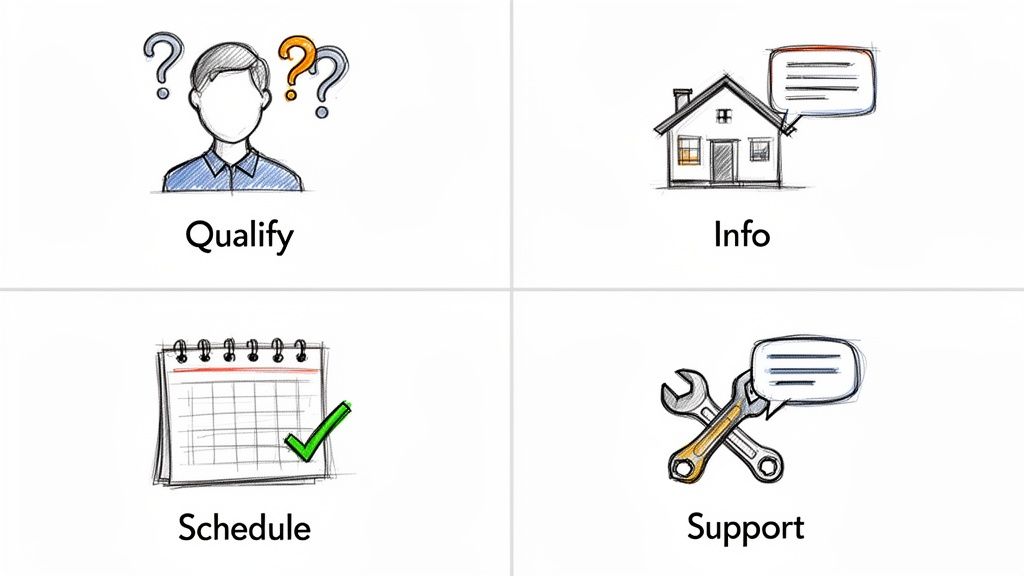
One of the biggest time-sinks in real estate is figuring out who’s a serious buyer and who’s just browsing. A chatbot acts as your front-line screener, engaging every single website visitor with smart questions the moment they arrive. This first conversation is your secret weapon for building a pipeline of genuinely interested prospects.
Instead of making someone fill out a boring "contact us" form, the bot starts a real conversation. It can ask about their budget, neighborhoods they're interested in, must-have features, and how soon they want to move. This simple exchange turns a passive click into an active, qualified lead, with all their details captured and ready for you to follow up.
Practical Example: Someone is scrolling through your listings at 11 PM and clicks on a featured home. The chatbot immediately chimes in: "Hi there! This is a great property. Are you looking for a home with at least 3 bedrooms?" The person types "Yes." The bot continues: "Perfect. To help me find more like it, what's your ideal move-in date?" In just two messages, you’ve got a warm lead and know exactly what they're looking for.
Today’s homebuyers want answers now. If they have to wait for you to email back about basic property details, they've already moved on to a competitor who was faster. A chatbot gets rid of that delay. Think of it as an instant encyclopedia for every property you represent.
You can load it up with all the key details for every listing. This allows it to answer the most common questions on the spot, any time of day or night.
Actionable Insight: Program your chatbot with answers to your top 10 most frequently asked questions for each listing type. When a user asks, "What are the HOA fees for 123 Maple St?", the bot can instantly reply, "The HOA fees for 123 Maple Street are $250 per month and include pool access and landscaping. Would you like to see the full list of amenities?" This immediate access to information doesn't just satisfy curiosity; it builds trust and keeps potential buyers on your website longer.
We've all been there: the endless email chain just to schedule one property viewing. Trying to align everyone's calendars can take days, which is a major turn-off for a motivated buyer. A real estate chatbot completely automates this headache.
By connecting directly to your calendar, the bot knows your real-time availability. When a qualified lead wants to see a home, the bot shows them a list of your open time slots. They simply pick what works for them, and boom—the appointment is on your calendar, complete with their contact info and the property address.
Practical Example: After a brief chat, the bot determines a lead is serious. It says, "It sounds like this property is a great fit! Our agent, Sarah, is available for showings tomorrow at 10 AM, 2 PM, and 4 PM. Do any of those times work for you?" The user selects 2 PM, and the chatbot confirms the booking and sends a calendar invite to both parties automatically.
For property managers, the benefits go way beyond just finding new clients. Chatbots are a lifesaver for handling routine tenant questions and support requests, which frees up your team to deal with more complex property issues.
A chatbot can be the first point of contact for tenants, available 24/7 to help with common requests. This gives your renters a much better, more responsive experience and makes your operations more efficient.
Common Tenant Support Tasks for a Chatbot:
Actionable Insight: Create a dedicated "Tenant Help" chatbot flow. When a tenant initiates a chat, the first question can be, "Hi! How can I help you today? Please choose an option: [Maintenance Request], [Payment Question], [General Inquiry]." This simple triage directs them to the right automated workflow or support channel instantly, ensuring they feel heard and boosting satisfaction and retention. This also helps you provide a consistent level of service across all your properties, which is much easier to manage with an effective omnichannel customer service platform tying everything together.
Bringing new tech into your business can feel like a big leap of faith. But with real estate chatbots, the return on investment (ROI) isn't just some vague promise—it’s something you can actually see and measure. This isn't about slapping a trendy gadget on your website; it's a strategic move that directly beefs up your bottom line.
To really get a handle on the value, we can look at the ROI from three different angles: better lead conversion, smoother operations, and happier clients. Each of these plays a huge part in building a healthier, more profitable real estate business.
In real estate, speed is everything. When a potential buyer lands on your site at 10 PM with a burning question, they want an answer now. If they have to wait for you to get to the office in the morning, they're gone—off to a competitor who's ready to help.
A chatbot bridges that gap perfectly.
By being there 24/7, a chatbot stops potential leads from just clicking away. It grabs their interest when it's highest, answers those first few crucial questions, and gets their contact info before they even think about leaving. That immediate, helpful interaction is the secret sauce to turning more of your website visitors into solid, qualified leads.
Actionable Insight: Track your website's conversion rate before and after implementing the chatbot. If you were converting 2% of visitors into leads via a contact form, and now the chatbot is engaging and converting 5% of visitors, that's a 150% increase in leads from the exact same amount of traffic. This makes the ROI calculation crystal clear.
Just think about how many hours your team sinks into answering the same questions over and over. "Is this property still available?" "Can I schedule a viewing?" "What are the HOA fees?" These simple, repetitive tasks add up fast, pulling your agents away from what they do best: building relationships and closing deals.
A chatbot takes all that routine work off their plate. It automates the simple stuff, freeing up hundreds of agent hours every single year. That reclaimed time is pure gold—it means lower costs and a huge jump in productivity. Now, your agents can focus their energy on the high-value activities that actually drive revenue.
Practical Example: An agent who previously spent 5 hours a week answering basic inquiry emails can now use that time to make 20 extra follow-up calls to warm leads. If just one of those calls turns into a sale, the chatbot has paid for itself many times over.
Today's clients expect everything to be seamless and on-demand. A chatbot delivers exactly that. By providing instant answers and support around the clock, it creates a much better experience, which is a direct line to higher client satisfaction.
And a happy client is your best marketing tool. They're far more likely to leave a glowing review, refer you to their friends and family, and come back to you for their next move.
This creates a powerful ripple effect. More referrals mean a lower cost to acquire each new lead, and a stronger brand reputation helps you stand out in a seriously crowded market. If you want to dive deeper, it's worth learning how to start measuring customer service performance to see the impact clearly.
To make the financial case crystal clear, let's just put the numbers side-by-side.
Here’s a quick breakdown of what you can expect when you bring a chatbot into your workflow, compared to sticking with the old-school methods.
| Business Metric | Before Chatbot (Traditional Methods) | After Chatbot (AI-Powered) | Impact |
|---|---|---|---|
| Lead Response Time | 2-8 hours | < 1 minute | 99% Faster Response |
| Lead Capture Rate | 5-10% of website visitors | 15-25% of website visitors | Up to 150% Increase |
| Cost Per Qualified Lead | $75 - $150 | $30 - $60 | Over 50% Reduction |
| Agent Hours on FAQs | 10-15 hours/week | 1-2 hours/week | 85%+ Time Savings |
As you can see, the data speaks for itself. A chatbot isn't just another expense on your balance sheet; it's a smart investment that pays for itself over and over through more leads, lower operating costs, and a brand that people trust.
So, you're sold on the idea of a chatbot. Great. But now comes the tricky part: picking the right one. Let's be honest, not all chatbots are created equal. Choosing a platform without the right features is like buying a beautiful sports car with no engine—it might look impressive, but it’s not going to get you anywhere.
To actually see a return on your investment, you need a tool built specifically for the chaos and opportunity of the real estate world. Think of this as your must-have checklist. These are the non-negotiable features that turn a simple pop-up window into a lead-generating, client-pleasing machine.
First things first: your chatbot has to talk to your CRM. If it doesn’t, you've just created a digital dead end. This integration is the crucial handshake that sends valuable lead information from the bot straight into your existing workflow, where you can actually use it.
Practical Example: A bot captures a new lead's name, email, budget, and ideal neighborhood. With proper integration (like with Salesforce or HubSpot), that data instantly creates a new contact profile in your CRM, assigns it to the right agent based on zip code, and sets a follow-up task. No more manually copying and pasting from chat transcripts or fumbling with messy spreadsheets. This simple connection means no lead ever falls through the cracks.
Think of CRM integration as the central nervous system of your sales process. It ensures every piece of client data is immediately logged and ready for an agent to follow up, creating a perfectly smooth journey from that first click to the final handshake.
Your clients are everywhere, and you need to be too. Some will find you on your website, others will slide into your DMs on Facebook, and some will even text you from a number they saw on a "For Sale" sign. A truly effective chatbot needs to be on every one of these channels, offering the same great experience.
This is what we mean by omnichannel capability. Your bot should be able to handle conversations from all fronts:
Actionable Insight: Use the same chatbot logic across all channels. This ensures a potential buyer who starts a conversation on Facebook Messenger and later visits your website gets a consistent, seamless experience without having to repeat themselves.
Automation is a game-changer, but it can't—and shouldn't—do everything. Some questions are just too complex or nuanced for a bot. More importantly, a highly motivated buyer often wants to talk to a person right now. A smart chatbot knows when to step aside and pass the baton to a human agent.
This seamless human handoff is absolutely critical. When a lead asks a detailed question about local zoning laws or says, "I want to make an offer today," the bot should instantly alert an available agent. The best systems will transfer the entire chat history, so the agent has the full context and can jump in without making the client repeat themselves. Nothing kills a hot lead faster than frustration.
Finally, a truly intelligent chatbot needs conversational memory. This is simply its ability to remember past conversations with a user. It’s what separates a helpful, personalized chat from a frustrating, repetitive one that makes people want to close the tab.
Practical Example: If someone was on your site last week looking at three-bedroom homes in a certain school district, the bot should remember that when they come back. The conversation can pick up right where it left off: "Welcome back! Still looking for three-bedroom homes near Northwood Elementary? A new listing just came on the market I think you'll love." This small touch makes clients feel heard and understood, building the kind of trust that closes deals.
Ready to put a chatbot to work for your real estate business? It might sound technical, but getting started is more about smart strategy than it is about complex software. If you break it down into a clear roadmap, you can launch a tool that starts adding value from day one.
Think of it like building a house. You wouldn't just start hammering nails without a blueprint, and you shouldn't launch a chatbot without a solid plan.
Before you even start looking at different chatbot platforms, you have to know exactly what you want it to accomplish. Vague goals like "get more leads" just won't cut it. You need to set clear, measurable objectives that will guide every single decision you make down the line.
Actionable Insight: Frame your goals as specific KPIs (Key Performance Indicators). For instance:
Having specific targets like these helps you design the chatbot’s conversations and, just as importantly, measure its success accurately later on. It’s the foundation for everything that follows.
Next up, you need to put yourself in your clients’ shoes. How do people typically interact with your business online? Mapping these journeys is the key to identifying the perfect moments for a chatbot to step in and offer a helping hand.
Practical Example:
Your chatbot needs completely different scripts for each of those scenarios.
This flow is critical. It visualizes how a chatbot gathers information, engages with clients no matter where they are, and—most importantly—knows when to pass the conversation to a human agent.
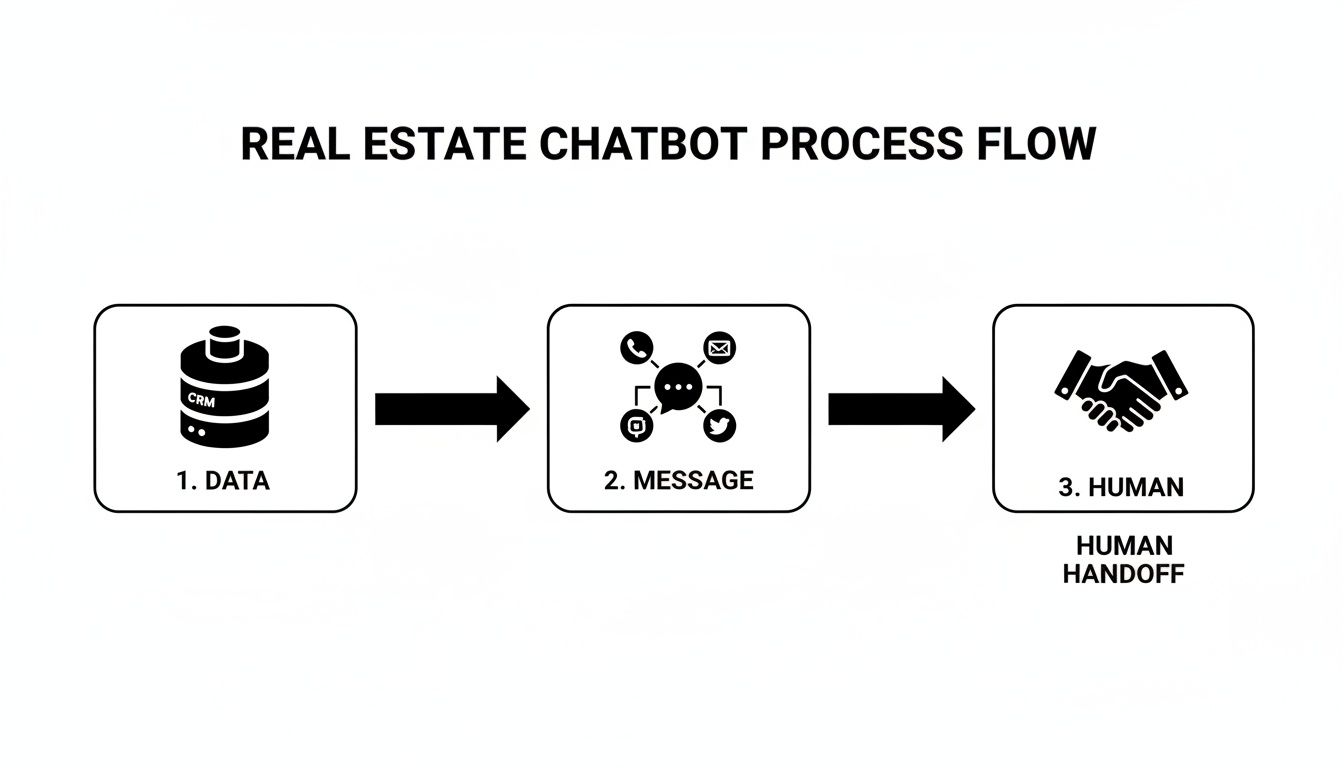
This process flow shows that success isn't just about the bot itself; it's about the seamless integration from your CRM data to omnichannel messaging and a smart human handoff strategy.
With your goals and customer journeys mapped out, now you can start looking at technology. Focus on a platform that offers the essential features we talked about earlier, especially seamless CRM integration and omnichannel capabilities.
Once you’ve picked a provider, the integration phase begins. This is where you connect the chatbot to your existing tech stack, like your CRM and calendar software. This step is absolutely non-negotiable—it's what empowers the bot to log new leads and book appointments automatically, without you lifting a finger.
This is where you breathe life into your chatbot, giving it a personality and a purpose. You’ll develop conversation scripts, often called "playbooks," for all the common scenarios you identified back in the journey mapping stage.
Actionable Insight: Don't write scripts that sound robotic. Use a friendly, helpful tone that reflects your brand. For example, instead of "Query received. Please wait.", try "Great question! Let me pull up the details for you right now." Always give users clear, clickable button options (like "Yes," "Tell me more," "Speak to an agent") to guide the conversation and prevent dead ends.
Start with the most common and high-impact interactions, like qualifying a new lead or handling frequently asked questions. You can always add more complex playbooks later on as you gather data on what your clients are actually asking.
Finally, it’s time for liftoff. But launching a chatbot isn’t a "set it and forget it" project. The real work actually begins after it’s up and running.
This ongoing cycle of testing and optimizing is what separates a mediocre chatbot from one that becomes an indispensable part of your business.
Adopting any new piece of tech comes with a healthy dose of skepticism. When I talk to agents and brokers about chatbots for real estate, the same practical questions always pop up—cost, setup time, and the big one: "Will a bot make my brand feel cold?"
Let's cut through the noise and tackle these concerns head-on. The goal here isn’t to replace the human touch that defines great real estate service. It’s about using smart automation to handle the tedious, repetitive stuff, freeing you up to focus on what you do best: building relationships and closing deals.
This is probably the biggest hurdle for most agents, and it’s a completely valid concern. Real estate is built on trust and personal connection.
The good news is that a well-designed chatbot doesn’t get in the way of that. In fact, it does the opposite. By providing instant, helpful answers 24/7, it creates a great first impression and shows you're on the ball.
The key is to give the bot a personality that mirrors your brand. A modern chatbot shouldn't sound like a clunky machine from the 90s. It should be warm, professional, and genuinely helpful, guiding visitors to the information they need without any friction.
Actionable Insight: Program your chatbot to be upfront. A great opening line is, "Hi! I'm Alex, the digital assistant for Aspire Realty. I can help with property searches and scheduling. If you'd rather speak with a human agent at any time, just type 'agent'!" This transparency builds trust and gives users control.
Ultimately, you’re just automating the simple, predictable questions. That way, you can pour all your energy into the complex, high-value conversations that only a human expert can handle.
The cost can swing pretty widely, but it’s far more accessible than most people assume. The price tag really boils down to the platform's features, how many conversations it needs to handle, and how much custom work you want done.
Generally, you'll see pricing fall into a few buckets:
Practical Takeaway: For a small to mid-sized agency, expect to invest anywhere from $50 to $500 per month for a solid platform. When you weigh that cost against the ROI from just one extra deal closed per quarter, the investment often pays for itself immediately.
Getting a chatbot live on your website is way faster and easier than it used to be. You don't need to be a tech genius or have a developer on standby. Most of the top platforms are built with a "no-code" or "low-code" philosophy, which means you can build and launch your bot with a simple drag-and-drop editor.
A typical setup process is pretty straightforward:
Actionable Insight: To get started quickly, launch with just one or two core functions, like "Qualify Buyer Leads" and "Answer FAQs." You can have a functional chatbot live on your site in as little as a few hours. You don't need to build a perfect, all-knowing bot from day one; it's better to start simple and expand its skills over time based on real user data.
Absolutely, and this is a game-changer for agents working in diverse, multicultural markets. A multilingual chatbot ensures you can give every single potential client a great experience, no matter what language they speak.
The tech is pretty slick. Modern chatbot platforms can automatically detect a user's browser language and start the chat in their native tongue. This immediately breaks down communication barriers and makes your business feel more welcoming and accessible to a much wider audience.
Practical Example: A potential client from a Spanish-speaking household visits your site. Their browser is set to Spanish. The chatbot automatically greets them with "¡Hola! Bienvenido. ¿Cómo puedo ayudarte hoy?" instead of English, instantly creating a more comfortable and effective interaction.
Ready to see how an AI-powered chatbot can transform your real estate business? MagicalCX delivers human-like conversations that capture more leads, schedule more showings, and free you to do what you do best—close deals. Learn more and get started at https://www.magicalcx.com.


